 plumi
Uncertainty and redox titration practicals (Core Practical 13): Edexcel International A Level Chemistry questions
Edexcel International A Level Chemistry past-paper questions on 16.2.2 Uncertainty and redox titration practicals (Core Practical 13), 2019–2025, with mark schemes and examiner’s reports where available.
Paper
All papers
Exam
All years
Calculations
Q2(a)
The whole paper ↗ Your answer
Q2(c)
The whole paper ↗Your answerQ3(a)(i)
The whole paper ↗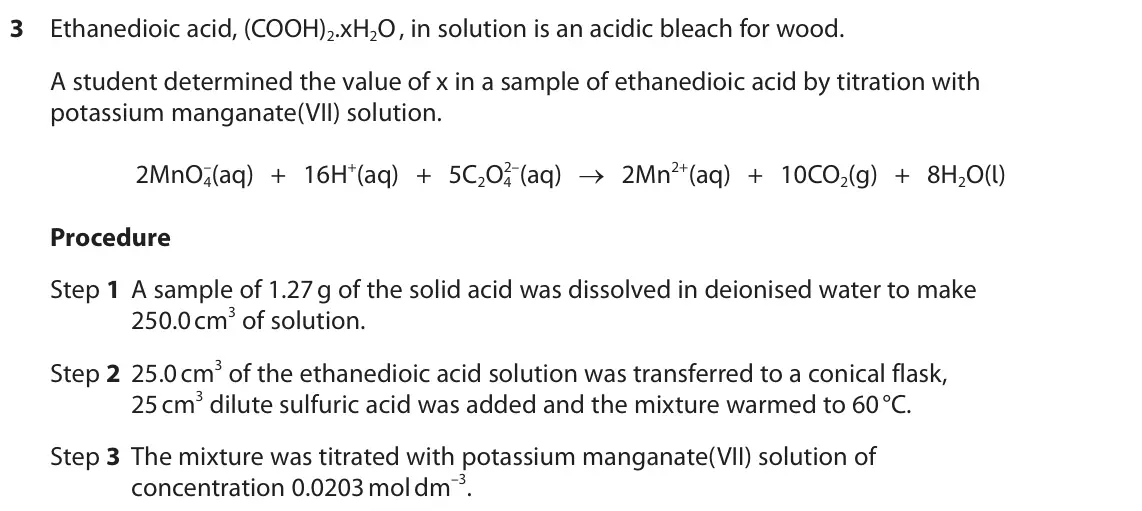
Q3(a)(ii)
The whole paper ↗Q3(a)(iii)
The whole paper ↗Q3(a)(ii)
The whole paper ↗
Q12(a)
The whole paper ↗ Your answer
Q12(b)
The whole paper ↗Your answerQ16(b)(iii)
The whole paper ↗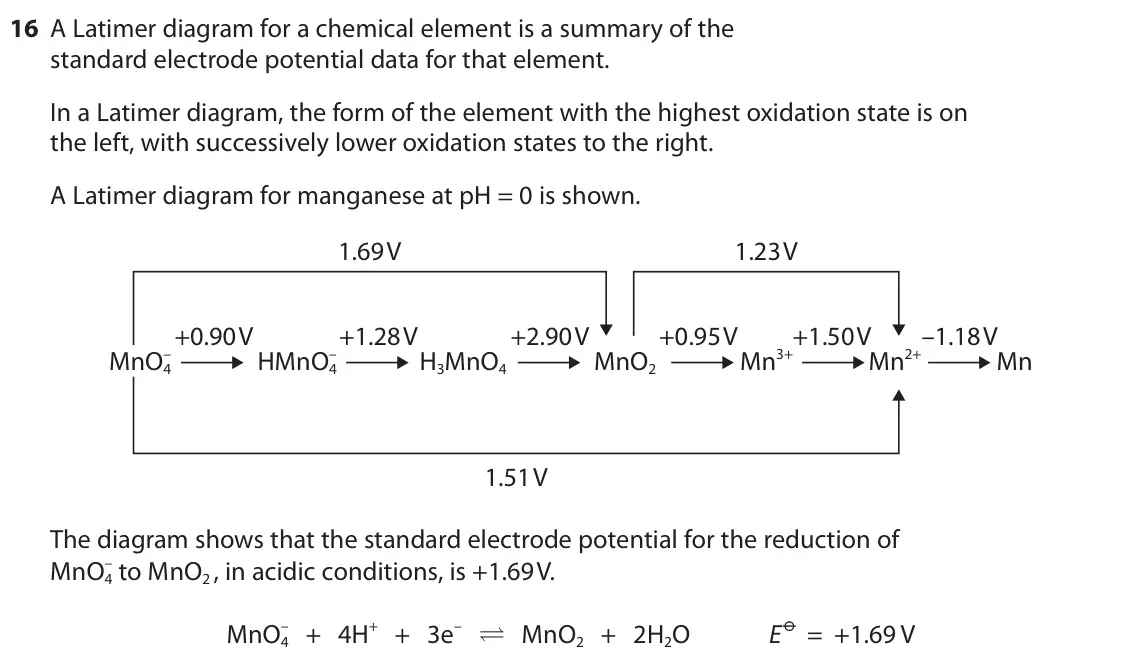
Q3(c)(iii)
The whole paper ↗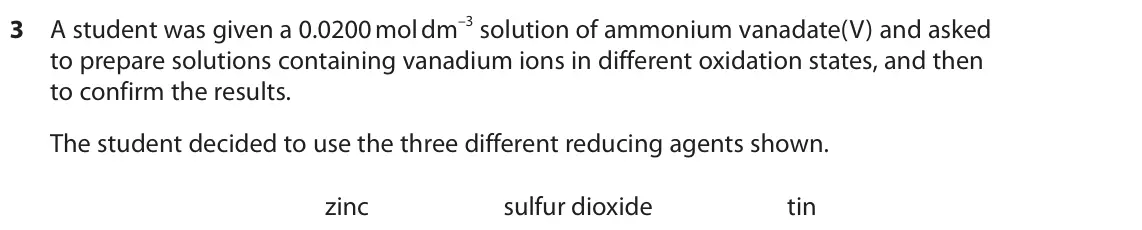
Q3(a)(i)
The whole paper ↗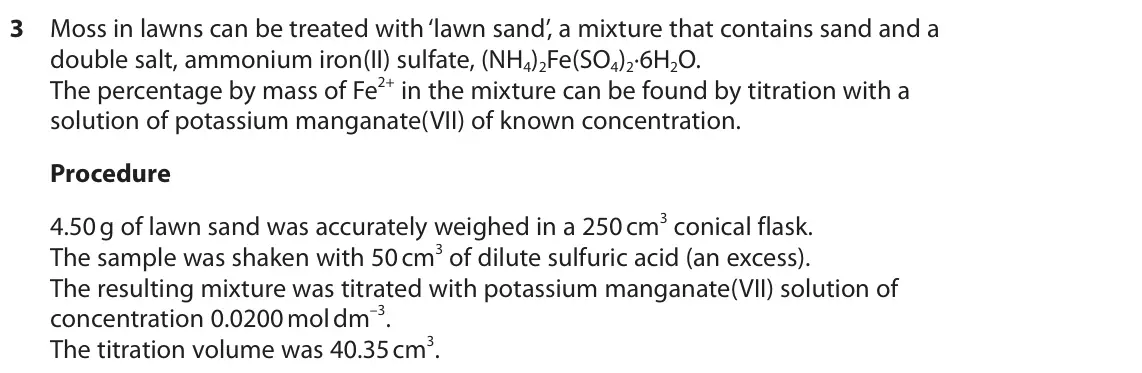
Q3(a)(ii)
The whole paper ↗Q3(c)
The whole paper ↗Q15(a)(ii)
The whole paper ↗
Q3(a)(ii)
The whole paper ↗
Q3(a)(iii)
The whole paper ↗Q3(a)(iv)
The whole paper ↗Q3(c)(i)
The whole paper ↗Q3(c)(ii)
The whole paper ↗Q3(c)(iii)
The whole paper ↗
All 32 questions on Uncertainty and redox titration practicals (Core Practical 13), as a list
- June 2025, Unit 5, Q2(a) (1 mark): What colour change is seen at the end-point? (1) A pale pink to pale green B purple to pale pink C pale green to pale pink D pale pink to purple
- June 2025, Unit 5, Q2(c) (1 mark): What is the percentage error in a single titre of 18.95 cm (1) 3] [The uncertainty in a single burette reading is ±0.05 cm A ± 0.20% B ± 0.26% C ± 0.40% D ± 0.5
- October 2024, Unit 6, Q3(a)(i) (3 marks): Describe how to make 250.0 cm3 of a solution of ethanedioic acid in Step 1. (3)
- October 2024, Unit 6, Q3(a)(ii) (2 marks): Explain why, in Step 2, the ethanedioic acid solution was measured using a 25.0 cm3 volumetric pipette but the dilute sulfuric acid was measured using a 25 cm3
- October 2024, Unit 6, Q3(a)(iii) (1 mark): State why the titration needed no indicator. (1)
- June 2024, Unit 6, Q3(a)(ii) (1 mark): State when the starch indicator should be added during the titrations in Step 5. (1)
- January 2024, Unit 5, Q12(a) (1 mark): 5.00 g of sodium thiosulfate was dissolved in deionised water and the solution made up to 250.0 cm3 in a volumetric flask. The volumetric flask has an uncertain
- January 2024, Unit 5, Q12(b) (1 mark): The titration was carried out with sodium thiosulfate in the burette and starch was added just before the end‑point. What would be the colour of the solution in
- January 2024, Unit 5, Q16(b)(iii) (3 marks): A second titration carried out without the addition of sulfuric acid resulted in the formation of a brown suspension. Explain how the value of the mean titre wo
- January 2024, Unit 6, Q3(c)(iii) (2 marks): Explain the effect on the titre of leaving the tin in the reaction mixture. (2)
- January 2023, Unit 6, Q3(a)(i) (1 mark): State what would happen in the titration if the mixture was not acidified. (1)
- January 2023, Unit 6, Q3(a)(ii) (2 marks): Neither hydrochloric acid nor nitric acid can be used to acidify the titration mixture. For each acid give a reason why it cannot be used. (2)
- January 2023, Unit 6, Q3(c) (3 marks): The titration is carried out using the apparatus shown. burette containing potassium manganate(VII) conical flask containing lawn sand and dilute sulfuric acid
- June 2022, Unit 5, Q15(a)(ii) (1 mark): Suggest a reason why an indicator is needed in this titration. (1)
- June 2022, Unit 6, Q3(a)(ii) (2 marks): State what would be seen during the reaction. (2)
- June 2022, Unit 6, Q3(a)(iii) (1 mark): Excess nitric acid must be neutralised before the iodide ions are added in Stage 2. Sodium carbonate solution is slowly added to the cooled solution. The soluti
- June 2022, Unit 6, Q3(a)(iv) (3 marks): Ethanoic acid solution is added, drop by drop, to the neutralised mixture until the precipitate redissolves. Describe how the solution in the beaker should then
- June 2022, Unit 6, Q3(c)(i) (1 mark): Give a possible reason why the starch indicator is added when the iodine colour is pale yellow rather than at the start of the titration. (1)
- June 2022, Unit 6, Q3(c)(ii) (1 mark): Give the colour change at the end‑point of the reaction. (1)
- June 2022, Unit 6, Q3(c)(iii) (1 mark): The results of the titration are shown. Titration number 1 2 3 Final burette reading / cm3 27.05 28.65 27.45 Initial burette reading / cm3 0.00 2.00 1.00 Titre
- June 2022, Unit 6, Q3(c)(v) (2 marks): Nitric acid reacts with iodide ions to form iodine. In another experiment the nitric acid was not neutralised before the start of Stage 2. Explain the effect on
- January 2022, Unit 5, Q8(c) (1 mark): What is the colour change at the end‑point of the titration? (1) A colourless to pale yellow B pale yellow to colourless C colourless to blue‑black D blue‑black
- October 2021, Unit 5, Q20(c)(i) (1 mark): State the colour change that would be observed at the end‑point of the titration. (1) From to
- October 2021, Unit 5, Q20(c)(v) (1 mark): Suggest why the contents of the conical flask are heated. (1)
- October 2021, Unit 5, Q20(c)(vi) (6 marks): The student’s teacher said, 2+ ions are colourless in aqueous solution, the titration can “As TiCl3 is blue and TiO be carried out without an alizarin indicator
- October 2021, Unit 6, Q1(d)(iii) (1 mark): State at what point in the titration the starch solution should be added. (1)
- June 2021, Unit 5, Q18(b)(i) (1 mark): State the colour change at the end-point of the titration. (1)
- June 2021, Unit 5, Q18(b)(iii) (3 marks): A second student carried out the same experiment but used distilled water to make up the solution in the volumetric flask. A brown suspension formed during the
- June 2021, Unit 5, Q18(c)(i) (2 marks): Complete the table. (2)
- June 2021, Unit 5, Q18(c)(ii) (2 marks): A third student obtained a value of 95.863% for the proportion of iron in the wire. State whether or not this student has given their answer to an appropriate n
- January 2021, Unit 6, Q2(e) (5 marks): Describe how to carry out the titration in Step 3. You should identify suitable apparatus and any additional chemicals required. (5)
- January 2021, Unit 6, Q2(g) (2 marks): + 3H2O(l) → Cl–(aq) + 6H+(aq) + 3SO2– 4 (aq) (g) Explain the change, if any, to the value calculated in (f) if the chloride ions were not removed before the rea
Questions, mark schemes and examiner’s reports are © Pearson Edexcel, from their published past papers. Plumi isn’t affiliated with any exam board. Want whole papers? Edexcel International A Level Chemistry past papers.
The Plumi iPad app also offers exam-style questions with AI feedback on your handwritten working.