 plumi
Predicting feasibility from electrode potentials: Edexcel International A Level Chemistry questions
Edexcel International A Level Chemistry past-paper questions on 16.1.3 Predicting feasibility from electrode potentials, 2019–2025, with mark schemes and examiner’s reports where available.
Paper
All papers
Exam
All years
Calculations
- Your answer
Q14(d)
The whole paper ↗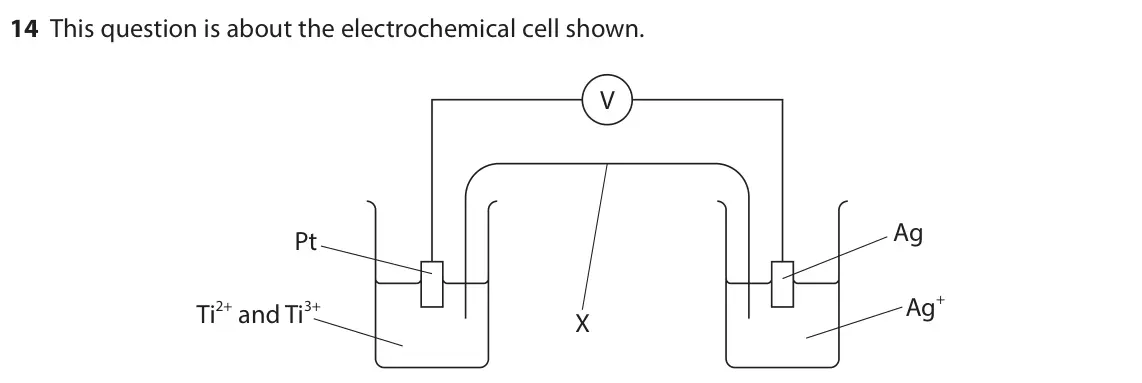
Q18(b)
The whole paper ↗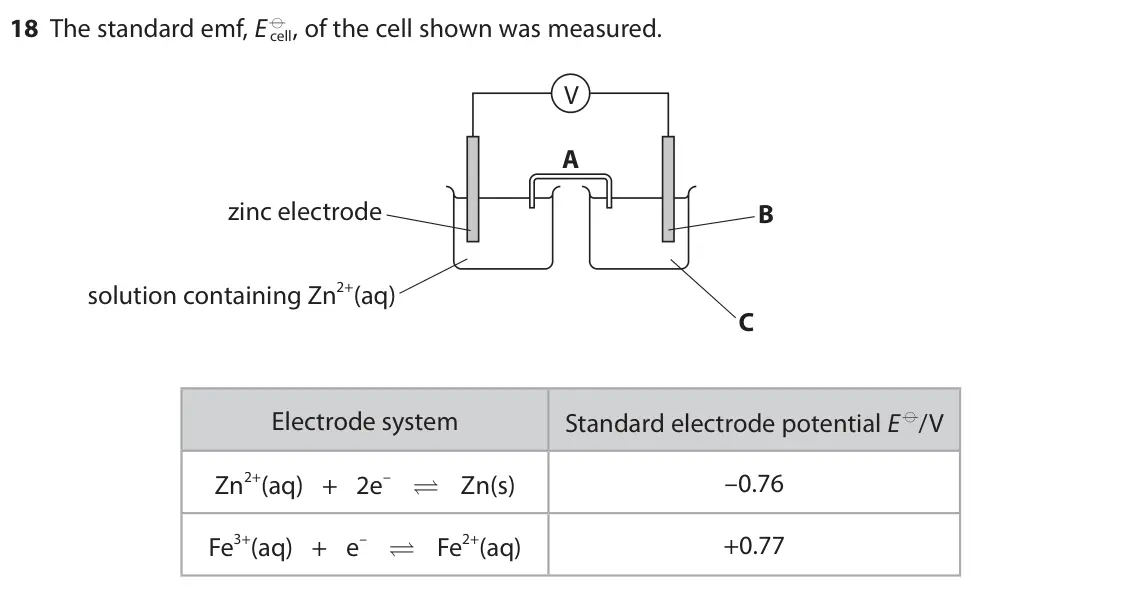
Q18(c)
The whole paper ↗Q20(a)(ii)
The whole paper ↗
Q17(b)
The whole paper ↗
Q17(d)(iii)
The whole paper ↗Q1(b)
The whole paper ↗Q14(b)(ii)
The whole paper ↗
Q14(b)(iii)
The whole paper ↗Q14(c)(i)
The whole paper ↗Q16(a)(iii)
The whole paper ↗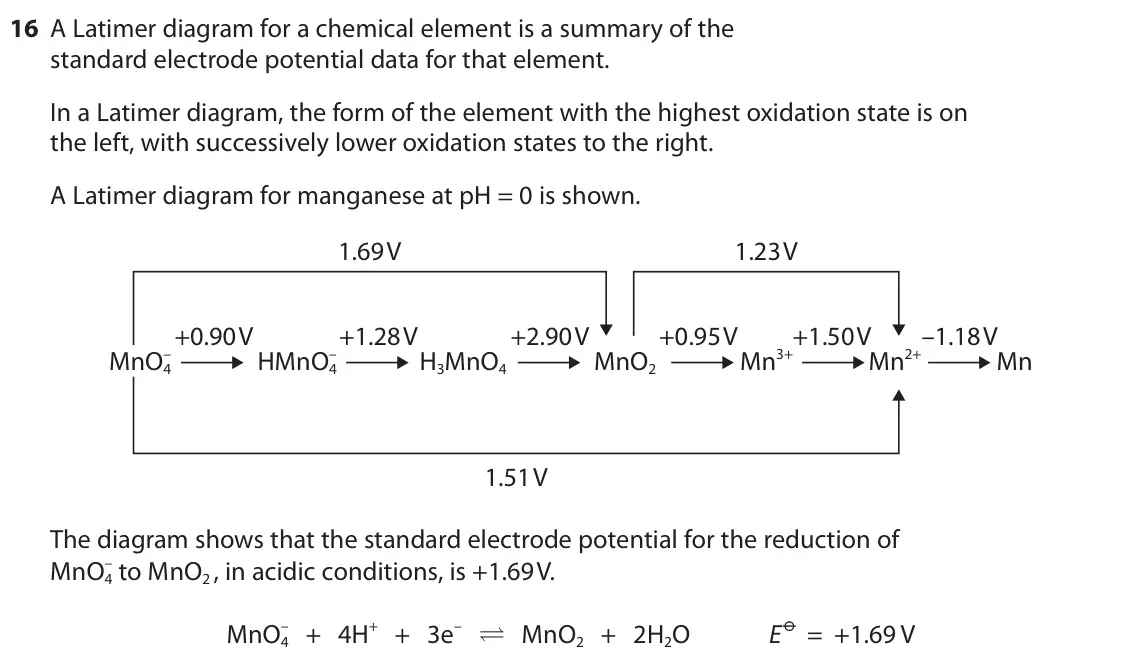
Q18(b)(i)
The whole paper ↗
- Your answer
Q18(e)
The whole paper ↗
Q19(b)(i)
The whole paper ↗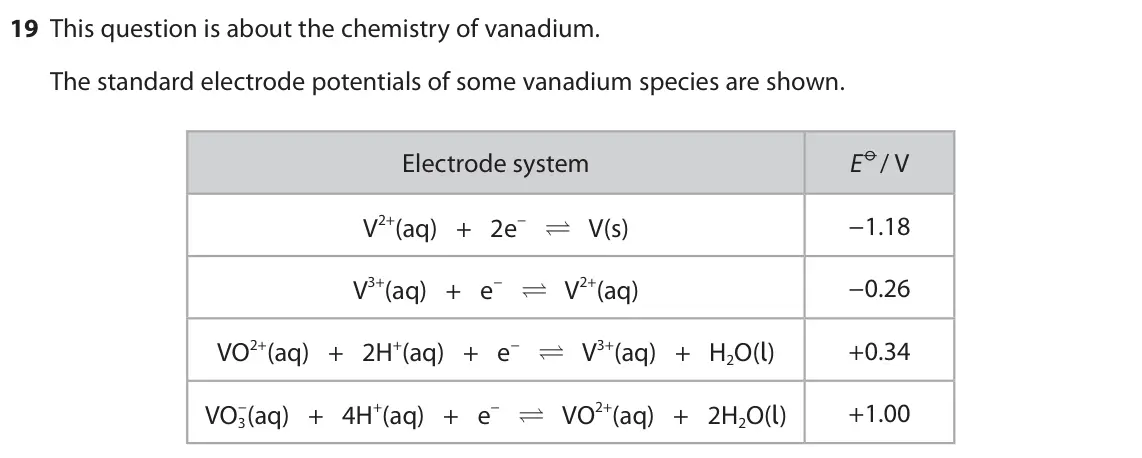
Q19(b)(ii)
The whole paper ↗Q1(a)
The whole paper ↗ Your answer
Q3(b)(i)
The whole paper ↗
Q3(c)
The whole paper ↗ Your answer
All 27 questions on Predicting feasibility from electrode potentials, as a list
- June 2025, Unit 5, Q1 (1 mark): Which reaction is thermodynamically feasible under standard conditions? Use your Data Booklet. 3+ → Ag + + V 2+ A Ag + V + + V 3+ → Cu 2+ + V 2+ B Cu 2+ + V 3+
- June 2025, Unit 5, Q14(d) (3 marks): State the changes, if any, that would occur to the cell emf, the electrodes and the ion concentrations when current flows for several hours in this cell. (3)
- January 2025, Unit 5, Q18(b) (2 marks): Write an equation for the reaction that would take place if current was allowed to flow through the circuit. State symbols are not required. (2)
- January 2025, Unit 5, Q18(c) (2 marks): Under standard conditions, the E d cell for this reaction is +1.53 V. State what would happen to this value, if anything, when the Zn2+ solution in the half‑cel
- January 2025, Unit 5, Q20(a)(ii) (2 marks): In Reaction 2, Cr2O7 2– reacts with a metal, M, in acid conditions forming Cr3+ and M2+. 2–. Identify a possible metal, M, calculating E d cell for its reaction
- October 2024, Unit 5, Q17(b) (3 marks): Acidified potassium dichromate(VI) is an oxidising agent. The acid commonly used is sulfuric acid. Explain, using reference to the electrode potentials shown, w
- October 2024, Unit 5, Q17(d)(iii) (1 mark): The reduction half-cell in the DMFC has a standard electrode potential E = +1.23 V . When the solution concentration changes, the electrode potential changes so
- October 2024, Unit 6, Q1(b) (2 marks): The student added a sample of a pale‑brown, aqueous solution of Q to a colourless aqueous solution of P. The student observed the formation of a darker brown so
- June 2024, Unit 5, Q14(b)(ii) (2 marks): Give two reasons why the initial reading on the voltmeter may differ from the stated value given in the Data Booklet. (2)
- June 2024, Unit 5, Q14(b)(iii) (2 marks): The voltmeter is removed and the cell is allowed to run for one hour. Explain the changes that would occur in the right‑hand half‑cell during this time. (2)
- June 2024, Unit 5, Q14(c)(i) (4 marks): Explain, by calculating E d cell values, why Fe(II) is used to reduce Cr(VI) to Cr(III) but zinc is used to reduce Cr(VI) to Cr(II). (4) Numbers chosen of the r
- January 2024, Unit 5, Q16(a)(iii) (2 marks): Deduce whether or not this disproportionation reaction is thermodynamically feasible by calculating E for the reaction. (2)
- October 2023, Unit 5, Q18(b)(i) (3 marks): Explain, in terms of electrode potentials, why acidified dichromate(VI) ions react with concentrated hydrochloric acid to form chlorine, even though E cell = −
- June 2023, Unit 5, Q2 (1 mark): Some standard electrode potentials are shown. Right-hand electrode system E / V Mg2+ + 2e– Mg –2.37 –2.33 Ce3+ + 3e– Ce Mn2+ + 2e– Mn –1.19 Mn3+ + e– Mn
- January 2023, Unit 5, Q18(e) (6 marks): Vanadium(V) ions, VO2 oxidation states. Compare and contrast the use of iron and tin in this reduction process. Include equations and Ecell values for any react
- October 2022, Unit 5, Q19(b)(i) (4 marks): Justify the use of sodium thiosulfate for this reaction by writing the relevant equations and calculating their Ecell values. Use the standard electrode potenti
- October 2022, Unit 5, Q19(b)(ii) (2 marks): Explain why nickel, Ni, is not a suitable reagent to convert VO2+ into V3+, with no other vanadium species being formed. (2)
- June 2022, Unit 5, Q1(a) (1 mark): Some standard electrode potentials are shown. Right-hand electrode system E / V Cu2+ + e− Cu+ +0.15 I2 + 2e− 2I− +0.54 Fe3+ + e− Fe2+ +0.77 Cl2 + 2e− 2C
- June 2022, Unit 6, Q3(b)(i) (2 marks): Use the electrode potential data to explain why the redox reaction might not be expected to be feasible. (2)
- January 2022, Unit 5, Q3(c) (1 mark): Which is the equation for the overall cell reaction under standard conditions? (1) A VO2+(aq) + Ag+(aq) + H2O(l) → VO2 +(aq) + Ag(s) + 2H+(aq) → VO2+(aq) + Ag+(
- October 2021, Unit 5, Q20(c)(iv) (1 mark): Use the electrode potential data provided to calculate E d cell for the overall titration reaction. (1)
- October 2021, Unit 6, Q1(c)(i) (1 mark): Calculate E d cell for the electrochemical cell. (1)
- June 2021, Unit 5, Q18(a)(ii) (2 marks): Calculate O conditions, stating whether or not the reaction is thermodynamically feasible. (2)
- June 2021, Unit 5, Q18(a)(iii) (4 marks): Using the standard electrode potentials in the table, assess the thermodynamic feasibility of preparing manganate(VI) by reacting manganate(VII) and manganese(I
- January 2021, Unit 5, Q19(c)(ii) (2 marks): Show that the reaction in (c)(i) is thermodynamically feasible. Use the standard electrode potentials of the relevant half-cells from the Data Booklet. (2)
- October 2020, Unit 5, Q21(c) (2 marks): The standard electrode potential, E Cr3+(aq) + 3e− ⇌ Cr(s) The effect on the electrode potential, E, of changing the concentration of the ions in the half cell
- October 2020, Unit 5, Q24(b)(iii) (5 marks): Predict the oxidising agent that could convert vanadium(II) ions to vanadium(III) ions and then vanadium(IV) ions, but not to vanadium(V) ions, under standard c
Questions, mark schemes and examiner’s reports are © Pearson Edexcel, from their published past papers. Plumi isn’t affiliated with any exam board. Want whole papers? Edexcel International A Level Chemistry past papers.
The Plumi iPad app also offers exam-style questions with AI feedback on your handwritten working.