 plumi
Homogeneous catalysts and autocatalysis: Edexcel International A Level Chemistry questions
Edexcel International A Level Chemistry past-paper questions on 17.3.2 Homogeneous catalysts and autocatalysis, 2019–2025, with mark schemes and examiner’s reports where available.
Paper
All papers
Exam
All years
Calculations
- Your answer
Q4(a)
The whole paper ↗ Your answer
Q4(b)
The whole paper ↗Your answerQ3(a)(iv)
The whole paper ↗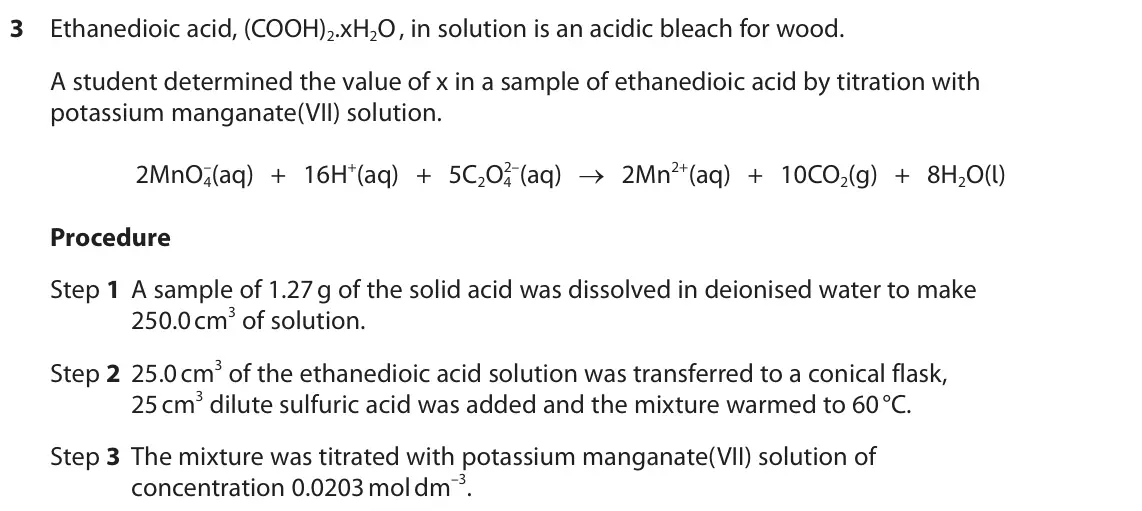
Q3(b)(i)
The whole paper ↗
Q3(b)(ii)
The whole paper ↗Q3(b)(iii)
The whole paper ↗- Your answer
Q19(b)(i)
The whole paper ↗
Q19(b)(ii)
The whole paper ↗- Your answer
Q20(d)
The whole paper ↗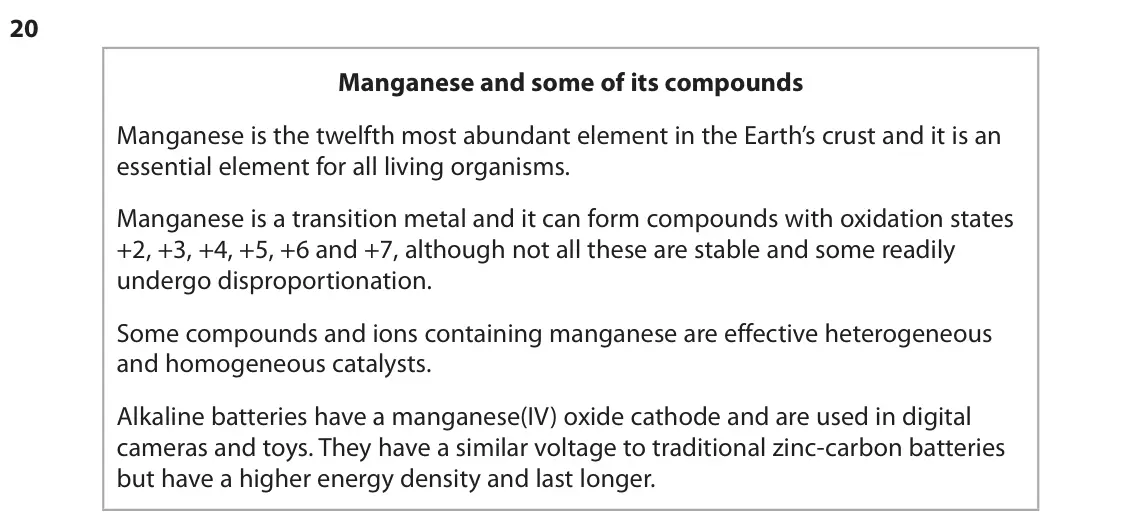
- Your answer
Q1(a)
The whole paper ↗ Your answer
Q1(b)
The whole paper ↗Your answer- Your answer
- Your answer
Q21(e)(i)
The whole paper ↗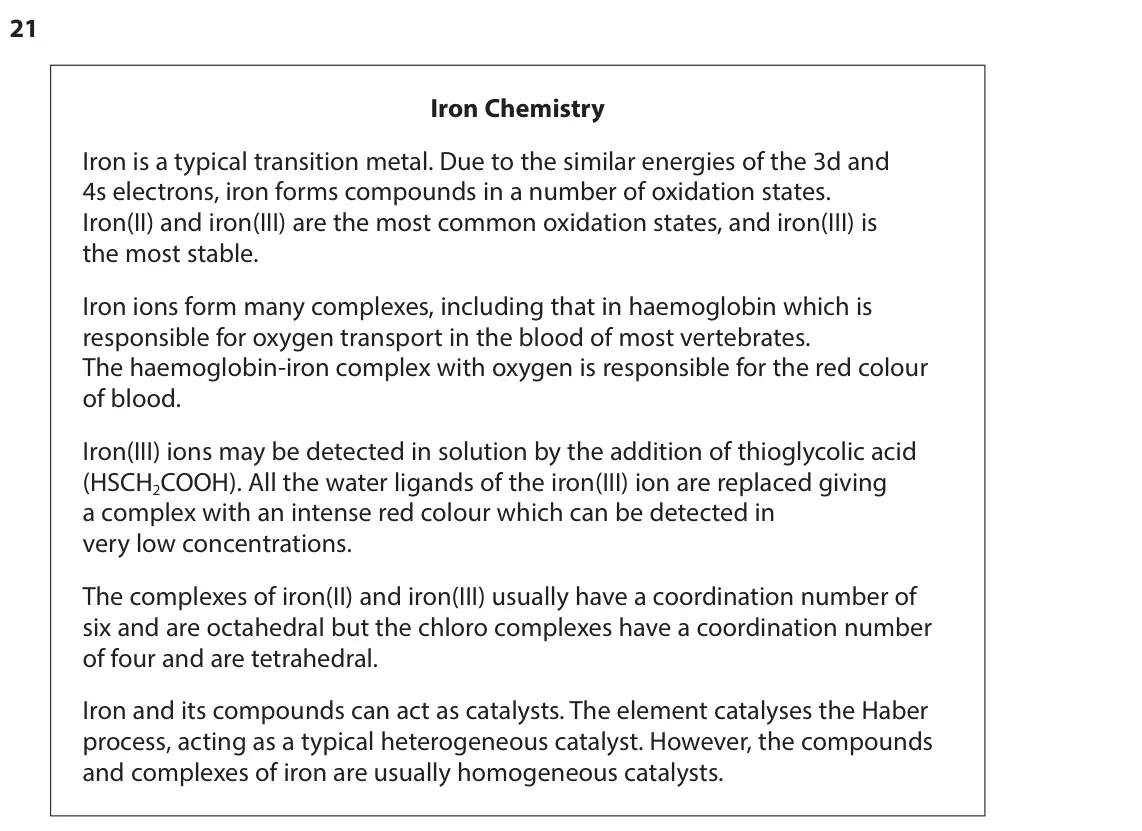
Q21(e)(ii)
The whole paper ↗
All 23 questions on Homogeneous catalysts and autocatalysis, as a list
- June 2025 (A), Unit 5, Q9 (1 mark): 2– , is mixed with 9 An acidified solution, containing tartrate ions, C4H4O6 hydrogen peroxide solution. When pink cobalt(II) chloride solution is added to the
- October 2024, Unit 5, Q4(a) (1 mark): What is the best explanation for the high activation energy of this reaction? (1) A the peroxodisulfate ion is a weak oxidising agent B the iodide ion is a weak
- October 2024, Unit 5, Q4(b) (1 mark): Which property of iron(II) ions enables them to function as a catalyst for this reaction? (1) A iron(II) ions can be easily reduced to metallic iron B iron(II)
- October 2024, Unit 5, Q14 (1 mark): The formation of carbon dioxide from the reaction between manganate(VII) ions and ethanedioate ions is autocatalysed by manganese(II) ions. The equation for thi
- October 2024, Unit 6, Q3(a)(iv) (3 marks): Suggest why, in Step 2, the temperature of the mixture at the start should be 60°C but no further warming is needed after a small quantity of the potassium mang
- June 2024, Unit 6, Q3(b)(i) (3 marks): Plot a graph of volume of sodium thiosulfate against time. (3)
- June 2024, Unit 6, Q3(b)(ii) (1 mark): Describe how the rate of reaction changes during the reaction. (1)
- June 2024, Unit 6, Q3(b)(iii) (3 marks): Explain why the rate of reaction changes in this way. (3)
- October 2023, Unit 5, Q6 (1 mark): Acidified manganate(VII) ions react with ethanedioate ions. 2− → 2Mn2+ + 8H2O + 10CO2 2MnO4 − + 16H+ + 5C2O4 The rate of this reaction increases then decreases.
- October 2023, Unit 5, Q19(b)(i) (1 mark): Give a reason why the activation energy for this reaction is high in the absence of a catalyst. (1)
- October 2023, Unit 5, Q19(b)(ii) (2 marks): Write the ionic equations for the reactions that occur when the catalyst of Fe2+ ions is added. State symbols are not required. (2)
- January 2023, Unit 5, Q7 (1 mark): Persulfate ions react slowly with iodide ions at room temperature unless a catalyst of Fe2+ or Fe3+ is added to the reaction mixture. 2–(aq) + 2I–(aq) → 2SO4 2–
- January 2023, Unit 5, Q20(d) (3 marks): Manganate(VII) ions react with ethanedioate ions in acidic solution. 2MnO4 –(aq) + 16H+(aq) + 5C2O4 2–(aq) → 2Mn2+(aq) + 8H2O(l) + 10CO2(g) Two experiments were
- October 2022, Unit 5, Q9 (1 mark): The sequence shown is the mechanism for a reaction in aqueous solution. Step 1 Ag+ + Ce4+ → Ag2+ + Ce3+ Step 2 Ti+ + Ag2+ → Ti2+ + Ag+ Step 3 Ti2+ + Ce4+ → Ti3+
- June 2022, Unit 5, Q1(a) (1 mark): Some standard electrode potentials are shown. Right-hand electrode system E / V Cu2+ + e− Cu+ +0.15 I2 + 2e− 2I− +0.54 Fe3+ + e− Fe2+ +0.77 Cl2 + 2e− 2C
- June 2022, Unit 5, Q1(b) (1 mark): Which term best describes the type of catalyst for the reaction in (a)? (1) A autocatalyst B biocatalyst C heterogeneous D homogeneous
- October 2021, Unit 5, Q9 (1 mark): The reaction of ethanedioate ions, C2O 4 2– , with manganate(VII) ions, MnO 4 – , in acidic solution involves autocatalysis. 2– → 2Mn2+ + 10CO2 + 8H2O 2MnO 4 –
- October 2021, Unit 5, Q10 (1 mark): Iodide ions, I–, are oxidised by peroxodisulfate(VI) ions, S2O 8 2– . 2I–(aq) + S2O 8 2–(aq) → I2(aq) + 2SO 4 2–(aq) Which of the following statements is true o
- June 2021, Unit 5, Q21(e)(i) (1 mark): State why the catalyst is described as ‘homogeneous’. (1)
- June 2021, Unit 5, Q21(e)(ii) (2 marks): Write two equations to show how iron(II) ions catalyse this oxidation. State symbols are not required. (2)
- June 2021, Unit 5, Q21(e)(iii) (1 mark): Suggest how iron(II) ions lower the activation energy of this reaction. (1)
- January 2021, Unit 5, Q9 (1 mark): Iodide ions are oxidised by peroxodisulfate ions in aqueous solution. 2I− + S2O2− → I2 + 2SO2− 8 4 This reaction is catalysed by adding Fe2+ ions to the solutio
- October 2020, Unit 5, Q24(c) (6 marks): Transition metals, their compounds and their ions can act as heterogeneous and homogeneous catalysts. Compare and contrast these two types of catalytic behaviou
Questions, mark schemes and examiner’s reports are © Pearson Edexcel, from their published past papers. Plumi isn’t affiliated with any exam board. Want whole papers? Edexcel International A Level Chemistry past papers.
The Plumi iPad app also offers exam-style questions with AI feedback on your handwritten working.