 plumi
Dichromate(VI) and chromate(VI): Edexcel International A Level Chemistry questions
Edexcel International A Level Chemistry past-paper questions on 17.2.2 Dichromate(VI) and chromate(VI), 2019–2025, with mark schemes and examiner’s reports where available.
Paper
All papers
Exam
All years
Calculations
Q20(a)(i)
The whole paper ↗
Q20(a)(ii)
The whole paper ↗Q20(a)(iv)
The whole paper ↗Q1(c)
The whole paper ↗
Q14(c)(i)
The whole paper ↗
Q14(c)(ii)
The whole paper ↗Q2(b)
The whole paper ↗
Q2(c)
The whole paper ↗- Your answer
Q1(c)(i)
The whole paper ↗
Q1(c)(ii)
The whole paper ↗- Your answer
Q1(b)(ii)
The whole paper ↗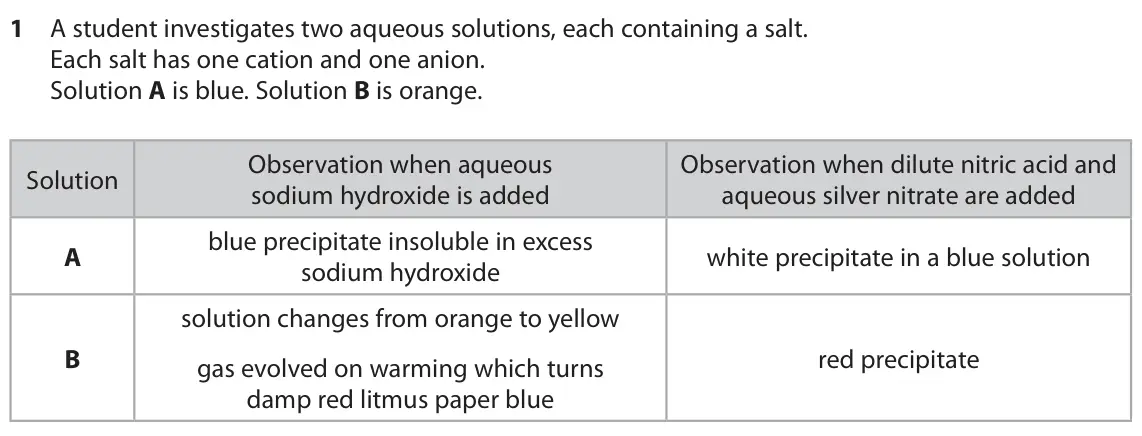
Q1(c)
The whole paper ↗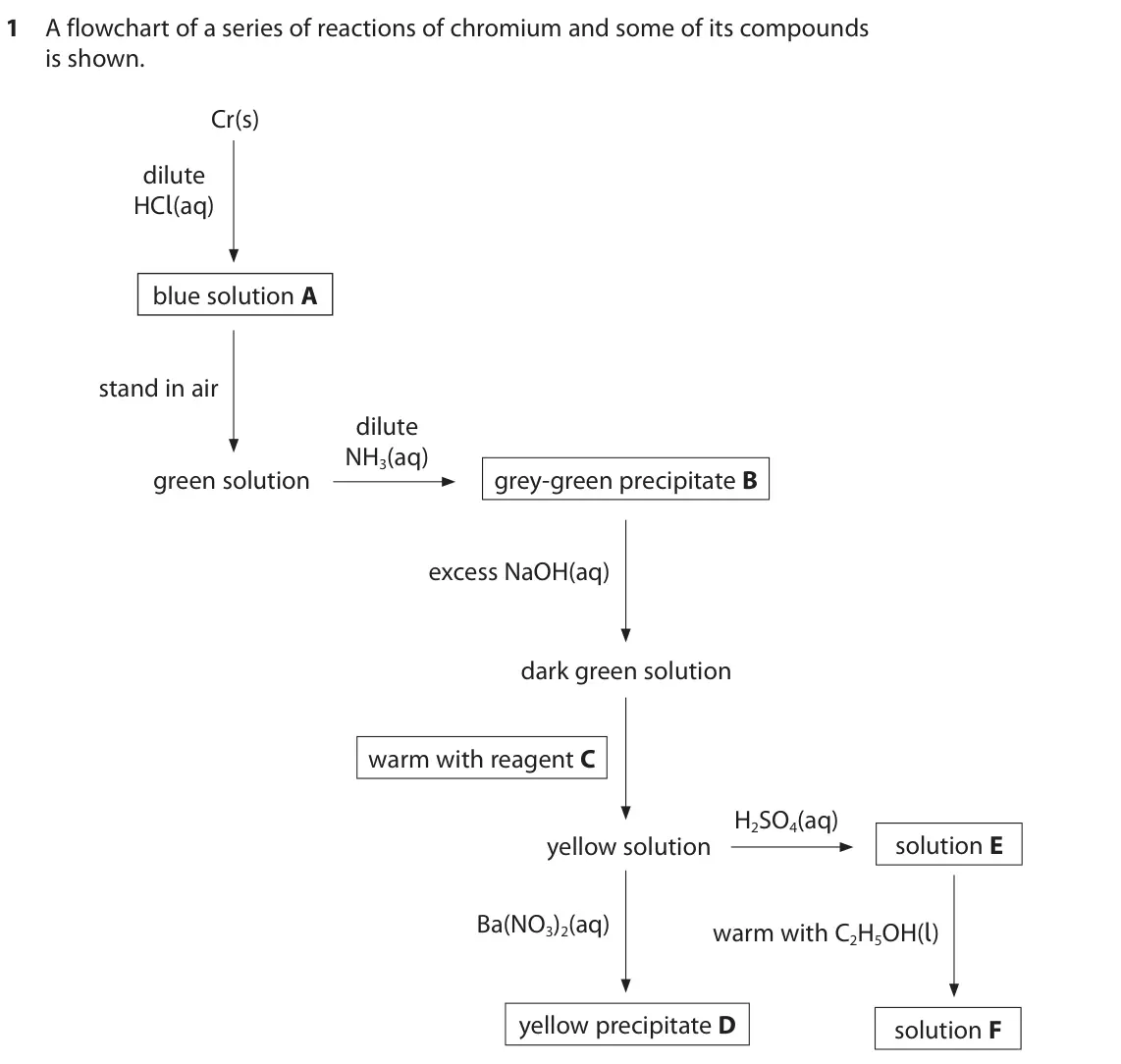
Q1(d)
The whole paper ↗Q1(e)
The whole paper ↗Q1(f)
The whole paper ↗Q21(a)
The whole paper ↗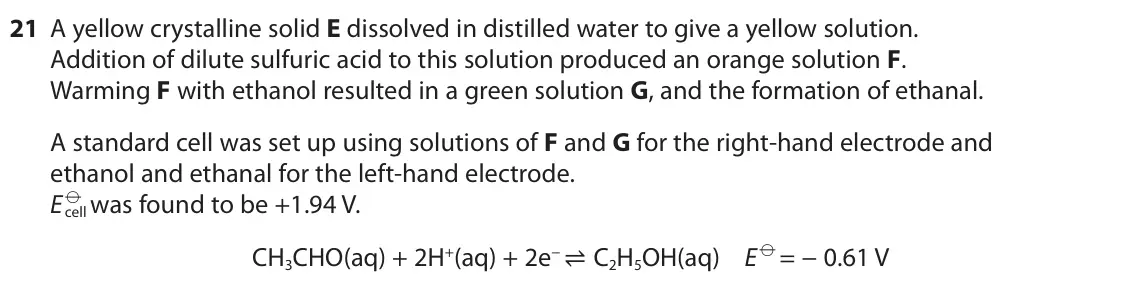
Q21(b)
The whole paper ↗Q21(c)
The whole paper ↗
All 22 questions on Dichromate(VI) and chromate(VI), as a list
- January 2025, Unit 5, Q20(a)(i) (2 marks): Write the equation for Reaction 1. Use the half‑equations from page 10 of your Data Booklet. State symbols are not required. (2)
- January 2025, Unit 5, Q20(a)(ii) (2 marks): In Reaction 2, Cr2O7 2– reacts with a metal, M, in acid conditions forming Cr3+ and M2+. 2–. Identify a possible metal, M, calculating E d cell for its reaction
- January 2025, Unit 5, Q20(a)(iv) (2 marks): State whether or not the reaction in Reaction 4 is a redox reaction. Justify your answer using oxidation numbers. (2)
- January 2025, Unit 6, Q1(c) (2 marks): A sample of solid Q was added to manganese(IV) oxide and excess sulfuric acid. A redox reaction occurred forming a mixture containing dichromate(VI) ions, Cr2O
- June 2024, Unit 5, Q14(c)(i) (4 marks): Explain, by calculating E d cell values, why Fe(II) is used to reduce Cr(VI) to Cr(III) but zinc is used to reduce Cr(VI) to Cr(II). (4) Numbers chosen of the r
- June 2024, Unit 5, Q14(c)(ii) (1 mark): State the essential condition required for these reactions to occur. (1)
- June 2024, Unit 6, Q2(b) (2 marks): Experiment 2 5 cm3 of hydrogen peroxide solution is added to the final mixture formed in (a) (i) and heated gently. 2–, is produced. A yellow solution containin
- June 2024, Unit 6, Q2(c) (1 mark): Experiment 3 Dilute sulfuric acid is added to the yellow solution formed in Experiment 2. The solution turns orange. Complete and balance the equation for this
- June 2023, Unit 5, Q11 (1 mark): Which equation shows a redox reaction in which the solution turns yellow? A Fe + 2HCl → FeCl2 + H2 B VO3 – + 2H+ → VO2 + + H2O C Cr2O7 2– + 2OH– → 2CrO4 2– + H2
- January 2023, Unit 6, Q1(c)(i) (1 mark): State the type of reaction involved when the dark green solution turned yellow. (1)
- January 2023, Unit 6, Q1(c)(ii) (1 mark): Identify, by name or formula, the ion responsible for the final orange colour of the solution. (1)
- June 2022, Unit 5, Q5 (1 mark): Which reagent, when added to aqueous sodium dichromate(VI), Na2Cr2O7(aq), causes a shift in equilibrium resulting in the formation of a yellow solution? A NaOH(
- June 2022, Unit 6, Q1(b)(ii) (2 marks): Give the formulae of the ions of the salt in B. (2)
- January 2022, Unit 6, Q1(c) (1 mark): Identify reagent C, by name or formula. (1)
- January 2022, Unit 6, Q1(d) (1 mark): Suggest the identity, by name or formula, of precipitate D. (1)
- January 2022, Unit 6, Q1(e) (1 mark): State the colour of solution E. (1)
- January 2022, Unit 6, Q1(f) (1 mark): State the colour of solution F. (1)
- January 2021, Unit 5, Q21(a) (2 marks): Deduce the formulae of the ions responsible for the colours of F and G, using the standard electrode potential and E d given, and the values in the Data Booklet
- January 2021, Unit 5, Q21(b) (2 marks): Write the overall equation for the reaction in the cell. State symbols are not required. (2)
- January 2021, Unit 5, Q21(c) (1 mark): Write the ionic equation for the reaction of the aqueous solution of E with dilute sulfuric acid. State symbols are not required. (1)
- October 2020, Unit 6, Q1(b)(i) (3 marks): Identify, by name or formula, the ions responsible for the colours observed. (3) Observation Ions yellow colour of solution C orange colour on adding dilute sul
- October 2020, Unit 6, Q1(c) (1 mark): Give the name or formula of compound A. (1)
Questions, mark schemes and examiner’s reports are © Pearson Edexcel, from their published past papers. Plumi isn’t affiliated with any exam board. Want whole papers? Edexcel International A Level Chemistry past papers.
The Plumi iPad app also offers exam-style questions with AI feedback on your handwritten working.