 plumi
Ligand exchange and the stability of complexes: Edexcel International A Level Chemistry questions
Edexcel International A Level Chemistry past-paper questions on 17.2.4 Ligand exchange and the stability of complexes, 2019–2025, with mark schemes and examiner’s reports where available.
Paper
All papers
Exam
All years
Calculations
Q15(c)
The whole paper ↗
Q15(d)(ii)
The whole paper ↗- Your answer
Q18(d)(i)
The whole paper ↗
Q16(b)(ii)
The whole paper ↗
Q17(b)(i)
The whole paper ↗
Q19(e)
The whole paper ↗
- Your answer
Q22(b)(i)
The whole paper ↗
Q22(b)(ii)
The whole paper ↗Q23(e)(ii)
The whole paper ↗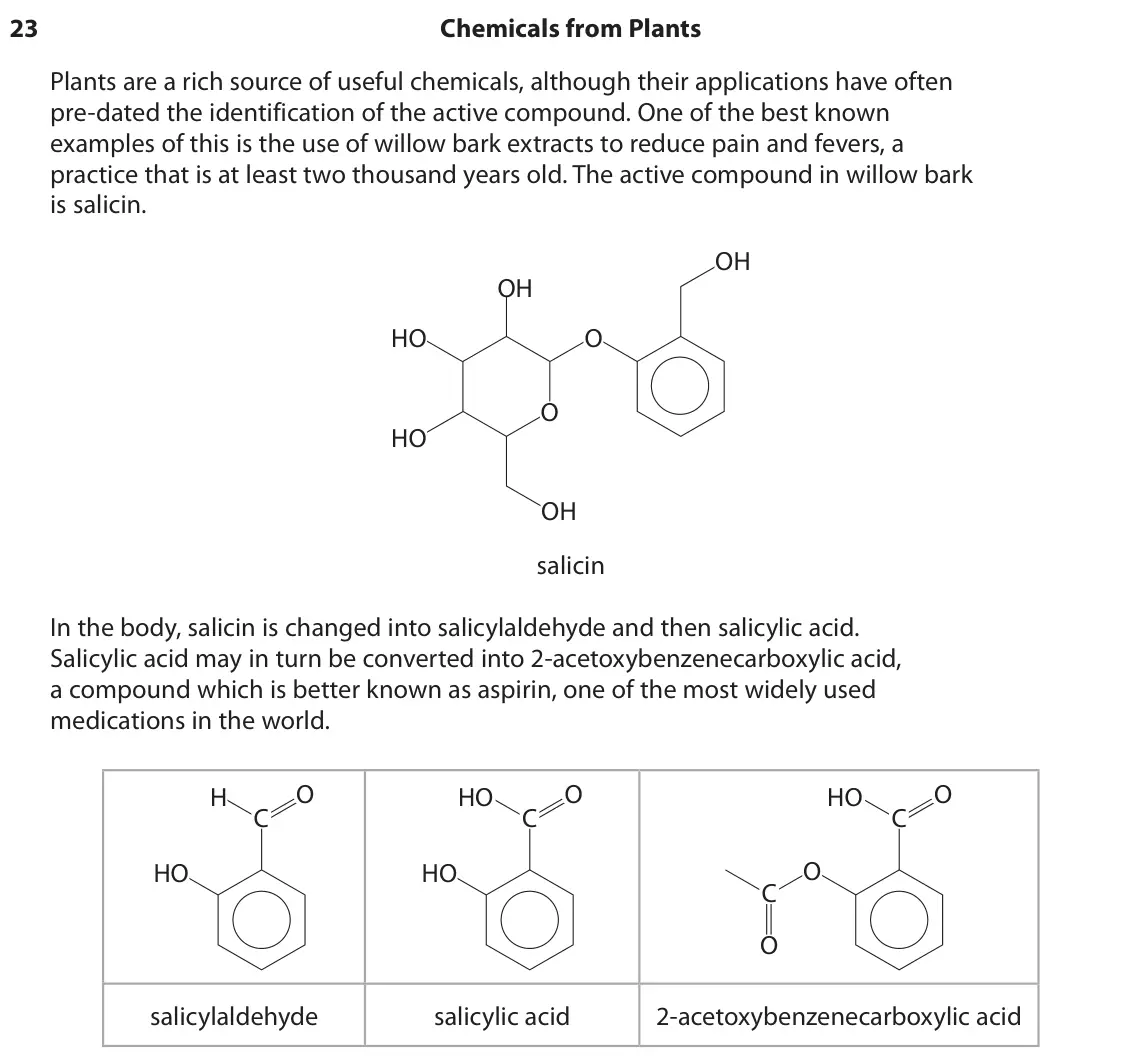
Q1(a)(iii)
The whole paper ↗Q15(d)
The whole paper ↗
- Your answer
Q18(f)
The whole paper ↗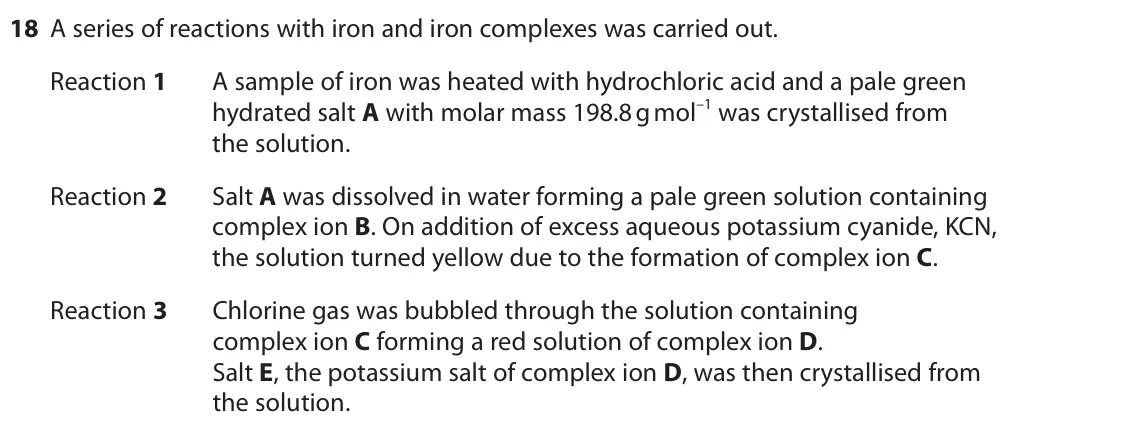
Q1(a)(ii)
The whole paper ↗
- Your answer
All 29 questions on Ligand exchange and the stability of complexes, as a list
- June 2025, Unit 5, Q15(c) (2 marks): In human cells, the two chloride ions are replaced by water molecules in a ligand exchange reaction as shown. 2+ + 2Cl − PtCl2(NH3)2 + 2H2O [Pt(NH3)2(H2O)2 ]
- June 2025, Unit 5, Q15(d)(ii) (2 marks): Explain, by considering the equation shown, why this process is thermodynamically feasible. Pt(Cl)2(NH3)2 + DNA → [Pt(NH3)2(DNA)] 2+ + 2Cl − (2)
- June 2025, Unit 5, Q19 (6 marks): *19 A solution containing tetrachlorocuprate(II) ions, [CuCl4] 2−, is treated with dilute aqueous ammonia. The ammonia solution is added gradually. The followin
- June 2025 (A), Unit 5, Q8 (1 mark): When EDTA4– is added to an aqueous solution of iron(III) ions, the EDTA complex is formed. Which is the best explanation for this? A iron(III) ions form stronge
- October 2024, Unit 5, Q18(d)(i) (1 mark): Give a reason, by referring to the equation, why the formation of the diamine complex from the aqueous complex ion is thermodynamically favoured. (1)
- June 2024, Unit 5, Q16(b)(ii) (2 marks): Explain, using a balanced equation, why the formation of the dimethyldithiocarbamate complex from an aqueous solution of nickel ions is thermodynamically feasib
- January 2024, Unit 5, Q17(b)(i) (1 mark): Write the balanced equation for Step 1. State symbo
- October 2023, Unit 5, Q19(e) (2 marks): Ethanedioate ligands react with iron(II) ions in aqueous solution. 2− → [Fe(C2O4)2 (H2O)2]2− + 4H2O [Fe(H2O)6]2+ + 2C2O4 Explain, in terms of entropy, why this
- June 2023, Unit 5, Q12 (1 mark): Aqueous ammonia is added in excess to an aqueous solution of Cu2+. What is the equation for the overall reaction? A [Cu(H2O)6]2+ + 2NH3 → [Cu(H2O)4(OH)2] + 2NH4
- January 2023, Unit 5, Q6 (1 mark): The diagram shows how the relative colour intensity of an aqueous solution containing 0.001 mol of chromium(III) ions varies with increasing amounts of cyanide
- October 2022, Unit 5, Q22(b)(i) (1 mark): Name the type of reaction that occurs when concentrated hydrochloric acid is added to aqueous cobalt(II) sulfate. (1)
- October 2022, Unit 5, Q22(b)(ii) (2 marks): Write an ionic equation for the reaction that occurs when concentrated hydrochloric acid is added to aqueous cobalt(II) sulfate. State symbols are not required.
- October 2022, Unit 5, Q23(e)(ii) (2 marks): Explain why the salen ligand complex of the Ni2+ ion is much more stable than the aqua complex of the same ion. (2)
- October 2022, Unit 6, Q1(a)(iii) (1 mark): Add concentrated The formula of the complex ion formed is [CoCl4]2– hydrochloric acid
- June 2022, Unit 5, Q15(d) (2 marks): The concentration of nickel(II) ions, Ni2+(aq), can be determined by forming a complex with the ligand dimethylglyoxime, C4H8N2O2 . [Ni(H2O)6]2+ + 2C4H8N2O2 + 2
- January 2022, Unit 5, Q14 (6 marks): *14 Describe the reactions of separate samples of aqueous cobalt(II) sulfate with aqueous sodium hydroxide, excess aqueous ammonia and concentrated hydrochloric
- October 2021, Unit 5, Q7 (1 mark): Some nickel(II) complex ions are formed by the addition of complexing agents to nickel(II) ions, [Ni(H2O)6]2+ , in aqueous solution. On formation, which of thes
- October 2021, Unit 5, Q18(f) (2 marks): Complete the table, using as appropriate, to identify the type of each reaction. (2) Neutralisation Ligand exchange Redox Reaction 2 Reaction 3
- October 2021, Unit 6, Q1(a)(ii) (2 marks): Test 2 A few drops of concentrated hydrochloric acid were added to another sample of the copper(II) sulfate solution. More of the concentrated hydrochloric acid
- June 2021, Unit 5, Q8 (1 mark): When aqueous ammonia is added to an aqueous solution of zinc sulfate, a white precipitate forms which dissolves in excess ammonia to give a colourless solution.
- June 2021, Unit 6, Q1(b)(i) (2 marks): Suggest the formulae of two complex ions present in solution T. (2)
- June 2021, Unit 6, Q1(b)(ii) (1 mark): State how the colour of solution T would change on the addition of excess concentrated hydrochloric acid. (1)
- June 2021, Unit 6, Q2(b) (1 mark): Give the colour of the solution at the end of Step 2. (1)
- January 2021, Unit 5, Q8 (1 mark): Cobalt chloride is used as a test for the presence of water. This test depends on the fact that A anhydrous cobalt(II) chloride is blue and hydrated cobalt(II)
- January 2021, Unit 5, Q19(a) (7 marks): Identify, by name (including the oxidation state) or formula, the species in the sequence that contain copper. (7) P Q R S T V W
- January 2021, Unit 6, Q1(b)(i) (1 mark): B is a blue solution. When A is added to B, the mixture first turns green and then gradually turns yellow. Give the formula of the cation in B. (1)
- January 2021, Unit 6, Q1(b)(vii) (2 marks): A solution of the sodium salt of EDTA, Na4EDTA, is added to a sample of solution F. The solution turns pale blue. Write an equation for the reaction. State symb
- October 2020, Unit 5, Q24(a)(ii) (1 mark): State the type of reaction occurring in Reaction 2. (1)
- October 2020, Unit 6, Q1(a)(iii) (1 mark): Excess concentrated hydrochloric acid was added to a further portion of B and the mixture warmed. The precipitate dissolved to form a different yellow solution
Questions, mark schemes and examiner’s reports are © Pearson Edexcel, from their published past papers. Plumi isn’t affiliated with any exam board. Want whole papers? Edexcel International A Level Chemistry past papers.
The Plumi iPad app also offers exam-style questions with AI feedback on your handwritten working.