 plumi
Identities and algebraic proof: Edexcel GCSE Maths questions
Every Edexcel GCSE Maths exam question on A6 Identities and algebraic proof, 2017–2025, with its mark scheme and examiner’s report.
Find questions997
Exam
All years
Calculator











All 13 questions on Identities and algebraic proof, as a list
- June 2025, Paper 1H, Q10 (3 marks): Prove that the difference in the squares of two consecutive even numbers is always a multiple of 4
- November 2024, Paper 3H, Q14 (3 marks): Prove algebraically that 0.46 495
- November 2023, Paper 2H, Q13 (3 marks): Prove algebraically that 0.07. 23. can be written as 241 3330
- June 2023, Paper 3H, Q13 (3 marks): An expression for the nth term of the sequence of triangular numbers is n n + 1 ( ) 2 Prove that the sum of any two consecutive triangular numbers is a square n
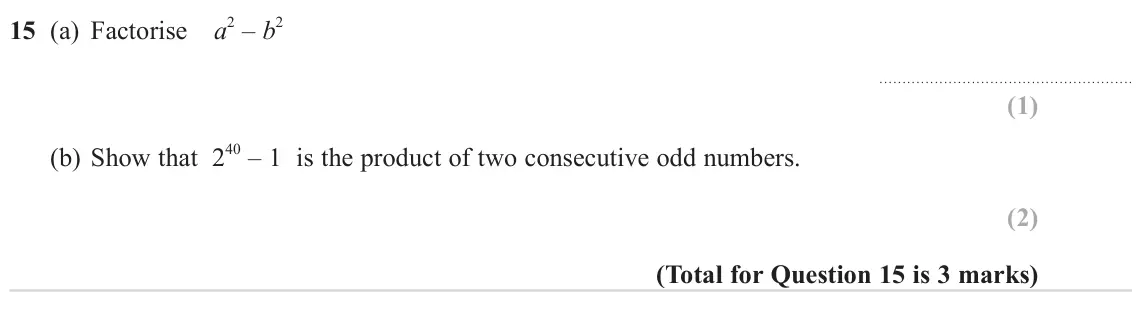
- June 2023, Paper 3H, Q15 (3 marks): (a) Factorise a 2 – b 2 40 – 1 is the product of two consecutive odd numbers. (b) Show that 2
- June 2023, Paper 3H, Q20 (3 marks): Prove algebraically that 0.12∙ 3∙ can be written as 61 495
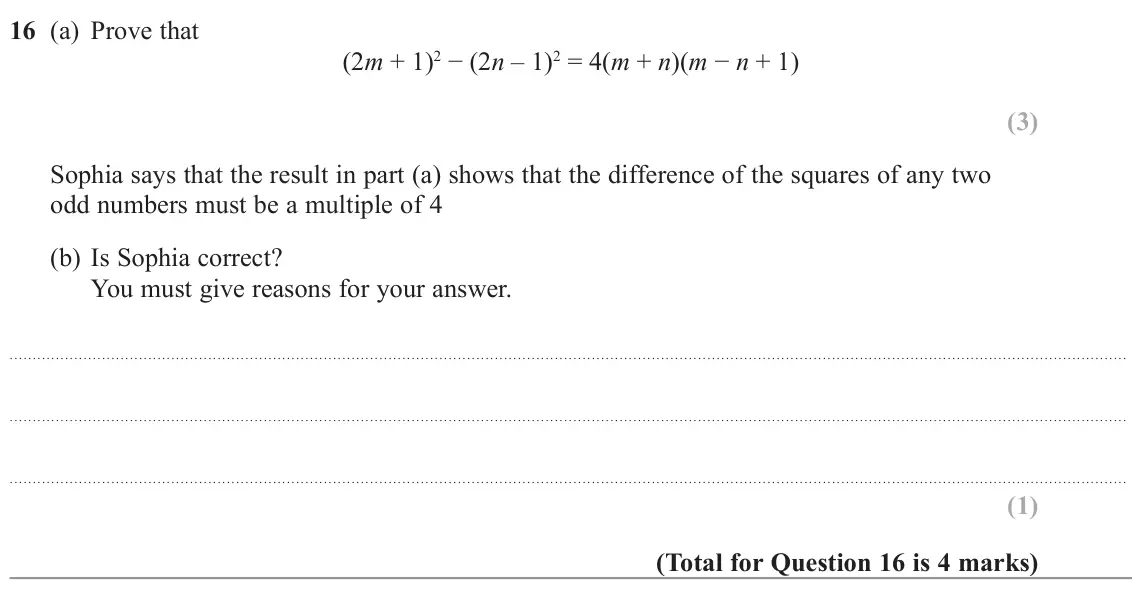
- November 2022, Paper 1H, Q16 (4 marks): (a) Prove that (2m + 1)2 − (2n – 1)2 = 4(m + n)(m − n + 1) Sophia says that the result in part (a) shows that the difference of the squares of any two odd numbe
- November 2019, Paper 3H, Q15 (3 marks): Prove algebraically that the sum of the squares of any two consecutive even numbers is always a multiple of 4
- June 2019, Paper 1H, Q13 (2 marks): Given that n can be any integer such that n 1, prove that n2 – n is never an odd number.
- November 2018, Paper 3H, Q15 (3 marks): Prove algebraically that the difference between the squares of any two consecutive odd numbers is always a multiple of 8
- June 2018, Paper 1H, Q12 (4 marks): Prove that the square of an odd number is always 1 more than a multiple of 4
- November 2017, Paper 1H, Q17 (2 marks): n is an integer. Prove algebraically that the sum of 1 2 n(n + 1) and 1 2 (n + 1)(n + 2) is always a square number.
- June 2017, Paper 1H, Q16 (4 marks): n is an integer greater than 1 Prove algebraically that n2 – 2 – (n – 2)2 is always an even number.
Questions, mark schemes and examiner’s reports are © Pearson Edexcel, from their published past papers. Plumi isn’t affiliated with any exam board. Want whole papers? Every Edexcel GCSE Maths paper.
Rather write your answers by hand on iPad? Plumi marks them against the same mark schemes.