 plumi
Antibiotics and new medicines: Edexcel GCSE Biology questions
Every Edexcel GCSE Biology exam question on Antibiotics and new medicines (specification points 5.16–5.20), 2018–2025, with its mark scheme and examiner’s report.
Find questions1,834
Exam
All years
Calculations
Q4(b)(i)
The whole paper ↗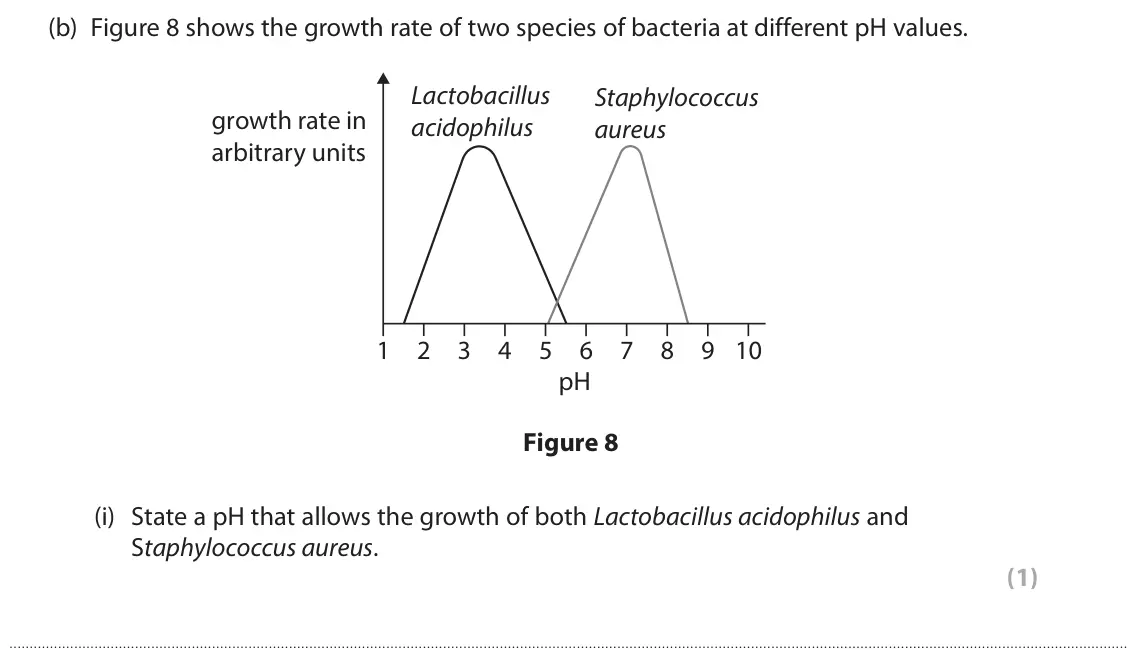
Q4(b)(ii)
The whole paper ↗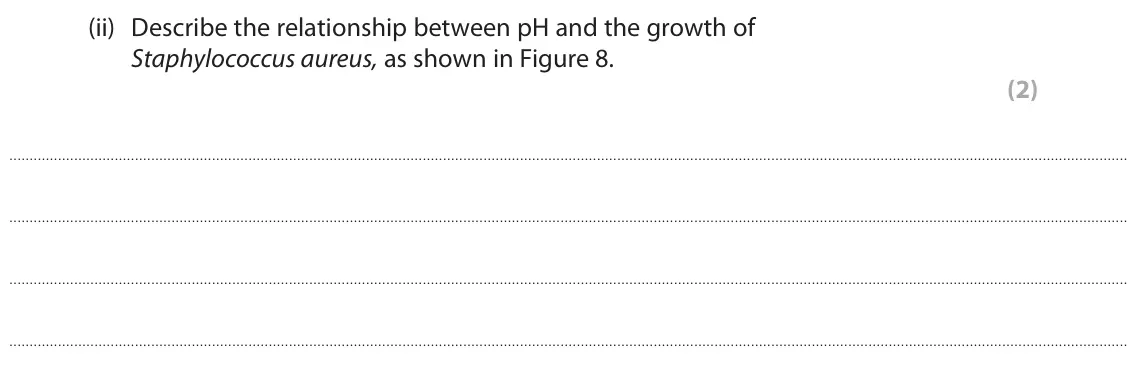
Q8(a)(i)
The whole paper ↗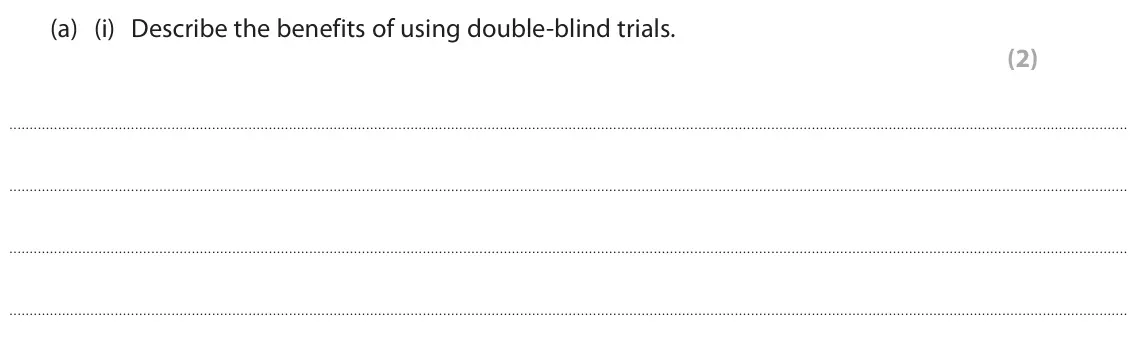
Q8(a)(ii)
The whole paper ↗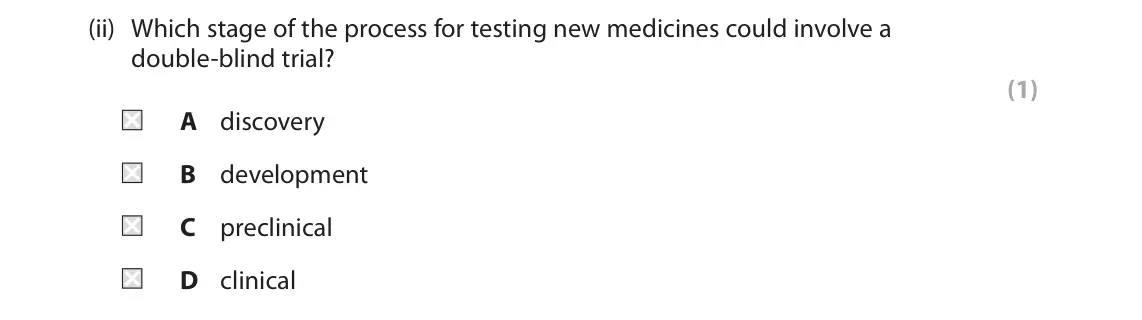
Q8(b)(i)
The whole paper ↗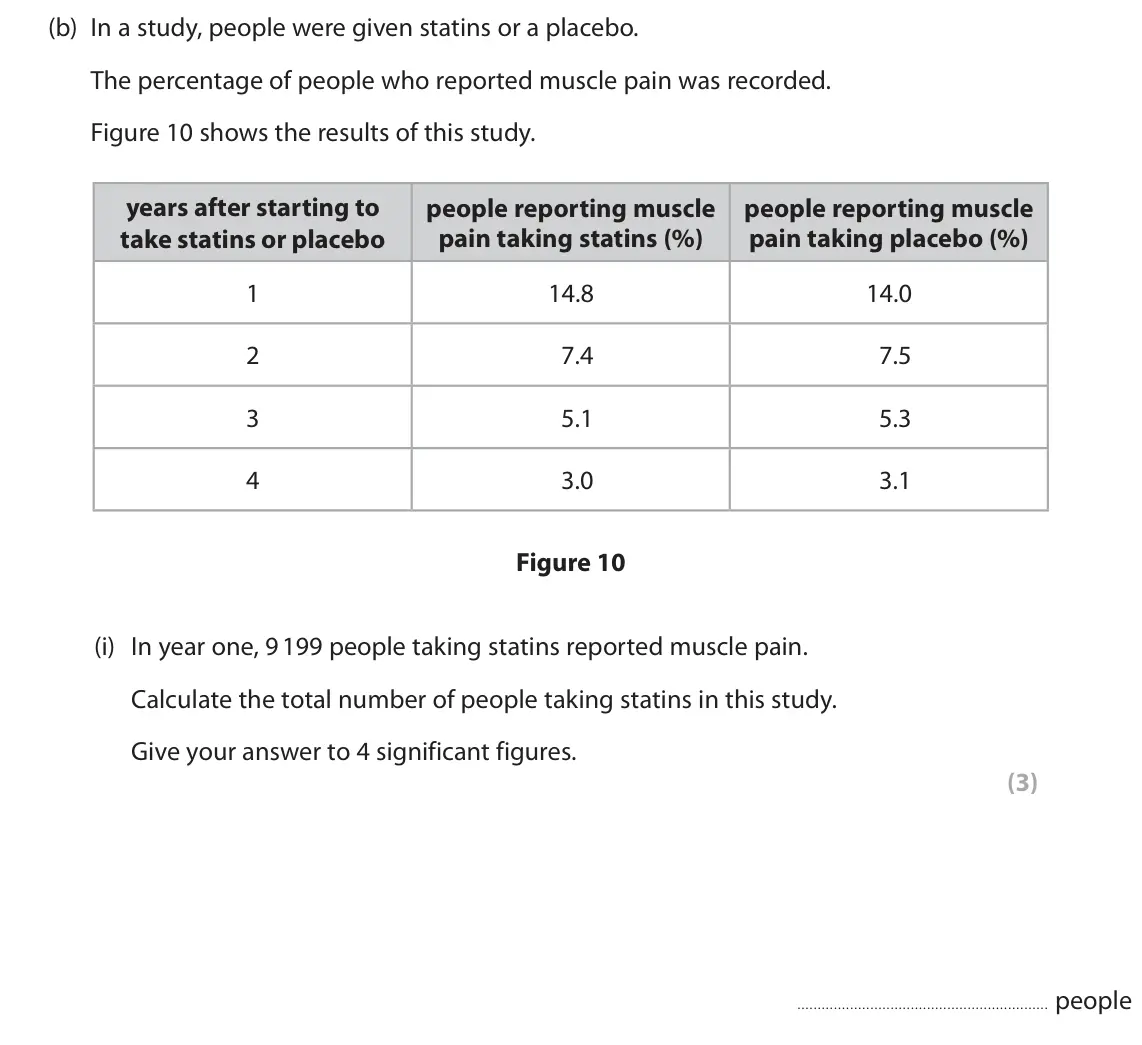
Q8(b)(ii)
The whole paper ↗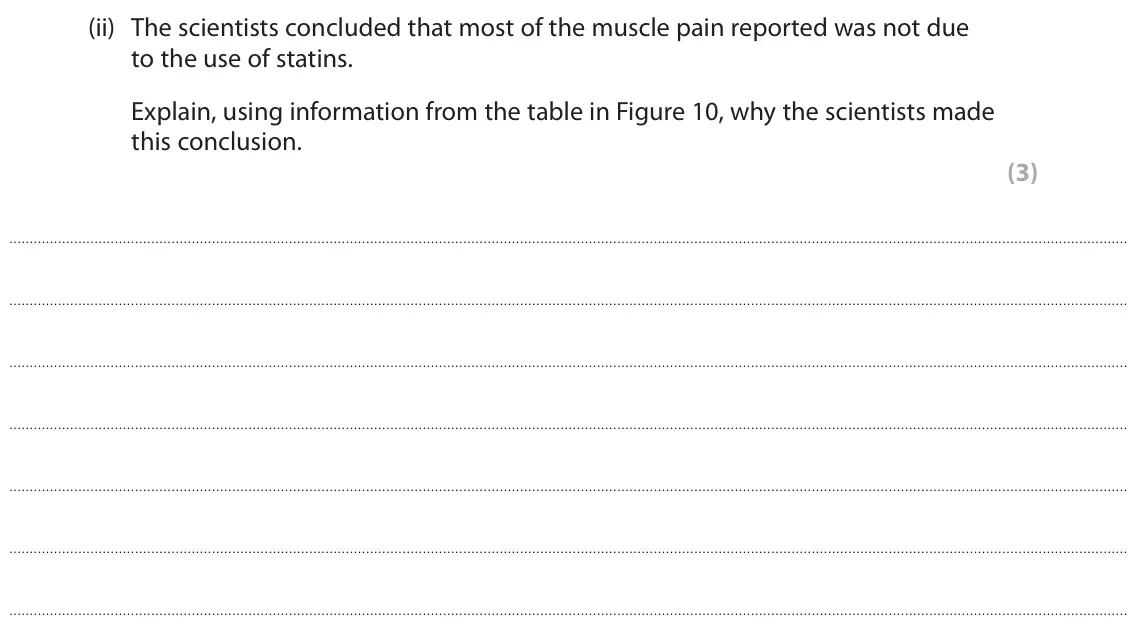
Q8(b)(iii)
The whole paper ↗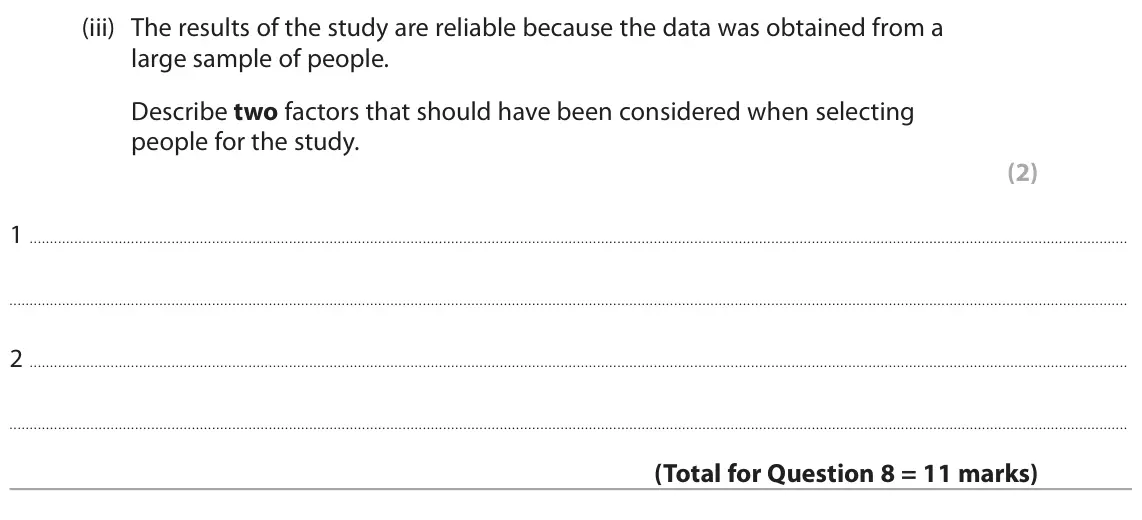
Q10(b)
The whole paper ↗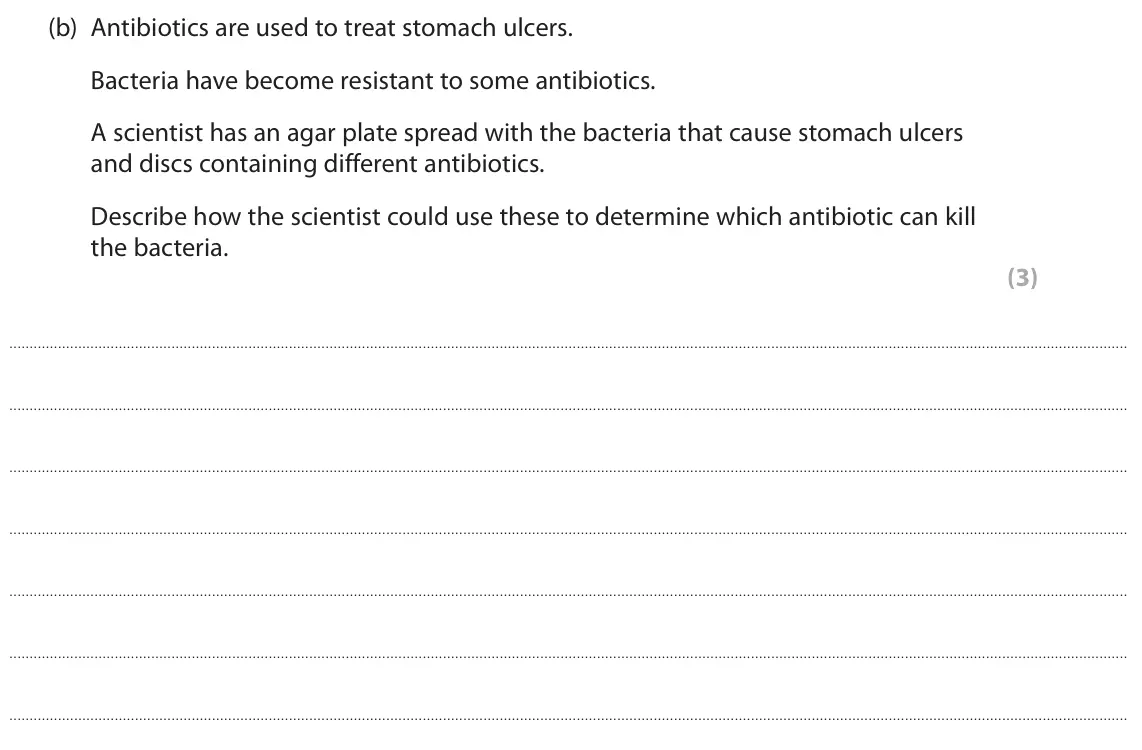
Q10(c)
The whole paper ↗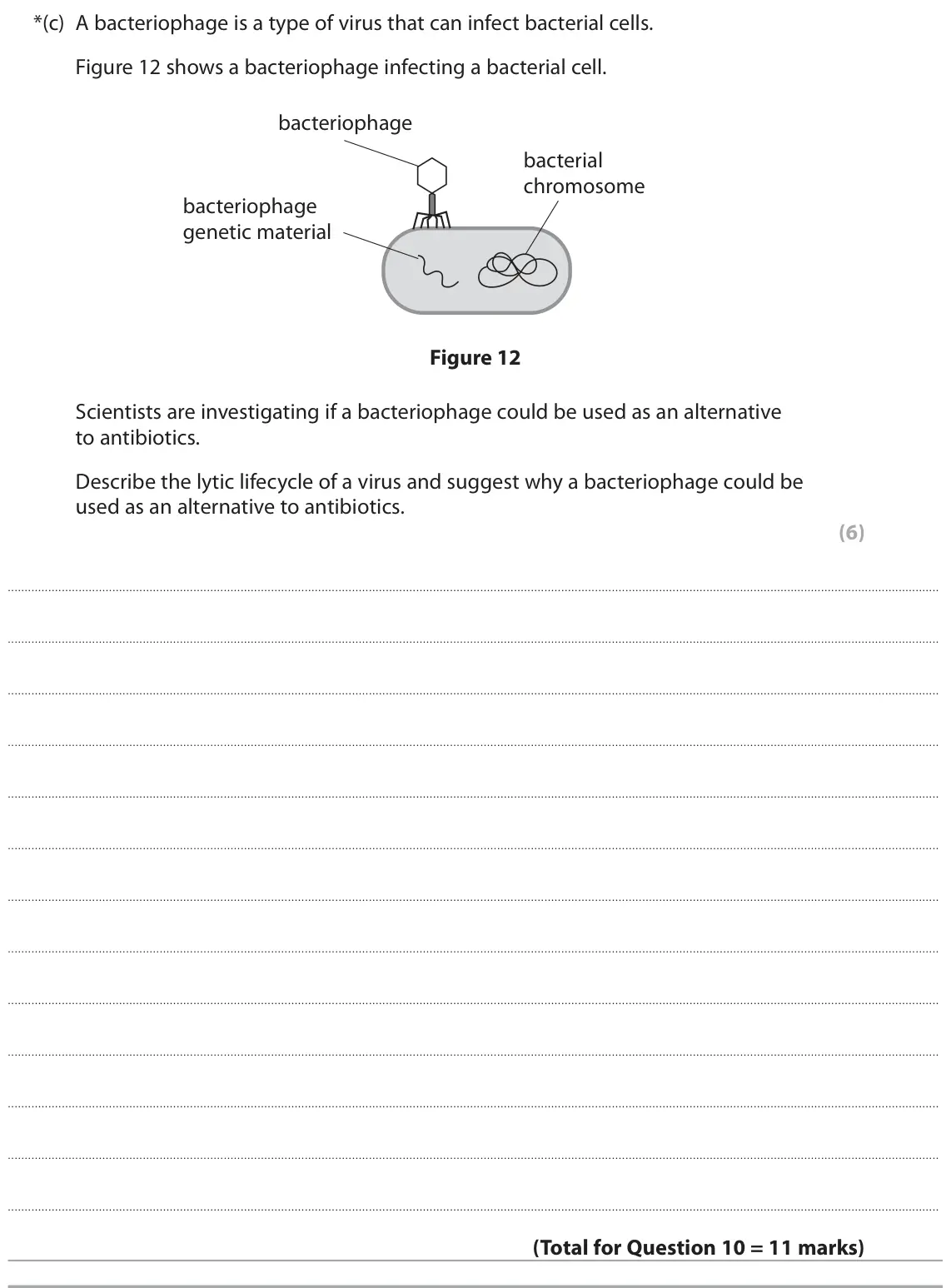
Q6(a)(i)
The whole paper ↗
Q6(a)(ii)
The whole paper ↗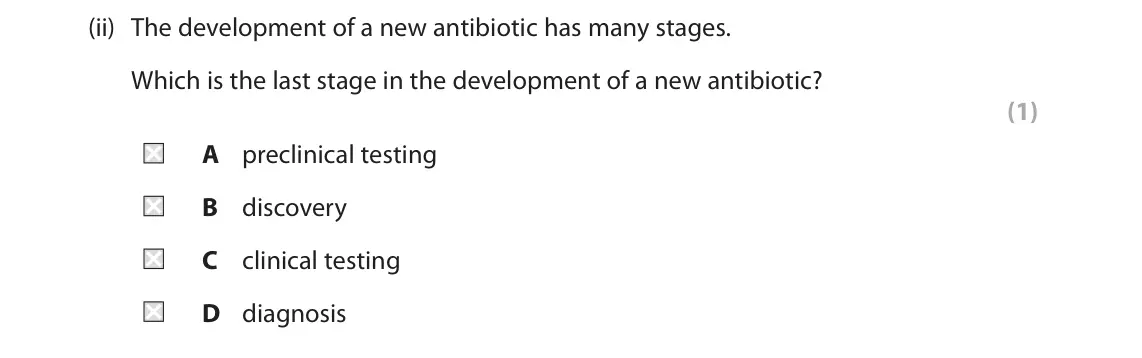
Q7(b)(i)
The whole paper ↗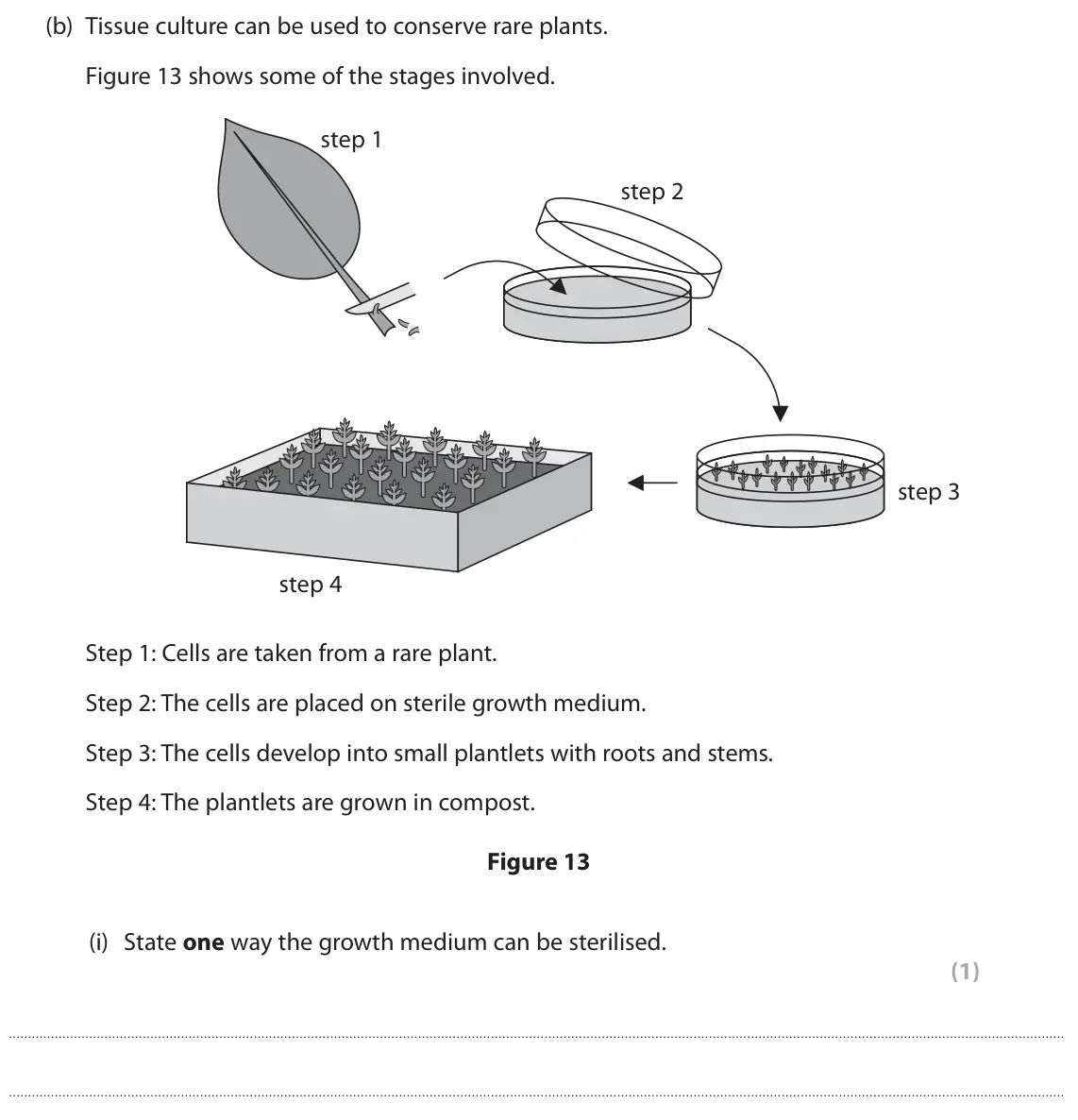
Q7(b)(ii)
The whole paper ↗
Q3(b)(ii)
The whole paper ↗
Q5(a)(i)
The whole paper ↗
Q5(a)(ii)
The whole paper ↗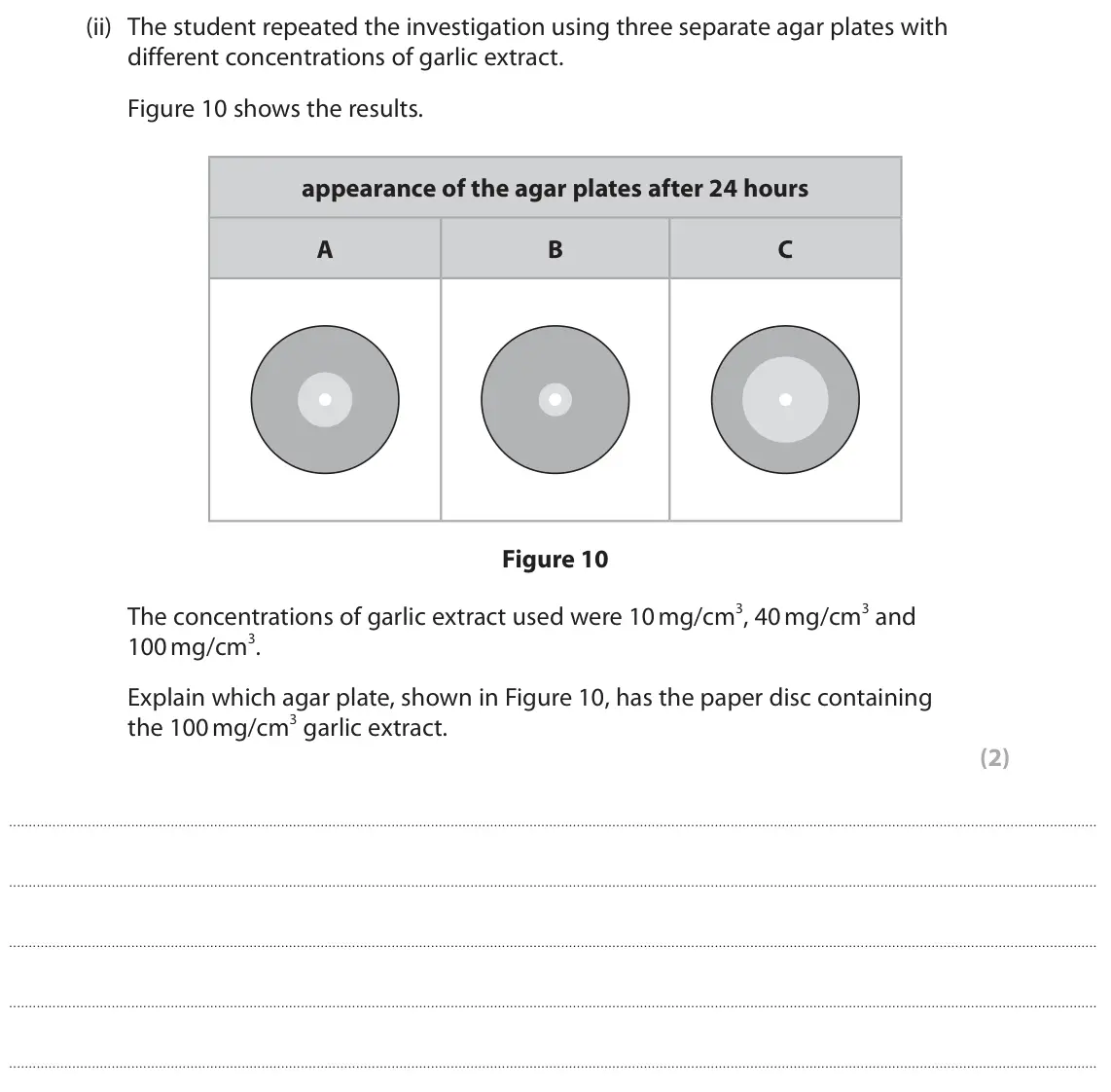
Q5(a)(iii)
The whole paper ↗
Q5(a)(iv)
The whole paper ↗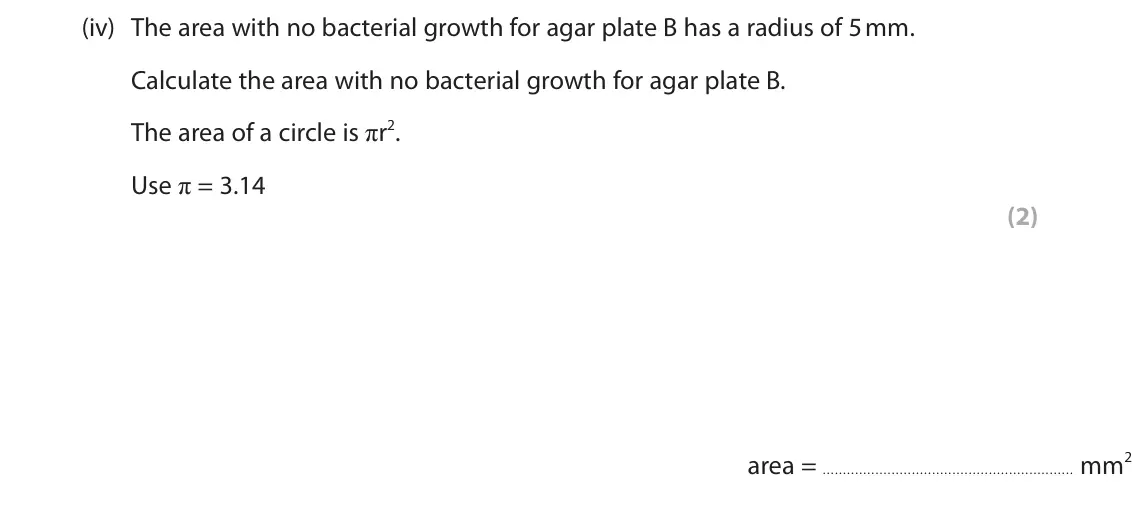
Q5(b)(i)
The whole paper ↗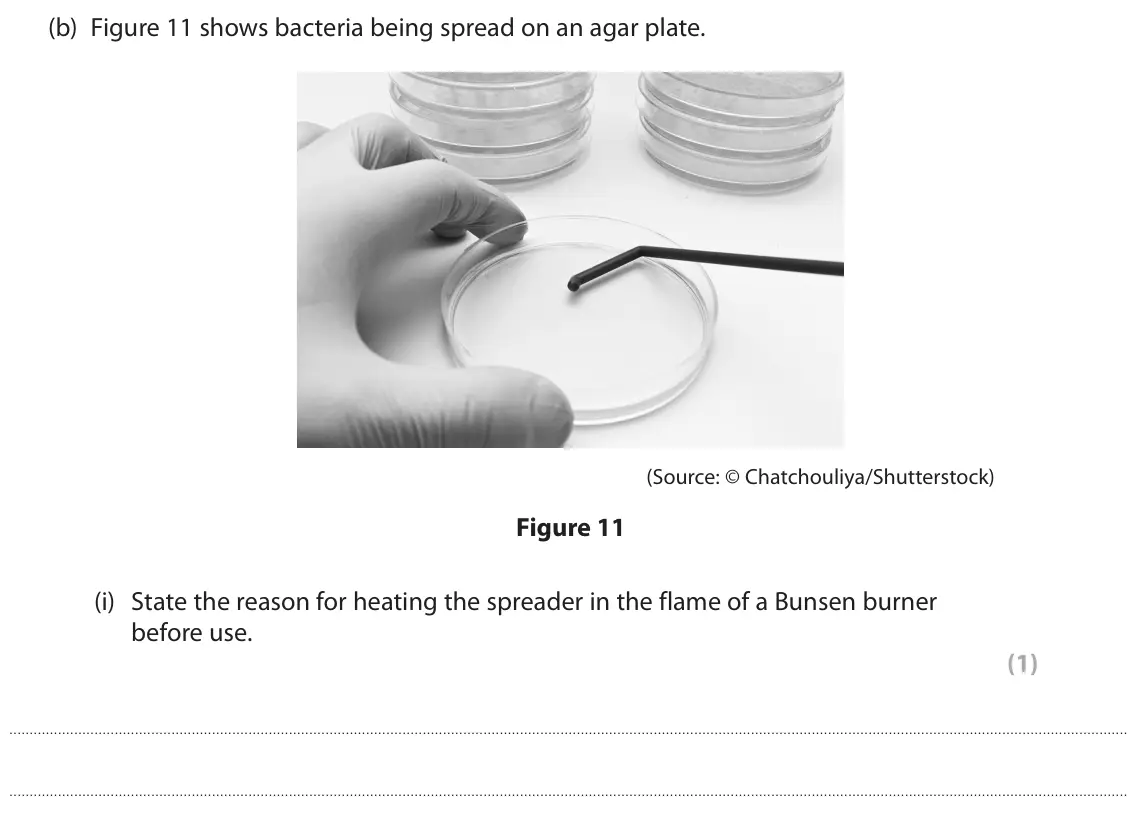
Q5(b)(ii)
The whole paper ↗
All 62 questions on Antibiotics and new medicines, as a list
- June 2025, Paper 2 Higher, Q4(b)(i) (1 mark): State a pH that allows the growth of both Lactobacillus acidophilus and Staphylococcus aureus. (1)
- June 2025, Paper 2 Higher, Q4(b)(ii) (2 marks): Describe the relationship between pH and the growth of Staphylococcus aureus, as shown in Figure 8. (2)
- June 2024, Paper 1 Higher, Q8(a)(i) (2 marks): Describe the benefits of using double‑blind trials. (2)
- June 2024, Paper 1 Higher, Q8(a)(ii) (1 mark): Which stage of the process for testing new medicines could involve a double‑blind trial? (1) A discovery B development C preclinical D clinical
- June 2024, Paper 1 Higher, Q8(b)(i) (3 marks): In year one, 9 199 people taking statins reported muscle pain. Calculate the total number of people taking statins in this study. Give your answer to 4 signific
- June 2024, Paper 1 Higher, Q8(b)(ii) (3 marks): The scientists concluded that most of the muscle pain reported was not due to the use of statins. Explain, using information from the table in Figure 10, why th
- June 2024, Paper 1 Higher, Q8(b)(iii) (2 marks): The results of the study are reliable because the data was obtained from a large sample of people. Describe two factors that should have been considered when se
- June 2024, Paper 1 Higher, Q10(b) (3 marks): Antibiotics are used to treat stomach ulcers. Bacteria have become resistant to some antibiotics. A scientist has an agar plate spread with the bacteria that ca
- June 2024, Paper 1 Higher, Q10(c) (6 marks): A bacteriophage is a type of virus that can infect bacterial cells. Figure 12 shows a bacteriophage infecting a bacterial cell. bacteriophage bacterial chromoso
- June 2024, Paper 1 Foundation, Q6(a)(i) (1 mark): Give one reason why antibiotics are not used to treat the common cold. (1)
- June 2024, Paper 1 Foundation, Q6(a)(ii) (1 mark): The development of a new antibiotic has many stages. Which is the last stage in the development of a new antibiotic? (1) A preclinical testing B discovery C cli
- June 2024, Paper 1 Foundation, Q7(b)(i) (1 mark): State one way the growth medium can be sterilised. (1)
- June 2024, Paper 1 Foundation, Q7(b)(ii) (2 marks): Explain one reason why the growth medium must be sterilised. (2)
- June 2023, Paper 1 Higher, Q3(b)(ii) (2 marks): Explain why antibiotics can be used to treat bacterial infections. (2)
- June 2023, Paper 1 Foundation, Q5(a)(i) (1 mark): Suggest why there is an area with no bacterial growth. (1)
- June 2023, Paper 1 Foundation, Q5(a)(ii) (2 marks): The student repeated the investigation using three separate agar plates with different concentrations of garlic extract. Figure 10 shows the results. appearance
- June 2023, Paper 1 Foundation, Q5(a)(iii) (1 mark): Give one way the student could improve their results. (1)
- June 2023, Paper 1 Foundation, Q5(a)(iv) (2 marks): The area with no bacterial growth for agar plate B has a radius of 5 mm. Calculate the area with no bacterial growth for agar plate B. The area of a circle is π
- June 2023, Paper 1 Foundation, Q5(b)(i) (1 mark): State the reason for heating the spreader in the flame of a Bunsen burner before use. (1)
- June 2023, Paper 1 Foundation, Q5(b)(ii) (2 marks): Give two other ways of working safely with microorganisms. (2) 1 2
- June 2023, Paper 1 Foundation, Q9(b)(ii) (2 marks): Explain why antibiotics can be used to treat bacterial infections. (2)
- June 2022, Paper 1 Higher, Q3(a)(v) (2 marks): Explain why chlamydia can be treated with antibiotics. (2)
- June 2022, Paper 1 Higher, Q5(b) (3 marks): New antibiotics are being developed to treat the disease caused by Klebsiella pneumoniae. Describe the stages of antibiotic development that would occur after t
- June 2022, Paper 1 Higher, Q10(a)(i) (1 mark): State why step 1 and step 2 are necessary. (1)
- June 2022, Paper 1 Higher, Q10(a)(ii) (1 mark): Give one reason why step 3 is included. (1)
- June 2022, Paper 1 Higher, Q10(a)(iii) (6 marks): A student wanted to investigate how effective three different antiseptics were at killing bacteria. The student was provided with: • an inoculated Petri dish pr
- June 2022, Paper 1 Foundation, Q9(a)(v) (2 marks): Explain why chlamydia can be treated with antibiotics. (2)
- November 2021, Paper 1 Higher, Q4(a)(i) (1 mark): Which word describes the techniques used to prevent contamination of the agar jelly plate? (1) A clinical B diagnostic C aseptic D lysogenic
- November 2021, Paper 1 Higher, Q4(a)(ii) (2 marks): Give two precautions needed to prevent contamination of the agar jelly plate. (2) 1 2
- November 2021, Paper 1 Higher, Q4(b)(i) (3 marks): The diameter of the zone of inhibition around disc A is 9 mm. Calculate the area of this zone of inhibition using the equation πr2. Use a value of 3.14 for π. G
- November 2021, Paper 1 Higher, Q4(b)(ii) (1 mark): Give a reason why disc B, soaked in only saliva, was included in this test. (1)
- November 2021, Paper 1 Higher, Q4(b)(iii) (2 marks): Suggest two reasons why this test does not prove that toothpaste kills all bacteria on teeth. (2) 1 2
- November 2021, Paper 1 Higher, Q4(c) (2 marks): Before a new toothpaste can be sold, the toothpaste has to be tested on cultured human cells. Cultured human cells were placed into four identical flasks. Saliv
- November 2021, Paper 1 Foundation, Q10(a)(i) (1 mark): Which word describes the techniques used to prevent contamination of the agar jelly plate? (1) A clinical B diagnostic C aseptic D lysogenic
- November 2021, Paper 1 Foundation, Q10(a)(ii) (2 marks): Give two precautions needed to prevent contamination of the agar jelly plate. (2) 1 2
- November 2021, Paper 1 Foundation, Q10(b)(i) (3 marks): The diameter of the zone of inhibition around disc A is 9 mm. Calculate the area of this zone of inhibition using the equation πr2. Use a value of 3.14 for π. G
- November 2021, Paper 1 Foundation, Q10(b)(ii) (1 mark): Give a reason why disc B, soaked in only saliva, was included in this test. (1)
- November 2021, Paper 1 Foundation, Q10(b)(iii) (2 marks): Suggest two reasons why this test does not prove that toothpaste kills all bacteria on teeth. (2) 1 2
- November 2021, Paper 1 Foundation, Q10(c) (2 marks): Before a new toothpaste can be sold, the toothpaste has to be tested on cultured human cells. Cultured human cells were placed into four identical flasks. Saliv
- November 2020, Paper 1 Higher, Q7(a)(i) (2 marks): Give two aseptic techniques the scientist should use when taking samples from the bacterial culture. (2) 1 2
- November 2020, Paper 1 Higher, Q7(a)(ii) (2 marks): Figure 8 shows the amount of light absorbed by the bacterial sample. 1.2 1.0 amount of light 0.8 absorbed by the bacterial 0.6 sample in arbitrary units 0.4 0.2
- November 2020, Paper 1 Foundation, Q7(c) (1 mark): The eye can be infected by bacteria. State the type of drug used to treat infections caused by bacteria. (1)
- June 2019, Paper 1 Foundation, Q4(b)(i) (1 mark): What is being shown in Figure 5? (1) A aseptic technique B cloning C genetic engineering D selective breeding
- June 2019, Paper 1 Foundation, Q4(b)(ii) (2 marks): Explain why the scientist worked near to a Bunsen burner. (2)
- June 2019, Paper 1 Foundation, Q4(c)(i) (2 marks): The area of a circle is calculated using πr2. Calculate the area of the zone of inhibition for chemical A. Use π = 3.14 (2) mm2
- June 2019, Paper 1 Foundation, Q4(c)(ii) (2 marks): The scientist concluded that chemical A was more effective than chemical B at killing bacteria. Give two variables the scientist needed to control to make this
- June 2018, Paper 1 Higher, Q4(a)(iii) (2 marks): An autoclave is used to prepare the agar growth medium used in Step 2. Explain why the agar growth medium is autoclaved. (2)
- June 2018, Paper 1 Higher, Q5(b) (1 mark): Patients with scarlet fever can be treated with antibiotics. New antibiotics need to be tested before they can be used in patients. Which is the correct sequenc
- June 2018, Paper 1 Higher, Q10(a)(i) (2 marks): Describe how the scientist could determine the effectiveness of myxopyronin on the two species of bacteria. (2)
- June 2018, Paper 1 Higher, Q10(a)(ii) (4 marks): Myxopyronin inhibits bacterial RNA polymerase. Explain why the antibiotic myxopyronin can be used to treat bacterial infections in humans. (4) QUESTION 10 CONTI
- June 2018, Paper 1 Foundation, Q1(b) (1 mark): Antibiotics can be used to treat diseases. Antibiotics kill (1) A antibodies B antigens C bacteria D viruses
- June 2018, Paper 1 Foundation, Q10(a)(iii) (2 marks): An autoclave is used to prepare the agar growth medium used in Step 2. Explain why the agar growth medium is autoclaved. (2)
- Specimen, Paper 1 Higher, Q2(a)(i) (3 marks): Calculate the area of the zone of inhibition for antiseptic 2. Give the answer to 3 significant figures. (π = 3.14) (3) zone of inhibition for antiseptic 2 = mm
- Specimen, Paper 1 Higher, Q2(a)(ii) (2 marks): Explain which antiseptic is the most effective. (2)
- Specimen, Paper 1 Higher, Q2(a)(iii) (1 mark): After the bacteria were spread on the plates, both plates were incubated for 24 hours at 37°C. Give a reason why the plates were incubated at 37°C. (1)
- Specimen, Paper 1 Higher, Q2(b) (2 marks): The wire loop used to spread bacteria on an agar plate was heated in a Bunsen burner flame before being used. Explain why this aseptic precaution was used. (2)
- Specimen, Paper 1 Higher, Q9(a) (3 marks): Penicillin inhibits the synthesis of the cell wall in bacteria. Explain the effect of penicillin on bacterial and human cells. (3)
- Specimen, Paper 1 Foundation, Q8(a)(i) (3 marks): Calculate the area of the zone of inhibition for antiseptic 2. Give the answer to 3 significant figures. (π = 3.14) (3) zone of inhibition for antiseptic 2 = mm
- Specimen, Paper 1 Foundation, Q8(a)(ii) (1 mark): Give the antiseptic that is the most effective. (1)
- Specimen, Paper 1 Foundation, Q8(a)(iii) (2 marks): Both plates were incubated for 24 hours. State two other variables the scientist would need to control during the test. (2) 1 2
- Specimen, Paper 1 Foundation, Q8(b)(i) (2 marks): Explain why this aseptic precaution was used. (2)
- Specimen, Paper 1 Foundation, Q8(b)(ii) (1 mark): State one additional aseptic technique which would have been used for this investigation. (1)
Questions, mark schemes and examiner’s reports are © Pearson Edexcel, from their published past papers. Plumi isn’t affiliated with any exam board. Want whole papers? Every Edexcel GCSE Biology paper.
Rather write your answers by hand on iPad? Plumi marks them against the same mark schemes.