 plumi
Eukaryotic cell cycle and division: Edexcel A‑Level Biology B questions
Every Edexcel A-Level Biology B exam question on 2.3 Eukaryotic cell cycle and division, 2016–2025, with its mark scheme and examiner’s report.
Find questions1,826
Calculations
Q5(a)
The whole paper ↗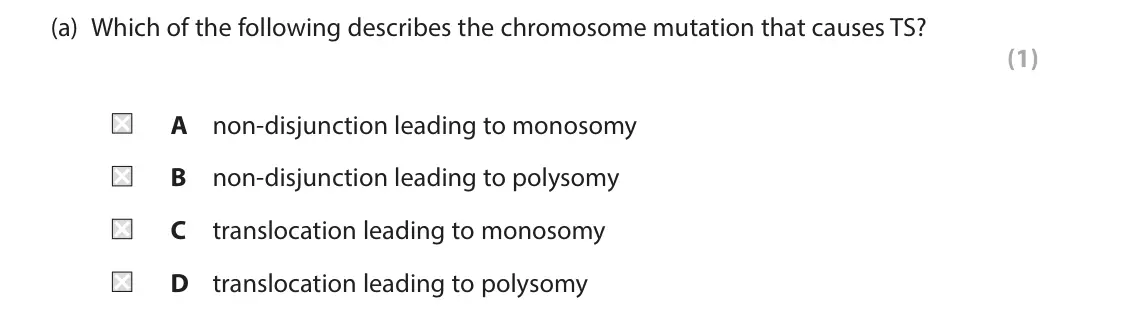
Q5(b)
The whole paper ↗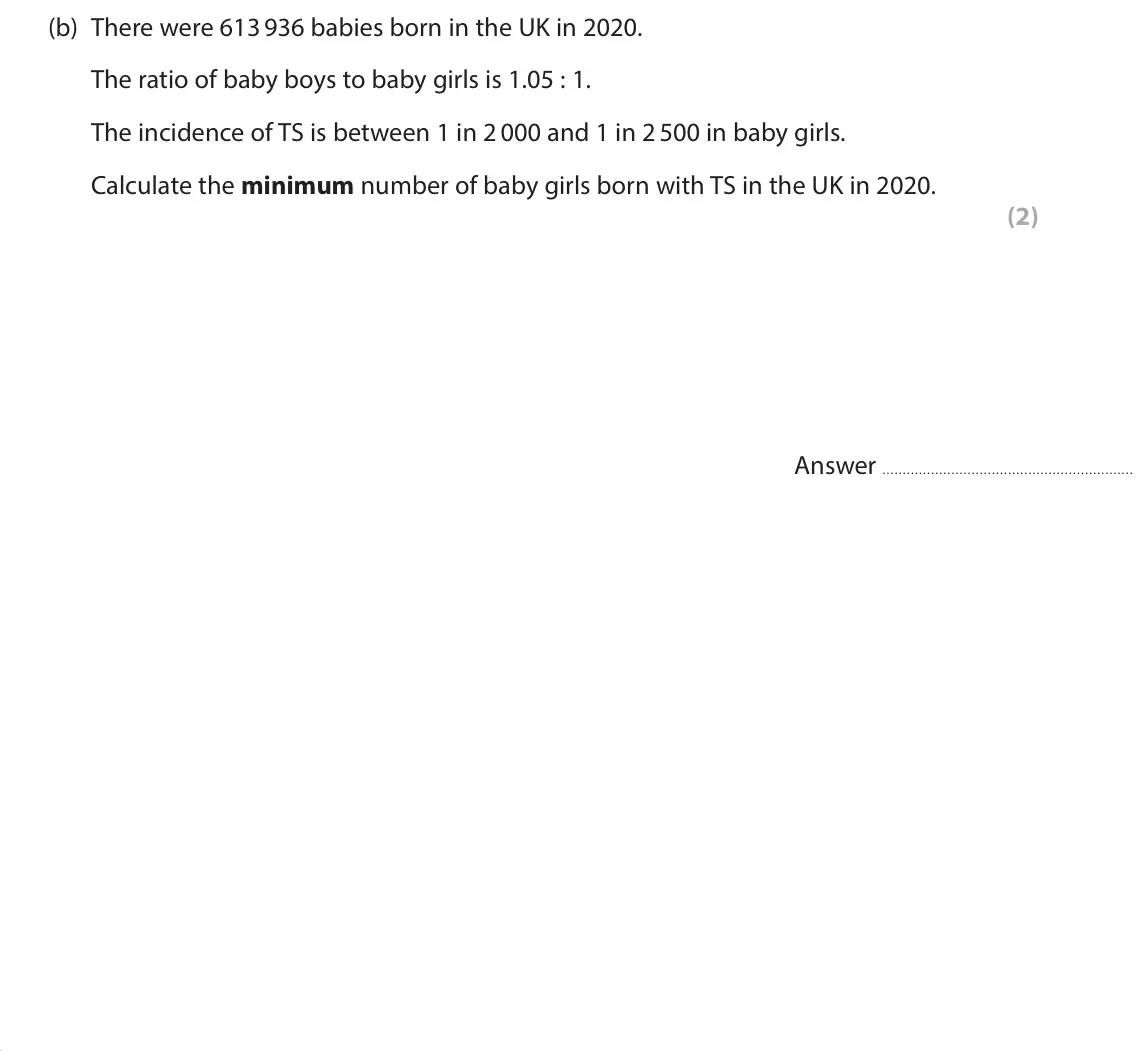
Q5(c)(ii)
The whole paper ↗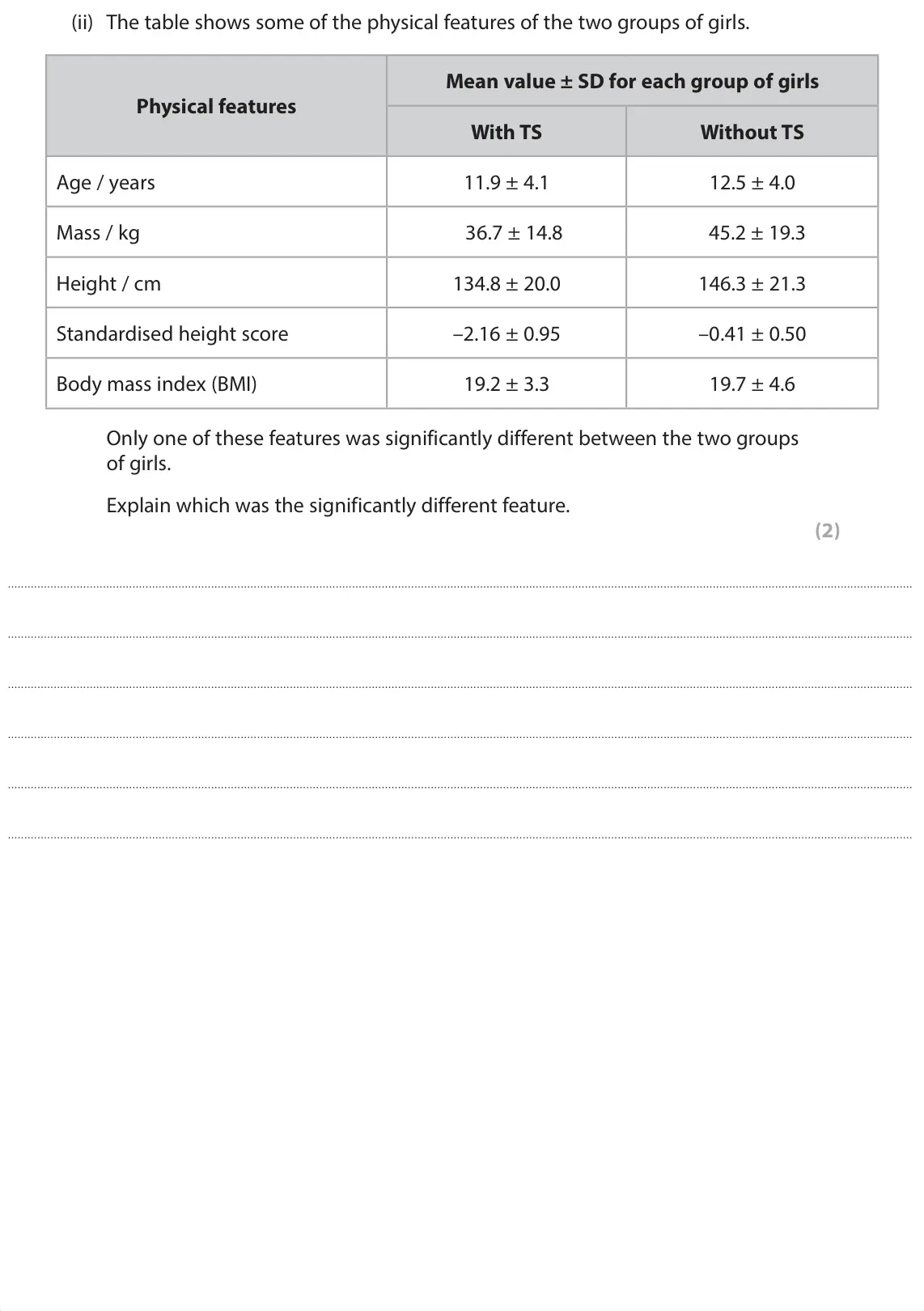
Q2(a)(ii)
The whole paper ↗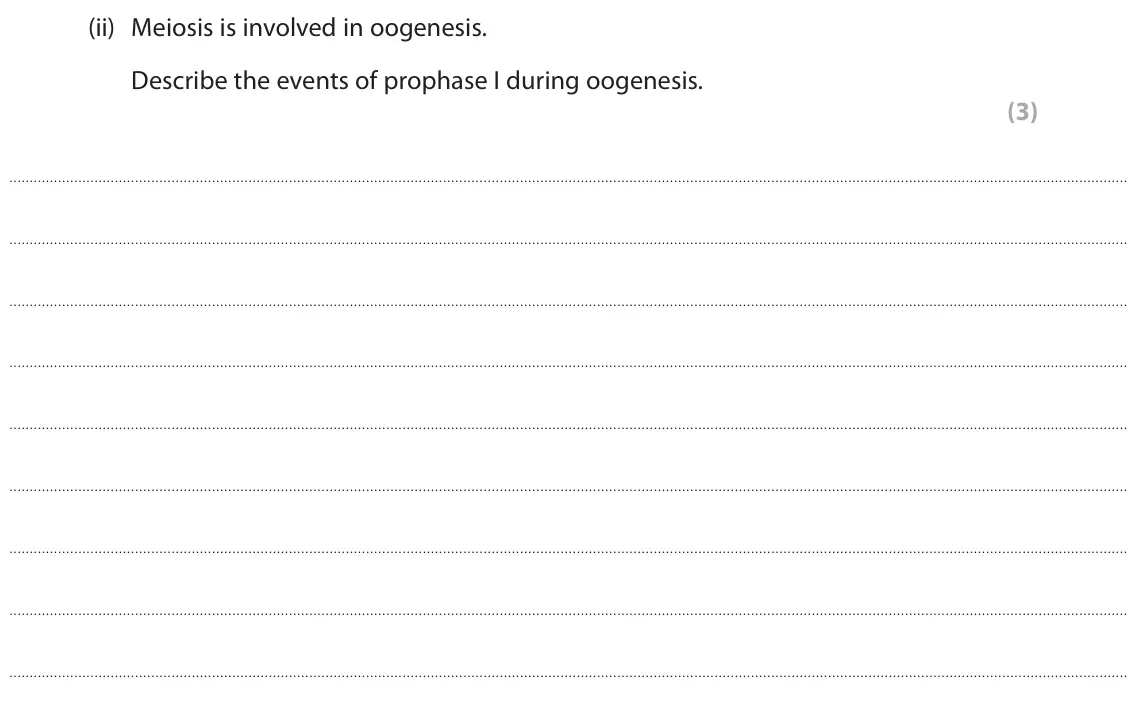
Q3(b)(i)
The whole paper ↗
Q1(a)
The whole paper ↗
Q1(b)(i)
The whole paper ↗
Q1(b)(ii)
The whole paper ↗
Q1(b)(iii)
The whole paper ↗
Q1(c)
The whole paper ↗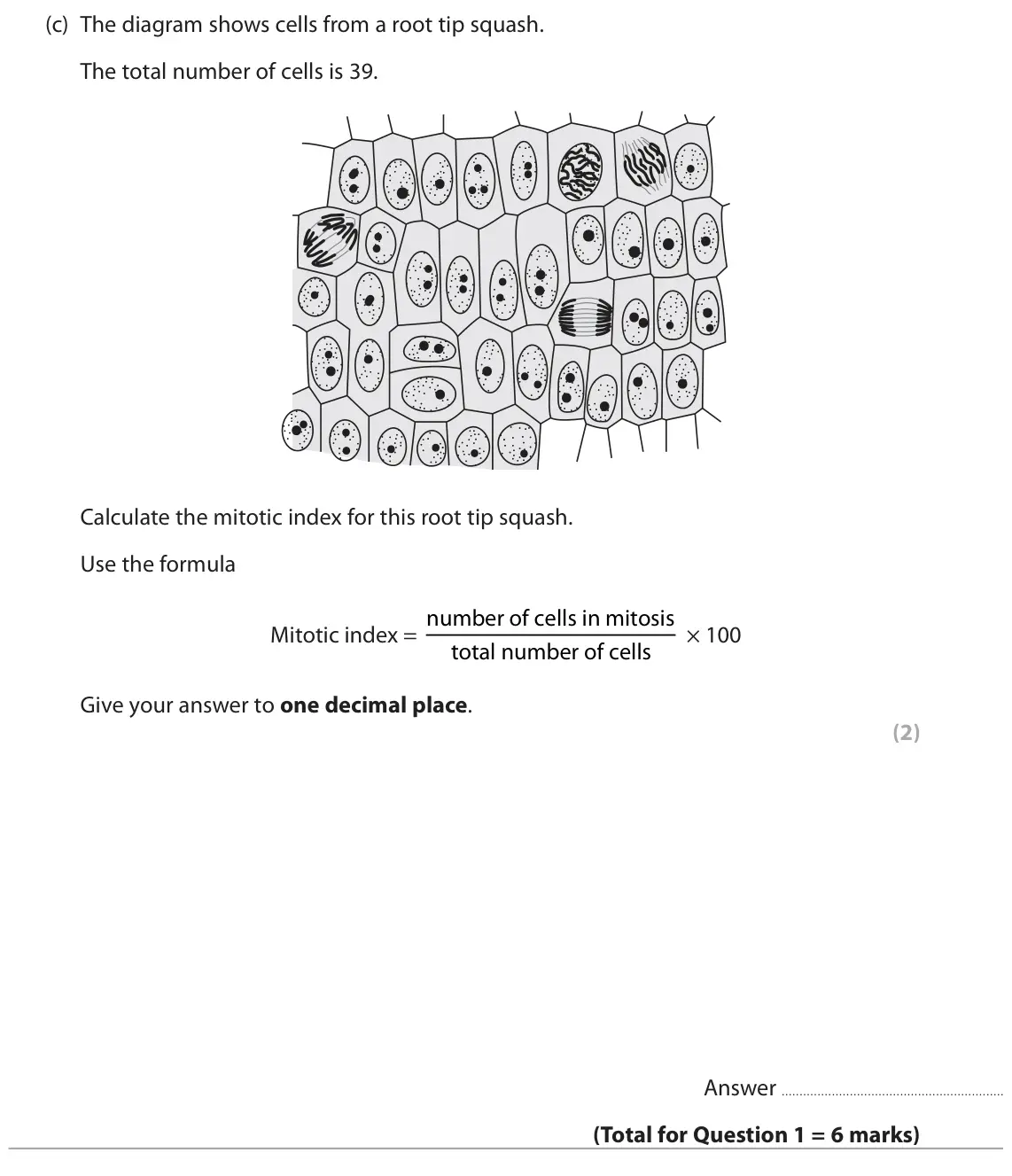
Q2(a)
The whole paper ↗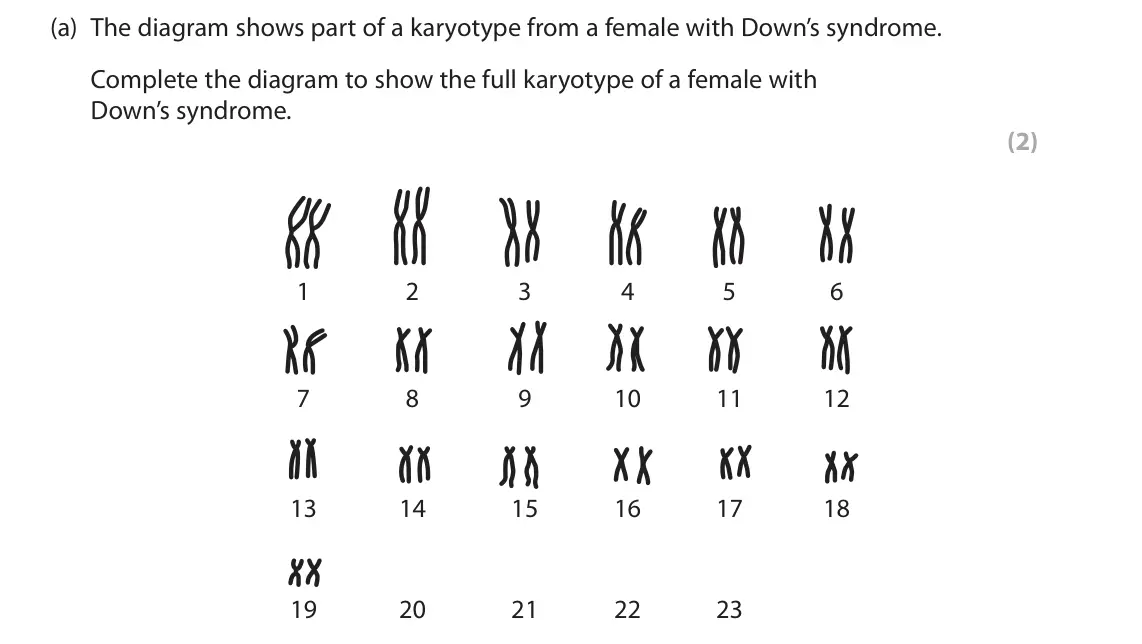
Q2(b)
The whole paper ↗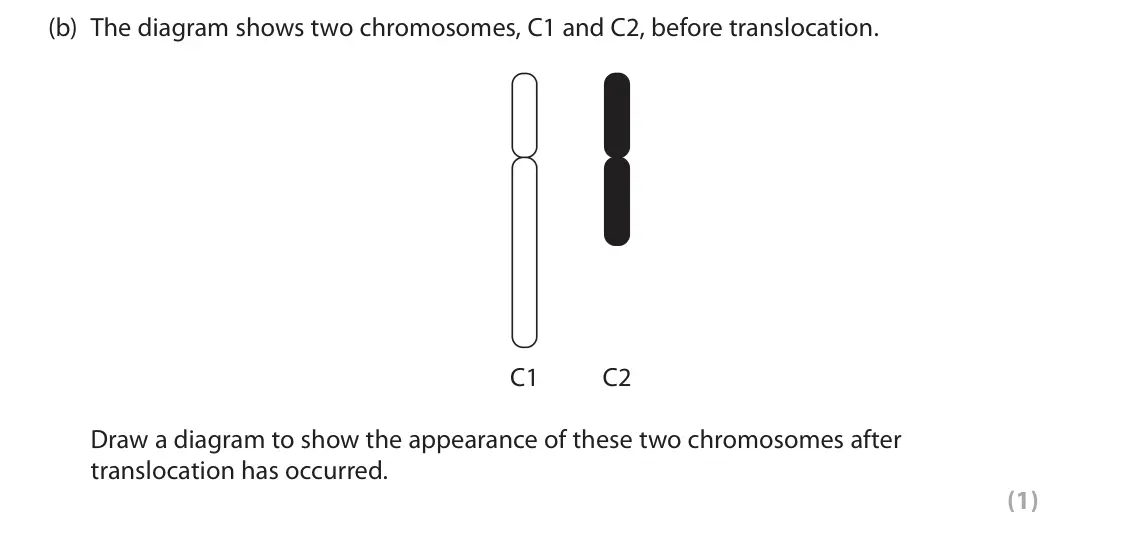
Q2(c)(i)
The whole paper ↗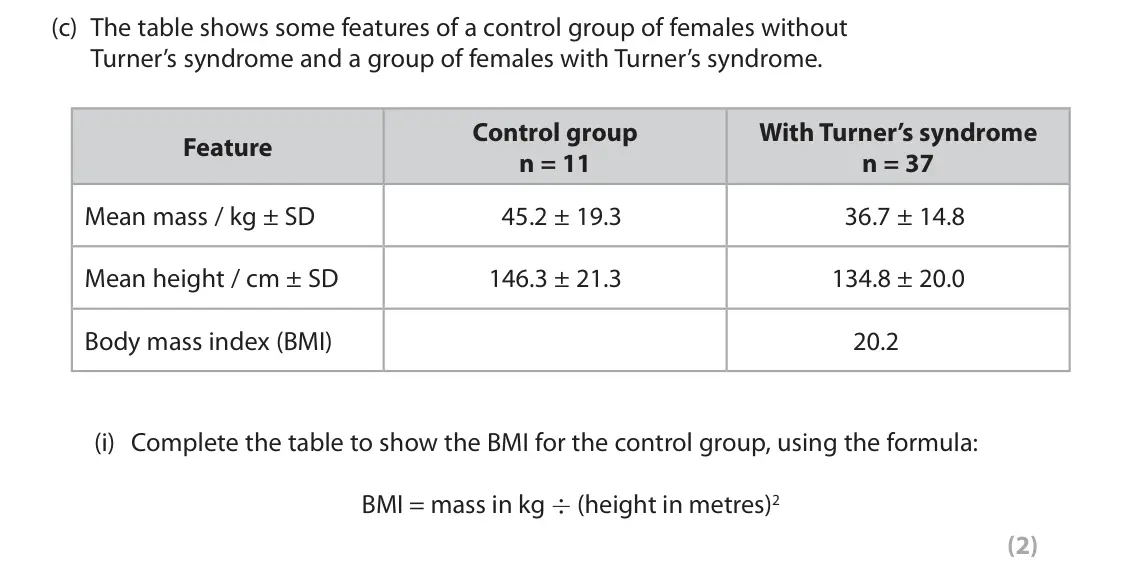
Q2(c)(ii)
The whole paper ↗
Q4(a)(i)
The whole paper ↗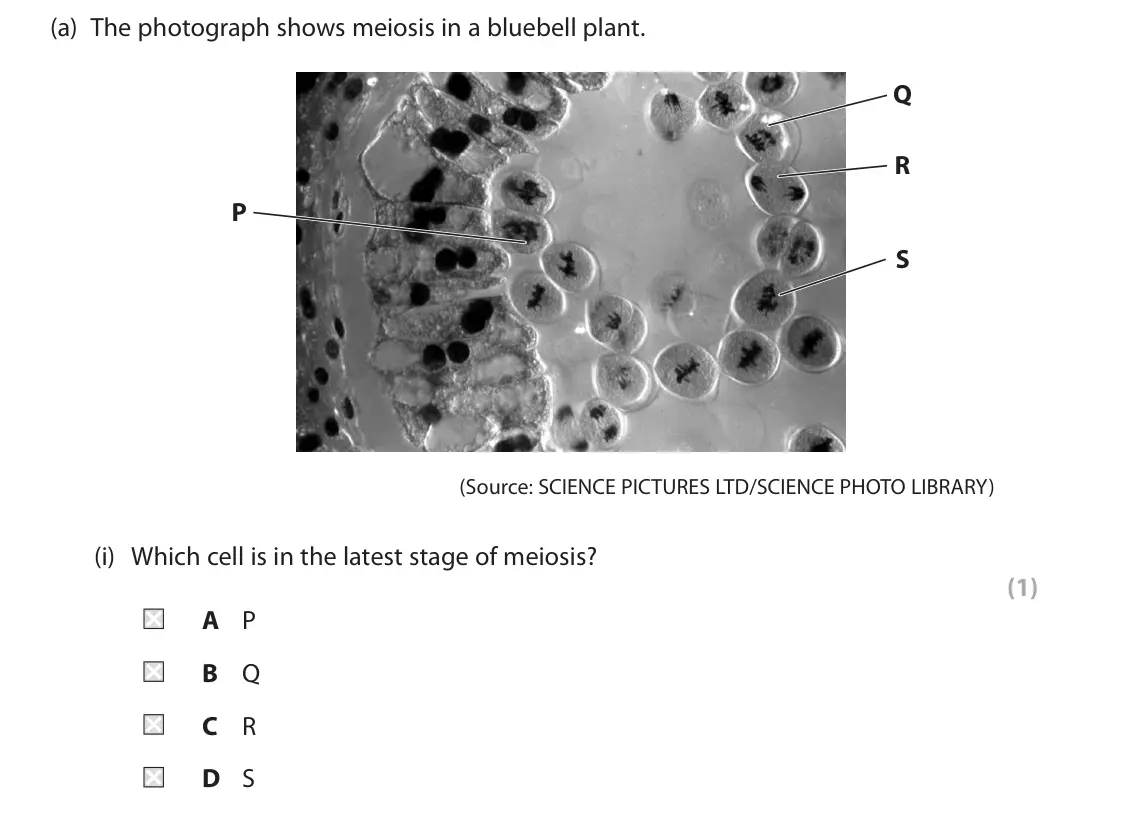
Q4(a)(ii)
The whole paper ↗
Q4(b)
The whole paper ↗
Q7(a)
The whole paper ↗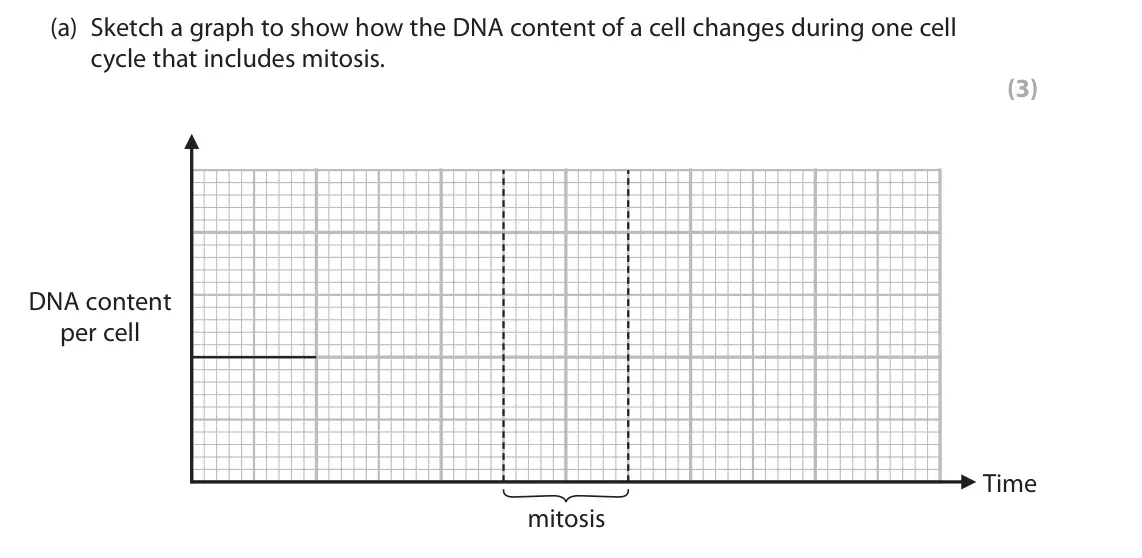
Q1(a)
The whole paper ↗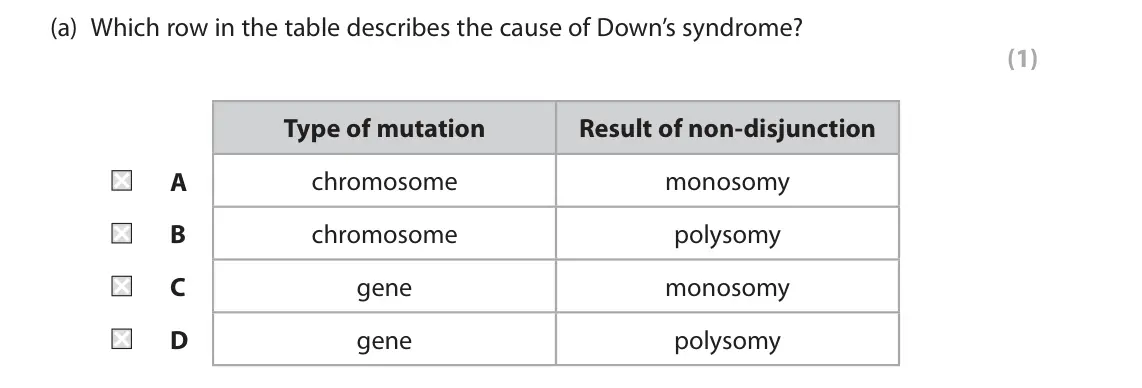
Q1(b)
The whole paper ↗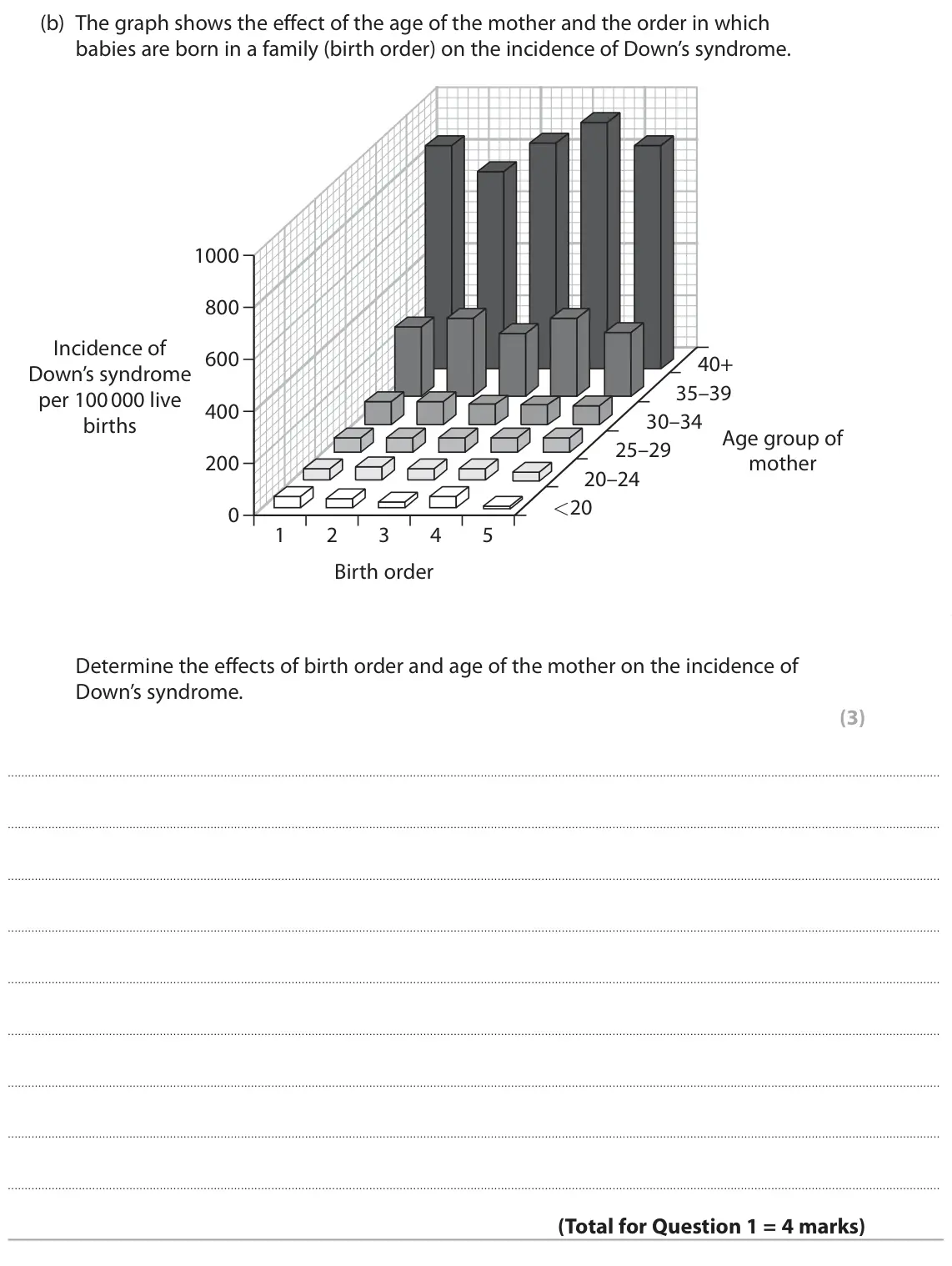
All 91 questions on Eukaryotic cell cycle and division, as a list
- June 2025, Paper 1, Q5(a) (1 mark): Which of the following describes the chromosome mutation that causes TS? (1) A non-disjunction leading to monosomy B non-disjunction leading to polysomy C trans
- June 2025, Paper 1, Q5(b) (2 marks): There were 613 936 babies born in the UK in 2020. The ratio of baby boys to baby girls is 1.05 : 1. The incidence of TS is between 1 in 2 000 and 1 in 2 500 in
- June 2025, Paper 1, Q5(c)(ii) (2 marks): The table shows some of the physical features of the two groups of girls. Mean value ± SD for each group of girls Physical features With TS Without TS Age / yea
- June 2025, Paper 2, Q2(a)(ii) (3 marks): Meiosis is involved in oogenesis. Describe the events of prophase I during oogenesis. (3)
- June 2025, AS Paper 1, Q3(b)(i) (2 marks): Explain why it is necessary for mitochondria to divide during the cell cycle. (2)
- June 2024, Paper 3, Q1(a) (1 mark): Name the region of the root tip where cells are actively dividing. (1)
- June 2024, Paper 3, Q1(b)(i) (1 mark): Treating the root tip with strong acid (1)
- June 2024, Paper 3, Q1(b)(ii) (1 mark): Adding a stain to the root tip (1)
- June 2024, Paper 3, Q1(b)(iii) (1 mark): Pressing lightly on the coverslip (1)
- June 2024, Paper 3, Q1(c) (2 marks): The diagram shows cells from a root tip squash. The total number of cells is 39. Calculate the mitotic index for this root tip squash. Use the formula Mitotic i
- June 2024, AS Paper 1, Q2(a) (2 marks): The diagram shows part of a karyotype from a female with Down’s syndrome. Complete the diagram to show the full karyotype of a female with Down’s syndrome. (2)
- June 2024, AS Paper 1, Q2(b) (1 mark): The diagram shows two chromosomes, C1 and C2, before translocation. C1 C2 Draw a diagram to show the appearance of these two chromosomes after translocation has
- June 2024, AS Paper 1, Q2(c)(i) (2 marks): Complete the table to show the BMI for the control group, using the formula: BMI = mass in kg ÷ (height in metres)2 (2)
- June 2024, AS Paper 1, Q2(c)(ii) (4 marks): Analyse the data to comment on the conclusions that could be made about the effect of Turner’s syndrome on these features. (4)
- June 2024, AS Paper 1, Q4(a)(i) (1 mark): Which cell is in the latest stage of meiosis? (1) A P B Q C R D S
- June 2024, AS Paper 1, Q4(a)(ii) (5 marks): Devise a practical procedure to determine the total percentage of cells in both metaphase I and metaphase II in a bluebell. (5)
- June 2024, AS Paper 1, Q4(b) (3 marks): Explain how meiosis results in genetic variation in a flowering plant. (3)
- June 2024, AS Paper 1, Q7(a) (3 marks): Sketch a graph to show how the DNA content of a cell changes during one cell cycle that includes mitosis.  (3) DNA content per cell Time mitosis
- June 2023, AS Paper 1, Q1(a) (1 mark): Which row in the table describes the cause of Down’s syndrome? (1) Type of mutation Result of non‑disjunction A chromosome monosomy B chromosome polysomy C gene
- June 2023, AS Paper 1, Q1(b) (3 marks): The graph shows the effect of the age of the mother and the order in which babies are born in a family (birth order) on the incidence of Down’s syndrome. 1000 8
- June 2023, AS Paper 1, Q5(a)(i) (1 mark): Which is the correct order for these steps? (1) A 2, 3, 1, 6, 5, 4 B 2, 3, 5, 1, 4, 6 C 3, 2, 1, 6, 5, 4 D 3, 2, 5, 1, 4, 6
- June 2023, AS Paper 1, Q5(a)(ii) (2 marks): Explain why the tip from a growing root is used in this preparation. (2)
- June 2023, AS Paper 1, Q5(a)(iii) (1 mark): The photographs J to N show stages of mitosis. J K L M N (Source: © STEVE GSCHMEISSNER/SCIENCE PHOTO LIBRARY) Which is the correct order of these stages? (1) A
- June 2023, AS Paper 1, Q5(b) (1 mark): The pie chart shows the proportion of time that cells spend in the cell cycle in one species of plant. mitosis G2 G1 S The cell cycle in this plant lasts 22 hou
- June 2022, Paper 1, Q2(a) (2 marks): Explain how meiosis results in genetic variation in the gametes. (2)
- June 2022, Paper 3, Q2(a)(i) (2 marks): Calculate the mitotic index for these results using the formula Mitotic index = number of actively dividing cells × 100 total number of cells (2) Answer
- June 2022, Paper 3, Q2(a)(ii) (2 marks): The mitotic index depends on the distance from the root tip. The graph shows the relationship between the mitotic index and the distance from the root tip. 14 1
- June 2022, Paper 3, Q2(b) (2 marks): The student used the following method to prepare the root tip squash. 1. Cut a small piece from the tip of a growing onion root and place it in weak acid. 2. Tr
- June 2022, AS Paper 1, Q3(a) (1 mark): When does crossing over first take place? (1) A metaphase I B metaphase II C prophase I D prophase II
- June 2022, AS Paper 1, Q3(b) (1 mark): Crossing over occurs between two genes found on the same chromosome. The recombination frequency reflects the likelihood of crossing over occurring. It depends
- June 2022, AS Paper 1, Q3(c) (3 marks): The table shows the recombinant frequencies between four genes, J, K, L and M, located on the same chromosome. Pairs of genes Recombinant frequency (%) J and K
- June 2022, AS Paper 1, Q3(d) (3 marks): Explain why crossing over between two different genes, located on a pair of homologous chromosomes, results in a maximum of 50% of gametes with the recombinant
- June 2022, AS Paper 1, Q6(b)(i) (2 marks): Draw and label the parts of a chromosome, as it would appear during metaphase of mitosis. (2)
- June 2022, AS Paper 1, Q6(b)(ii) (2 marks): Describe the events that take place during metaphase of mitosis. (2)
- June 2022, AS Paper 1, Q6(c)(i) (3 marks): Explain the results shown in the table. (3)
- June 2022, AS Paper 1, Q6(c)(ii) (3 marks): Describe how these results could have been obtained. (3)
- November 2021, Paper 2, Q2(a)(i) (1 mark): Which of the following identifies the human with this karyotype? (1) A female with Down’s syndrome B female with Turner’s syndrome C male with Down’s syndrome D
- November 2021, Paper 2, Q2(a)(ii) (1 mark): Which of the following would cause the karyotype in the diagram? (1) A non-disjunction producing a monosomy B non-disjunction producing a polysomy C translocati
- November 2021, AS Paper 1, Q6(a) (2 marks): The cell cycle time for this cell is 24 hours. Give an estimate for the length of time that this cell spends in each of the four stages of the cell cycle. (2) E
- November 2021, AS Paper 1, Q6(b) (4 marks): The percentage of cells in any one stage is proportional to the length of time of that stage. Describe an investigation that could be carried out to confirm the
- November 2021, AS Paper 1, Q6(c) (5 marks): A cell in G1 of interphase contains 68 arbitrary units of DNA. Explain how the DNA content and the structure of the chromosomes of this cell will change during
- November 2021, AS Paper 1, Q8(a)(ii) (4 marks): Explain the events that take place in stage 2, that result in genetic variation. (4)
- October 2020, Paper 2, Q1(a)(i) (1 mark): Which of the following identifies the genetic condition shown in the photograph? (1) A Down’s syndrome due to monosomy B Down’s syndrome due to polysomy C Turne
- October 2020, Paper 2, Q1(a)(ii) (1 mark): Which process would have caused the genetic condition shown by this karyotype? (1) A base insertion B base substitution C non-disjunction D translocation
- October 2020, Paper 2, Q1(b)(i) (1 mark): Which of the following correctly identifies the stages shown in the photograph? (1) W X Y Z A anaphase telophase prophase metaphase B anaphase prophase telophas
- October 2020, Paper 2, Q1(b)(ii) (4 marks): Colchicine is a chemical that inhibits mitosis. A student investigated the effect of colchicine on mitosis. Two sets of genetically identical cells were grown i
- October 2020, AS Paper 1, Q3(a)(i) (2 marks): Complete the empty boxes in the diagram to show the number of chromosomes present in a single cell at that stage of reproduction. (2)
- October 2020, AS Paper 1, Q3(a)(ii) (1 mark): Label the arrows on the diagram with the letter M to show where meiosis takes place. . (1)
- October 2020, AS Paper 1, Q3(b) (3 marks): Explain why a juvenile aphid is genetically identical to its parent. (3)
- October 2020, AS Paper 1, Q3(c)(i) (3 marks): Complete the table with a or × to compare the events during mitosis and meiosis. The first row in the table has been completed for you. (3) Event Mitosis Meio
- October 2020, AS Paper 1, Q3(c)(ii) (1 mark): Which of the following increases the number of different alleles in a population? (1) A crossing over B gene mutation C independent assortment of chromosomes du
- June 2019, Paper 1, Q9(a) (5 marks): Cancer is caused when cells divide uncontrollably. This drug works in two ways: • it becomes inserted into the DNA and holds the two strands together. • it bind
- June 2019, AS Paper 1, Q2(a)(i) (1 mark): In which stage does DNA replication take place? (1) A stage I B stage II C stage III D stage IV
- June 2019, AS Paper 1, Q2(b) (3 marks): Describe what is happening during stage IV in the cell cycle. (3)
- June 2019, AS Paper 1, Q4(a)(i) (2 marks): Explain which type of cell division produces gametes in female bees. (2)
- June 2019, AS Paper 1, Q4(a)(ii) (2 marks): Explain which type of cell division produces gametes in male bees. (2)
- June 2019, AS Paper 1, Q4(a)(iii) (1 mark): Which row identifies the features that contribute to genetic variation in the offspring of bees? (1) Independent Random fusion of assortment of Crossing over ga
- June 2019, AS Paper 1, Q4(b)(i) (1 mark): Which of the parts, W, X, Y or Z, should be used to prepare a slide showing mitosis? (1) A W B X C Y D Z
- June 2019, AS Paper 1, Q4(b)(ii) (1 mark): Name a stain that can be used to show the stages of mitosis. (1)
- June 2019, AS Paper 1, Q4(b)(iii) (2 marks): Explain how to make a temporary preparation to show the stages of mitosis, after adding the stain to the slide. (2)
- June 2018, Paper 1, Q5(b)(ii) (3 marks): Explain the importance of DNA replication during the development of this zygote into a blastocyst. (3)
- June 2018, Paper 2, Q6(a)(i) (1 mark): Which row of the table shows the stages of meiosis of cells P and Q? (1) P Q A anaphase II anaphase I B metaphase I prophase I C prophase I anaphase II D propha
- June 2018, Paper 2, Q6(a)(ii) (1 mark): Non-disjunction occurred during meiosis I. Which of the following shows the number of chromosomes in each of the four sperm cells produced? (1) A 4, 3, 3, 2 B 4
- June 2018, Paper 2, Q6(b) (2 marks): Down’s syndrome in humans is caused by non-disjunction. The chance of having a baby with Down’s syndrome increases as the age of the mother increases. At age 40
- June 2018, Paper 2, Q6(c) (4 marks): In vitro fertilisation (IVF) is a technique in which eggs are taken from the ovaries and fertilised with sperm in a laboratory. The resulting embryos are cultur
- June 2018, Paper 3, Q5(a) (2 marks): Calculate the percentage of cells in this photomicrograph in anaphase. (2) Answer
- June 2018, Paper 3, Q5(b) (4 marks): Describe how to prepare a microscope slide of root tissue to show stages of mitosis. (4)
- June 2018, Paper 3, Q5(c) (4 marks): Devise a method the student should use to investigate the effect of waterlogged soil on mitosis in root cells. (4)
- June 2018, AS Paper 1, Q1(a)(i) (1 mark): Identify the correct sequence in the diagram that shows the first division of meiosis. (1) A 1, 2, 3, 4, 5 B 2, 5, 4, 1, 3 C 3, 2, 4, 1, 5 D 5, 4, 1, 2, 3
- June 2018, AS Paper 1, Q1(a)(ii) (2 marks): Identify the parts labelled P and Q. (2) P Q
- June 2018, AS Paper 1, Q4(a)(i) (1 mark): Name the type of nuclear division that produces the plantlets. (1)
- June 2018, AS Paper 1, Q4(a)(ii) (2 marks): State two advantages of this type of reproduction. (2)
- June 2018, AS Paper 1, Q4(b)(i) (1 mark): Which row of the table correctly describes the zygote of organism A and the gametes of organism B? (1) Zygote of organism A Gametes of organism B diploid diploi
- June 2018, AS Paper 1, Q4(b)(ii) (1 mark): Which row in the table shows where meiosis occurs in each life cycle? (1) Life cycle A Life cycle B A P T B Q U C R S D R T
- June 2018, AS Paper 1, Q4(b)(iii) (3 marks): Explain the significance of meiosis in living organisms. (3)
- June 2017, AS Paper 1, Q2(a) (2 marks): Translocation is one type of chromosome mutation. Describe how translocation occurs. (2)
- June 2017, AS Paper 1, Q2(b) (1 mark): Name the type of chromosome mutation that results in Down’s syndrome. (1)
- June 2017, AS Paper 1, Q2(c) (2 marks): Genetic disorders can be diagnosed by looking at an individual’s karyotype. A karyotype shows the number of each type of chromosome present in a cell. The diagr
- June 2017, AS Paper 1, Q3(a) (1 mark): The student used the following statements to identify cells in metaphase. ● Pairs of homologous chromosomes lined up along the equator of each cell. ● Crossing
- June 2017, AS Paper 1, Q3(b)(i) (2 marks): Explain why the student had to make sure that an appropriate stain was used. (2)
- June 2017, AS Paper 1, Q3(b)(ii) (4 marks): Describe the changes that need to be made to this method to allow stages of mitosis to be seen. (4)
- June 2016, AS Paper 1, Q6(a) (2 marks): Explain why cells carry out mitosis. (2)
- June 2016, AS Paper 1, Q6(b) (4 marks): Explain what happens to the DNA content and the number of chromosomes in the stage labelled K. (4)
- June 2016, AS Paper 1, Q6(c) (1 mark): Name the stage of the cell cycle labelled L. (1)
- June 2016, AS Paper 1, Q6(d)(i) (2 marks): The cells in this root tip had a cell cycle time of 23 hours. Calculate the time, in minutes, that these cells spent in anaphase. (2) Answer mins
- June 2016, AS Paper 1, Q6(d)(ii) (2 marks): The student then used the same method to study mitosis in a root tip from another plant of the same species. The student worked out that the cells spent 8% less
- June 2016, AS Paper 1, Q6(d)(iii) (2 marks): Explain why these two calculated values are not identical. (2)
- June 2016, AS Paper 1, Q8(a) (1 mark): State what is meant by the term allele. (1)
- June 2016, AS Paper 1, Q8(b)(i) (1 mark): Which row of the table correctly shows when independent assortment and crossing over take place during meiosis? (1) Independent Crossing over assortment A metap
- June 2016, AS Paper 1, Q8(b)(ii) (3 marks): Describe the process of crossing over that occurs during meiosis. (3)
- June 2016, AS Paper 1, Q8(c) (4 marks): The table shows some data on the genome size, haploid number of chromosomes and the recombination rate of several species of animals. Genome size Haploid number
Questions, mark schemes and examiner’s reports are © Pearson Edexcel, from their published past papers. Plumi isn’t affiliated with any exam board. Want whole papers? Every Edexcel A-Level Biology B paper.
Rather write your answers by hand on iPad? Plumi marks them against the same mark schemes.