 plumi
Eukaryotic and prokaryotic cell structure and function: Edexcel A‑Level Biology B questions
Every Edexcel A-Level Biology B exam question on 2.1 Eukaryotic and prokaryotic cell structure and function, 2016–2025, with its mark scheme and examiner’s report.
Find questions1,826
Calculations
Q1(a)
The whole paper ↗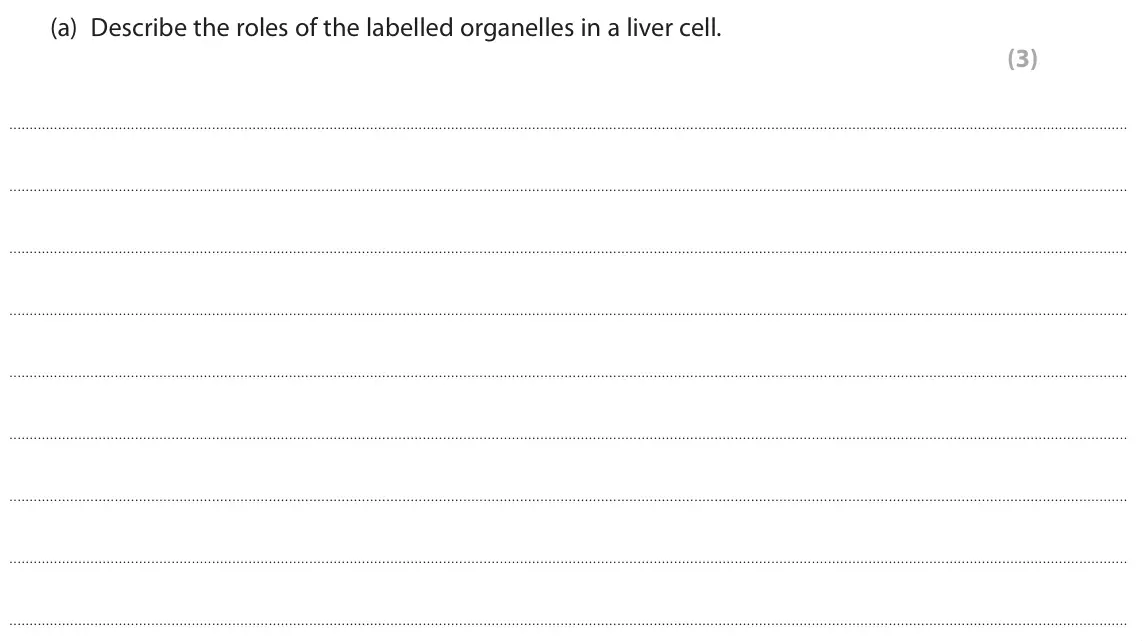
Q1(a)
The whole paper ↗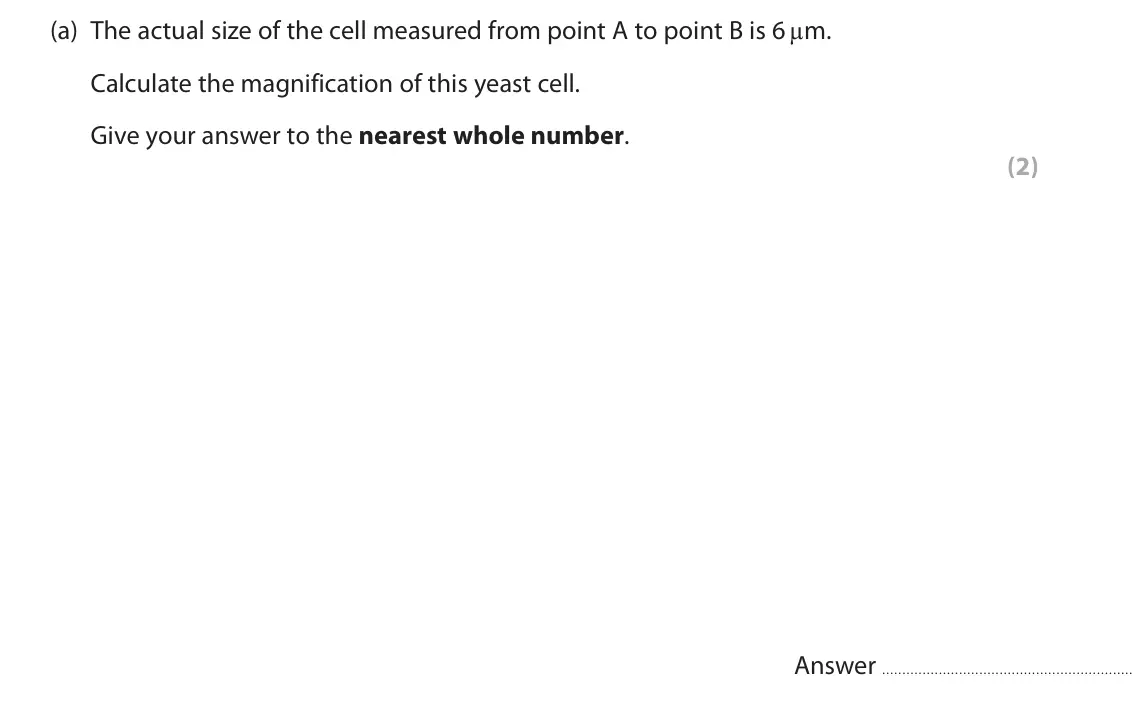
Q1(b)
The whole paper ↗
Q1(c)(i)
The whole paper ↗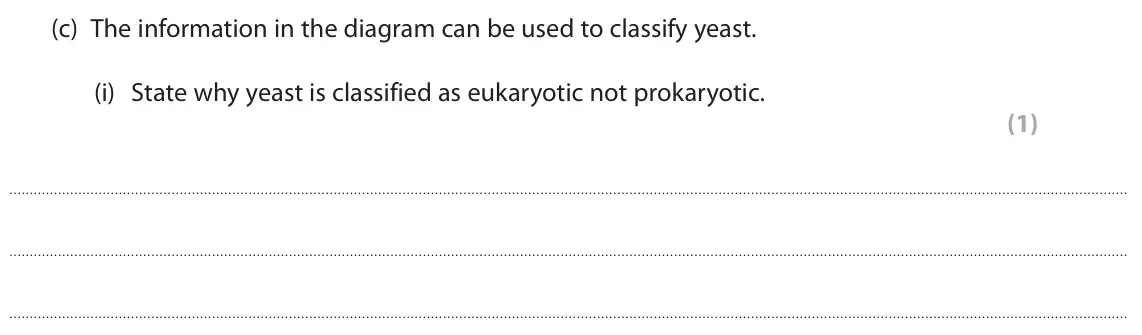
Q5(a)
The whole paper ↗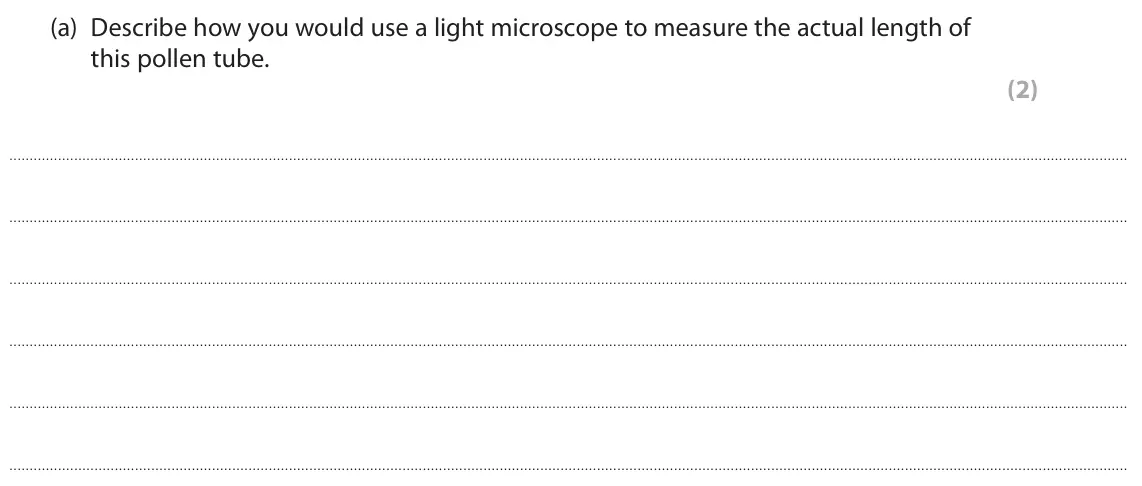
Q3(a)(ii)
The whole paper ↗
Q3(a)(iii)
The whole paper ↗
Q3(a)(iv)
The whole paper ↗
Q3(b)(ii)
The whole paper ↗
Q4(a)
The whole paper ↗
Q2(a)(i)
The whole paper ↗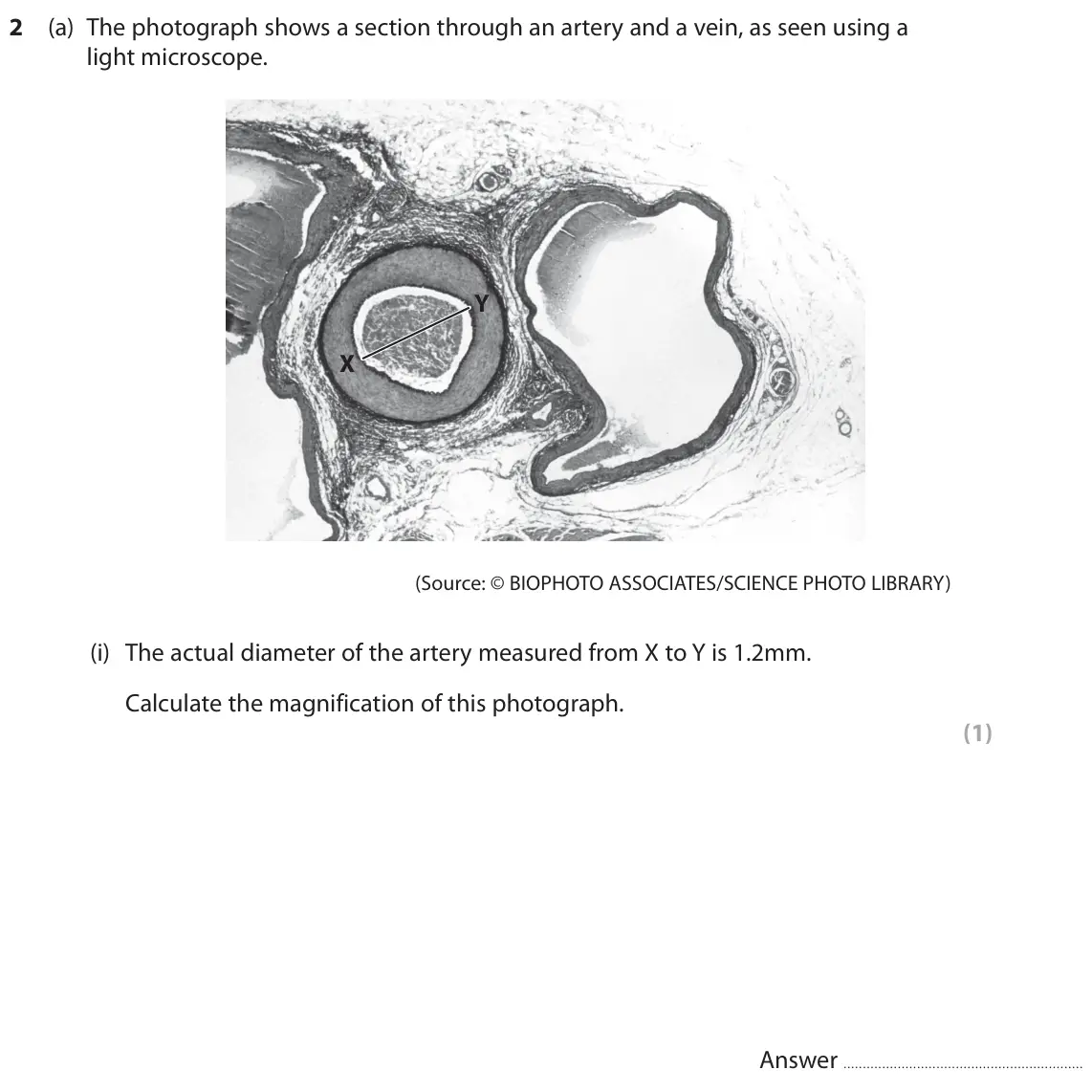
Q5(b)(i)
The whole paper ↗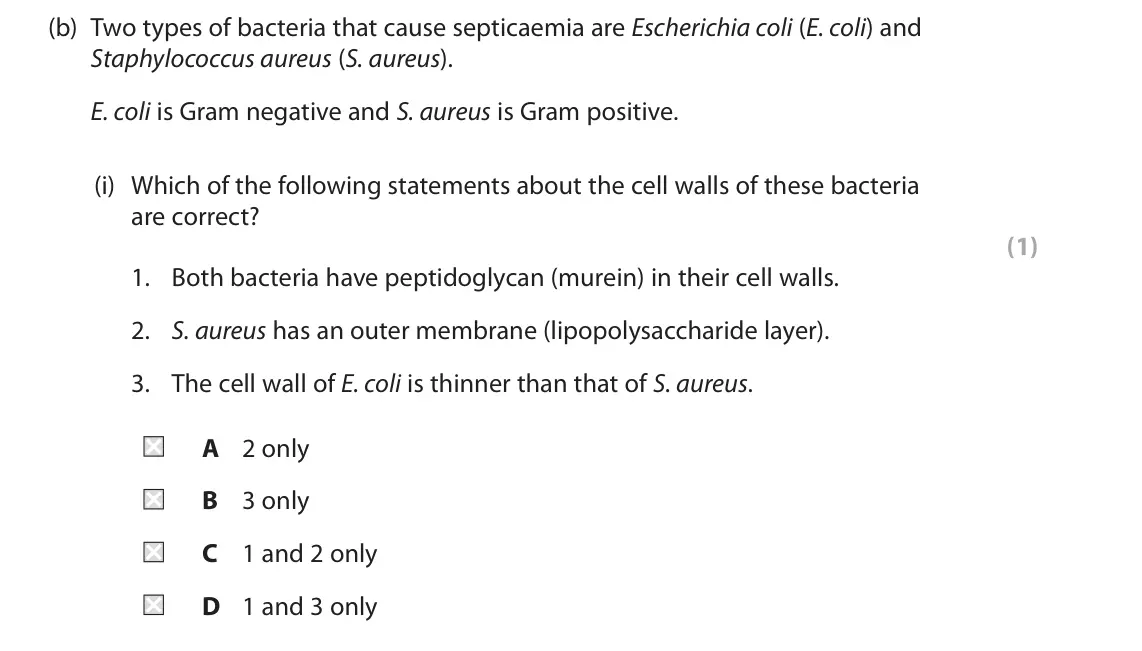
Q6(a)
The whole paper ↗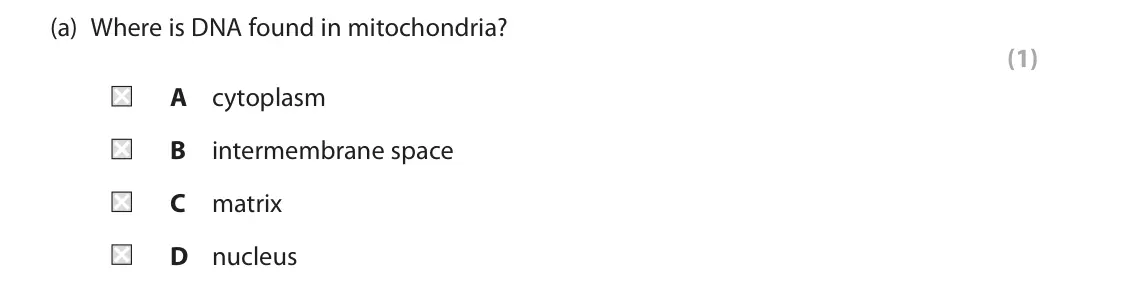
Q7(b)(i)
The whole paper ↗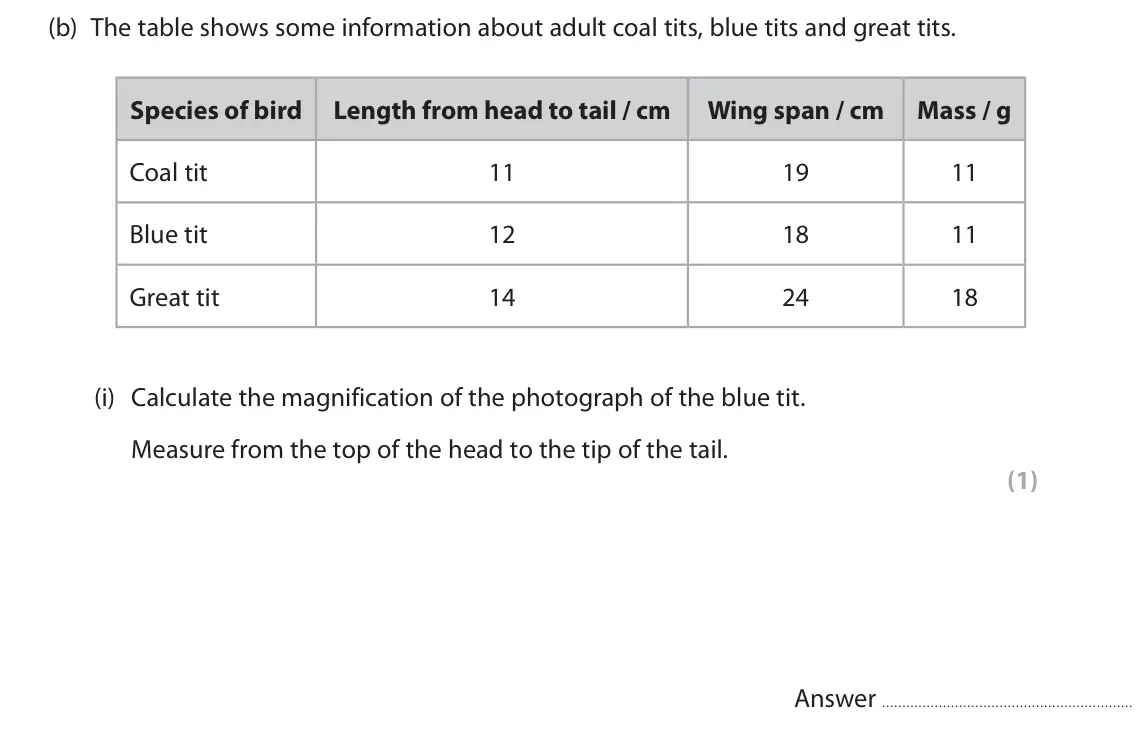
Q1(a)(i)
The whole paper ↗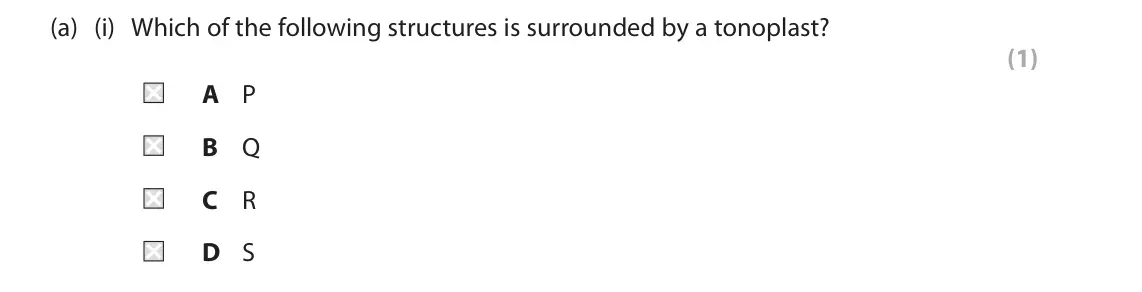
Q1(a)(ii)
The whole paper ↗
Q1(a)(iii)
The whole paper ↗
Q1(b)
The whole paper ↗
Q3(a)(i)
The whole paper ↗
Q3(a)(i)
The whole paper ↗
All 125 questions on Eukaryotic and prokaryotic cell structure and function, as a list
- June 2025, Paper 2, Q1(a) (3 marks): Describe the roles of the labelled organelles in a liver cell. (3)
- June 2025, Paper 3, Q1(a) (2 marks): The actual size of the cell measured from point A to point B is 6 µm. Calculate the magnification of this yeast cell. Give your answer to the nearest whole numb
- June 2025, Paper 3, Q1(b) (2 marks): Draw this yeast cell as it would be seen using a light microscope at high magnification. Labels are not required. (2)
- June 2025, Paper 3, Q1(c)(i) (1 mark): State why yeast is classified as eukaryotic not prokaryotic. (1)
- June 2025, Paper 3, Q5(a) (2 marks): Describe how you would use a light microscope to measure the actual length of this pollen tube. (2)
- June 2025, AS Paper 1, Q3(a)(ii) (1 mark): The gap between these two membranes is called the intermembrane space. The intermembrane space is 200 angstroms wide. One angstrom = 0.1nm Which of the followin
- June 2025, AS Paper 1, Q3(a)(iii) (2 marks): Explain why the intermembrane space can be seen in this photograph. (2)
- June 2025, AS Paper 1, Q3(a)(iv) (1 mark): Name one other organelle with a double membrane. (1)
- June 2025, AS Paper 1, Q3(b)(ii) (3 marks): Describe how mitochondria divide. Use the information in the photograph and your own knowledge to support your answer. (3)
- June 2025, AS Paper 1, Q4(a) (3 marks): Draw the cells in the box on the photograph, at a magnification × 2 of the photograph. (3)
- June 2025, AS Paper 2, Q2(a)(i) (1 mark): The actual diameter of the artery measured from X to Y is 1.2mm. Calculate the magnification of this photograph. (1) Answer
- June 2024, Paper 1, Q5(b)(i) (1 mark): Which of the following statements about the cell walls of these bacteria are correct? (1) 1. Both bacteria have peptidoglycan (murein) in their cell walls. 2. S
- June 2024, Paper 1, Q6(a) (1 mark): Where is DNA found in mitochondria? (1) A cytoplasm B intermembrane space C matrix D nucleus
- June 2024, Paper 1, Q7(b)(i) (1 mark): Calculate the magnification of the photograph of the blue tit. Measure from the top of the head to the tip of the tail. (1) Answer
- June 2024, Paper 2, Q1(a)(i) (1 mark): Which of the following structures is surrounded by a tonoplast? (1) A P B Q C R D S
- June 2024, Paper 2, Q1(a)(ii) (1 mark): In which of the following structures does the process of translation occur? (1) A P B Q C R D S
- June 2024, Paper 2, Q1(a)(iii) (1 mark): How many of the labelled structures in this cell will be present in a cell of an organism in the domain Archaea? (1) A 0 B 1 C 2 D 3
- June 2024, Paper 2, Q1(b) (2 marks): The width of structure P, measured between X and Y, is 36 μm. Calculate the magnification of this photograph. Give your answer in standard form. (2) Answer
- June 2024, Paper 3, Q3(a)(i) (2 marks): Draw a typical cell from a root, as seen using a light microscope. Label three named membranes. (2)
- June 2024, AS Paper 1, Q3(a)(i) (1 mark): Which pair of structures is found in these bacteria? (1) A nucleoid and 70S ribosomes B nucleoid and 80S ribosomes C nucleus and 70S ribosomes D nucleus and 80S
- June 2024, AS Paper 1, Q3(a)(ii) (2 marks): Name three other structures that are surrounded by the cell wall of bacteria. (2) 1 2 3
- June 2024, AS Paper 1, Q3(b)(i) (1 mark): Calculate the ratio of the thickness of the cell wall of B. subtilis to that of P. aeruginosa. Give your values to two significant figures. (1) Answer
- June 2024, AS Paper 1, Q3(b)(ii) (2 marks): Some antibiotics affect only Gram positive bacteria. Explain which of B. subtilis or P. aeruginosa will be affected by these types of antibiotics. (2)
- June 2024, AS Paper 1, Q3(c) (2 marks): Bacillus subtilis was grown in a culture. At the start the culture contained 6 × 10³ cells and after two hours the culture contained 1.7 × 10⁵ cells. Calculate
- June 2024, AS Paper 1, Q5(a) (2 marks): Name the parts labelled A, B and C. (2) A . B C
- June 2024, AS Paper 1, Q5(b) (2 marks): Draw a diagram of this mitochondrion. (2)
- June 2024, AS Paper 1, Q5(c)(i) (1 mark): What is the magnification of this photograph? (1) A × 1200 B × 8200 C × 12 000 D × 82 000
- June 2024, AS Paper 1, Q5(c)(ii) (1 mark): The magnification of this photograph can be shown as a scale bar. Complete the 1 cm scale bar for this photograph. (1) 1 cm scale bar Answer µm
- June 2024, AS Paper 1, Q5(d) (2 marks): Explain why specimens have to be stained with coloured dyes when viewed using a light microscope and not when using an electron microscope. (2)
- June 2024, AS Paper 1, Q9(b)(iii) (2 marks): The scientists who produced the data did not expect the phospholipid content in the membranes of the endoplasmic reticulum and the Golgi apparatus to be differe
- June 2024, AS Paper 2, Q2(a)(ii) (2 marks): The actual diameter of the stem section A to B is 12 mm. Calculate the magnification of the photograph. (2) Answer
- June 2023, Paper 1, Q2(b)(ii) (2 marks): Some types of Archaea have only one type of AK enzyme. This enzyme can catalyse both the reactions shown in the table. The tertiary structure of this enzyme is
- June 2023, Paper 1, Q3(a) (1 mark): Give the meaning of the term tissue. (1)
- June 2023, Paper 1, Q6(a)(ii) (2 marks): Chloroplasts can be 3 µm in length. Calculate the magnification of this diagram for a chloroplast that is 3 µm in length. Give your answer to two significant fi
- June 2023, Paper 2, Q3(a)(ii) (2 marks): In the photograph, cell X has a width of 0.8 cm. The magnification of the photograph is ×1500. Calculate the actual width, in micrometres (μm), of cell X. Give
- June 2023, Paper 3, Q5(a)(i) (2 marks): Give two differences between the structures of a prokaryotic cell and a eukaryotic cell. (2)
- June 2023, Paper 3, Q5(a)(ii) (3 marks): Gram staining is often used to help identify bacteria. A sample of bacteria from an infected person was tested by using Gram staining. The bacteria stained red.
- June 2023, AS Paper 1, Q2(b) (3 marks): Describe how the enzymes are synthesised and packaged during the development of the acrosome. (3)
- June 2023, AS Paper 1, Q6(a)(i) (1 mark): The size of a typical eukaryotic cell is in the range 10 µm to 100 µm. The size of a typical prokaryotic cell is in the range 100 nm to 5000 nm. Calculate how m
- June 2023, AS Paper 1, Q6(a)(ii) (2 marks): Eukaryotic cells and prokaryotic cells both respire aerobically. Only eukaryotic cells have mitochondria. A number of enzyme reactions involved in aerobic respi
- June 2023, AS Paper 1, Q6(b)(i) (2 marks): A student prepared a 1.25 g cm–3 sucrose solution by diluting a sucrose solution with a concentration of 5 g cm–3. Calculate the ratio of sucrose solution to wa
- June 2023, AS Paper 1, Q6(b)(ii) (2 marks): The diagram shows the student measuring 2.00 cm3 of the organelle suspension using a pipette. Analyse the diagram to explain why this method will produce an ina
- June 2023, AS Paper 1, Q6(b)(iii) (1 mark): The student actually measured 2.01 cm3 of the suspension using the method shown in this diagram. Calculate the percentage error of this measurement. (1) Answer
- June 2023, AS Paper 1, Q6(b)(iv) (1 mark): The diagram shows the positions of three organelles in a sucrose density gradient after centrifuging. position 1 increasing position 2 sucrose layers of sucrose
- June 2023, AS Paper 1, Q6(c) (6 marks): Cells can be grown in media containing radioactively-labelled amino acids. In an investigation, scientists grew cells in the media and removed a sample of cells
- June 2023, AS Paper 1, Q7(b)(i) (3 marks): Describe how a light microscope can be used to determine the area of one fat cell. Assume that a fat cell is circular in shape. (3)
- June 2022, Paper 1, Q1(a)(ii) (1 mark): Give one difference between the structure of Gram negative bacteria and Gram positive bacteria. (1)
- June 2022, Paper 1, Q4(b) (2 marks): The image shows phage viruses attacking a bacterium. phage bacterium (Source: © nobeastsofierce Science/Alamy Stock Photo) The length of this bacterium is 1.7 µ
- June 2022, Paper 2, Q3(a)(i) (1 mark): Which of the following is the name of the structure labelled Q? (1) A centriole B nucleus C rough endoplasmic reticulum D smooth endoplasmic reticulum
- June 2022, Paper 2, Q3(a)(ii) (1 mark): These cells were cultured in radioactively-labelled amino acids. In which sequence would the cell structures in the diagram become radioactive during protein sy
- June 2022, Paper 2, Q3(a)(iii) (2 marks): Explain one function of lysosomes. (2)
- June 2022, Paper 3, Q5(a) (2 marks): The photograph shows a germinating pollen grain as seen through a light microscope. (Source: © CAROLINA BIOLOGICAL SUPPLY COMPANY/SCIENCE PHOTO LIBRARY) The act
- June 2022, AS Paper 1, Q1(a) (2 marks): Calculate the magnification of the drawing of cell A, using the mean diameter of this cell. Measure the diameter of cell A between the points X and Y on the dia
- June 2022, AS Paper 1, Q1(b) (3 marks): This method of calculating the magnification of these drawings is not accurate. Describe a method that the student could use to calculate the magnification accu
- June 2022, AS Paper 1, Q4(b)(i) (1 mark): State why the intermembrane space can be seen in this photograph, when it is not always visible in photographs of mitochondria using other electron microscopes.
- June 2022, AS Paper 1, Q4(b)(ii) (2 marks): The width of each membrane in this photograph is 6 nm. Calculate the actual width of the intermembrane space in the region labelled on this photograph. (2) Answ
- June 2022, AS Paper 1, Q4(c) (3 marks): The table shows the percentage of some types of membrane in one cell from a liver and one cell from a pancreas. Percentage of total membranes (%) Type of membra
- June 2022, AS Paper 1, Q6(a) (2 marks): Describe the differences between a tissue and an organ. (2)
- June 2022, AS Paper 2, Q1(a) (2 marks): The actual diameter of this cell is 7.20 µm. Calculate the magnification of this diagram. (2) Answer
- November 2021, Paper 1, Q5(a)(i) (2 marks): Describe the structure of a ribosome. (2)
- November 2021, Paper 3, Q1(a)(i) (2 marks): Draw the cell labelled X. (2)
- November 2021, Paper 3, Q1(b) (1 mark): State why stains, such as methylene blue, are sometimes used when preparing a microscope slide. (1)
- November 2021, Paper 3, Q8(b)(i) (2 marks): Give two differences between Gram negative and Gram positive bacteria. (2)
- November 2021, Paper 3, Q8(b)(ii) (2 marks): The cell of the predatory BvB is 1µm in length and can swim 100 times its length per second. Calculate the swimming speed of this bacterial cell in mm s–1. (2)
- November 2021, AS Paper 1, Q1(a) (1 mark): Which of the following is a lysosome? (1) A P B Q C R D S
- November 2021, AS Paper 1, Q1(b) (1 mark): How many of the organelles in the table contain DNA? (1) A 1 B 2 C 3 D 4
- November 2021, AS Paper 1, Q1(c) (2 marks): The table gives information about organelles found in prokaryotic cells and animal cells. For each organelle, put one cross in the appropriate box in each row t
- November 2021, AS Paper 1, Q1(d) (1 mark): Which of the following shows the organelles in order of size from largest to smallest? (1) A P S Q B Q P S C Q S P D S P Q
- November 2021, AS Paper 2, Q2(a)(ii) (2 marks): The length of the root hair cell in the diagram is 60 mm. The magnification of the diagram is ×100. Calculate the actual length of the root hair cell in microme
- October 2020, Paper 2, Q9(a)(i) (1 mark): How many of the labelled organelles have a double membrane? (1) A 0 B 1 C 2 D 3
- October 2020, Paper 3, Q3(a) (1 mark): Determine the number of eyepiece units that equal the diameter of the water flea heart. (1) Answer
- October 2020, Paper 3, Q5(b)(ii) (5 marks): Describe the processes occurring after transcription that result in the release of amylase from the cell shown in the diagram. (5)
- October 2020, Paper 3, Q6(d)(i) (3 marks): Compare and contrast the structure of the wall of Gram positive bacteria and Gram negative bacteria. (3)
- October 2020, AS Paper 1, Q2(a)(i) (1 mark): The structure labelled R on the diagram represents a (1) A chloroplast B lysosome C mitochondrion D ribosome
- October 2020, AS Paper 1, Q2(a)(ii) (1 mark): The structure labelled Q on the diagram represents the (1) A cell surface membrane B nuclear envelope C rough endoplasmic reticulum D smooth endoplasmic reticul
- October 2020, AS Paper 1, Q2(a)(iii) (2 marks): Calculate the actual diameter of the structure labelled U. (2) Answer
- October 2020, AS Paper 1, Q2(a)(iv) (3 marks): Describe how the structures labelled P, S and T are involved in the production and secretion of molecules from this cell. (3)
- October 2020, AS Paper 1, Q2(b) (1 mark): Which row in the table is correct for structures found in animal cells and prokaryotic cells? (1) Nucleolus Plasmid Ribosome Animal Prokaryotic Animal Prokaryot
- October 2020, AS Paper 1, Q2(c) (2 marks): Explain why it is possible to see the detailed structure of a prokaryotic cell with an electron microscope but not with a light microscope. (2)
- October 2020, AS Paper 2, Q3(b)(i) (2 marks): The line AB shown on the actual leaf sample is 4 mm. Calculate the magnification of the photograph. (2) Answer
- June 2019, Paper 1, Q4(a)(i) (1 mark): What is the structure labelled S? (1) A crista B matrix C stroma D thylakoid
- June 2019, Paper 1, Q4(a)(ii) (2 marks): Explain the difference in appearance of the parts labelled C using the two different electron microscopes. (2)
- June 2019, Paper 1, Q8(a)(i) (2 marks): Calculate the magnification of the GM plant photograph using the scale bar. Give the answer in standard form. (2) Answer
- June 2019, Paper 3, Q3(b) (2 marks): The actual diameter of pollen grain P is 30 µm. Calculate the magnification of pollen grain P. (2) Answer
- June 2019, AS Paper 1, Q5(a) (1 mark): State one way in which the structure of a prokaryotic cell would differ from the cell shown in this diagram. (1)
- June 2019, AS Paper 1, Q5(b)(i) (2 marks): Using the information in the table, draw arrows on the diagram showing the path of radioactivity through and out of the cell. (2)
- June 2019, AS Paper 1, Q5(b)(ii) (4 marks): Comment on the results of this investigation. (4)
- June 2019, AS Paper 1, Q8(b)(i) (4 marks): Analyse the data to comment on the relationship between centrioles and tubulin in the production of microtubules. (4)
- June 2019, AS Paper 1, Q8(c) (2 marks): It was observed that for the mixture of 1.40 mg cm−3 tubulin with centriole fragments the mean length of microtubules decreased after 40 minutes. Explain why th
- June 2019, AS Paper 2, Q3(a)(i) (2 marks): The diameter of the monocyte in Adult 1 is 20 μm. Calculate the magnification of the blood sample. (2) Answer
- June 2018, Paper 1, Q5(a) (4 marks): Draw and label a mitochondrion. (4)
- June 2018, Paper 1, Q8(a) (1 mark): Which is the correct statement about Salmonella? (1) A Salmonella has a thick peptidoglycan cell wall and produces endotoxins B Salmonella has a thick peptidogl
- June 2018, Paper 2, Q4(a)(i) (1 mark): Which of these structures would be present in a bacterial cell but absent in a palisade mesophyll cell? (1) A cellulose cell wall and nucleoid B cellulose cell
- June 2018, Paper 2, Q4(a)(iii) (2 marks): Explain why an electron microscope, rather than a light microscope, was used to produce this photograph. (2)
- June 2018, Paper 3, Q6(a) (3 marks): Describe how a microscope should be used to observe the stomata using the high power lens. (3)
- June 2018, Paper 3, Q6(c) (2 marks): The diagram shows one of the stomata drawn by the student. The actual length of this stoma is 20 µm. Calculate the magnification of this drawing. (2) Answer
- June 2018, Paper 3, Q10(a)(i) (1 mark): Name the antibiotic that affects Gram positive bacteria only. (1)
- June 2018, AS Paper 1, Q2(b)(i) (3 marks): Explain why Gram positive bacteria and Gram negative bacteria react differently to some antibiotics. (3)
- June 2018, AS Paper 1, Q5(a)(i) (2 marks): Explain why the clumps of misfolded proteins can be seen with an electron microscope, but not with a light microscope. (2)
- June 2018, AS Paper 1, Q5(a)(ii) (2 marks): Explain why stains are used when preparing tissue for examination using a light microscope. (2)
- June 2018, AS Paper 1, Q6(a)(i) (1 mark): The structure labelled Y represents the (1) A centrioles B Golgi apparatus C rough endoplasmic reticulum D smooth endoplasmic reticulum
- June 2018, AS Paper 1, Q6(a)(ii) (1 mark): The structure also found in a prokaryotic cell is labelled (1) A W B X C Y D Z
- June 2018, AS Paper 1, Q6(a)(iii) (2 marks): Calculate the magnification of this cell. (2) Answer
- June 2018, AS Paper 1, Q6(a)(iv) (3 marks): Explain why these pancreatic cells contain large numbers of organelle Z. (3)
- June 2017, Paper 1, Q6(a)(i) (3 marks): Analyse the data and use your knowledge to explain why these two organelles are thought to have originated from different prokaryotic organisms. (3)
- June 2017, Paper 1, Q8(b)(i) (2 marks): Calculate the maximum width of this gap in this electron micrograph. (2) Answer
- June 2017, Paper 1, Q8(b)(ii) (2 marks): Explain why the envelope in this electron micrograph cannot be seen as two separate membranes. (2)
- June 2017, Paper 1, Q8(c) (6 marks): In an investigation, the mean size of leaf cells was determined. The mean number of chloroplasts per cell and the mean number of DNA molecules (cpDNA) per chlor
- June 2017, Paper 2, Q6(a) (1 mark): Name organelle Q. (1)
- June 2017, Paper 2, Q6(b) (2 marks): Calculate the maximum diameter of organelle Q. (2) Answer
- June 2017, Paper 2, Q6(c) (3 marks): Describe the role of the Golgi apparatus in producing secreted enzymes. (3)
- June 2017, AS Paper 1, Q1(a) (1 mark): Which of the following describes the structure of organelle S? (1) A network of interconnecting tubules B pair of cylinders at right angles to one another C sta
- June 2017, AS Paper 1, Q1(b) (1 mark): Which row of the table is correct for organelles Q and R ? (1) Found in animals cells Found in plant cells A Q and R Q and R B Q R C R Q and R D Q and R Q
- June 2017, AS Paper 1, Q1(c) (1 mark): Which of the following shows the organelles in order of size from smallest to largest? (1) A P S T B P T S C S T P D T S P
- June 2017, AS Paper 1, Q1(d) (1 mark): The number of organelles in the table which contain DNA is (1) A one B two C three D four
- June 2017, AS Paper 1, Q1(e) (1 mark): The DNA of organelle R contains 37 genes. Thirteen of these genes code for proteins involved in part of aerobic respiration. Calculate the percentage of genes c
- June 2017, AS Paper 1, Q5(a) (4 marks): Compare and contrast the ultrastructures of eukaryotic cells and prokaryotic cells. (4)
- June 2017, AS Paper 1, Q9(a)(i) (4 marks): Draw the cell labelled K, as shown in the photograph. Your drawing should have a magnification ×2. (4). (4)
- June 2017, AS Paper 1, Q9(a)(ii) (4 marks): Describe how to use a micrometer to determine how many times bigger your drawing is than the actual cell in the blood smear. (4)
- June 2017, AS Paper 1, Q9(b) (6 marks): A school wanted to buy some new microscope objective lenses that would give better resolution. Several factors affect the resolution of a microscope. The tables
- June 2017, AS Paper 2, Q2(b) (2 marks): The actual diameter of the contractile vacuole shown in this diagram is 20 µm. Calculate the magnification of this Amoeba. (2) Answer
- June 2016, AS Paper 1, Q5(a) (2 marks): Component W was present after centrifugation. Explain what might be present in component W other than water and salt. (2)
- June 2016, AS Paper 1, Q5(b) (1 mark): Which row correctly identifies the organelles present in component X and component Y? (1) Component X Component Y A endoplasmic reticulum mitochondrion B Golgi
- June 2016, AS Paper 1, Q5(c) (2 marks): Explain which other organelle would be present in component Z. (2)
- June 2016, AS Paper 1, Q5(d) (2 marks): Explain how rough endoplasmic reticulum can be separated from smooth endoplasmic reticulum using density gradient centrifugation. (2)
Questions, mark schemes and examiner’s reports are © Pearson Edexcel, from their published past papers. Plumi isn’t affiliated with any exam board. Want whole papers? Every Edexcel A-Level Biology B paper.
Rather write your answers by hand on iPad? Plumi marks them against the same mark schemes.