 plumi
Time of death and decomposition: Edexcel A‑Level Biology A questions
Every Edexcel A-Level Biology A exam question on Time of death and decomposition (specification points 6.1–6.2), 2016–2025, with its mark scheme and examiner’s report.
Find questions1,749
Calculations
Q1(a)
The whole paper ↗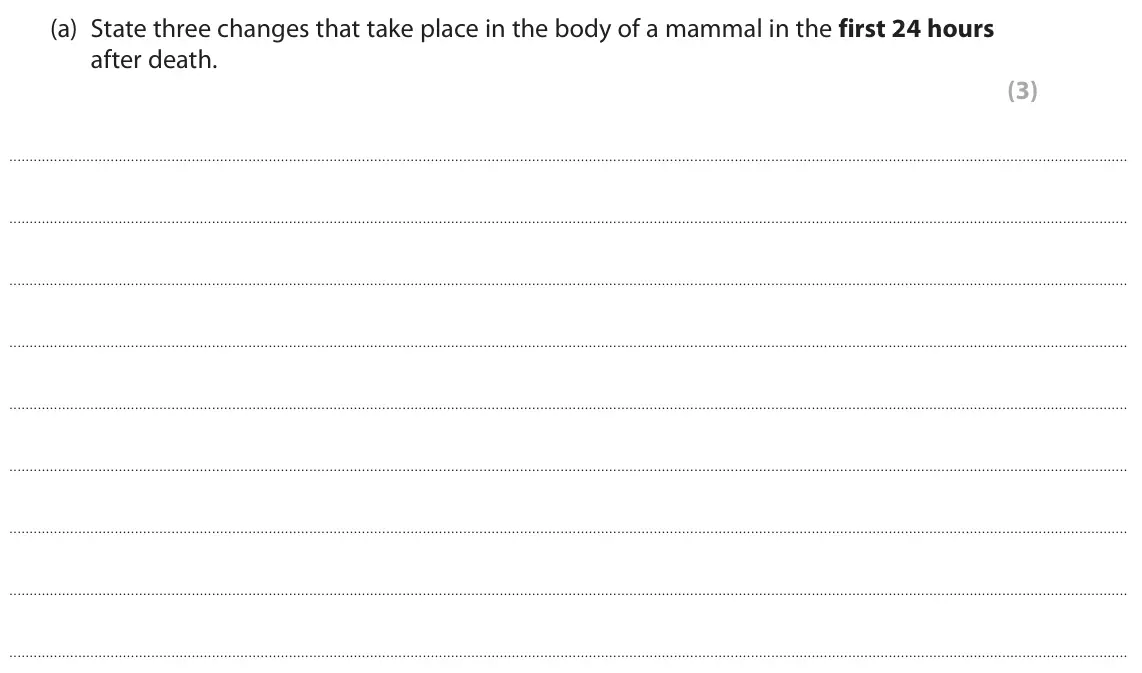
Q1(b)(i)
The whole paper ↗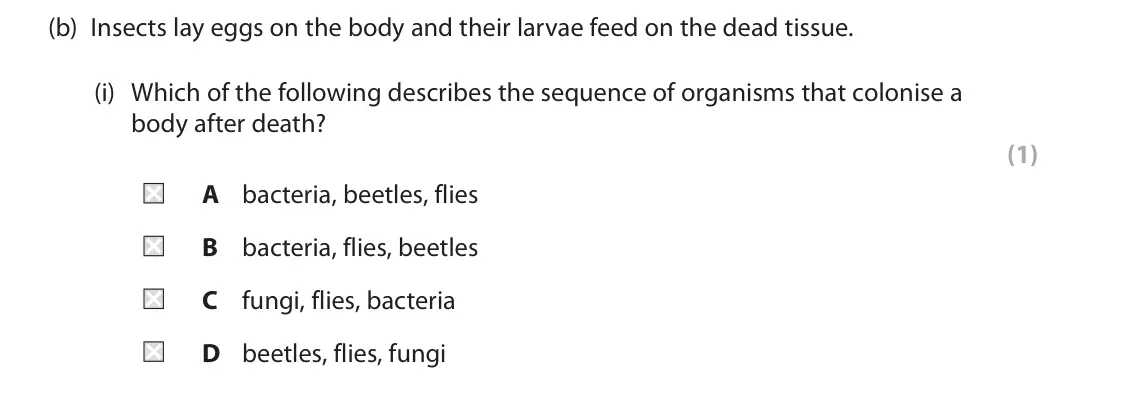
Q1(b)(ii)
The whole paper ↗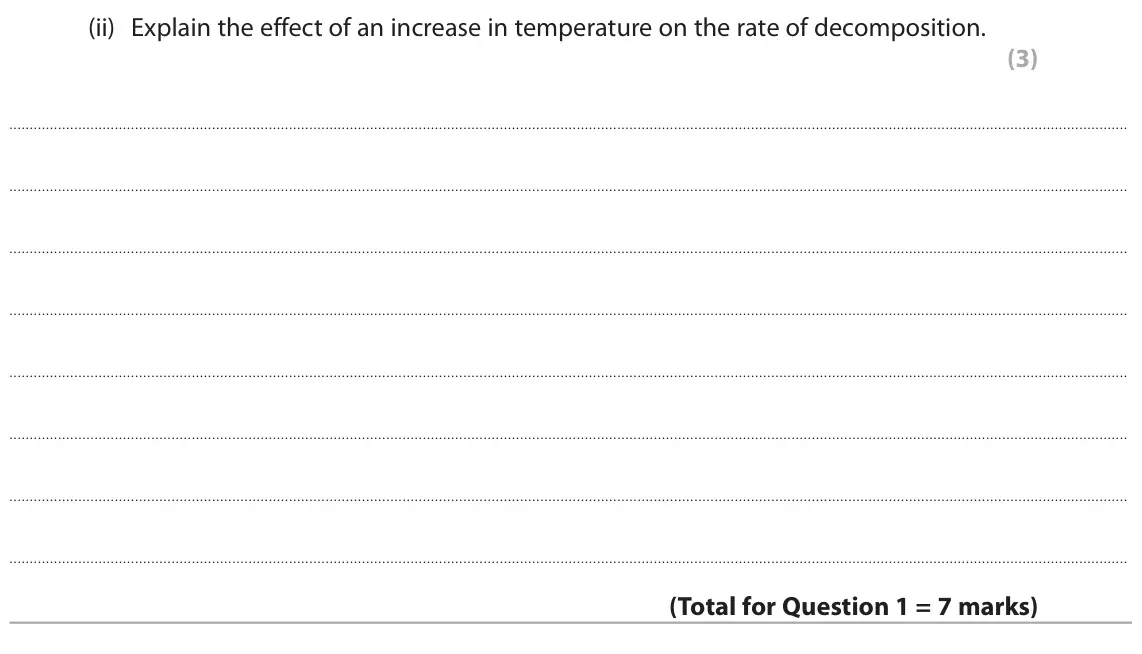
Q9(d)
The whole paper ↗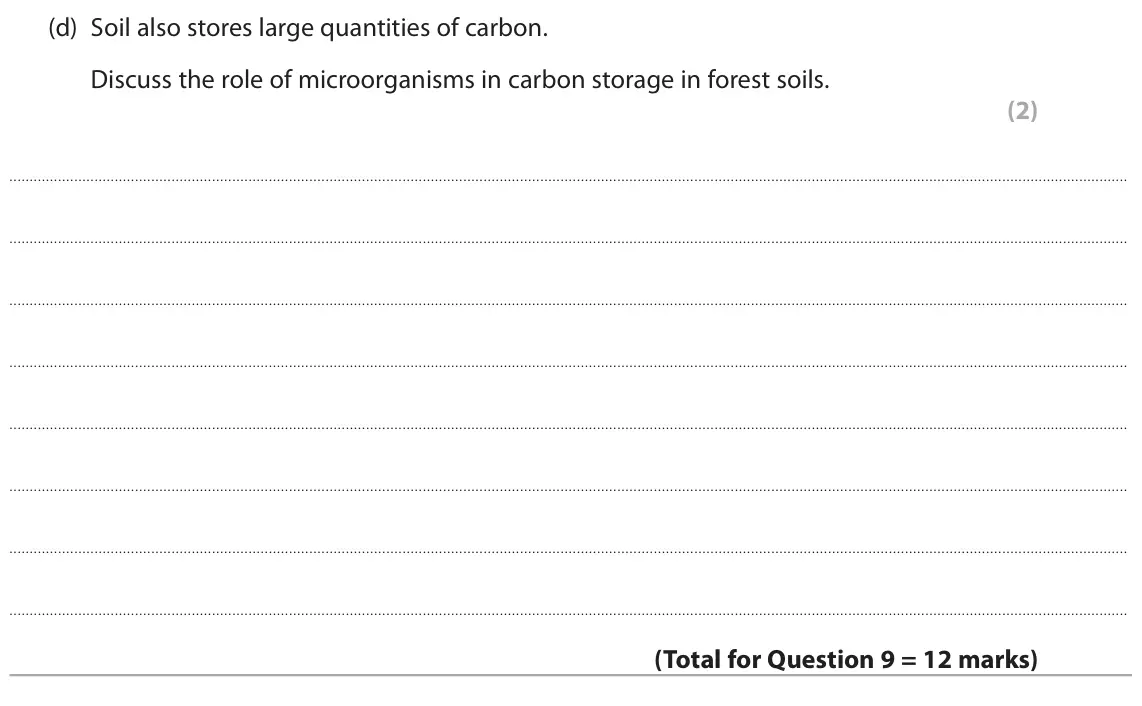
Q3(a)(ii)
The whole paper ↗
Q10(b)(ii)
The whole paper ↗
Q5(a)
The whole paper ↗
Q5(b)
The whole paper ↗
Q5(c)(i)
The whole paper ↗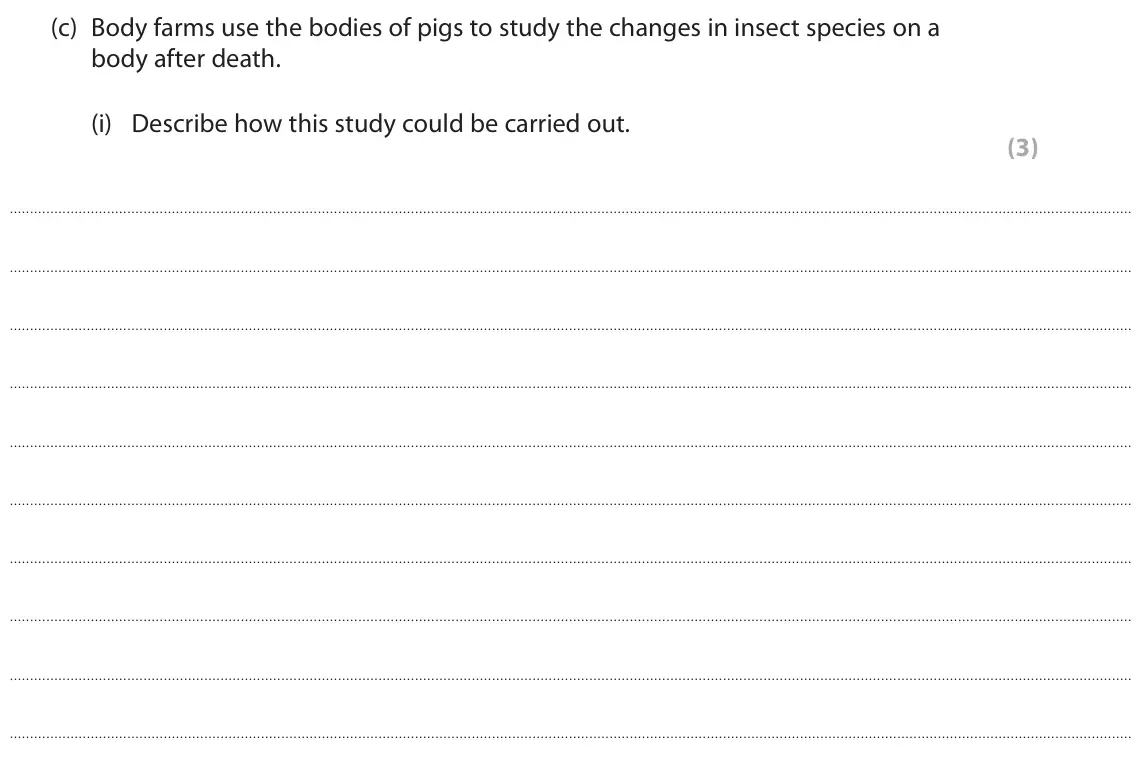
Q5(c)(ii)
The whole paper ↗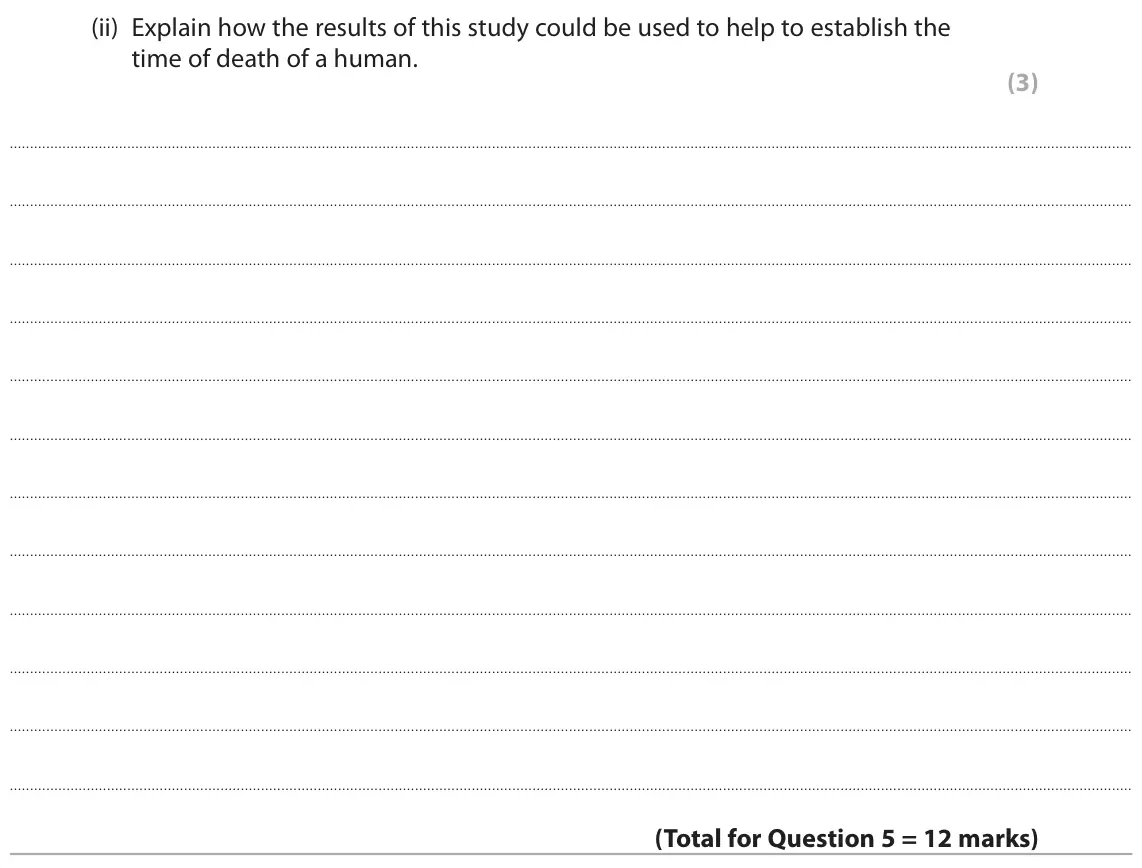
Q2(a)(i)
The whole paper ↗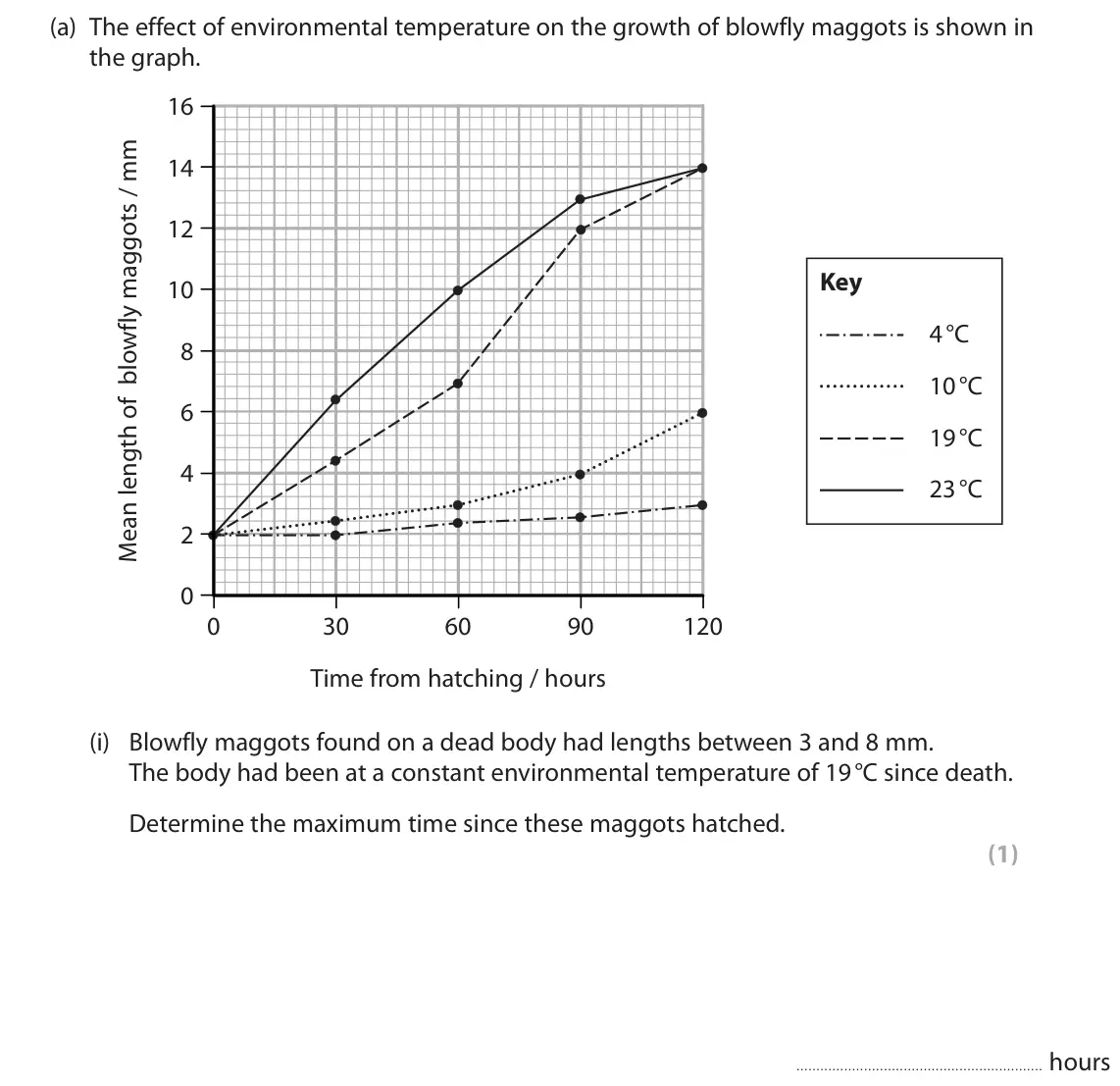
Q2(a)(ii)
The whole paper ↗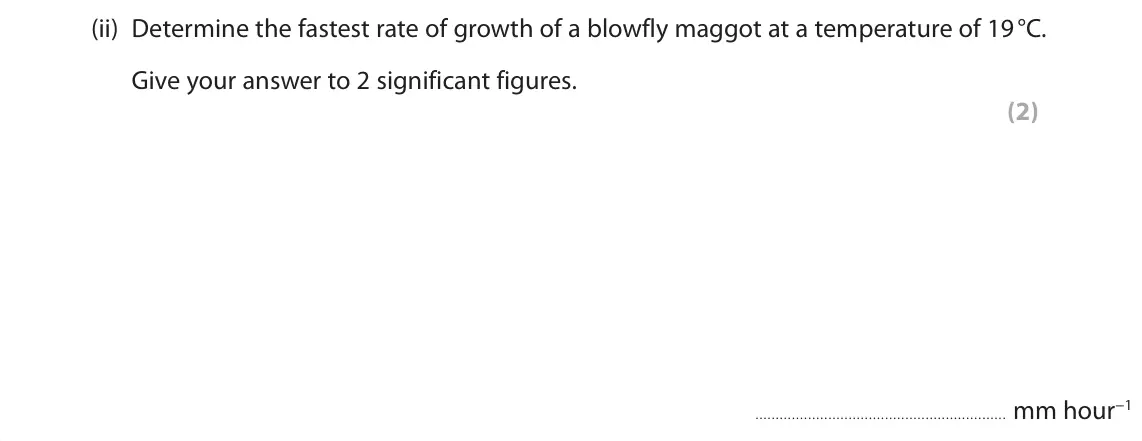
Q2(a)(iii)
The whole paper ↗
Q2(b)
The whole paper ↗
Q3(a)(i)
The whole paper ↗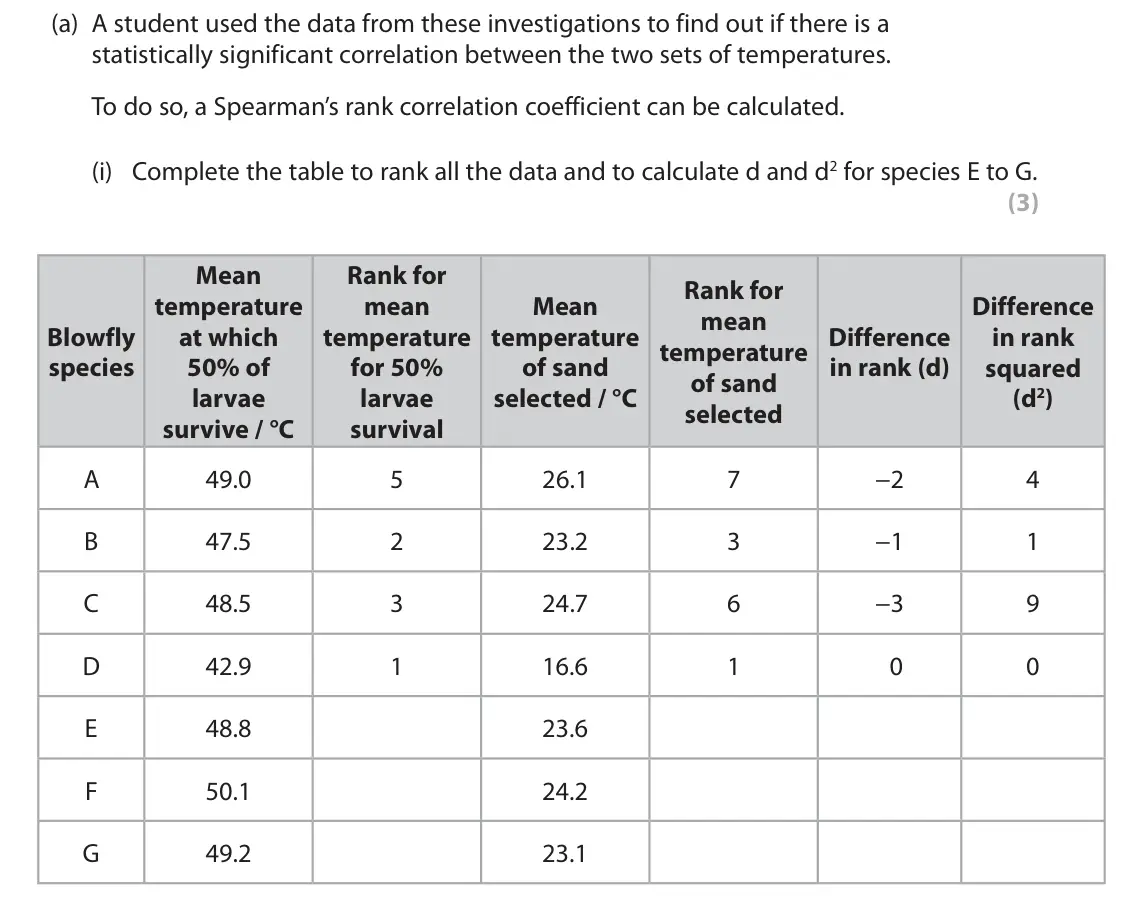
Q3(a)(ii)
The whole paper ↗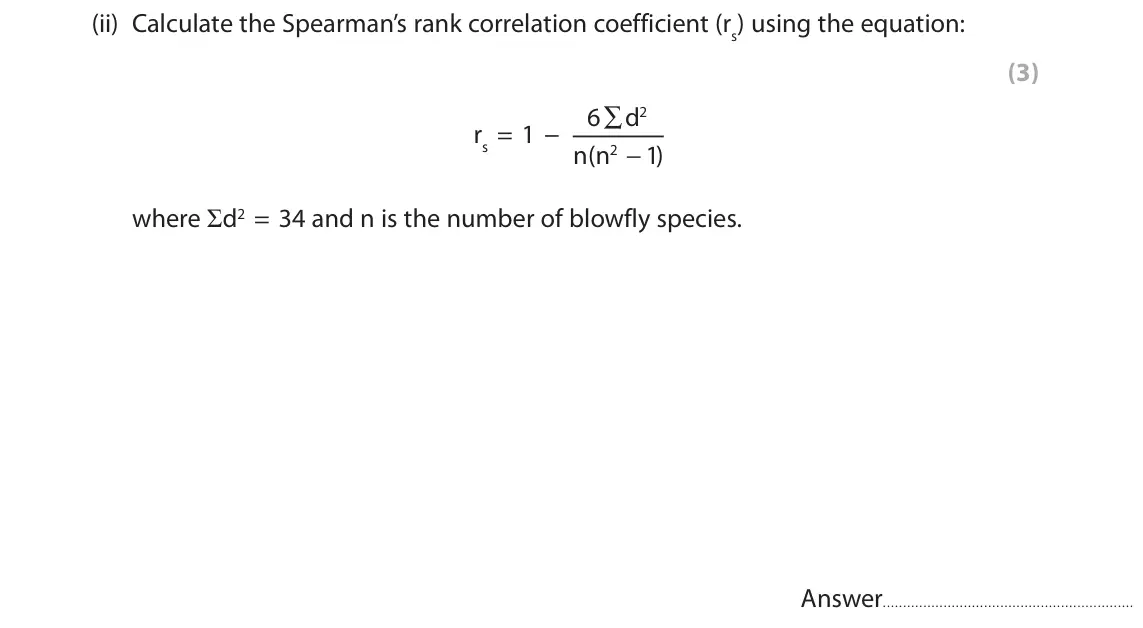
Q3(a)(iii)
The whole paper ↗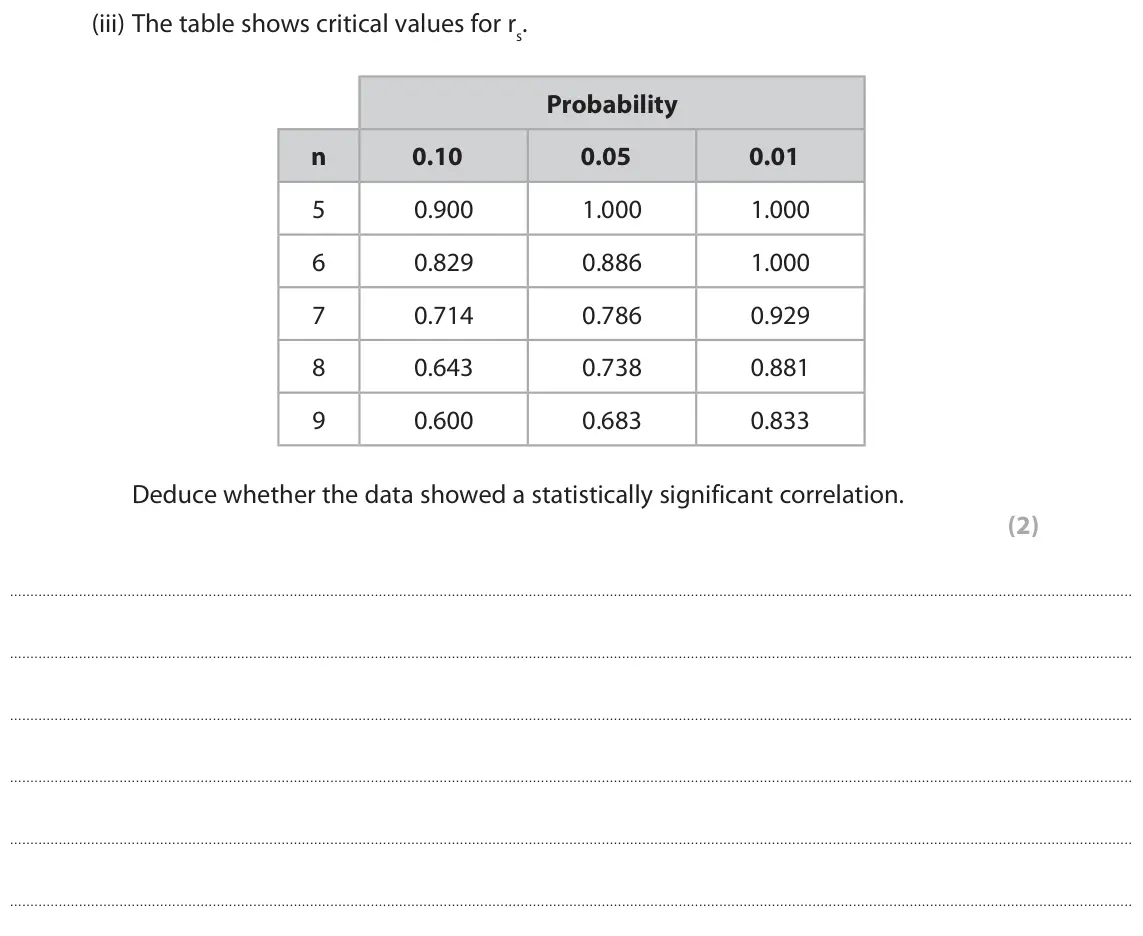
Q3(b)(i)
The whole paper ↗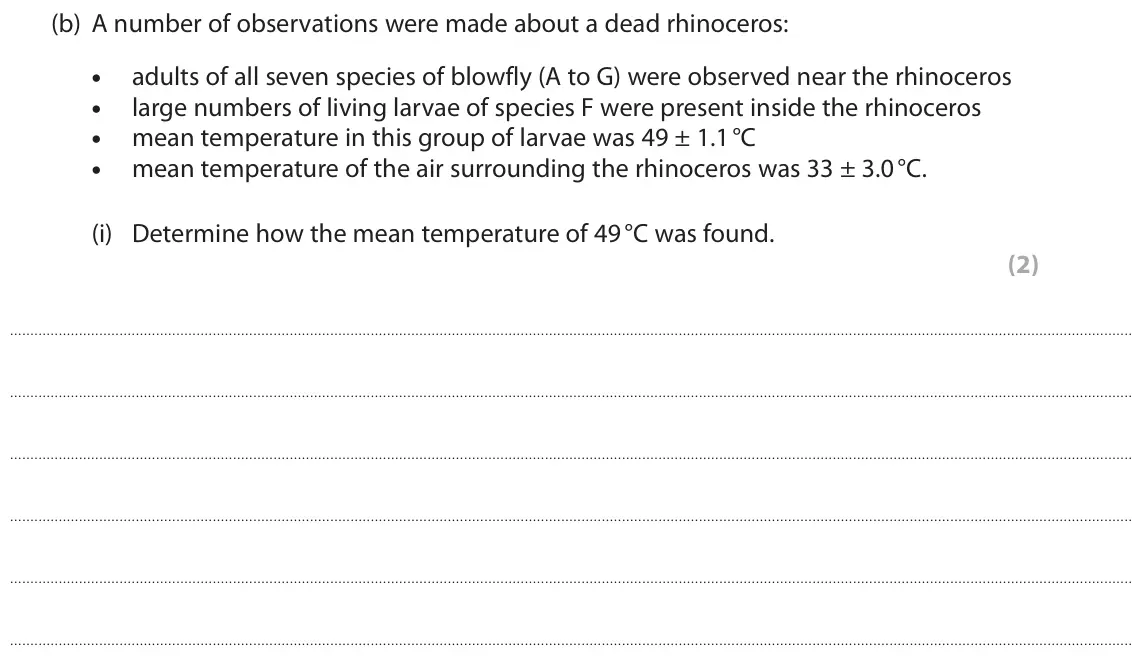
Q3(b)(ii)
The whole paper ↗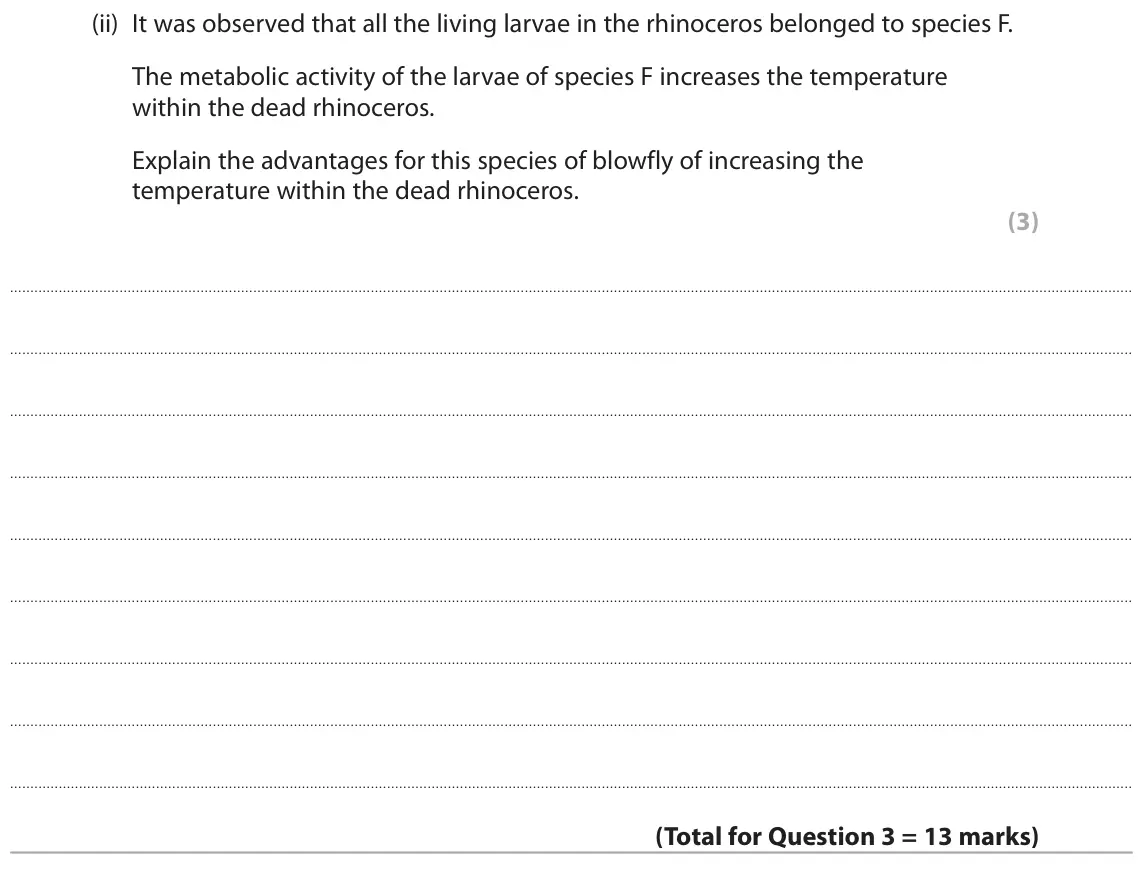
Q9(a)
The whole paper ↗
All 21 questions on Time of death and decomposition, as a list
- June 2025, Paper 1, Q1(a) (3 marks): State three changes that take place in the body of a mammal in the first 24 hours after death. (3)
- June 2025, Paper 1, Q1(b)(i) (1 mark): Which of the following describes the sequence of organisms that colonise a body after death? (1) A bacteria, beetles, flies B bacteria, flies, beetles C fungi,
- June 2025, Paper 1, Q1(b)(ii) (3 marks): Explain the effect of an increase in temperature on the rate of decomposition. (3)
- June 2025, Paper 1, Q9(d) (2 marks): Soil also stores large quantities of carbon. Discuss the role of microorganisms in carbon storage in forest soils. (2)
- June 2022, Paper 1, Q3(a)(ii) (3 marks): Explain why the conditions in peat bogs prevent decomposition. (3)
- October 2020, Paper 1, Q10(b)(ii) (3 marks): After the grain is harvested, farmers plough the stems (straw) from wheat plants into the soil. This improves the quality of the soil. These stems contain polys
- June 2019, Paper 1, Q5(a) (3 marks): Explain the effect of ambient temperature on the rate of decomposition. (3)
- June 2019, Paper 1, Q5(b) (3 marks): Describe the changes that occur inside a body in the first week after death. (3)
- June 2019, Paper 1, Q5(c)(i) (3 marks): Describe how this study could be carried out. (3)
- June 2019, Paper 1, Q5(c)(ii) (3 marks): Explain how the results of this study could be used to help to establish the time of death of a human. (3)
- June 2018, Paper 1, Q2(a)(i) (1 mark): Blowfly maggots found on a dead body had lengths between 3 and 8 mm. The body had been at a constant environmental temperature of 19 °C since death. Determine t
- June 2018, Paper 1, Q2(a)(ii) (2 marks): Determine the fastest rate of growth of a blowfly maggot at a temperature of 19 °C. Give your answer to 2 significant figures. (2) mm hour−1
- June 2018, Paper 1, Q2(a)(iii) (3 marks): Explain the effect of temperature on the rate of growth of blowfly maggots. (3)
- June 2018, Paper 1, Q2(b) (2 marks): Microorganisms are also found on a dead body. Describe the role of decomposers, such as microorganisms, in the carbon cycle. (2)
- June 2018, Paper 3, Q3(a)(i) (3 marks): Complete the table to rank all the data and to calculate d and d2 for species E to G. (3) Mean Rank for Rank for temperature mean Mean Difference mean Blowfly a
- June 2018, Paper 3, Q3(a)(ii) (3 marks): Calculate the Spearman’s rank correlation coefficient (rs) using the equation: (3) 6 ∑ d 2 rs = 1 − n(n 2 − 1 ) where Ȉd2 = 34 and n is the number of blowfly sp
- June 2018, Paper 3, Q3(a)(iii) (2 marks): The table shows critical values for rs. Probability n 0.10 0.05 0.01 5 0.900 1.000 1.000 6 0.829 0.886 1.000 7 0.714 0.786 0.929 8 0.643 0.738 0.881 9 0.600 0.6
- June 2018, Paper 3, Q3(b)(i) (2 marks): Determine how the mean temperature of 49 °C was found. (2)
- June 2018, Paper 3, Q3(b)(ii) (3 marks): It was observed that all the living larvae in the rhinoceros belonged to species F. The metabolic activity of the larvae of species F increases the temperature
- June 2017, Paper 1, Q9(a) (3 marks): Comment on the effect of adding cow dung to composting coffee husks. (3)
- June 2017, Paper 1, Q9(b) (6 marks): The changes in the compost heaps are due to the activity of decomposers and other organisms. Devise an investigation to determine the effect of the carbon to ni
Questions, mark schemes and examiner’s reports are © Pearson Edexcel, from their published past papers. Plumi isn’t affiliated with any exam board. Want whole papers? Every Edexcel A-Level Biology A paper.
Rather write your answers by hand on iPad? Plumi marks them against the same mark schemes.