 plumi
Climate change: Edexcel A‑Level Biology A questions
Every Edexcel A-Level Biology A exam question on Climate change (specification points 5.12–5.16), 2016–2025, with its mark scheme and examiner’s report.
Find questions1,749
Calculations
Q2(b)
The whole paper ↗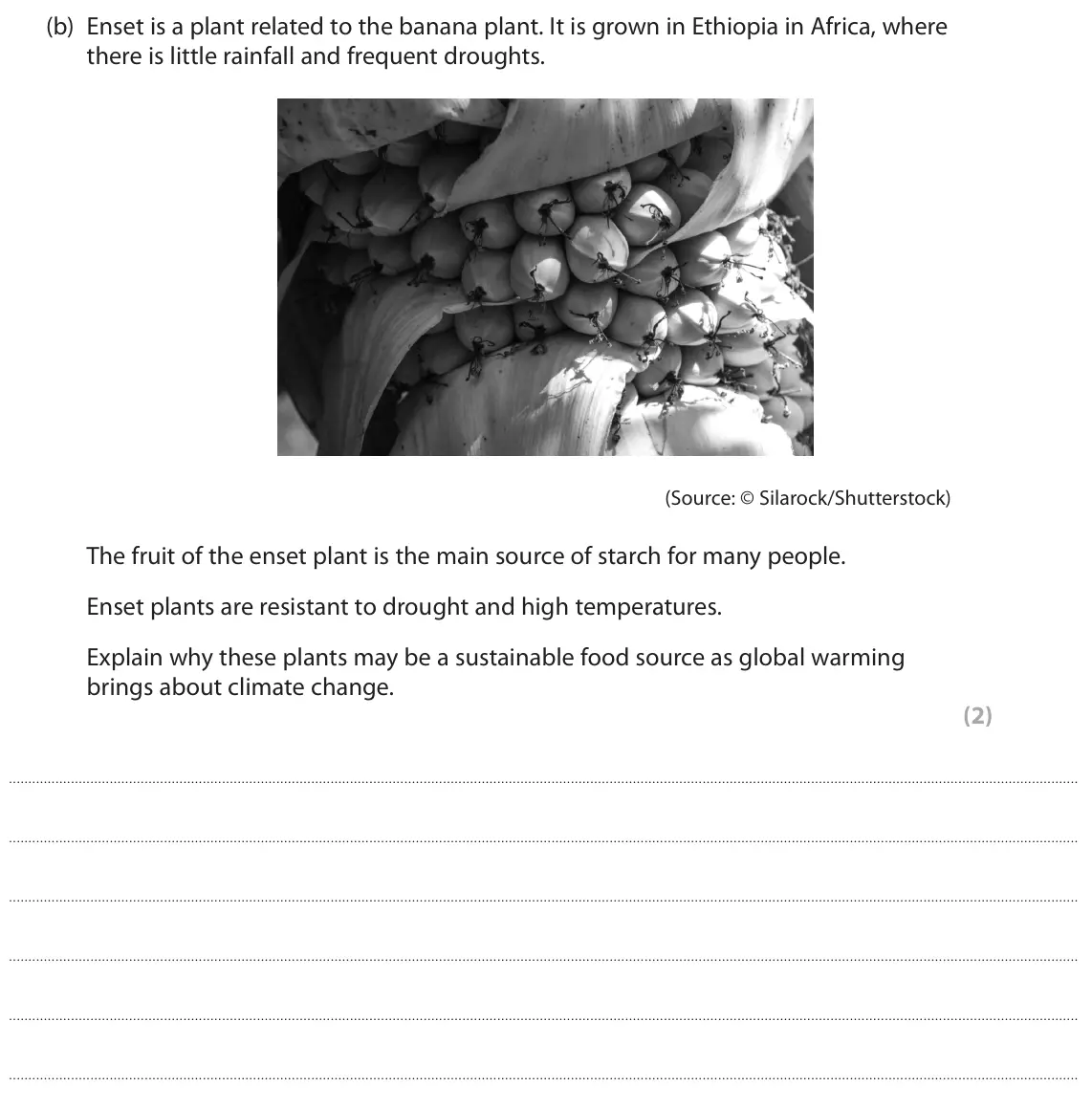
Q10(b)(i)
The whole paper ↗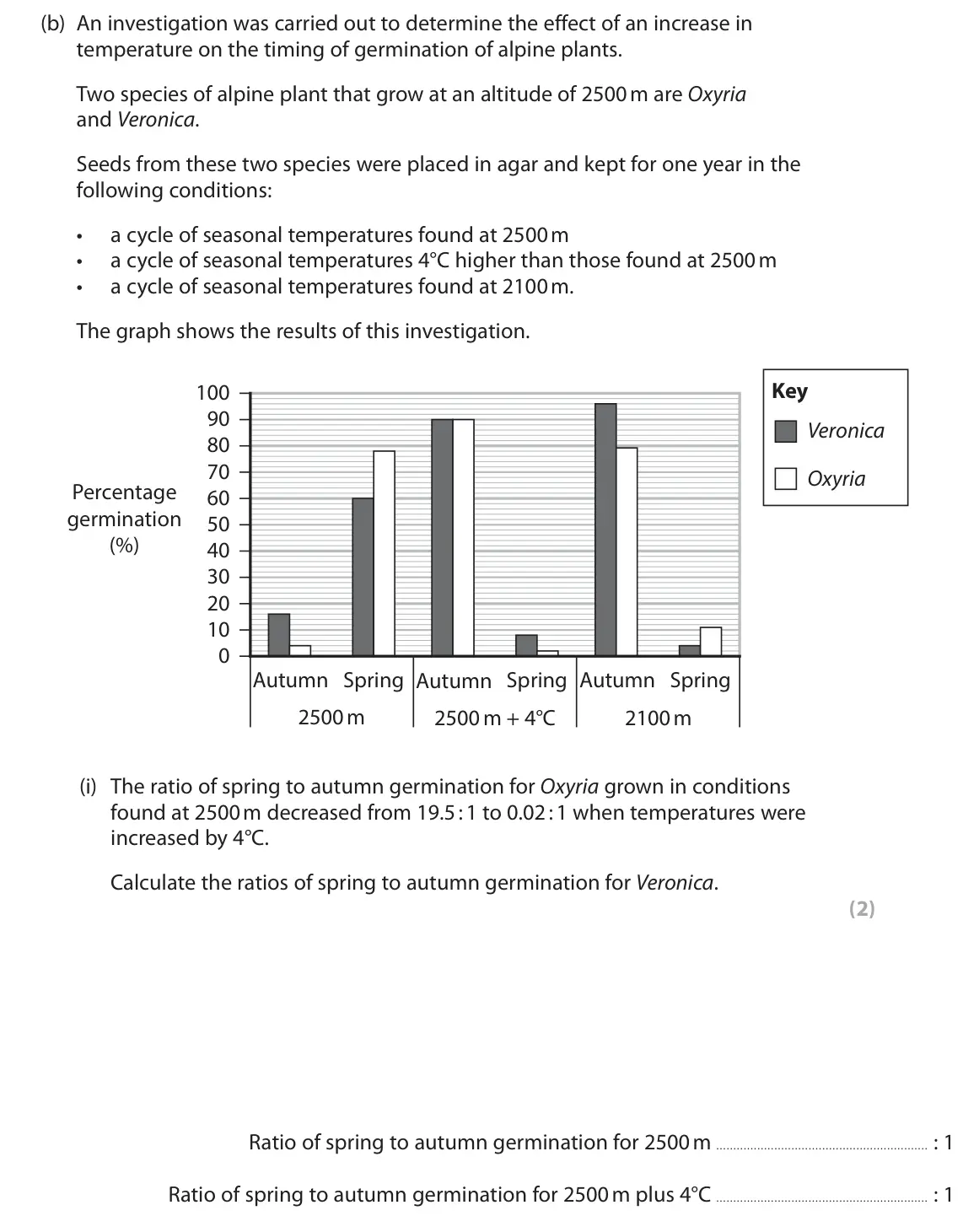
Q10(b)(ii)
The whole paper ↗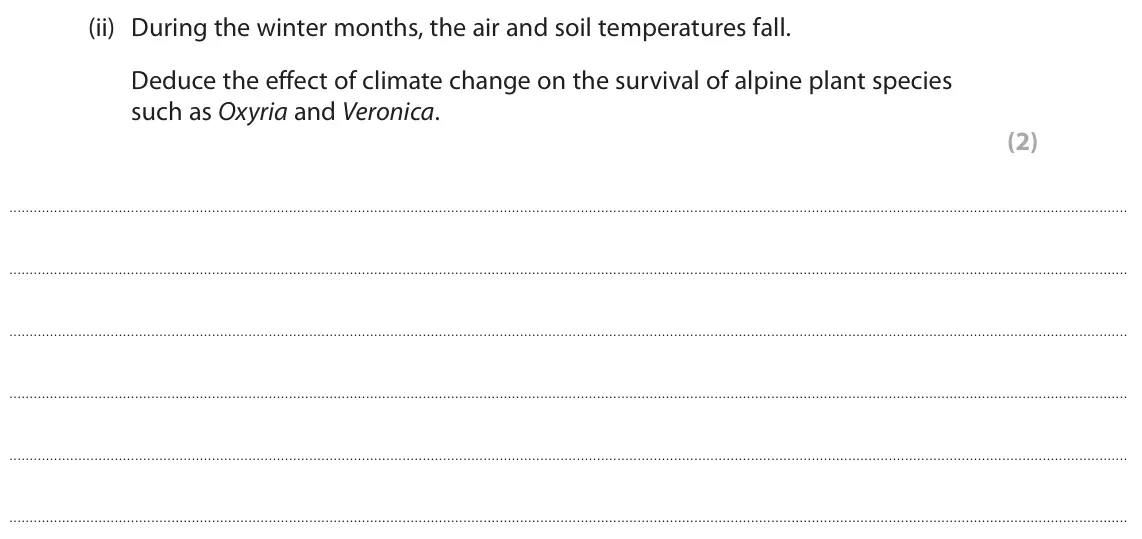
Q10(c)
The whole paper ↗
Q8(h)
The whole paper ↗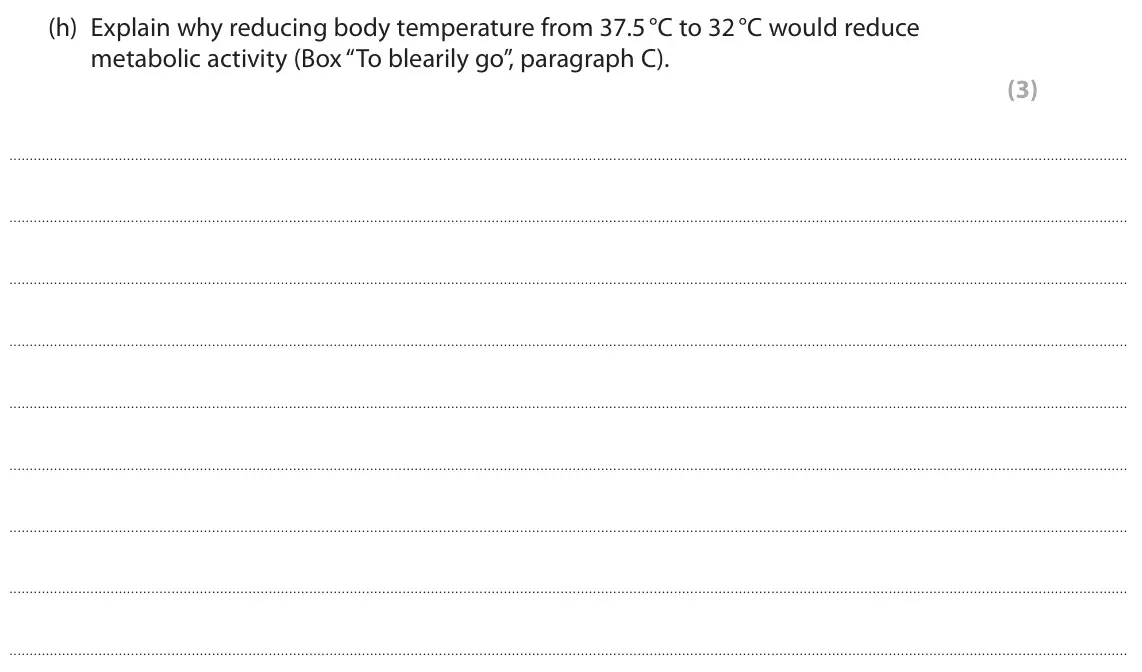
Q6(b)(i)
The whole paper ↗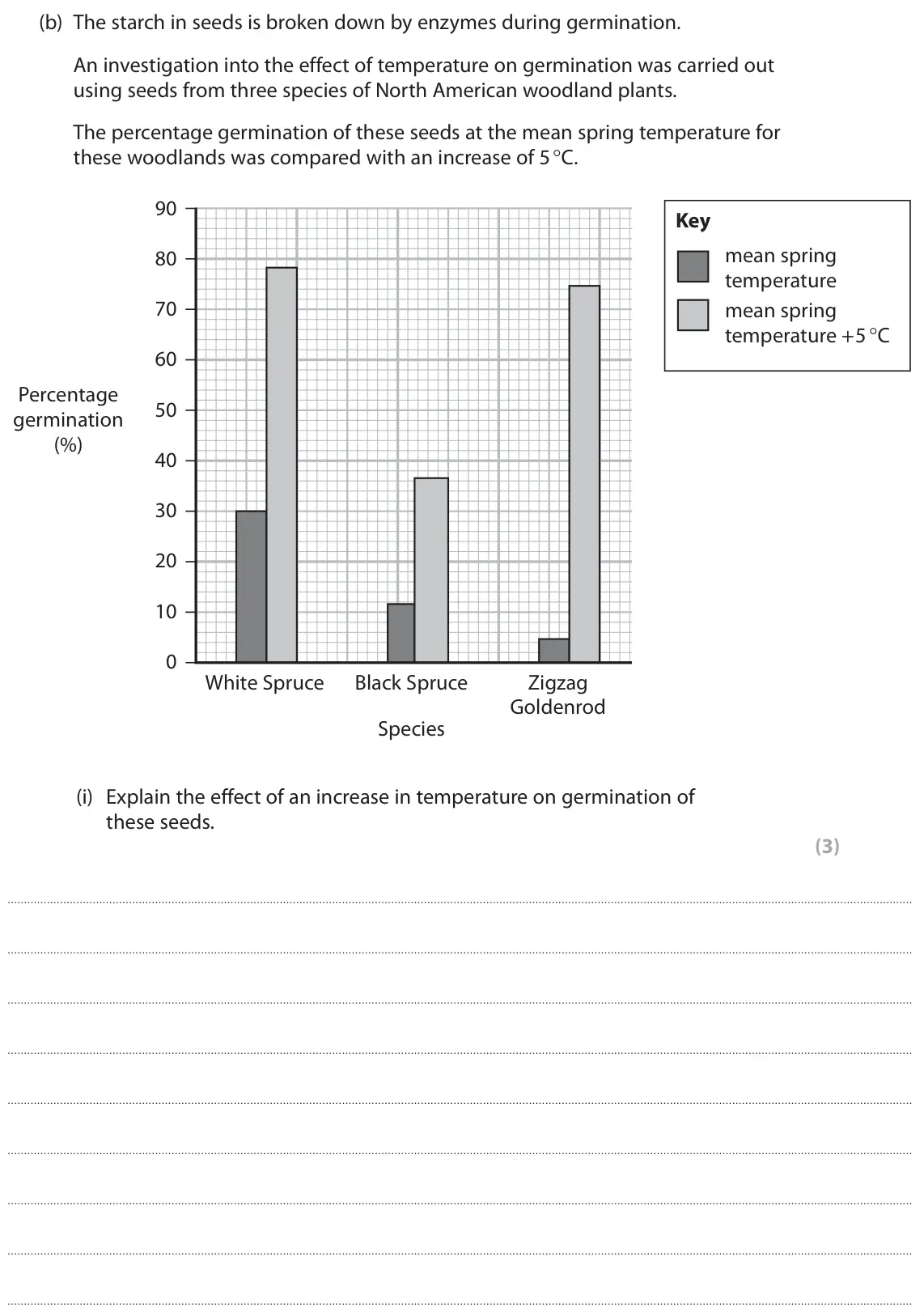
Q6(b)(ii)
The whole paper ↗
Q8(c)(i)
The whole paper ↗
Q10(a)
The whole paper ↗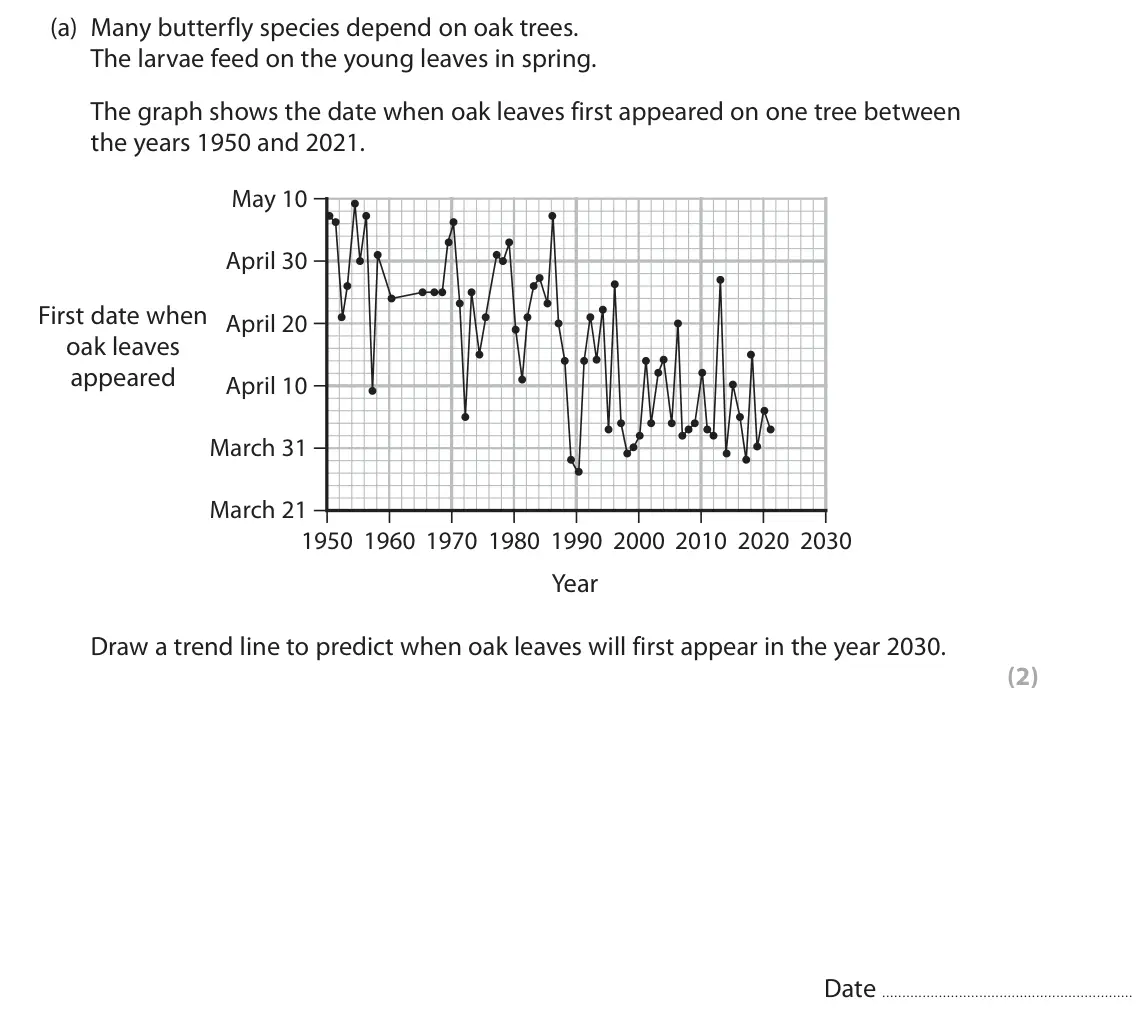
Q10(b)
The whole paper ↗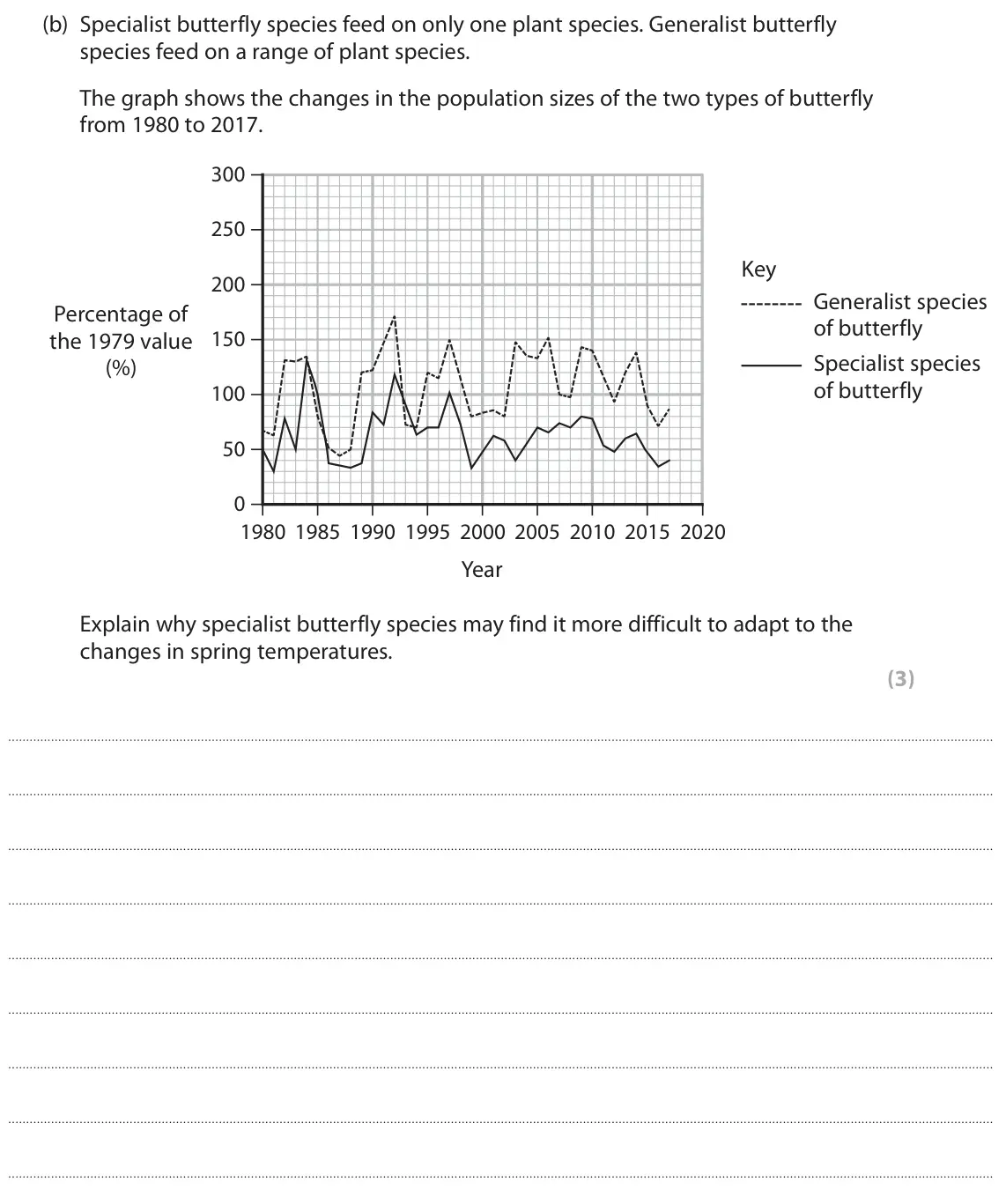
Q10(c)(i)
The whole paper ↗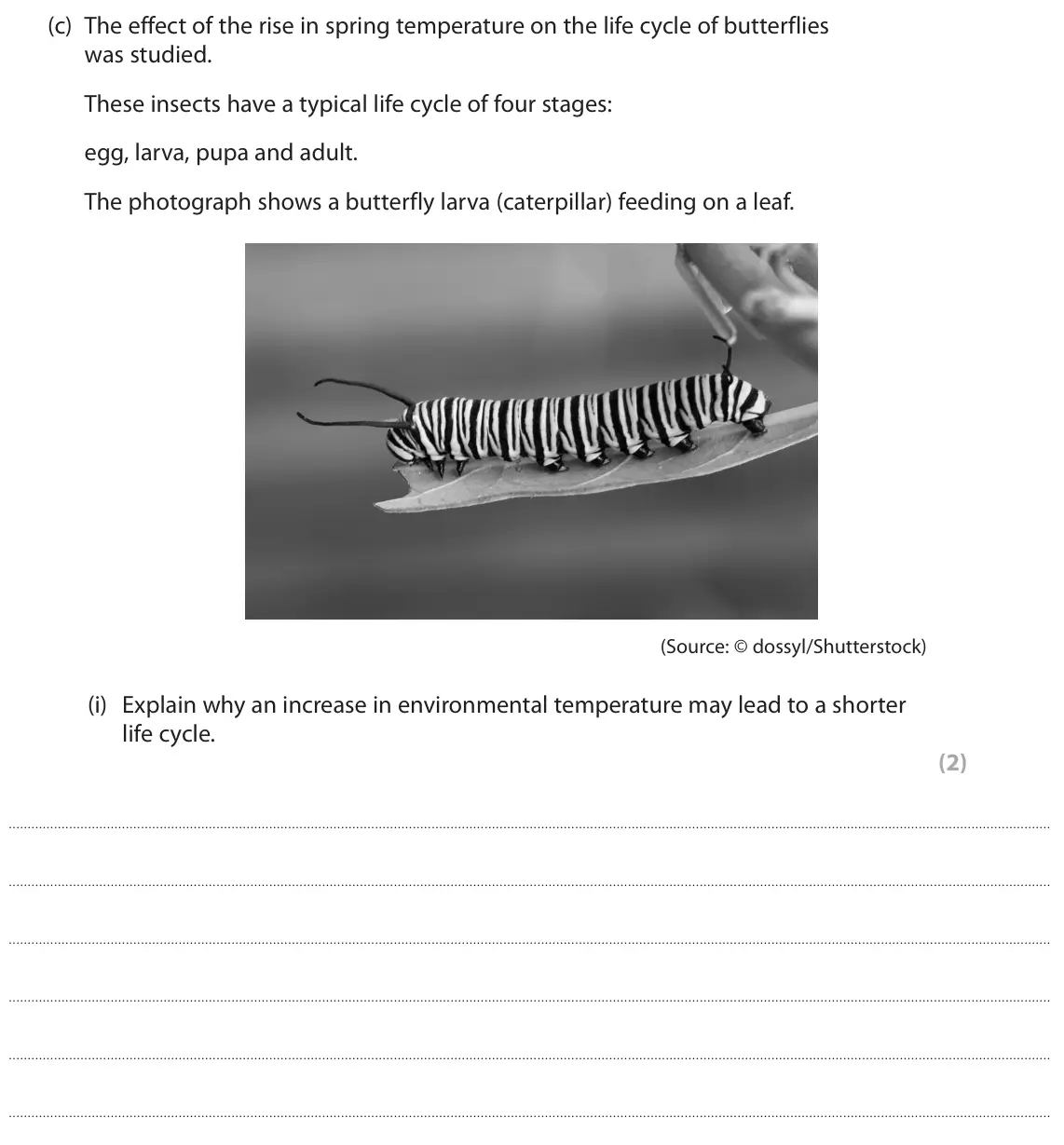
Q10(c)(ii)
The whole paper ↗
Q2(a)
The whole paper ↗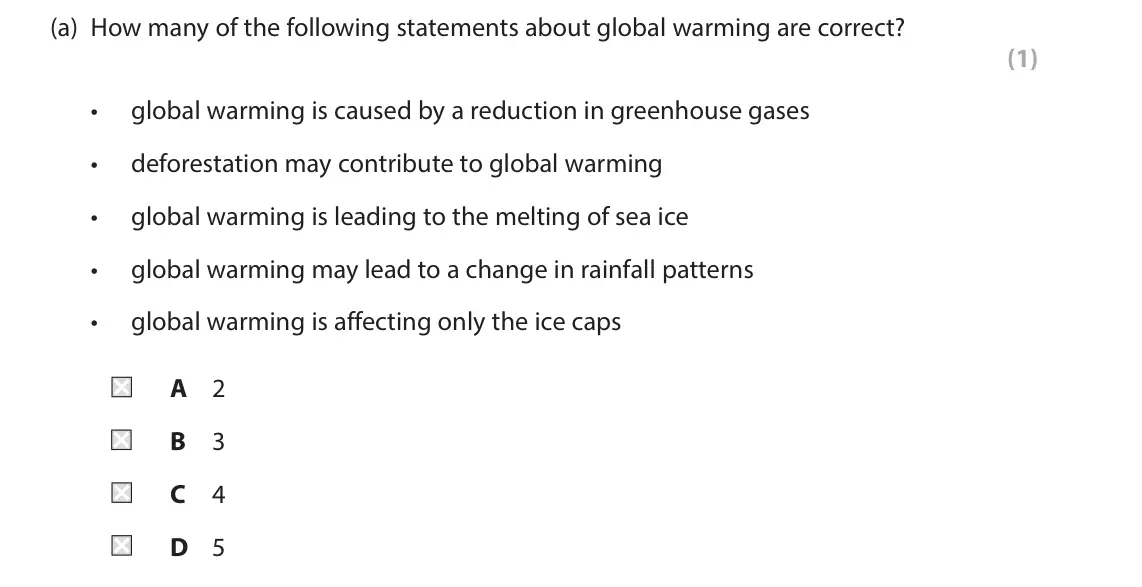
Q3(a)(i)
The whole paper ↗
Q1(a)
The whole paper ↗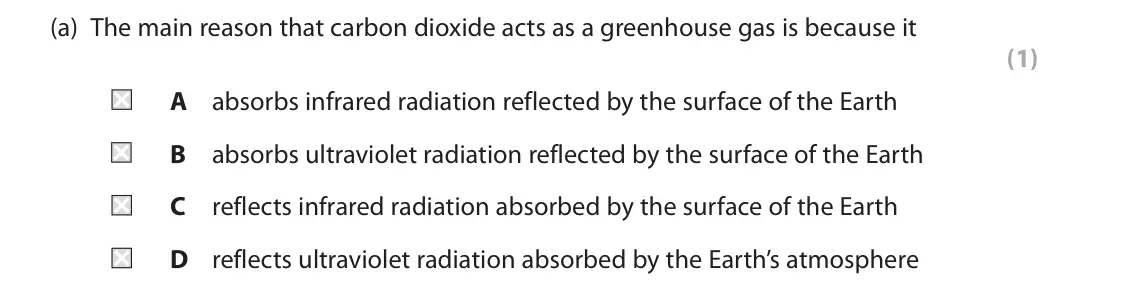
Q10(a)
The whole paper ↗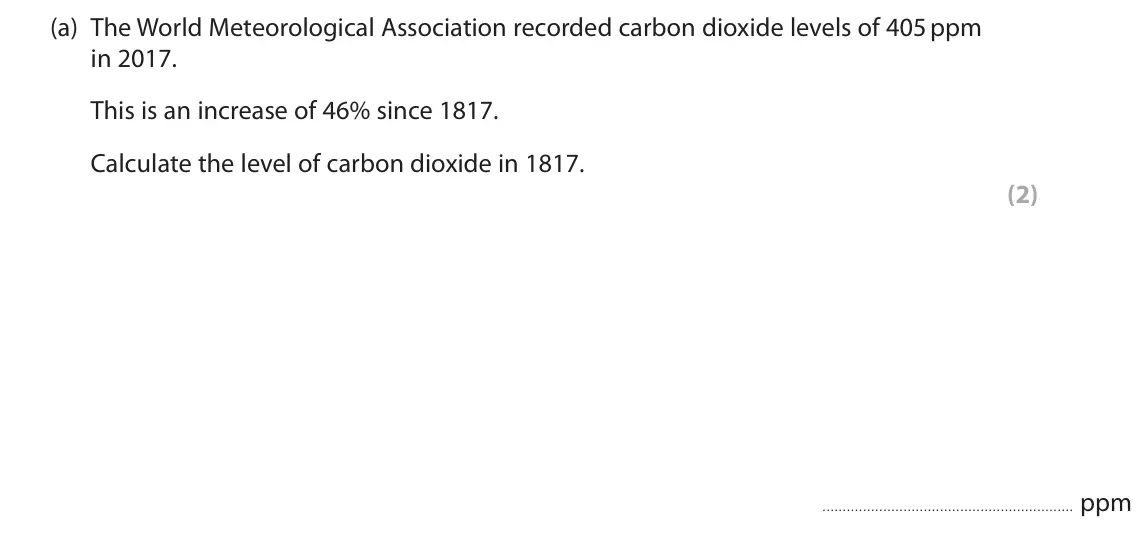
Q10(b)
The whole paper ↗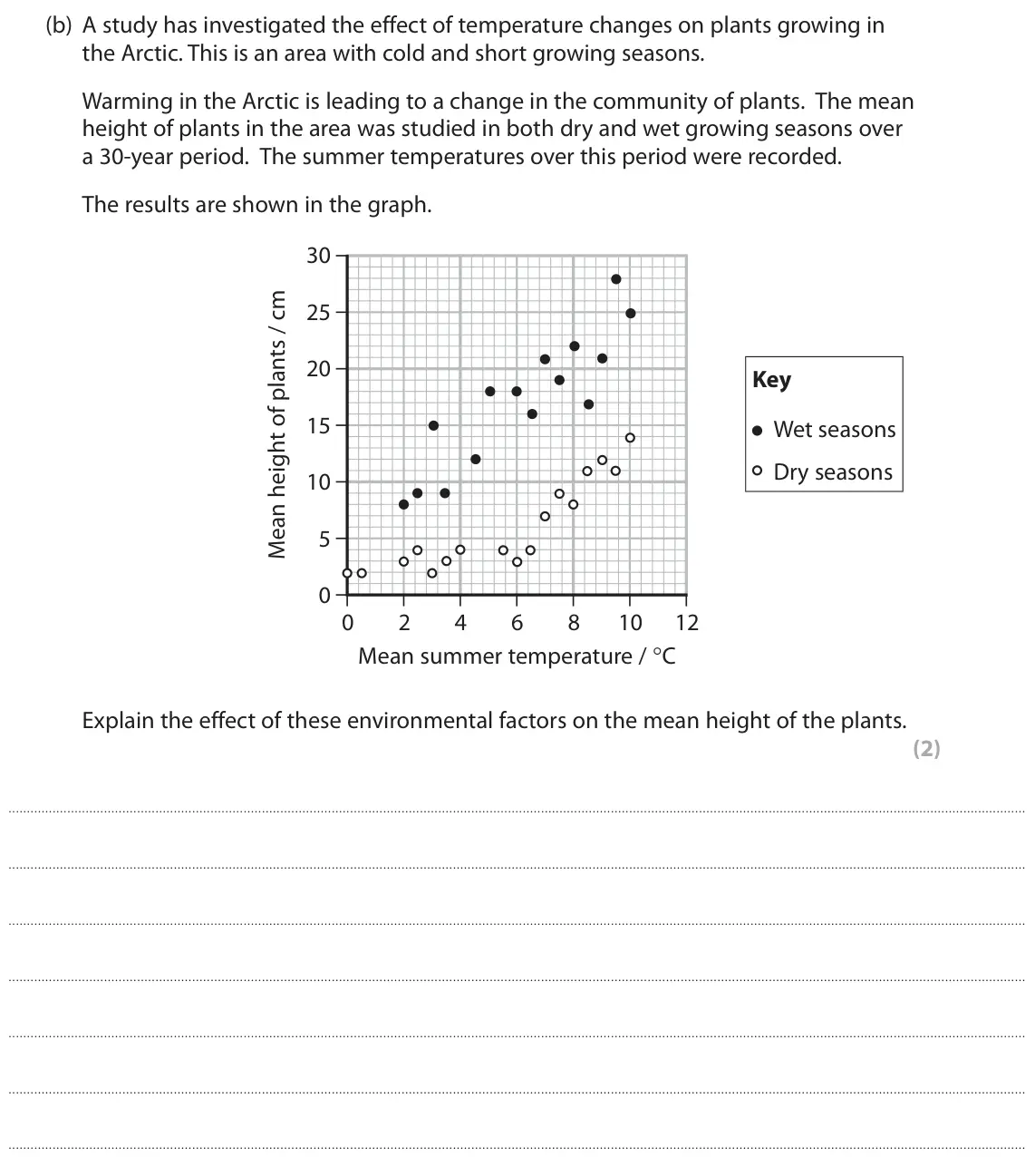
Q10(c)
The whole paper ↗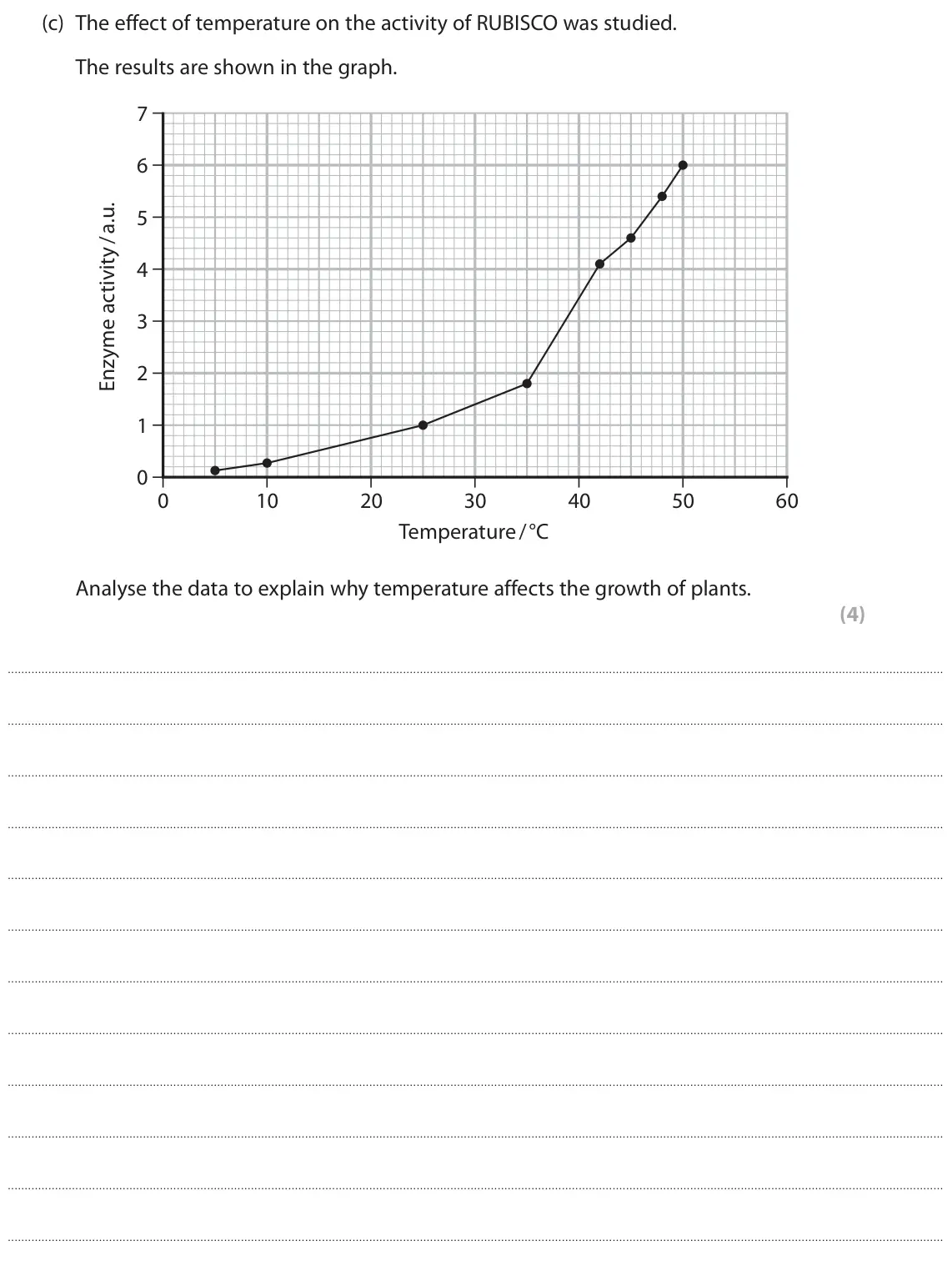
Q10(d)
The whole paper ↗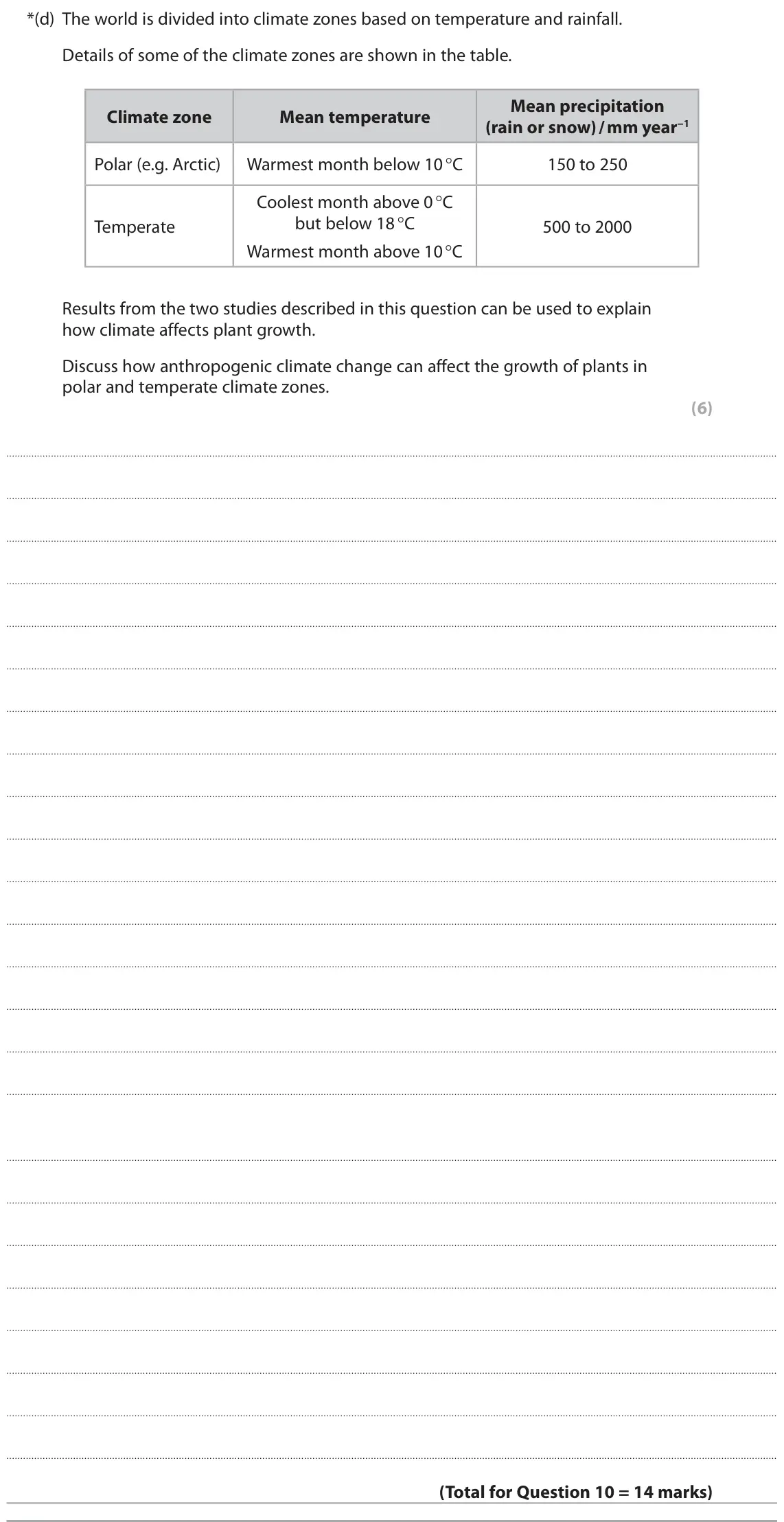
Q4(a)
The whole paper ↗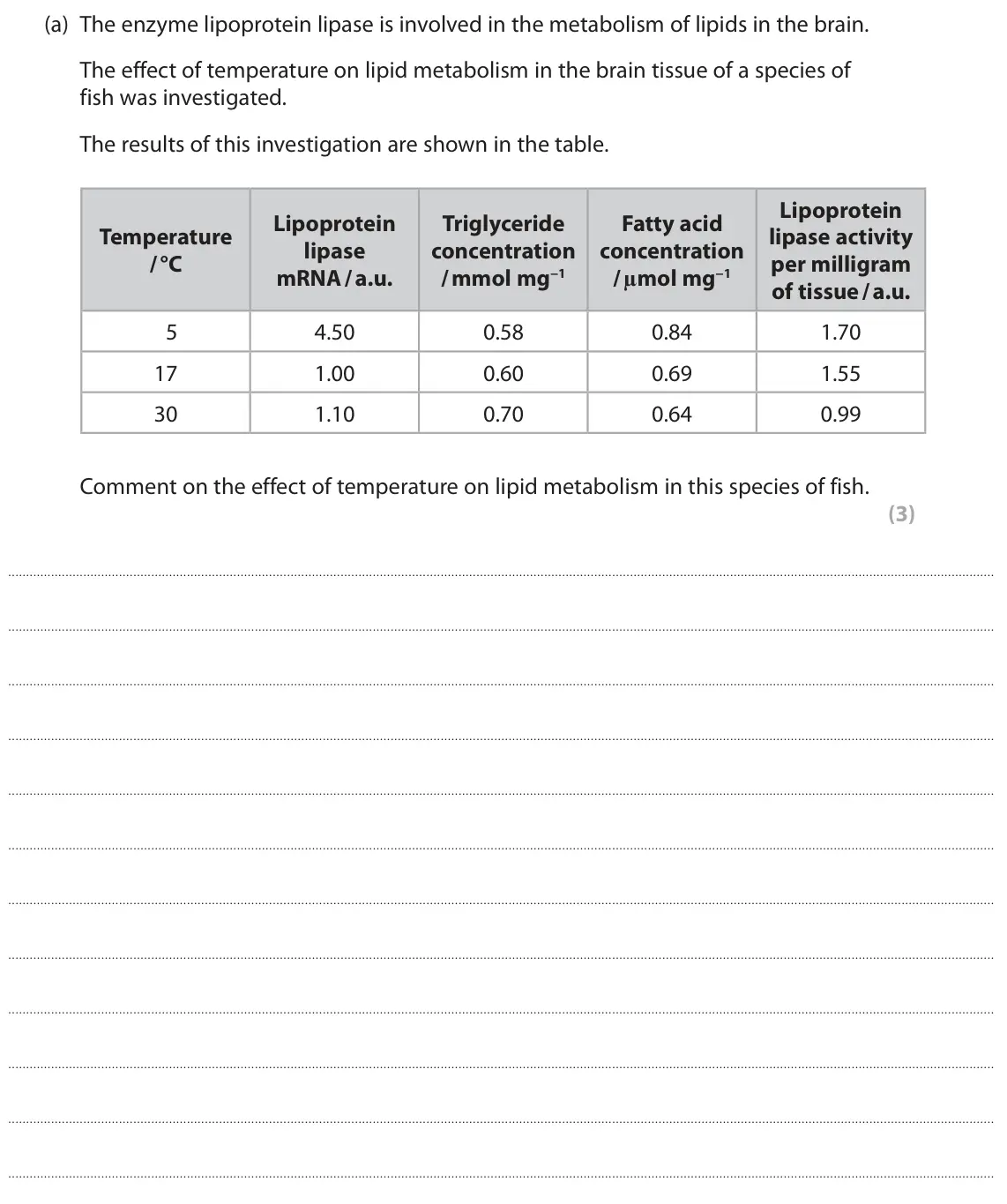
All 52 questions on Climate change, as a list
- June 2025, Paper 1, Q2(b) (2 marks): Enset is a plant related to the banana plant. It is grown in Ethiopia in Africa, where there is little rainfall and frequent droughts. (Source: © Silarock/Shutt
- June 2025, Paper 1, Q10(b)(i) (2 marks): The ratio of spring to autumn germination for Oxyria grown in conditions found at 2500 m decreased from 19.5 : 1 to 0.02 : 1 when temperatures were increased by
- June 2025, Paper 1, Q10(b)(ii) (2 marks): During the winter months, the air and soil temperatures fall. Deduce the effect of climate change on the survival of alpine plant species such as Oxyria and Ver
- June 2025, Paper 1, Q10(c) (6 marks): The effect of temperature on germinating seeds can be demonstrated by measuring the Q10 value for enzyme activity. When seeds germinate, amylase is produced. Th
- June 2025, Paper 3, Q8(h) (3 marks): Explain why reducing body temperature from 37.5 °C to 32 °C would reduce metabolic activity (Box “To blearily go”, paragraph C). (3)
- June 2024, Paper 1, Q6(b)(i) (3 marks): Explain the effect of an increase in temperature on germination of these seeds. (3)
- June 2024, Paper 1, Q6(b)(ii) (2 marks): Global warming can result in climate change. Describe how climate change could affect the distribution of plants in woodlands in North America. (2)
- June 2023, Paper 1, Q8(c)(i) (3 marks): Explain why the increase in greenhouse gases is leading to a decrease in the growth of seagrass. (3)
- June 2023, Paper 1, Q10(a) (2 marks): Many butterfly species depend on oak trees. The larvae feed on the young leaves in spring. The graph shows the date when oak leaves first appeared on one tree b
- June 2023, Paper 1, Q10(b) (3 marks): Specialist butterfly species feed on only one plant species. Generalist butterfly species feed on a range of plant species. The graph shows the changes in the p
- June 2023, Paper 1, Q10(c)(i) (2 marks): Explain why an increase in environmental temperature may lead to a shorter life cycle. (2)
- June 2023, Paper 1, Q10(c)(ii) (6 marks): Devise a laboratory investigation to study the effect of temperature on the duration of the larval stage in a specialist butterfly species. (6)
- June 2022, Paper 1, Q2(a) (1 mark): How many of the following statements about global warming are correct? (1) • global warming is caused by a reduction in greenhouse gases • deforestation may con
- June 2022, Paper 1, Q3(a)(i) (1 mark): State how the age of the layers in a peat bog can be determined. (1)
- November 2021, Paper 1, Q1(a) (1 mark): The main reason that carbon dioxide acts as a greenhouse gas is because it (1) A absorbs infrared radiation reflected by the surface of the Earth B absorbs ultr
- November 2021, Paper 1, Q10(a) (2 marks): The World Meteorological Association recorded carbon dioxide levels of 405 ppm in 2017. This is an increase of 46% since 1817. Calculate the level of carbon dio
- November 2021, Paper 1, Q10(b) (2 marks): A study has investigated the effect of temperature changes on plants growing in the Arctic. This is an area with cold and short growing seasons. Warming in the
- November 2021, Paper 1, Q10(c) (4 marks): The effect of temperature on the activity of RUBISCO was studied. The results are shown in the graph. 7 6 5 4 3 2 1 0 0 10 20 30 40 50 60 Temperature / °C Analy
- November 2021, Paper 1, Q10(d) (6 marks): The world is divided into climate zones based on temperature and rainfall. Details of some of the climate zones are shown in the table. Mean precipitation Clima
- November 2021, Paper 3, Q4(a) (3 marks): The enzyme lipoprotein lipase is involved in the metabolism of lipids in the brain. The effect of temperature on lipid metabolism in the brain tissue of a speci
- November 2021, Paper 3, Q4(b)(i) (1 mark): State what is meant by the term Q10 temperature coefficient. (1)
- November 2021, Paper 3, Q4(b)(ii) (5 marks): Devise an investigation to determine Q10 for an extract of lipoprotein lipase enzyme. (5)
- October 2020, Paper 1, Q2(b)(i) (1 mark): Which of the following causes global warming? (1) A a decrease in carbon dioxide and methane in the atmosphere that trap infrared radiation B a decrease in carb
- October 2020, Paper 1, Q2(b)(ii) (1 mark): Which of the following could provide evidence for climate change? (1) A dendrochronology, peat bog pollen analysis and ice cores B ice cores, classification and
- October 2020, Paper 1, Q2(c) (4 marks): Golden snub‑nosed monkeys live in areas with very cold winters. The seeds in their diet contain lipids and carbohydrates. Climate change is reducing seed produc
- October 2020, Paper 3, Q4(a)(i) (1 mark): Give a null hypothesis for this experiment. (1)
- October 2020, Paper 3, Q4(a)(ii) (3 marks): Calculate the chi-squared (χ2) value for these results, using the formula provided. (3) − = ∑ 2 (O E) 2 χ E Answer
- October 2020, Paper 3, Q4(a)(iii) (2 marks): In a second experiment, using the same three treatments, the chi-squared (χ2) value was found to be 6.635. The table gives the critical values for the chi-squar
- June 2019, Paper 1, Q9(a)(i) (1 mark): Calculate the temperature coefficient (Q10) for this reaction between 20 °C and 30 °C. (1) Answer
- June 2019, Paper 1, Q9(a)(ii) (3 marks): Explain the effects of a temperature increase from 20 °C to 30 °C on the initial rate of activity of catalase in the yeast cells. (3)
- June 2019, Paper 1, Q9(a)(iii) (2 marks): Explain what happens to the Q10 value between 40 °C and 50 °C. (2)
- June 2019, Paper 1, Q9(b) (4 marks): Leaf rust is a disease caused by a species of fungus. Leaf rust affects cereal crops such as wheat. Leaf rust yeast spreads through cereal crops when the humidi
- June 2019, Paper 1, Q10(a) (3 marks): Explain why anthropogenic emissions of greenhouse gases are affecting the climate. (3)
- June 2019, Paper 1, Q10(b) (6 marks): Pteropods are small free-swimming snails found in oceans throughout the world. They are a food source for a variety of fish including salmon, mackerel and herri
- June 2019, Paper 1, Q10(c) (2 marks): Climate change can also affect the life cycle of organisms. The effect of temperature on the lifespan of fruit flies (Drosophila melanogaster) was investigated.
- June 2018, Paper 1, Q7(b)(ii) (1 mark): Which of the following could be caused by an increase in atmospheric carbon dioxide from 398 ppm to 1080 ppm? (1) A decreased photosynthesis B global warming C
- June 2018, Paper 1, Q7(b)(iii) (5 marks): Analyse the data to explain the predicted effect of climate change on the distribution of ash trees. (5)
- June 2018, Paper 3, Q2(a)(i) (2 marks): Explain how the data could support a conclusion that climate change is occurring in the Arctic. (2)
- June 2018, Paper 3, Q2(a)(ii) (4 marks): Explain why the data may not be useful for predicting future climate change. (4)
- June 2018, Paper 3, Q2(b) (1 mark): The scientists also recorded data from west Spitsbergen on polar bear behaviour. The graph shows the number of days polar bears were seen on land. 25 20 15 10 5
- June 2018, Paper 3, Q2(c) (4 marks): Birds, such as barnacle geese, use the land on Spitsbergen as nesting sites. Polar bears usually hunt for seals from sea ice. They have also been seen feeding o
- June 2018, Paper 3, Q3(b)(ii) (3 marks): It was observed that all the living larvae in the rhinoceros belonged to species F. The metabolic activity of the larvae of species F increases the temperature
- June 2017, Paper 1, Q5(a) (4 marks): Scientists studying climate change have examined peat bogs to observe pollen grains such as those shown in the photograph. Explain how studying pollen grains in
- June 2017, Paper 3, Q4(a)(i) (1 mark): Calculate the mean length of shrimp three days after hatching in the 5% salt solution. Give your answer to an appropriate number of significant figures. (1) Ans
- June 2017, Paper 3, Q4(a)(ii) (2 marks): Explain how these data can be used to show the effect of salt concentration on the rate of growth of brine shrimps. (2)
- June 2017, Paper 3, Q4(b)(i) (1 mark): Draw a line on the graph to show a normal distribution for a population of brine shrimp. (1) Length / mm
- June 2017, Paper 3, Q4(b)(ii) (1 mark): Complete the table by filling in the missing value for specimen 7 and then calculate the value for Ȉx1 2. (1) 3% salt solution 5% salt solution Specimen Length
- June 2017, Paper 3, Q4(b)(iii) (2 marks): The variances are used in the calculation of a t-value. The variance for the 3% salt solution S1 2 = 0.0059. Calculate the variance for the 5% salt solution (S2
- June 2017, Paper 3, Q4(b)(iv) (3 marks): Calculate the t-value using the formula. Give your answer to an appropriate number of significant figures. x − x 1 2 t = 2 2 s s 1 + 2 n n 1 2 (3) t =
- June 2017, Paper 3, Q4(b)(v) (2 marks): The calculated t-value is greater than the critical value at p = 0.05. Describe what this result indicates about the effect of salt concentration on the length
- June 2017, Paper 3, Q7(a) (3 marks): Explain why the ‘anaerobic oxidation of methane’ could be a ‘key climate regulator’ (paragraph 2). (3)
- June 2017, Paper 3, Q7(e) (3 marks): Explain how the unfolding of the enzymes in E. coli makes them ‘become ineffective at 60 °C’ (paragraph 12). (3)
Questions, mark schemes and examiner’s reports are © Pearson Edexcel, from their published past papers. Plumi isn’t affiliated with any exam board. Want whole papers? Every Edexcel A-Level Biology A paper.
Rather write your answers by hand on iPad? Plumi marks them against the same mark schemes.