 plumi
Muscles and movement: Edexcel A‑Level Biology A questions
Every Edexcel A-Level Biology A exam question on Muscles and movement (specification points 7.1–7.2), 2016–2025, with its mark scheme and examiner’s report.
Find questions1,749
Calculations
Q6(a)
The whole paper ↗
Q6(b)
The whole paper ↗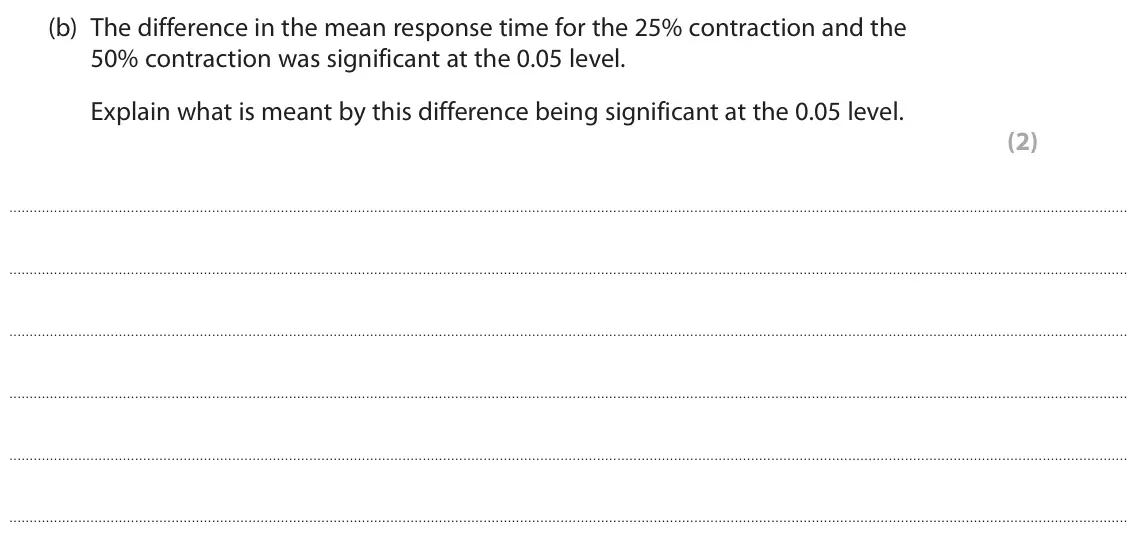
Q6(c)
The whole paper ↗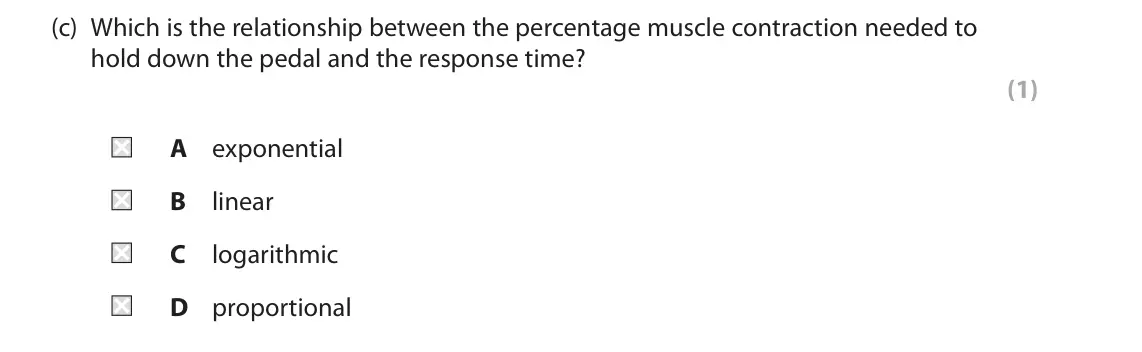
Q6(d)
The whole paper ↗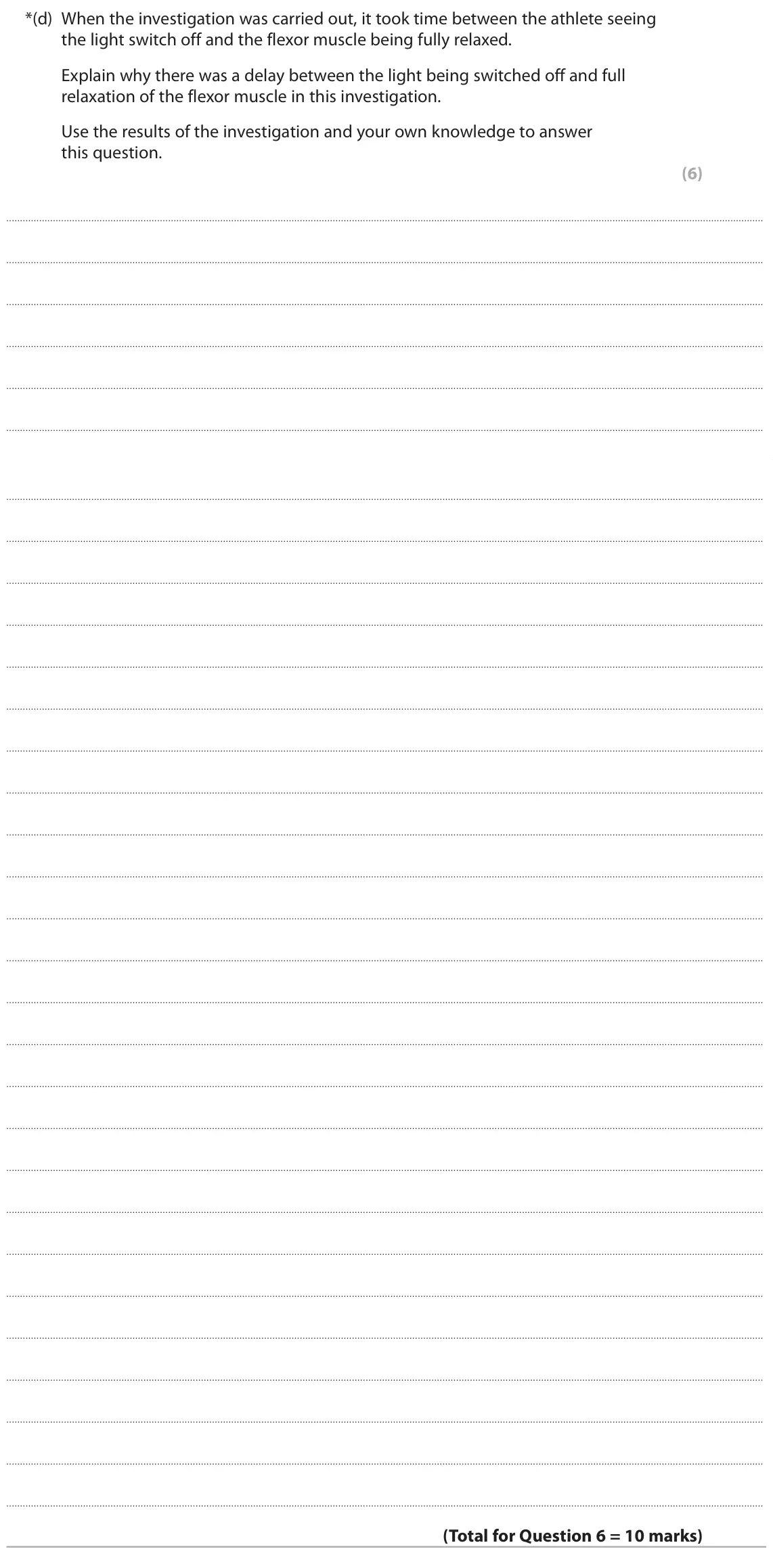
Q8(g)
The whole paper ↗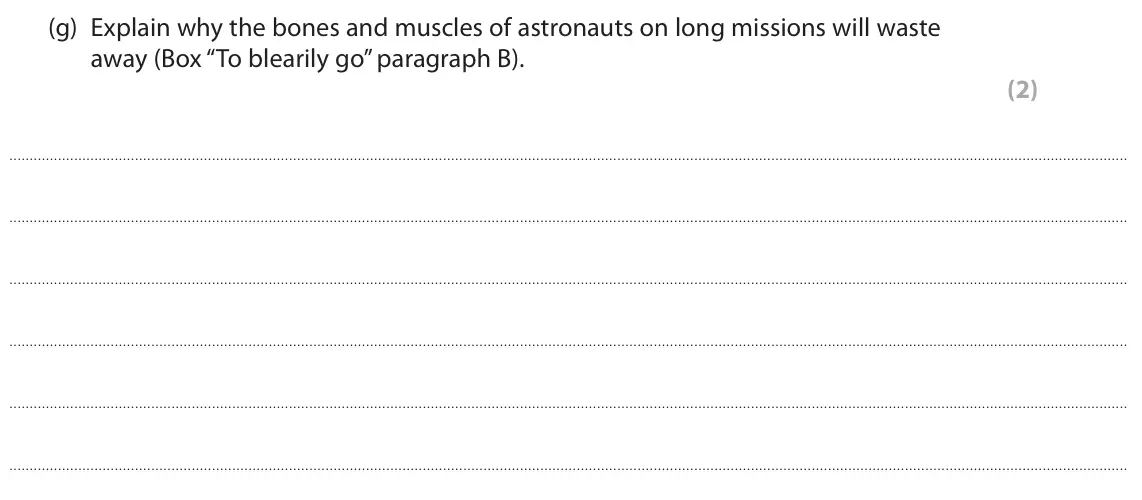
Q8(h)
The whole paper ↗
Q3(a)
The whole paper ↗
Q8(b)(i)
The whole paper ↗
Q10(a)
The whole paper ↗
Q7(a)(ii)
The whole paper ↗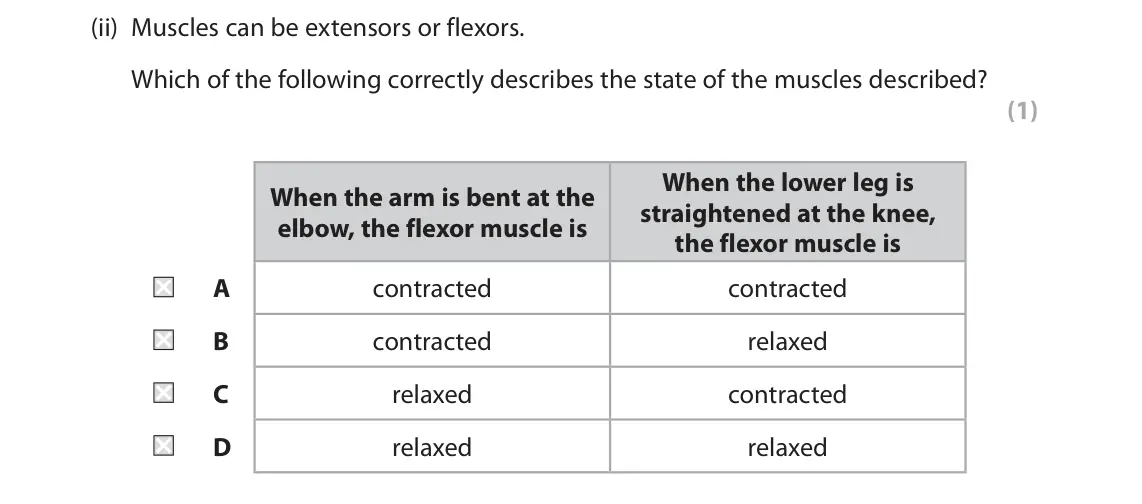
Q7(b)(i)
The whole paper ↗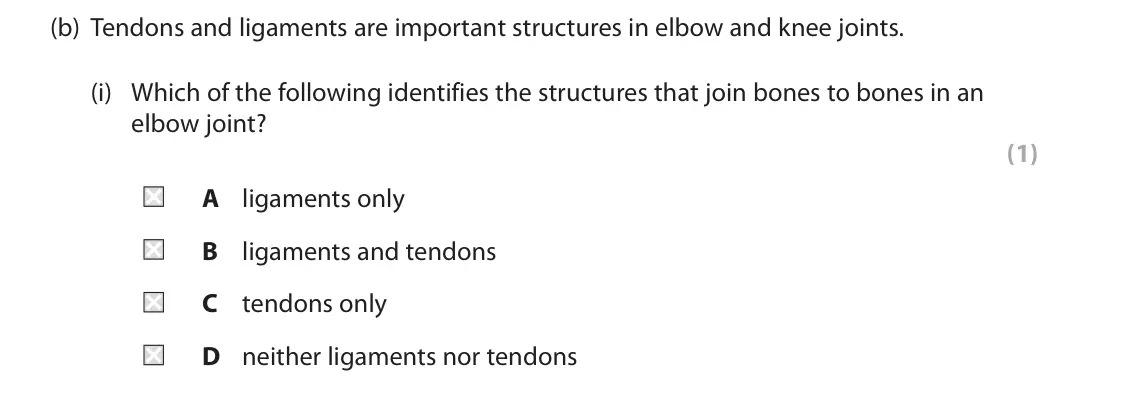
Q9(a)
The whole paper ↗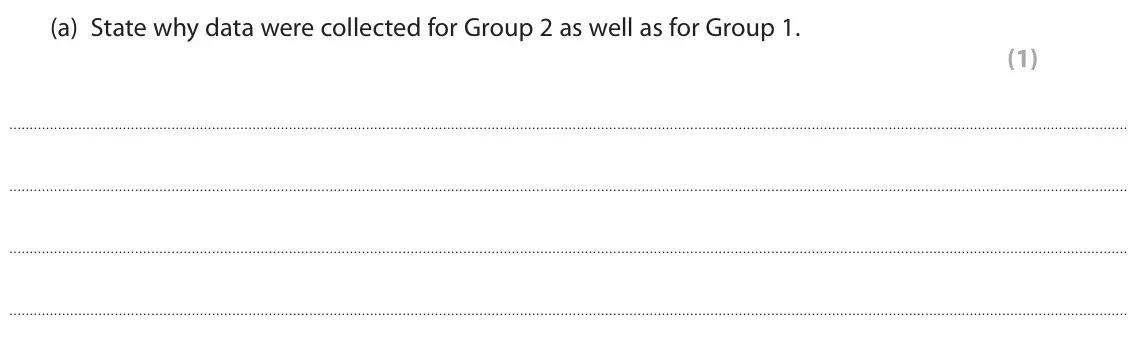
Q9(b)(i)
The whole paper ↗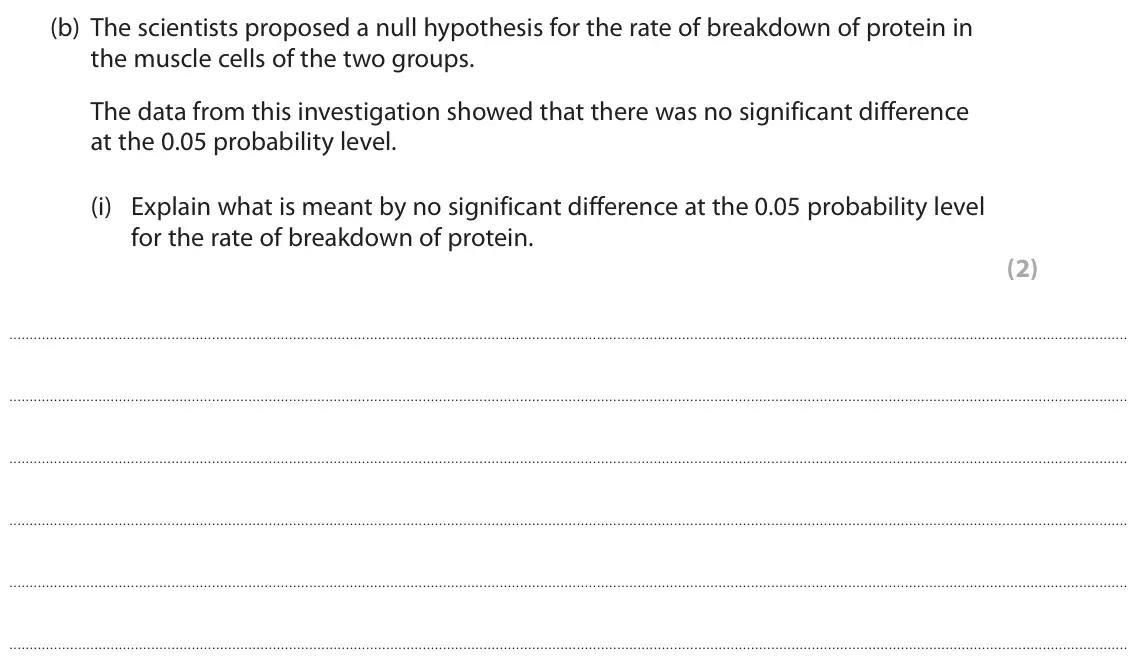
Q9(b)(ii)
The whole paper ↗
Q9(c)
The whole paper ↗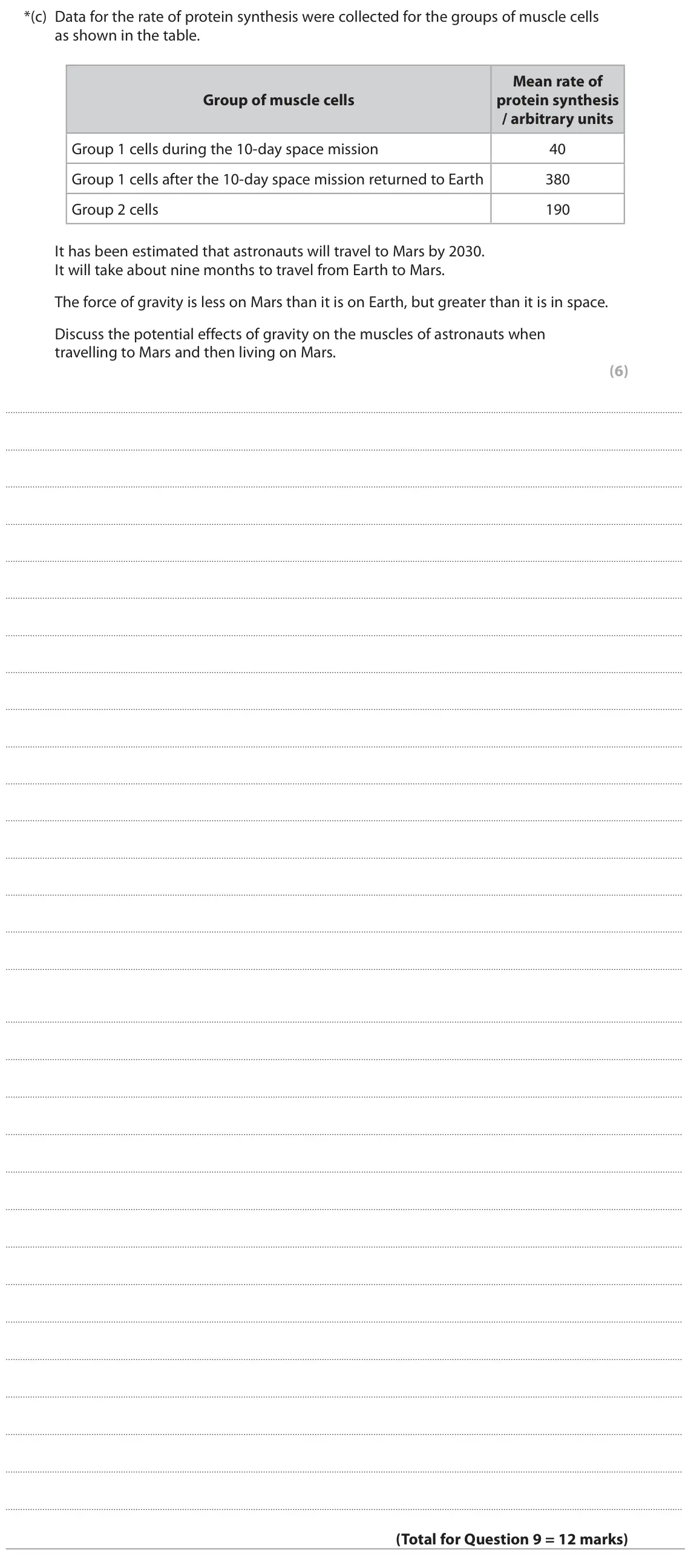
Q5(a)
The whole paper ↗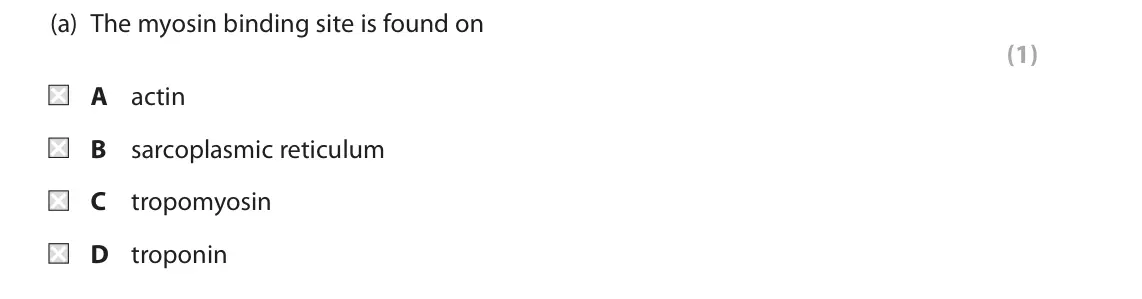
Q5(c)(i)
The whole paper ↗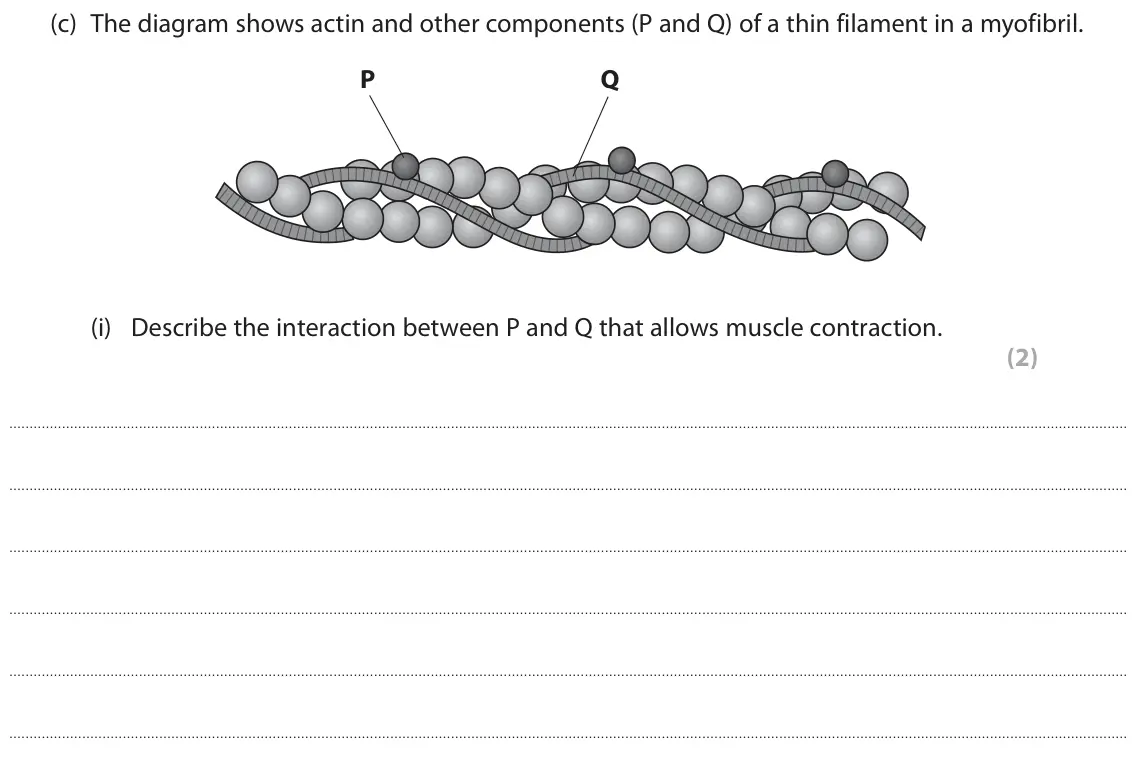
Q3(c)(i)
The whole paper ↗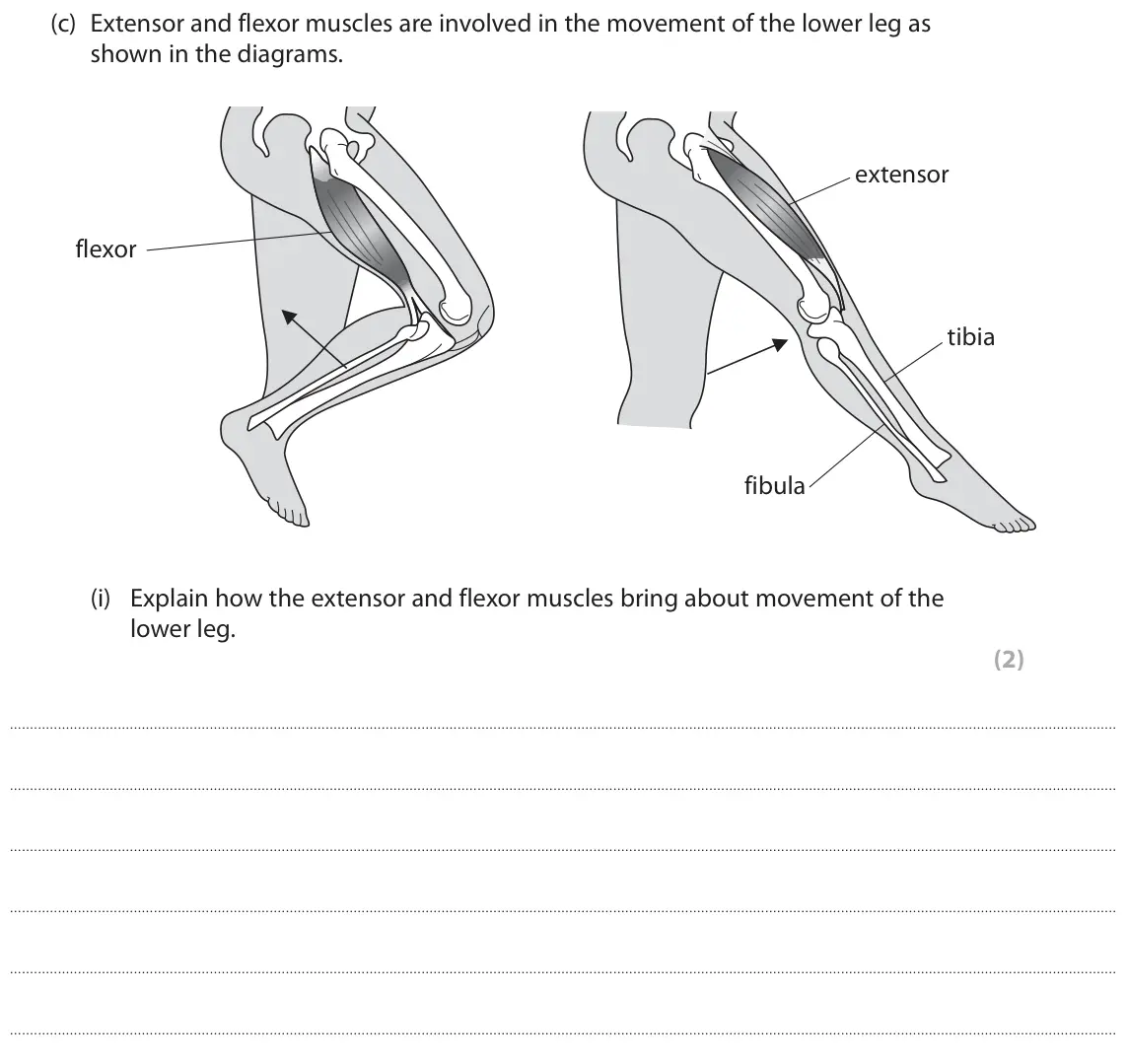
Q5(a)
The whole paper ↗
Q5(b)(i)
The whole paper ↗
All 25 questions on Muscles and movement, as a list
- June 2025, Paper 2, Q6(a) (1 mark): State the type of muscle that works antagonistically with a flexor muscle. (1)
- June 2025, Paper 2, Q6(b) (2 marks): The difference in the mean response time for the 25% contraction and the 50% contraction was significant at the 0.05 level. Explain what is meant by this differ
- June 2025, Paper 2, Q6(c) (1 mark): Which is the relationship between the percentage muscle contraction needed to hold down the pedal and the response time? (1) A exponential B linear C logarithmi
- June 2025, Paper 2, Q6(d) (6 marks): When the investigation was carried out, it took time between the athlete seeing the light switch off and the flexor muscle being fully relaxed. Explain why ther
- June 2025, Paper 3, Q8(g) (2 marks): Explain why the bones and muscles of astronauts on long missions will waste away (Box “To blearily go” paragraph B). (2)
- June 2024, Paper 3, Q8(h) (3 marks): Sloths spend a lot of time hanging upside down – ‘constant grip is made possible by a lattice of tendons in the hands and feet that draw the digits closed’ (par
- June 2023, Paper 2, Q3(a) (1 mark): Which of the following describes the structure and function of a ligament? (1) A elastic and attaches bone to bone B elastic and attaches muscle to bone C non-e
- June 2023, Paper 2, Q8(b)(i) (3 marks): Explain how the myosin head could move mitochondria along the axon. (3)
- June 2022, Paper 2, Q10(a) (2 marks): Explain one way in which cartilage at the ends of the bones in the knee joint reduces wear and tear. (2)
- November 2021, Paper 2, Q7(a)(ii) (1 mark): Muscles can be extensors or flexors. Which of the following correctly describes the state of the muscles described? (1) When the lower leg is When the arm is be
- November 2021, Paper 2, Q7(b)(i) (1 mark): Which of the following identifies the structures that join bones to bones in an elbow joint? (1) A ligaments only B ligaments and tendons C tendons only D neith
- November 2021, Paper 2, Q9(a) (1 mark): State why data were collected for Group 2 as well as for Group 1. (1)
- November 2021, Paper 2, Q9(b)(i) (2 marks): Explain what is meant by no significant difference at the 0.05 probability level for the rate of breakdown of protein. (2)
- November 2021, Paper 2, Q9(b)(ii) (3 marks): Some of the myosin in the muscle cells was broken down. Describe how the tertiary structure of myosin is related to its function. (3)
- November 2021, Paper 2, Q9(c) (6 marks): Data for the rate of protein synthesis were collected for the groups of muscle cells as shown in the table. Mean rate of Group of muscle cells protein synthesis
- June 2019, Paper 2, Q5(a) (1 mark): The myosin binding site is found on (1) A actin B sarcoplasmic reticulum C tropomyosin D troponin
- June 2019, Paper 2, Q5(c)(i) (2 marks): Describe the interaction between P and Q that allows muscle contraction. (2)
- June 2018, Paper 2, Q3(c)(i) (2 marks): Explain how the extensor and flexor muscles bring about movement of the lower leg. (2)
- June 2018, Paper 3, Q5(a) (3 marks): Describe the role of calcium ions in the contraction of muscle fibres. (3)
- June 2018, Paper 3, Q5(b)(i) (2 marks): Give one advantage and one disadvantage of using muscle fibres from the same sample of muscle. (2) Advantage: Disadvantage:
- June 2018, Paper 3, Q5(b)(ii) (4 marks): The results are shown in the graph. 1.0 0.8 0.6 0.4 0.2 0.0 0 1 2 3 4 Calcium ion concentration / a.u. Explain the effect of increasing calcium ion concentratio
- June 2017, Paper 2, Q7(a) (1 mark): Which of the following is molecule S? (1) A actin B myosin C tropomyosin D troponin
- June 2017, Paper 2, Q7(b)(i) (2 marks): Describe the changes caused when calcium ions bind to the molecules shown in the diagram. (2)
- June 2017, Paper 2, Q7(b)(ii) (4 marks): Explain how these changes cause muscles to contract. (4)
- June 2017, Paper 2, Q7(c) (3 marks): Describe how the concentration of calcium ions around the myofibrils is controlled. (3)
Questions, mark schemes and examiner’s reports are © Pearson Edexcel, from their published past papers. Plumi isn’t affiliated with any exam board. Want whole papers? Every Edexcel A-Level Biology A paper.
Rather write your answers by hand on iPad? Plumi marks them against the same mark schemes.