 plumi
Proteins and enzymes: Edexcel A‑Level Biology A questions
Every Edexcel A-Level Biology A exam question on Proteins and enzymes (specification points 2.9–2.10), 2016–2025, with its mark scheme and examiner’s report.
Find questions1,749
Calculations
Q3(c)(ii)
The whole paper ↗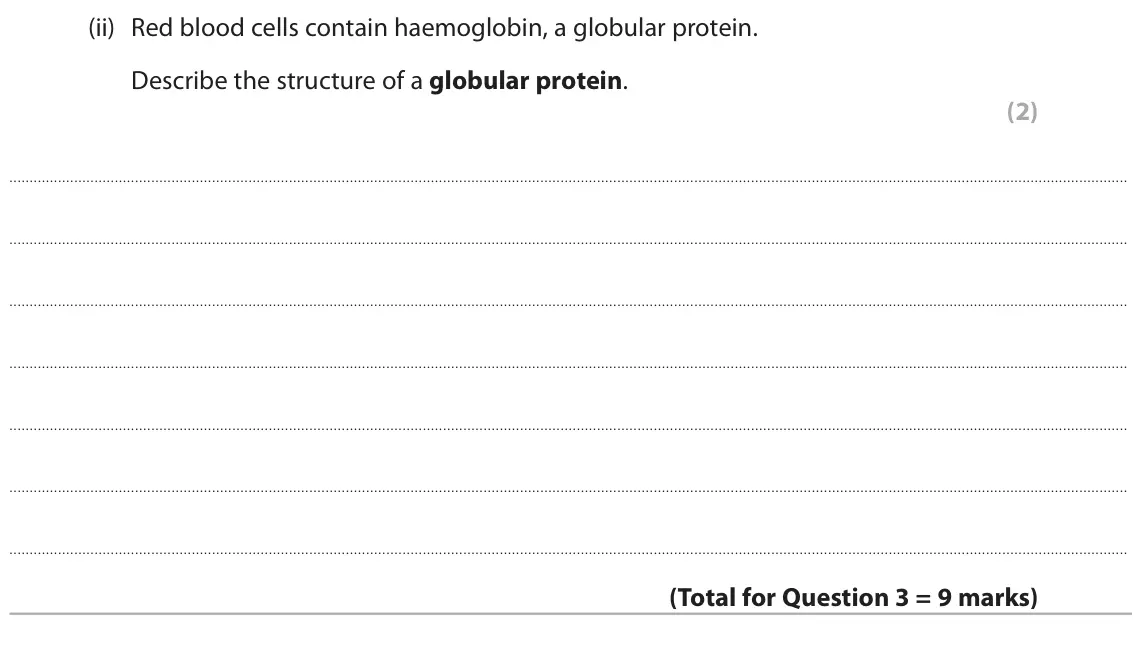
Q10(a)(ii)
The whole paper ↗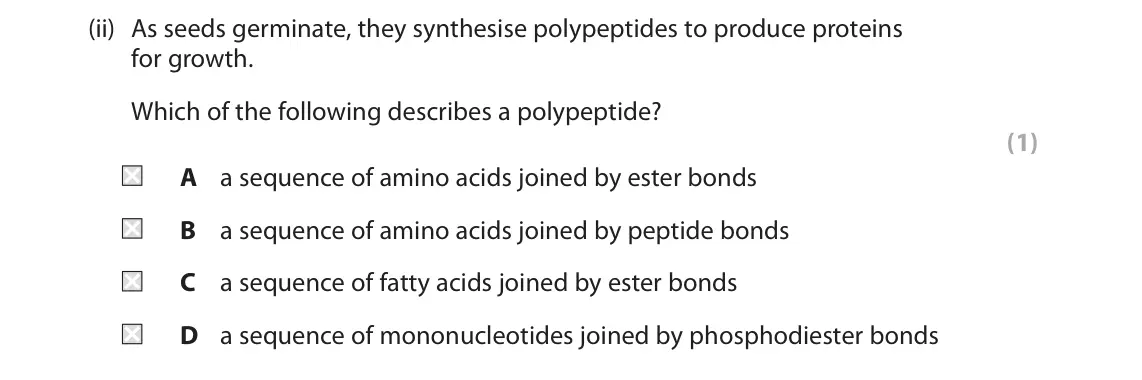
Q8(b)(i)
The whole paper ↗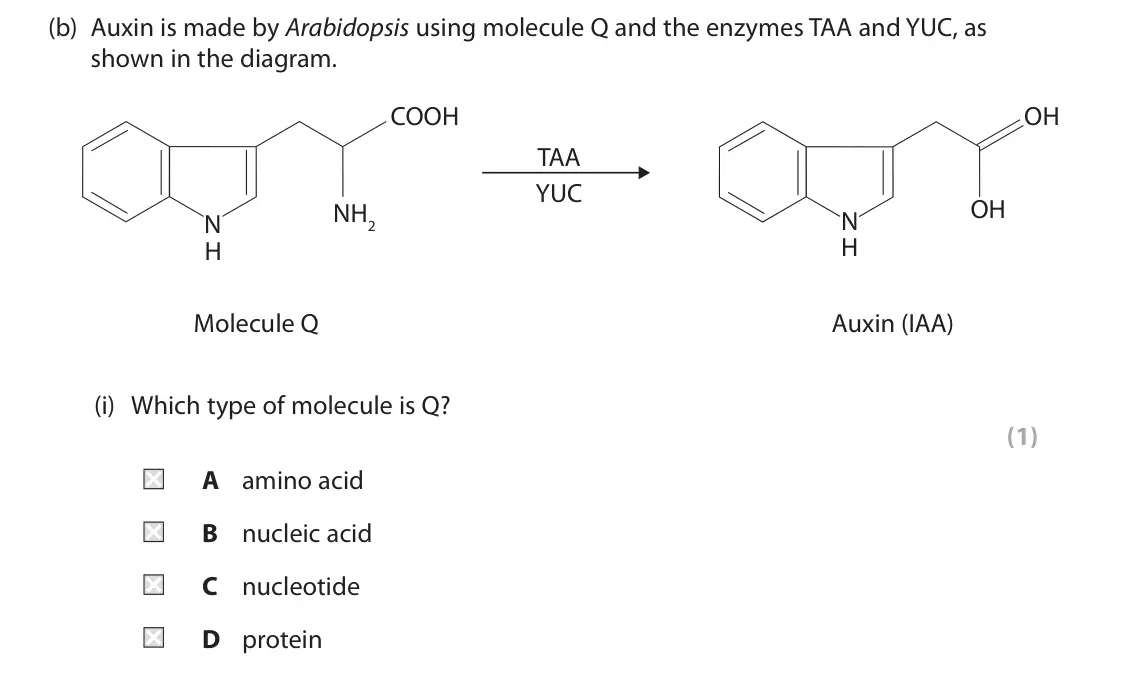
Q8(f)
The whole paper ↗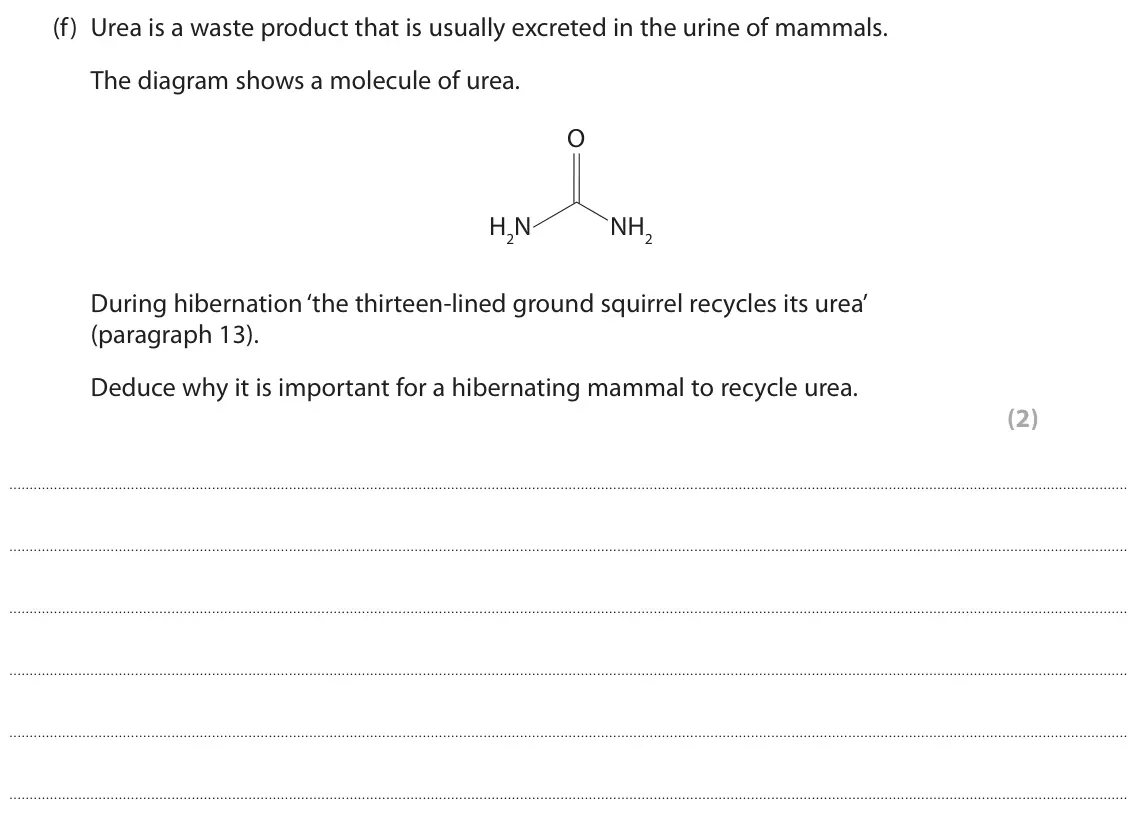
Q6(a)(ii)
The whole paper ↗
Q6(b)(i)
The whole paper ↗
Q6(b)(ii)
The whole paper ↗
Q6(c)
The whole paper ↗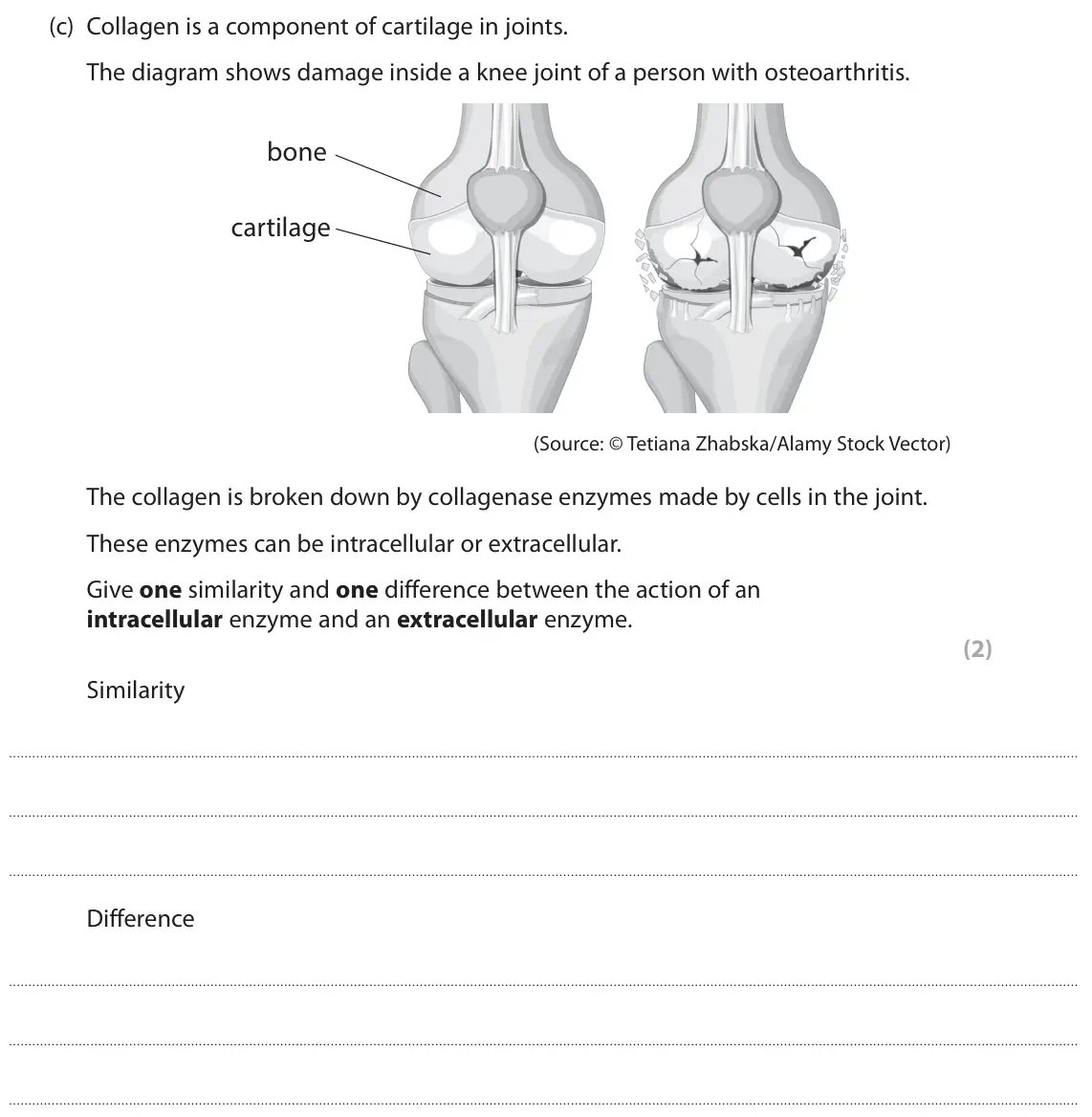
Q6(d)(i)
The whole paper ↗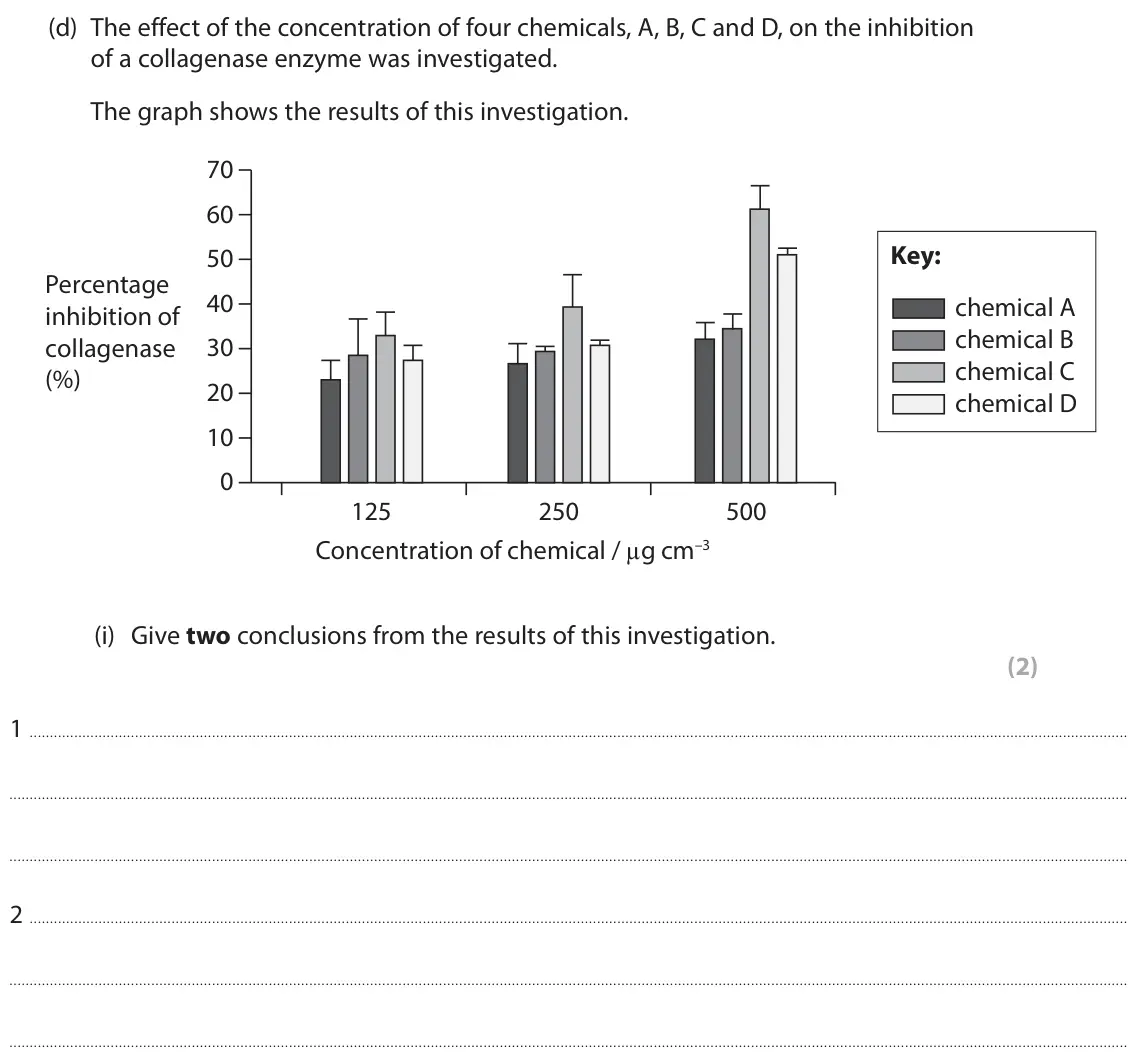
Q6(d)(ii)
The whole paper ↗
Q4(c)
The whole paper ↗
Q8(a)(i)
The whole paper ↗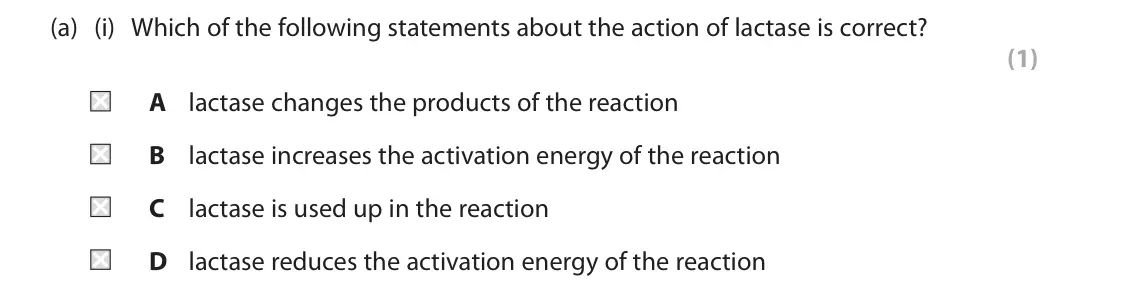
Q8(a)(iii)
The whole paper ↗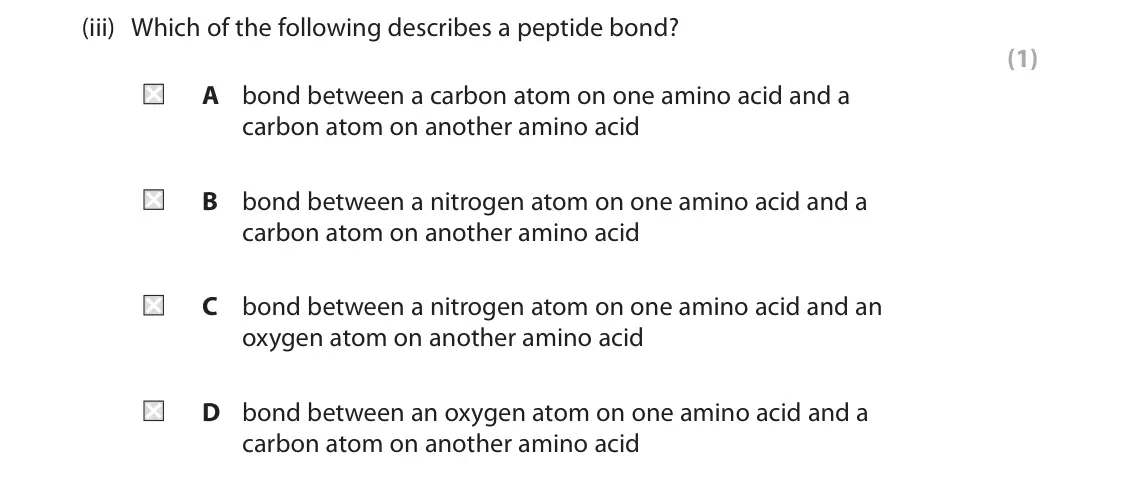
Q5(b)
The whole paper ↗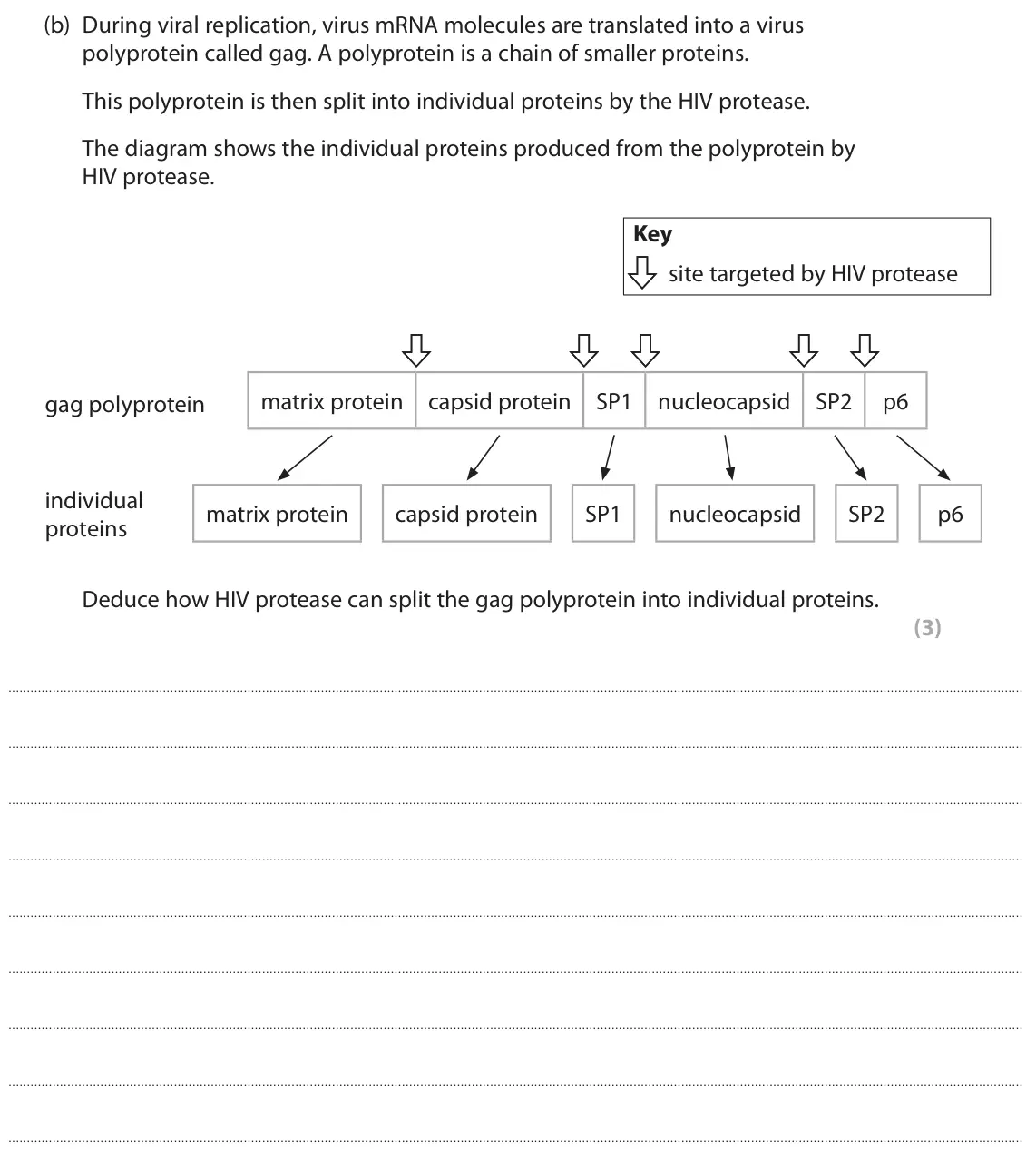
Q5(c)(i)
The whole paper ↗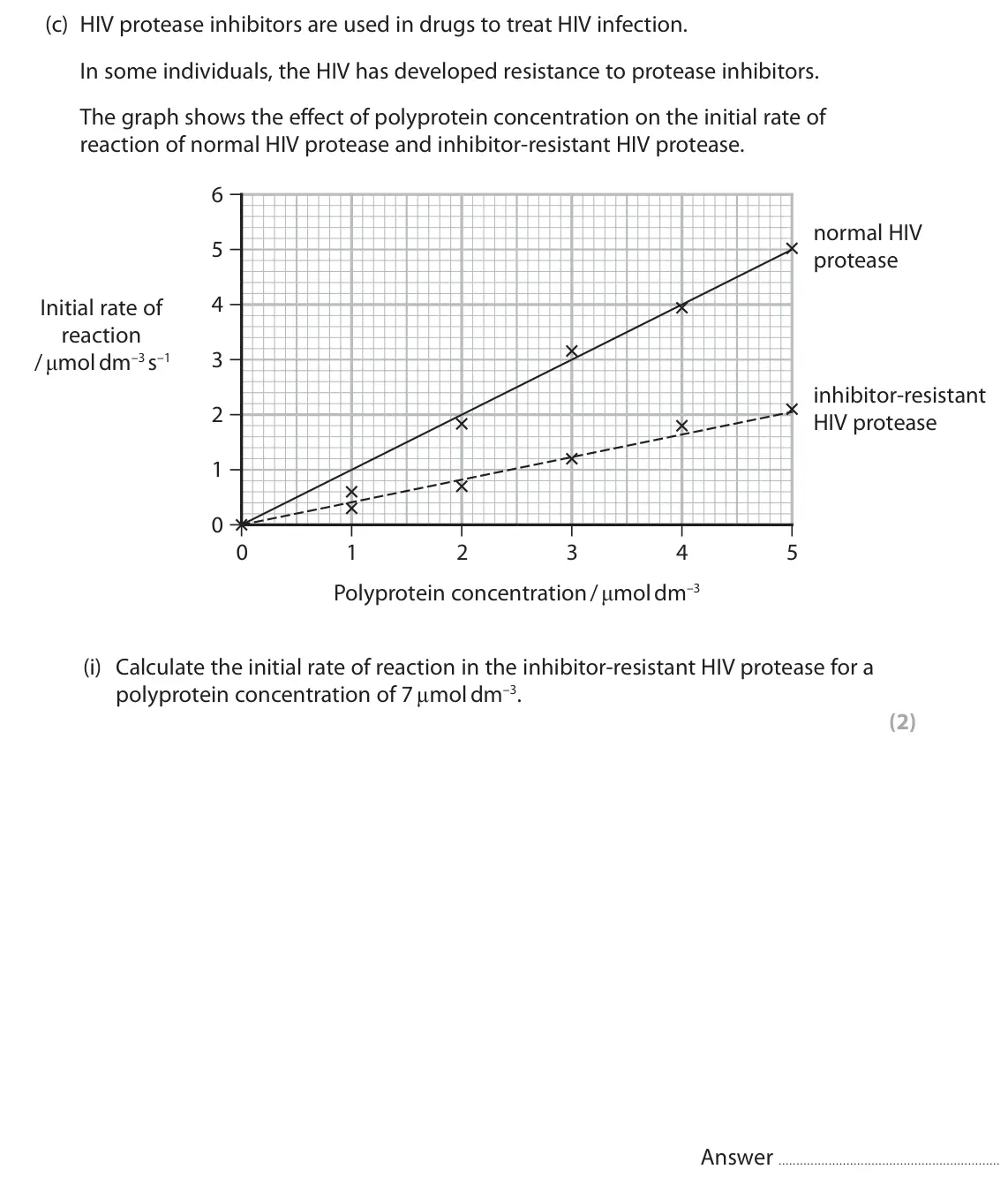
Q5(c)(ii)
The whole paper ↗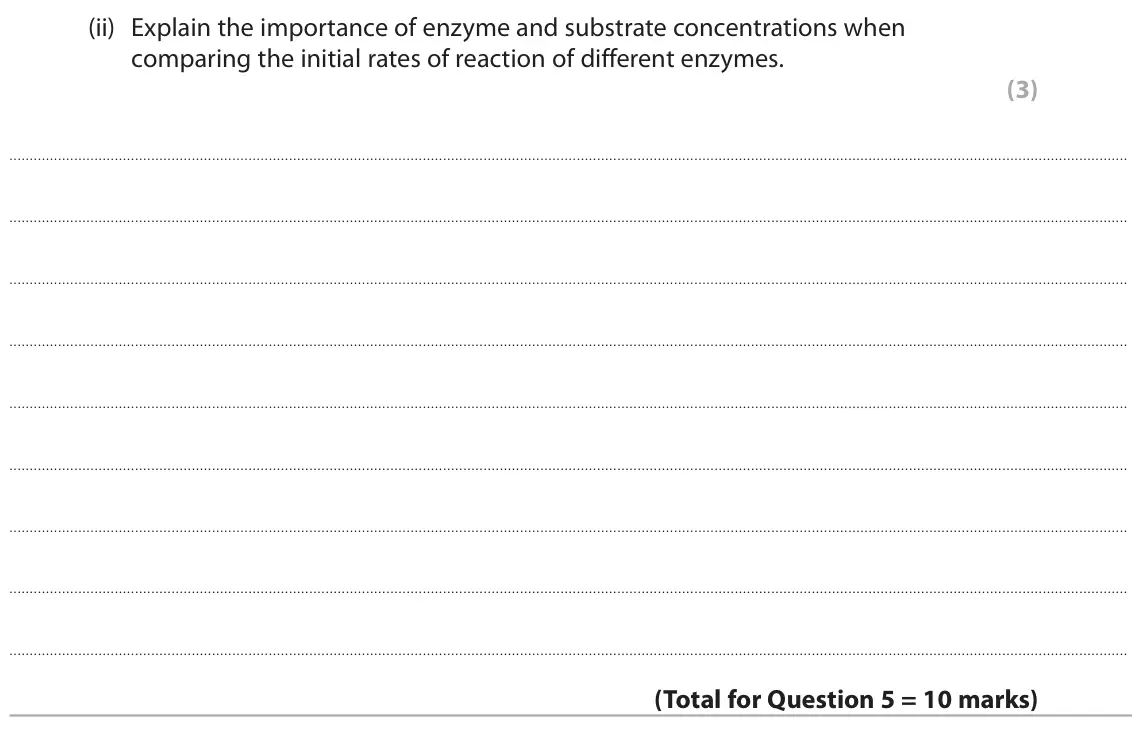
Q8(i)
The whole paper ↗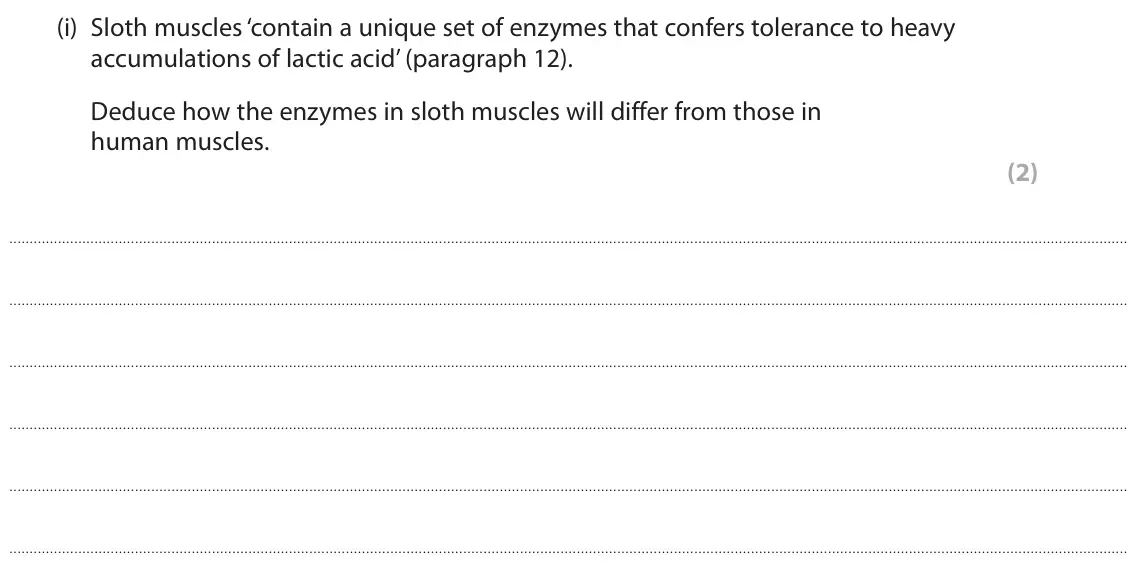
Q3(b)(i)
The whole paper ↗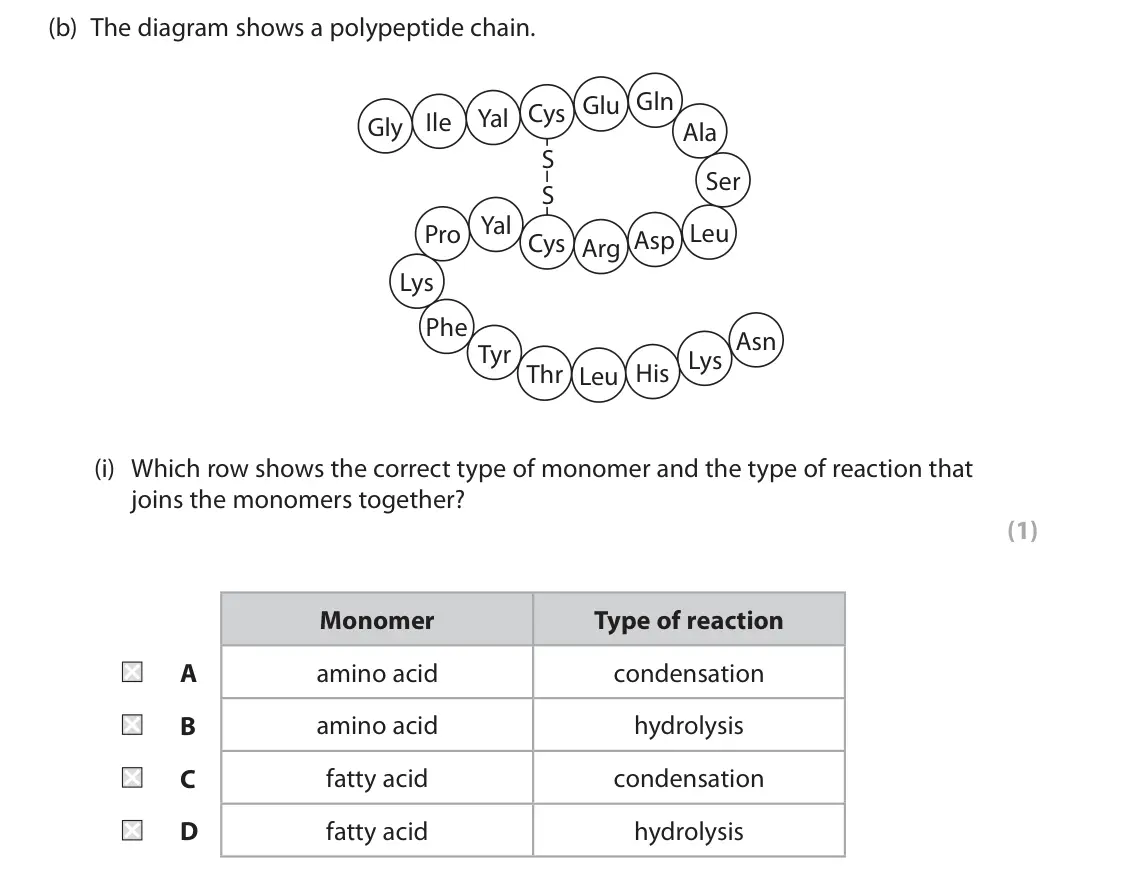
Q3(b)(ii)
The whole paper ↗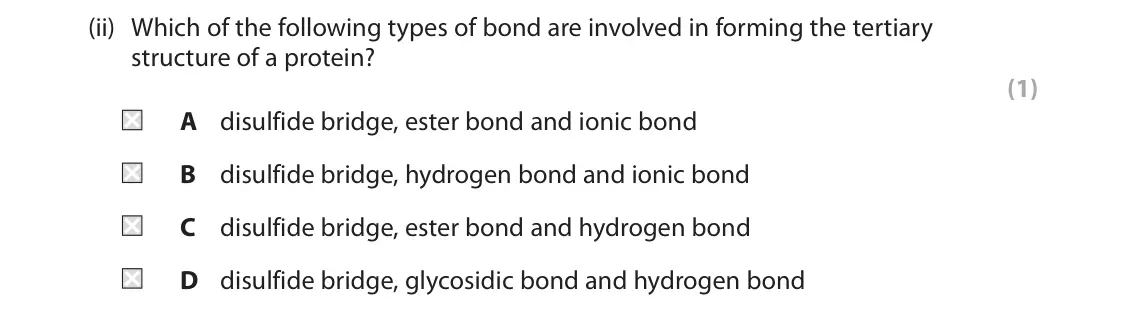
All 73 questions on Proteins and enzymes, as a list
- June 2025, Paper 1, Q3(c)(ii) (2 marks): Red blood cells contain haemoglobin, a globular protein. Describe the structure of a globular protein. (2)
- June 2025, Paper 1, Q10(a)(ii) (1 mark): As seeds germinate, they synthesise polypeptides to produce proteins for growth. Which of the following describes a polypeptide? (1) A a sequence of amino acids
- June 2025, Paper 2, Q8(b)(i) (1 mark): Which type of molecule is Q? (1) A amino acid B nucleic acid C nucleotide D protein
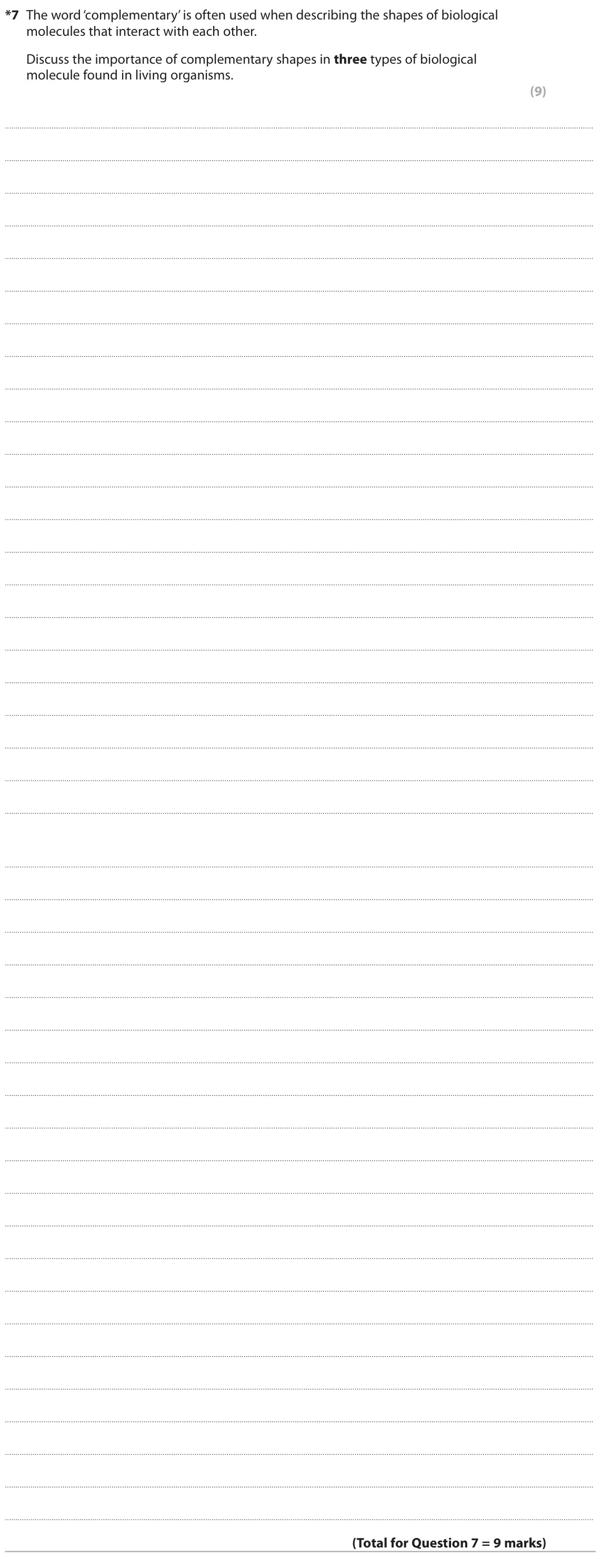
- June 2025, Paper 3, Q7 (9 marks): *7 The word ‘complementary’ is often used when describing the shapes of biological molecules that interact with each other. Discuss the importance of complement
- June 2025, Paper 3, Q8(f) (2 marks): Urea is a waste product that is usually excreted in the urine of mammals. The diagram shows a molecule of urea. O H2N NH2 During hibernation ‘the thirteen-lined
- June 2025, AS Paper 1, Q6(a)(ii) (2 marks): Describe the structure of collagen. (2)
- June 2025, AS Paper 1, Q6(b)(i) (1 mark): Give one other property of collagen. (1)
- June 2025, AS Paper 1, Q6(b)(ii) (2 marks): Explain why collagen has a low solubility in water. (2)
- June 2025, AS Paper 1, Q6(c) (2 marks): Collagen is a component of cartilage in joints. The diagram shows damage inside a knee joint of a person with osteoarthritis. bone cartilage (Source: © Tetiana
- June 2025, AS Paper 1, Q6(d)(i) (2 marks): Give two conclusions from the results of this investigation. (2) 1 2
- June 2025, AS Paper 1, Q6(d)(ii) (2 marks): Describe how the initial rate of reaction for collagenase could be calculated. (2)
- June 2024, Paper 1, Q4(c) (3 marks): The most common mutation in the CFTR gene produces a protein that has the incorrect shape. Explain why a change in the primary structure of a protein changes th
- June 2024, Paper 1, Q8(a)(i) (1 mark): Which of the following statements about the action of lactase is correct? (1) A lactase changes the products of the reaction B lactase increases the activation
- June 2024, Paper 2, Q8(a)(iii) (1 mark): Which of the following describes a peptide bond? (1) A bond between a carbon atom on one amino acid and a carbon atom on another amino acid B bond between a nit
- June 2024, Paper 3, Q5(b) (3 marks): During viral replication, virus mRNA molecules are translated into a virus polyprotein called gag. A polyprotein is a chain of smaller proteins. This polyprotei
- June 2024, Paper 3, Q5(c)(i) (2 marks): Calculate the initial rate of reaction in the inhibitor‑resistant HIV protease for a polyprotein concentration of 7 µmol dm–3. (2) Answer
- June 2024, Paper 3, Q5(c)(ii) (3 marks): Explain the importance of enzyme and substrate concentrations when comparing the initial rates of reaction of different enzymes. (3)
- June 2024, Paper 3, Q8(i) (2 marks): Sloth muscles ‘contain a unique set of enzymes that confers tolerance to heavy accumulations of lactic acid’ (paragraph 12). Deduce how the enzymes in sloth mus
- June 2024, AS Paper 1, Q3(b)(i) (1 mark): Which row shows the correct type of monomer and the type of reaction that joins the monomers together? (1) Monomer Type of reaction A amino acid condensation B
- June 2024, AS Paper 1, Q3(b)(ii) (1 mark): Which of the following types of bond are involved in forming the tertiary structure of a protein? (1) A disulfide bridge, ester bond and ionic bond B disulfide
- June 2024, AS Paper 1, Q4(b) (3 marks): Collagen and haemoglobin are proteins associated with the cardiovascular system. Give three differences between the structures of collagen and haemoglobin. (3)
- June 2024, AS Paper 1, Q6(b)(i) (6 marks): Explain how to carry out a valid investigation to collect the data shown in the table. (6)
- June 2024, AS Paper 1, Q6(b)(ii) (4 marks): Comment on the effects of enzyme concentration and temperature in this investigation. (4)
- June 2023, Paper 1, Q6(b)(iii) (3 marks): Explain why a change in the base sequence of the gene coding for myoglobin could change its tertiary structure. (3)
- June 2023, Paper 2, Q9(a)(ii) (3 marks): Rhodopsin is made of protein and retinal. The structure of rhodopsin can be studied by measuring the ratio of light absorbed at 280 nm and at 500 nm. The table
- June 2023, Paper 3, Q8(j) (3 marks): Sketch a graph to compare the effect of substrate concentration on the rate of reaction of catalase and peroxidase (paragraphs 19 and 20). Include suitable unit
- June 2023, AS Paper 1, Q3(a) (2 marks): Amylase is a biological catalyst. State what is meant by the term biological catalyst. (2)
- June 2023, AS Paper 1, Q3(b)(iii) (1 mark): Which of the following shows the correct unit for the rate of this reaction? (1) A mg dm3 min1 B mg dm–3 min1 C mg dm3 min–1 D mg dm–3 min–1
- June 2023, AS Paper 1, Q3(d) (2 marks): The diagram shows part of another molecule. H2COH H H2COH OH H H H O O O O H OH H H OH H OH H H O O H H O H H OH H2COH H OH The enzyme amylase cannot hydrolyse
- June 2022, Paper 1, Q4(b)(i) (2 marks): The GM fungus transcribes and translates the gene for this protein. Describe the primary structure of a protein. (2)
- June 2022, Paper 1, Q5(a) (4 marks): Explain why this mutation may prevent the enzyme involved in the production of haem from functioning correctly. (4)
- June 2022, Paper 3, Q7 (9 marks): *7 The human genome codes for approximately 20 000 different proteins. The pie chart shows the proportion of proteins carrying out different functions. defence
- June 2022, AS Paper 1, Q3(b)(i) (1 mark): How many of the following types of bond can be made when a protein is formed? • disulfide • hydrogen • ionic • peptide (1) A one B two C three D four
- June 2022, AS Paper 1, Q3(b)(ii) (3 marks): The diagram shows a complete R group. Complete the diagram to show the position of this R group in an amino acid. (3) CH2 H N C H C C N H
- June 2022, AS Paper 1, Q7(a) (2 marks): Calculate the initial rate of reaction from this graph. Give your answer to one decimal place. (2) mg per 100 cm3 min−1
- June 2022, AS Paper 1, Q7(b) (6 marks): The effect of sucrose concentration on the initial rate of reaction was investigated. A solution containing 2% sucrase was added to sucrose solutions of differe
- June 2022, AS Paper 1, Q7(c) (2 marks): The rate of a reaction, controlled by an enzyme, can be affected by an enzyme inhibitor. An enzyme inhibitor can change the shape of an enzyme as shown in the d
- November 2021, Paper 2, Q9(b)(ii) (3 marks): Some of the myosin in the muscle cells was broken down. Describe how the tertiary structure of myosin is related to its function. (3)
- November 2021, AS Paper 1, Q7(a)(i) (1 mark): Name a piece of apparatus that would be used to measure the light absorbance of this mixture. (1)
- November 2021, AS Paper 1, Q7(a)(ii) (3 marks): Calculate the initial rate of reaction for this experiment. (3) Answer
- November 2021, AS Paper 1, Q7(a)(iii) (1 mark): Draw a line on the graph to show the expected trend if a 5% amylase solution was used instead. (1)
- November 2021, AS Paper 1, Q7(b) (3 marks): Explain why the light absorbance of the mixture changed over time. (3)
- October 2020, Paper 1, Q1(b)(ii) (3 marks): Cells in people with these diseases produce incorrectly folded enzyme molecules. Explain why enzymes that are incorrectly folded cannot carry out their function
- October 2020, Paper 2, Q6(b) (4 marks): The stinger injects a venom that contains the enzyme phospholipase. This enzyme hydrolyses phospholipids, releasing fatty acids. Describe how the structure of p
- October 2020, AS Paper 1, Q4(a)(i) (2 marks): The protein prothrombin is composed of monomers called amino acids. Complete the diagram to show the structure of an amino acid. (2) R C H
- October 2020, AS Paper 1, Q4(a)(ii) (1 mark): Name the products formed when several amino acids are joined together. (1)
- June 2019, Paper 1, Q7(a) (2 marks): Describe how a peptide bond is formed. (2)
- June 2019, Paper 2, Q5(b) (3 marks): Actin and collagen are both proteins. The diagram shows two filaments of actin from a muscle fibre. Each filament is a polymer of repeating globular protein uni
- June 2019, Paper 2, Q5(c)(ii) (3 marks): The thick filament in a myofibril contains myosin. The myosin head contains the enzyme ATPase. Explain the importance of the primary structure for the functioni
- June 2019, Paper 2, Q7(a)(iii) (2 marks): During protein synthesis, two amino acids are joined together to form a dipeptide. The diagram shows two identical amino acids. Complete the diagram to show how
- June 2019, AS Paper 1, Q2(c) (2 marks): Sucralose is a disaccharide that has been modified from sucrose. The enzyme sucrase is used to break down sucrose into glucose and fructose. Sucralose cannot be
- June 2019, AS Paper 1, Q3(b)(iii) (4 marks): Explain how a change of one amino acid could lead to a change in the structure and properties of the haemoglobin protein. (4)
- June 2019, AS Paper 1, Q6(a)(i) (1 mark): Draw a circle around the amine group on the diagram of an amino acid. (1) R H O N C C OH H H
- June 2019, AS Paper 1, Q6(a)(ii) (1 mark): The R group differs between the amino acids. The R group may contain elements that are not found in a carbohydrate. Name one of these elements. (1)
- June 2018, Paper 1, Q4(a)(iii) (3 marks): Describe how the primary structure of leptin enables it to be soluble in water. (3)
- June 2018, Paper 1, Q8(a) (1 mark): State the type of chemical reaction catalysed by trypsin. (1)
- June 2018, Paper 1, Q8(d) (2 marks): In an experiment, the effect of enzyme concentration on the activity of human trypsin was measured. The results are shown in the graph. 1.6 1.4 1.2 1.0 0.8 0.6
- June 2018, Paper 2, Q9(b) (3 marks): The active site of the plasmin enzyme binds to the amino acid lysine on the fibrin protein molecule. Plasmin binds to part of the fibrin molecule in order to br
- June 2018, Paper 2, Q9(c)(ii) (6 marks): Scientists are developing new plasmin inhibitors. Devise an investigation, using fibrin plates, to compare the effectiveness of a new inhibitor with tranexamic
- June 2018, Paper 2, Q10(a) (1 mark): Enzymes work by (1) A increasing the activation energy of a reaction B lowering the activation energy of a reaction C providing energy to the reactants D removi
- June 2018, AS Paper 1, Q1(a)(iv) (1 mark): Which of these molecules could be joined to another molecule of the same type by a peptide bond? (1) A B C D
- June 2017, Paper 1, Q6(a)(i) (2 marks): Calculate the initial rate of reaction. (2) Answer
- June 2017, Paper 1, Q6(a)(ii) (1 mark): On the graph, draw a line to show the effect of halving the concentration of thrombin. (1)
- June 2017, Paper 1, Q7(a)(i) (3 marks): Describe the structure of collagen. (3)
- June 2017, Paper 1, Q7(a)(ii) (1 mark): Give a function for collagen in the blood-gas barrier. (1)
- June 2017, Paper 3, Q7(e) (3 marks): Explain how the unfolding of the enzymes in E. coli makes them ‘become ineffective at 60 °C’ (paragraph 12). (3)
- June 2017, AS Paper 1, Q5(a) (1 mark): Which of the following contains nitrogen atoms? (1) A carbohydrate B glycogen C lipid D protein
- June 2017, AS Paper 1, Q8(a) (1 mark): State why enzymes are described as biological catalysts. (1)
- June 2017, AS Paper 1, Q8(b)(i) (4 marks): Compare and contrast the molecular structure of collagen and an enzyme such as arazyme. (4)
- June 2017, AS Paper 1, Q8(b)(ii) (4 marks): The hydrolysis of collagen results in a decrease in pH. The indicator phenolphthalein is pink at pH 8 and becomes colourless at lower pH values. Devise an inves
- June 2017, AS Paper 1, Q8(c) (4 marks): The effect of substrate concentration on the rate of an enzyme reaction was investigated. Two substrate solutions, A and B, were used. Solution A had a higher c
- June 2016, AS Paper 1, Q2(c) (4 marks): Haemophilia is a disease that affects blood clotting. People with haemophilia are sometimes given a protein called factor VIII. Factor VIII is an enzyme that is
- June 2016, AS Paper 1, Q5(a) (4 marks): Compare and contrast the molecular structures of globular and fibrous proteins. (4)
Questions, mark schemes and examiner’s reports are © Pearson Edexcel, from their published past papers. Plumi isn’t affiliated with any exam board. Want whole papers? Every Edexcel A-Level Biology A paper.
Rather write your answers by hand on iPad? Plumi marks them against the same mark schemes.