 plumi
Second Law and engines: AQA A‑Level Physics questions
AQA A-Level Physics past-paper questions on 3.11.2.5 Second Law and engines, 2008–2025, with mark schemes and examiner’s reports where available.
Paper
All papers
Exam
All years
Calculations
Q03.5
The whole paper ↗Q03.6
The whole paper ↗Q04.3
The whole paper ↗Q04.4
The whole paper ↗Q05.1
The whole paper ↗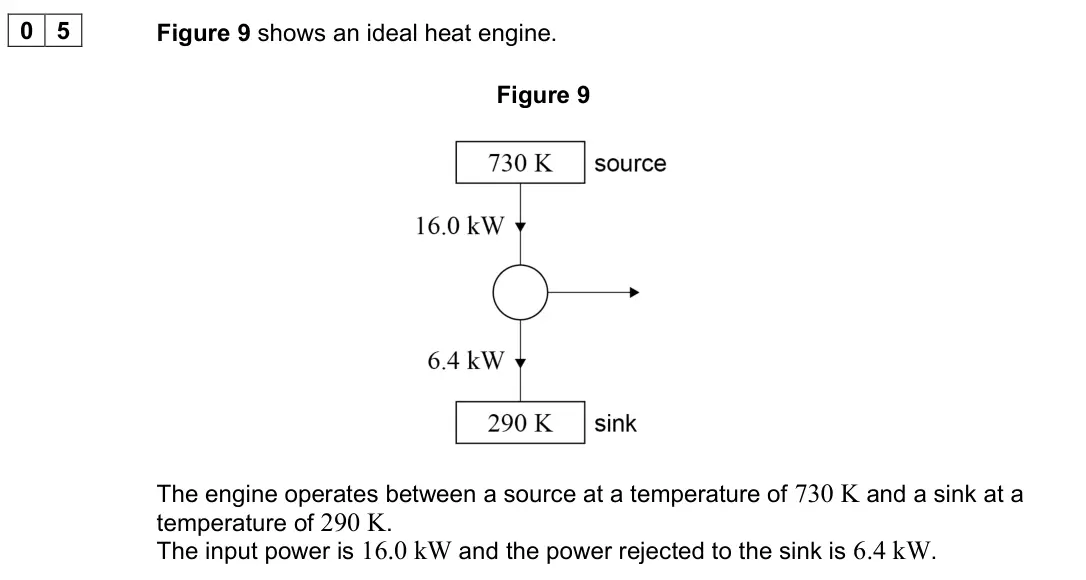
Q05.2
The whole paper ↗Q05.1
The whole paper ↗Q05.2
The whole paper ↗Q05.1
The whole paper ↗Q05.2
The whole paper ↗Q03.5
The whole paper ↗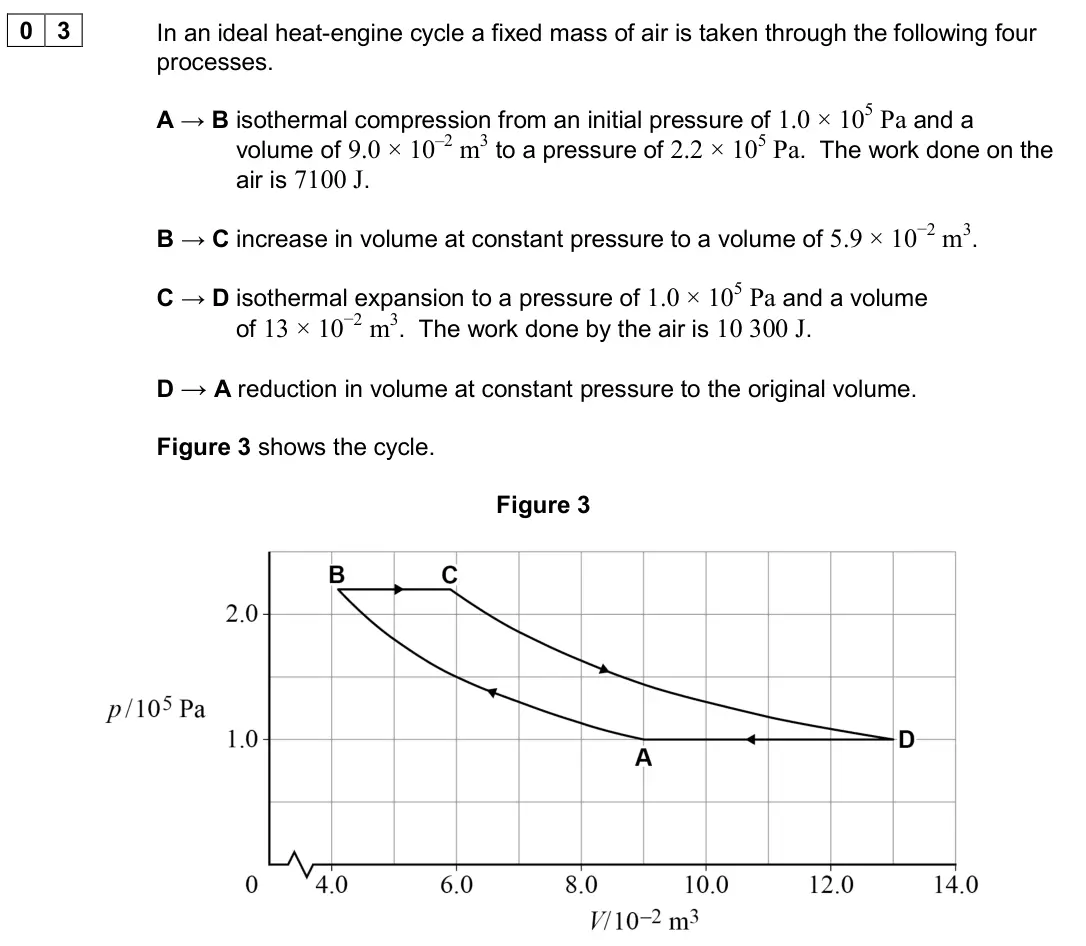
Q03.6
The whole paper ↗Q04.1
The whole paper ↗
Q04.2
The whole paper ↗Q4(a)
The whole paper ↗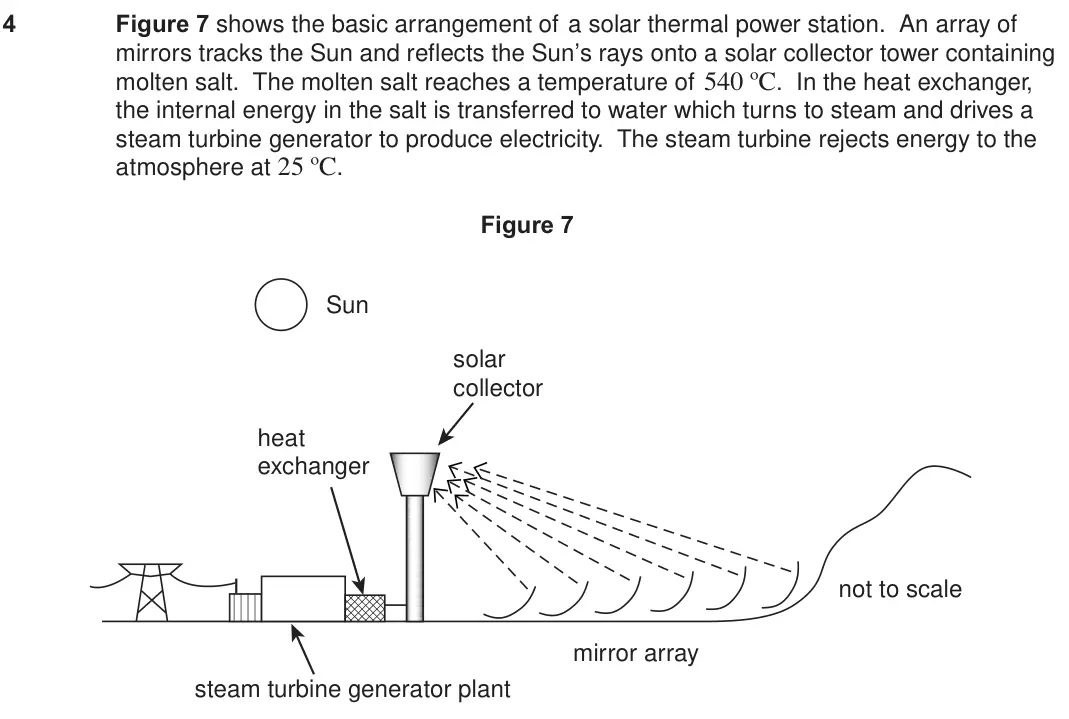
Q4(b)
The whole paper ↗Q4(c)
The whole paper ↗Q3(b)(ii)
The whole paper ↗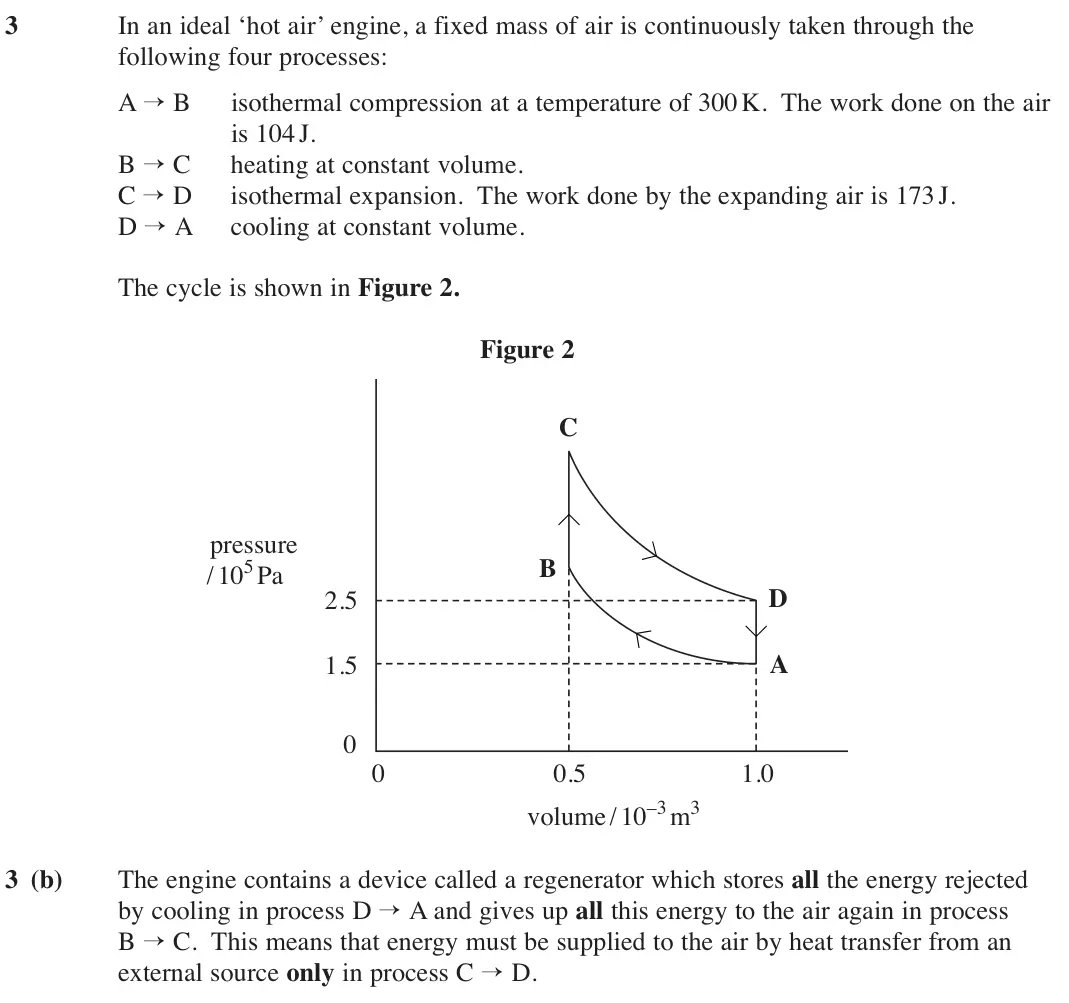
Q5(c)
The whole paper ↗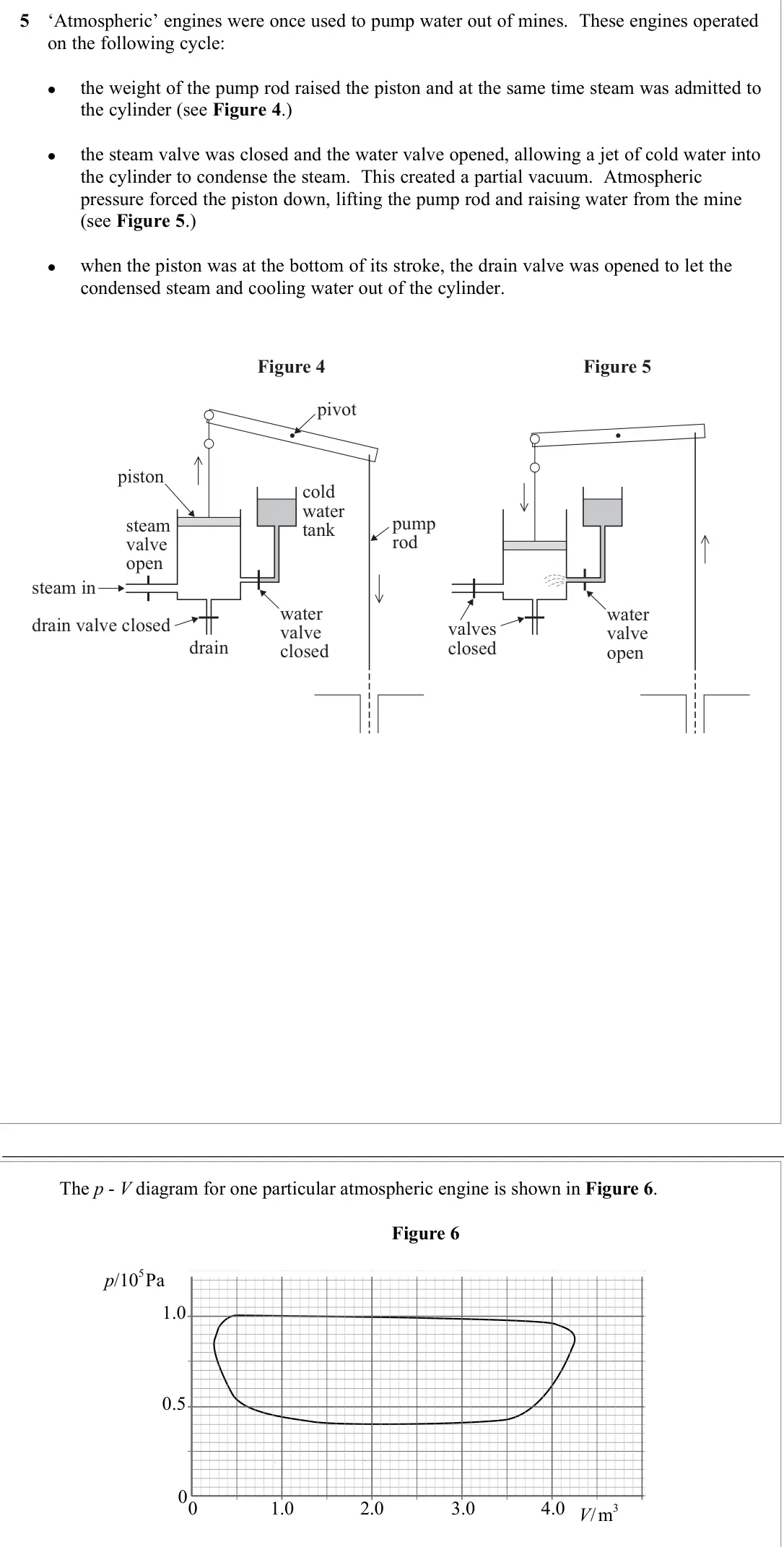
All 20 questions on Second Law and engines, as a list
- June 2025, Paper 3 Engineering physics, Q03.5 (2 marks): Two criteria for a heat engine to achieve the maximum theoretical efficiency are: 1. the gas must always be at the same temperature as the hot source when energ
- June 2025, Paper 3 Engineering physics, Q03.6 (6 marks): The overall efficiency of a heat engine is defined as overall efficiency = net work output in one cycle energy supplied by heat transfer in one cycle An enginee
- June 2024, Paper 3 Engineering physics, Q04.3 (1 mark): Complete Figure 8 so that the engine obeys the second law of thermodynamics. [1 mark]
- June 2024, Paper 3 Engineering physics, Q04.4 (2 marks): Explain why the maximum theoretical efficiency of an ideal heat engine must be less than 100%. [2 marks]
- June 2023, Paper 3 Engineering physics, Q05.1 (1 mark): Calculate the efficiency of this engine. [1 mark] efficiency =
- June 2023, Paper 3 Engineering physics, Q05.2 (3 marks): Figure 10 shows another system operating between the same overall temperatures and with the same input power as the engine in Figure 9. This system consists of
- November 2021, Paper 3 Engineering physics, Q05.1 (1 mark): Which is a correct statement about an ideal heat engine? Tick () one box. [1 mark]
- November 2021, Paper 3 Engineering physics, Q05.2 (2 marks): An ideal heat engine has an efficiency of 0.33 The same engine works in reverse as an ideal refrigerator between the same hot and cold spaces. Determine the coe
- November 2020, Paper 3 Engineering physics, Q05.1 (2 marks): Explain how the second law of thermodynamics predicts that a heat engine can never be 100% efficient. [2 marks]
- November 2020, Paper 3 Engineering physics, Q05.2 (4 marks): A company plans to build a geothermal power station in a region where there is hot rock deep below the surface. The scheme is shown in Figure 7. Figure 7 In the
- June 2019, Paper 3 Engineering physics, Q03.5 (3 marks): It is claimed that the efficiency of this engine cycle is the same as the maximum theoretical efficiency of a heat engine operating between the same temperature
- June 2019, Paper 3 Engineering physics, Q03.6 (2 marks): Discuss one problem that would be faced by an engineer designing a real engine based on this cycle. [2 marks]
- June 2018, Paper 3 Engineering physics, Q04 (6 marks): The National Grid is supplied mainly from power stations which have overall efficiencies of up to about 40% Table 1 shows the average power requirements of a la
- Specimen, Paper 3 Engineering physics, Q04.1 (1 mark): Show that the maximum theoretical efficiency of any heat engine operating between temperatures of 1450 K and 310 K is about 80%. [1 mark] . 0 4 . 1
- Specimen, Paper 3 Engineering physics, Q04.2 (5 marks): A company claims to be able to provide a combined heat and power plant for a mark garden that requires both electrical power and space heating for greenhouses.
- June 2015, PHYA5 Applied physics (old spec), Q4(a) (2 marks): Calculate the maximum theoretical efficiency of a heat engine operating between temperatures of 540 ºC and 25 ºC. [2 marks] maximum efficiency =
- June 2015, PHYA5 Applied physics (old spec), Q4(b) (1 mark): On one particular day the output of the power station is 48 MW. Calculate the input power to the power station assuming it can run at its maximum theoretical ef
- June 2015, PHYA5 Applied physics (old spec), Q4(c) (2 marks): The actual efficiency of the steam turbine is about 38% when the molten salt is at 540 ºC. State two reasons why the actual efficiency of the power station is m
- June 2011, PHYA5 Applied physics (old spec), Q3(b)(ii) (2 marks): Show that the efficiency of the cycle is the same as the maximum possible efficiency of any heat engine operating between the same highest and lowest temperatur
- June 2008, PHA7W (2008 spec), Q5(c) (3 marks): 5 (c) The temperature of the steam was 103 °C (376 K) and the cooling water was at 15 °C (288 K). 5 (c) (i) Calculate the maximum theoretical efficiency of a he
Questions, mark schemes and examiner’s reports are © AQA, from their published past papers. Plumi isn’t affiliated with any exam board. Want whole papers? AQA A-Level Physics past papers.
The Plumi iPad app also offers exam-style questions with AI feedback on your handwritten working.