 plumi
Non-flow processes: AQA A‑Level Physics questions
AQA A-Level Physics past-paper questions on 3.11.2.2 Non-flow processes, 2008–2025, with mark schemes and examiner’s reports where available.
Paper
All papers
Exam
All years
Calculations
Q03.1
The whole paper ↗Q03.2
The whole paper ↗Q03.3
The whole paper ↗Q03.4
The whole paper ↗Q03.2
The whole paper ↗Q03.3
The whole paper ↗Q03.4
The whole paper ↗Q03.1
The whole paper ↗Q03.2
The whole paper ↗Q04.2
The whole paper ↗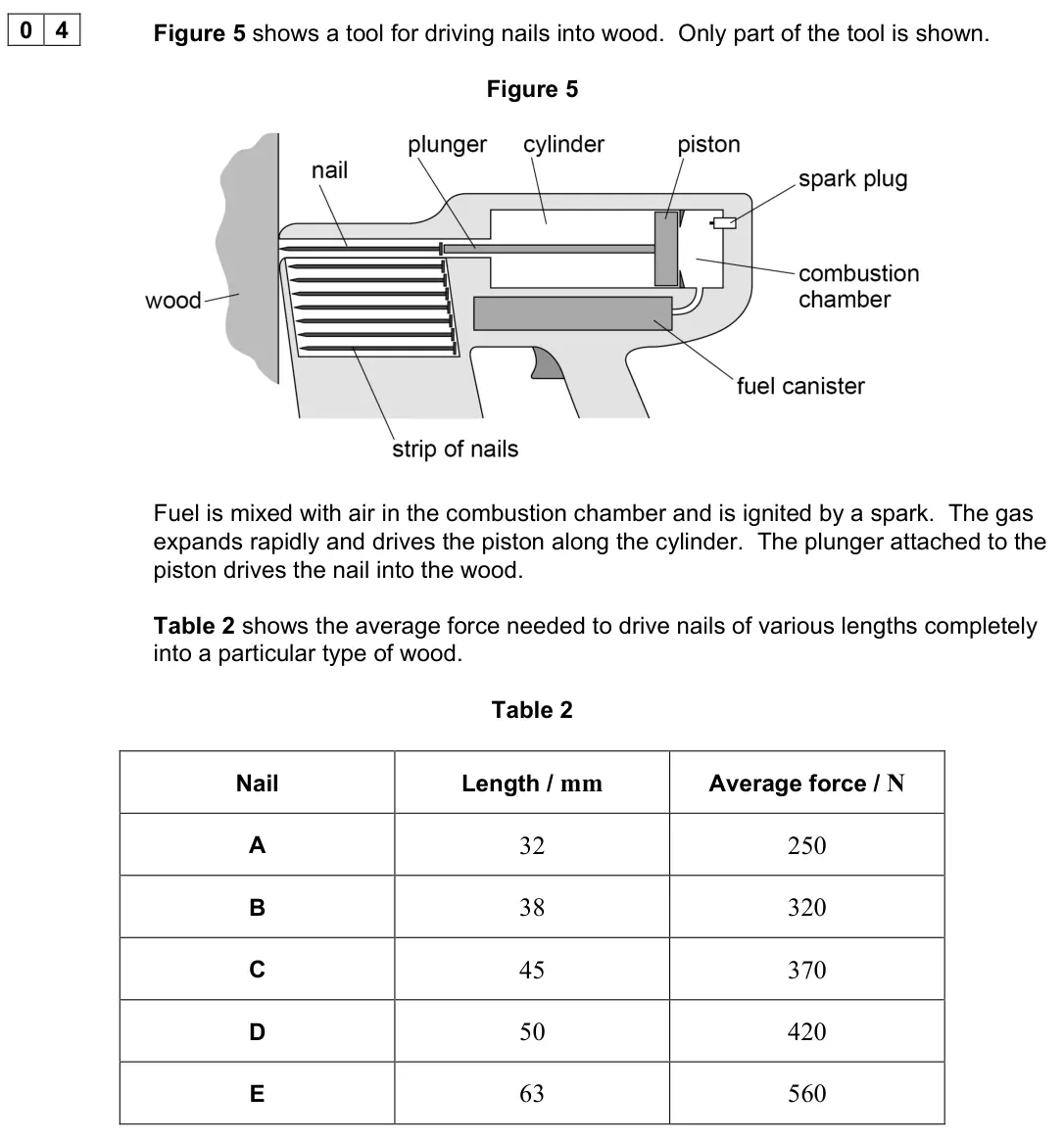
Q04.1
The whole paper ↗Q04.2
The whole paper ↗Q04.3
The whole paper ↗Q04.4
The whole paper ↗Q03.1
The whole paper ↗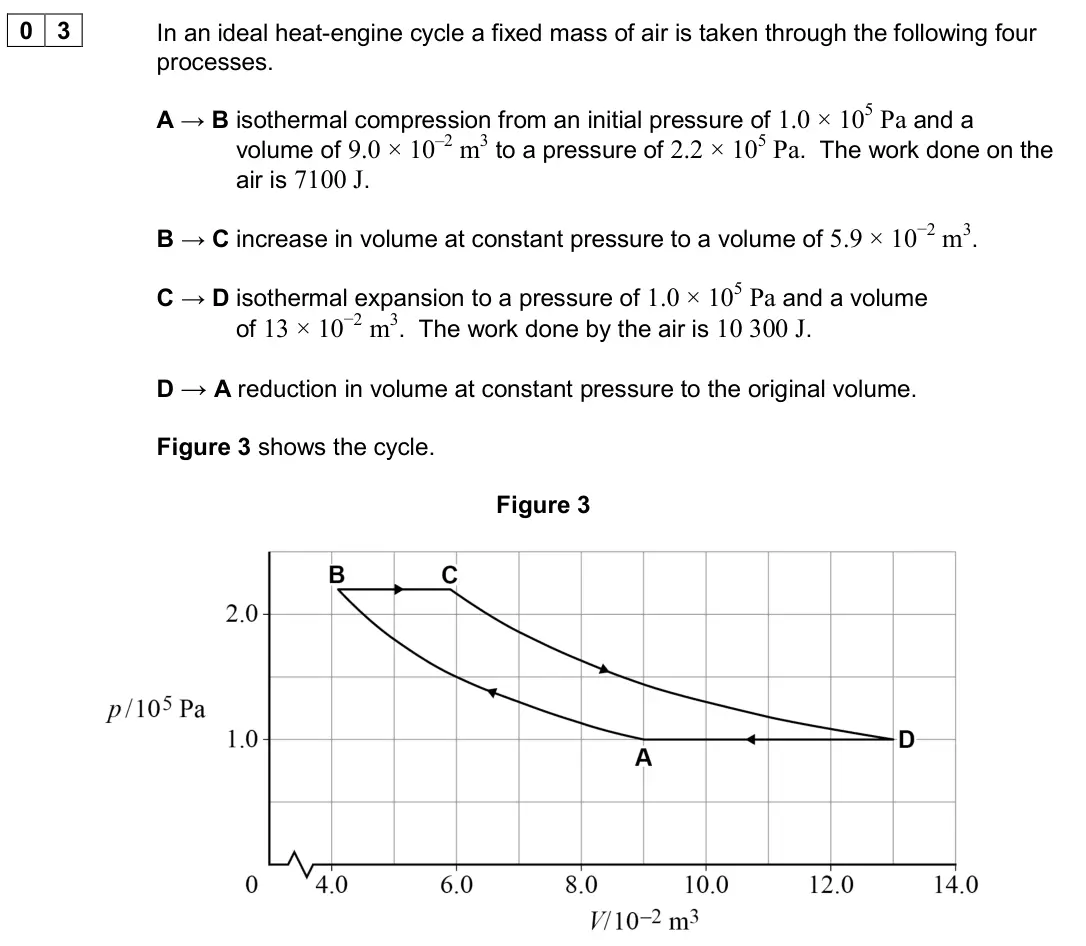
Q03.2
The whole paper ↗Q03.3
The whole paper ↗Q03.5
The whole paper ↗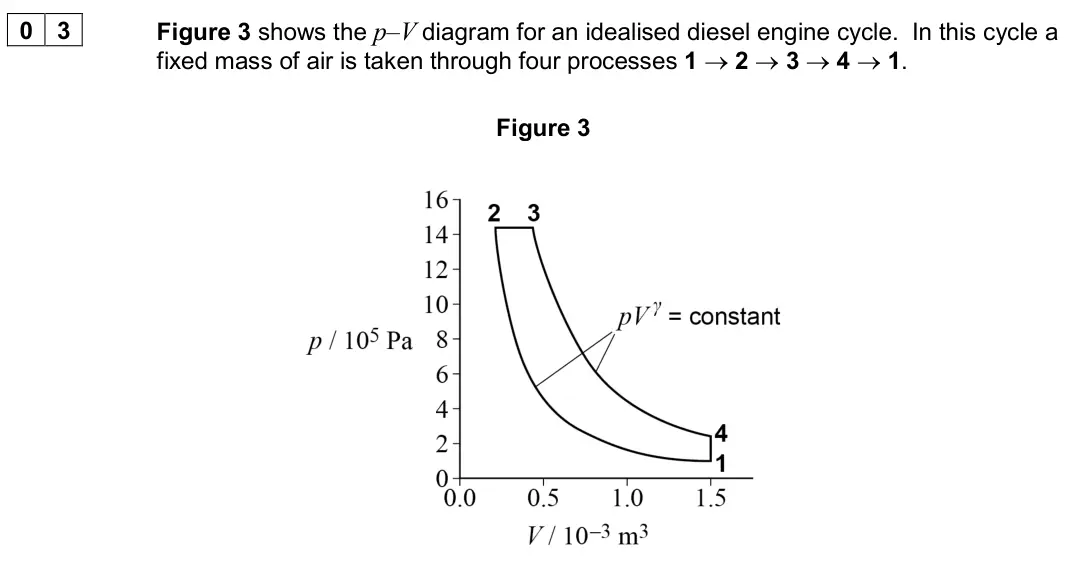
Q03.1
The whole paper ↗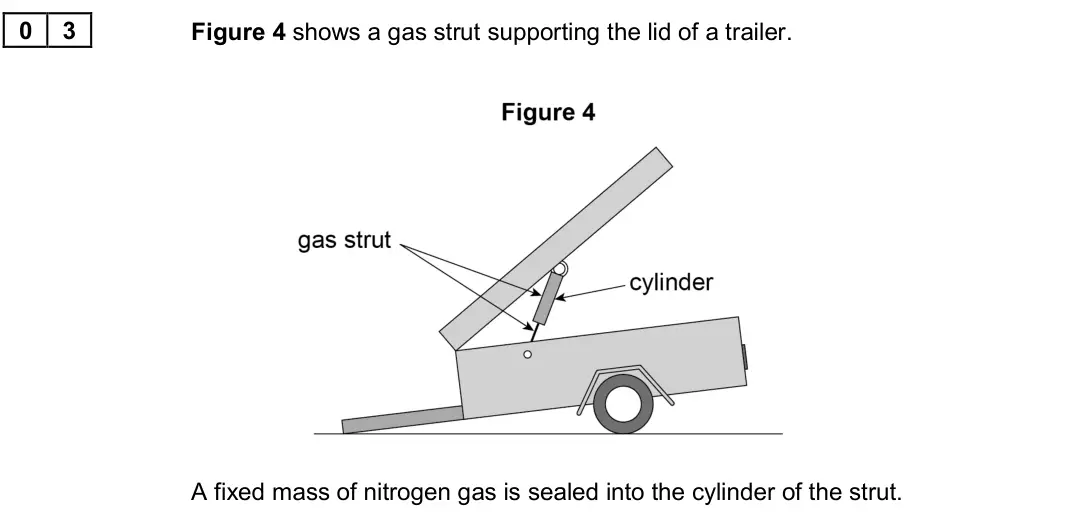
Q03.2
The whole paper ↗
All 40 questions on Non-flow processes, as a list
- June 2025, Paper 3 Engineering physics, Q03.1 (1 mark): State what is meant by an isothermal change. [1 mark] Figure 6 shows a p–V diagram in which a fixed mass of an ideal gas is taken through a cycle of three proce
- June 2025, Paper 3 Engineering physics, Q03.2 (2 marks): Calculate, in mol, the amount of gas. [2 marks] amount of gas = mol
- June 2025, Paper 3 Engineering physics, Q03.3 (1 mark): Show that the work done in process C → A is about 100 J. [1 mark]
- June 2025, Paper 3 Engineering physics, Q03.4 (3 marks): Complete Table 2 for each process and for the whole cycle. [3 marks] Table 2 Q / J W / J ΔU / J Process A → B −253 Process B → C 473 Process C → A −253 Whole cy
- June 2023, Paper 3 Engineering physics, Q03.2 (1 mark): The work done on the air when it is compressed is 10.8 mJ. Which row is correct for this adiabatic compression? Tick () one box. [1 mark] W / mJ Q / mJ ΔU / mJ
- June 2023, Paper 3 Engineering physics, Q03.3 (3 marks): The initial conditions for the air are: volume of air = 2.91 × 10⁻⁸ m3 pressure of air = 1.05 × 10⁵ Pa temperature of air = 293 K. During sudden braking, the ai
- June 2023, Paper 3 Engineering physics, Q03.4 (2 marks): To produce the adiabatic change, the brake lever is pulled very quickly. The cyclist thinks that by applying the brake slowly, the work done to compress the bub
- June 2022, Paper 3 Engineering physics, Q03.1 (1 mark): Explain what is meant by an adiabatic change. [1 mark]
- June 2022, Paper 3 Engineering physics, Q03.2 (2 marks): Figure 4 shows the p–V diagram for an ideal diesel engine cycle. Figure 4 In this cycle, air is compressed adiabatically from a pressure of 1.0 × 10⁵ Pa and vol
- November 2021, Paper 3 Engineering physics, Q04.2 (3 marks): After a nail has been used, another nail takes its place automatically. The tool can drive up to 180 nails per minute. Discuss why the expansion cannot be isoth
- November 2020, Paper 3 Engineering physics, Q04.1 (1 mark): Which row in Table 3 shows • Process 1 in which work done is zero, and • Process 2 in which the change in internal energy is zero? Tick () one box. [1 mark] Ta
- November 2020, Paper 3 Engineering physics, Q04.2 (3 marks): When irregular particles are packed, air gaps are left between the particles. The true volume of a quantity of irregular particles must be determined using a me
- November 2020, Paper 3 Engineering physics, Q04.3 (2 marks): Sketch on Figure 6 the variation of pressure with volume when the plunger is pushed in fully very quickly and then left for several seconds. Assume no leakage p
- November 2020, Paper 3 Engineering physics, Q04.4 (2 marks): Explain why the compression of a gas can be considered to be an isothermal change when the gas is compressed very slowly. [2 marks]
- June 2019, Paper 3 Engineering physics, Q03.1 (1 mark): Show, by calculation, that the volume at B is 4.1 × 10⁻² m3. [1 mark]
- June 2019, Paper 3 Engineering physics, Q03.2 (2 marks): The temperature of the air between A and B is 295 K. Show that the temperature of the air at C is about 420 K. [2 marks]
- June 2019, Paper 3 Engineering physics, Q03.3 (2 marks): An ideal engine based on this cycle uses a device called an economiser. The economiser stores all the energy transferred in the cooling process D → A and gives
- June 2018, Paper 3 Engineering physics, Q03.5 (3 marks): 0.060 mol of air is taken through the cycle. Determine the maximum temperature in the cycle. [3 marks] maximum temperature = K
- June 2017, Paper 3 Engineering physics, Q03.1 (4 marks): The gas is initially at a pressure of 1.2 × 10⁶ Pa, a volume of 9.0 × 10⁻⁵ m3 and a temperature of 290 K. When the lid is closed quickly the gas is compressed r
- June 2017, Paper 3 Engineering physics, Q03.2 (2 marks): Explain why the rapid compression of the gas can be assumed to be an adiabatic process. [2 marks]
- June 2017, Paper 3 Engineering physics, Q03.3 (3 marks): When the lid is closed slowly, the compression can be assumed to be isothermal. The gas can be compressed either isothermally or adiabatically from the same ini
- Specimen, Paper 3 Engineering physics, Q03.1 (3 marks): A single-cylinder air motor running on compressed air has the theoretical indicator diagram shown in Figure 4. • From B to C the high-pressure air pushes a pist
- June 2016, PHYA5 Applied physics (old spec), Q3(a) (3 marks): Calculate the new volume of the air pocket when it reaches the top of the mountain, where the pressure is 8.25 × 10⁴ Pa. Give your answer to an appropriate numb
- June 2016, PHYA5 Applied physics (old spec), Q3(b) (3 marks): Meteorologists use the term adiabatic lapse rate for the temperature change per km when air rises as it expands adiabatically. Calculate the temperature of the
- June 2015, PHYA5 Applied physics (old spec), Q3(a) (1 mark): A fixed mass of gas undergoes a change from one of states E, F, G, H to state X as shown on the pressure–volume (p–V) diagram in Figure 4. Figure 4 Which change
- June 2015, PHYA5 Applied physics (old spec), Q3(b)(i) (2 marks): The temperature of the air in the cylinder at the start of compression (point A on Figure 6) is 310 K. Determine the temperature of the air at the point when th
- June 2014, PHYA5 Applied physics (old spec), Q3(a)(i) (2 marks): Show that process A →B is isothermal. [2 marks]
- June 2014, PHYA5 Applied physics (old spec), Q3(a)(ii) (1 mark): Calculate the work done by the gas in process B →C. [1 mark] work done J
- June 2014, PHYA5 Applied physics (old spec), Q3(d) (2 marks): Describe two problems that would be encountered in trying to design a real engine based on this cycle. [2 marks]
- June 2013, PHYA5 Applied physics (old spec), Q3(a) (2 marks): Explain why the compression stroke of a diesel engine is considered to be an adiabatic change. (2 marks)
- June 2013, PHYA5 Applied physics (old spec), Q3(b)(i) (3 marks): Calculate the volume above the piston at the instant just before the fuel is injected. Give your answer to an appropriate number of significant figures. volume
- June 2013, PHYA5 Applied physics (old spec), Q3(b)(ii) (2 marks): The temperature of the air in the cylinder at the start of the compression stroke is 297K. Calculate the temperature of the air at the instant just before the f
- June 2012, PHYA5 Applied physics (old spec), Q1(a)(i) (2 marks): The volume of air in the barrel at the instant the cork is expelled is 1.2 × 10⁻⁵ m3. Calculate the pressure of the air in the barrel at the instant the cork is
- June 2012, PHYA5 Applied physics (old spec), Q1(a)(ii) (3 marks): Calculate the maximum temperature reached by the air in the gun. Give your answer to an appropriate number of significant figures. answer = K (3 marks)
- June 2012, PHYA5 Applied physics (old spec), Q1(c) (3 marks): Explain, giving your reasons, whether the volume of air in the barrel at the point when the cork leaves the gun would be less than, equal to, or greater than 1.
- June 2011, PHYA5 Applied physics (old spec), Q3(a)(i) (2 marks): Show that the temperature of the air at point D is 500K. (2 marks)
- June 2011, PHYA5 Applied physics (old spec), Q3(c) (2 marks): On the axes below, sketch the cycle on a graph of volume V against temperature T. Label the points A, B, C and D. (2 marks) 1.0 0.5 0 0 300 500 T/K V/10 –3 m3
- June 2010, PHYA5 Applied physics (old spec), Q4(b) (3 marks): With reference to the graph on page 6, state and explain whether the rocket would have reached the same height if the air had expanded isothermally. (3 marks)
- June 2008, PHA7W (2008 spec), Q3(a) (2 marks): 3 (a) (i) Explain what is meant by the adiabatic compression of a gas. 3 (a) (ii) Explain why the compression stroke of a Diesel engine can be considered to be
- June 2008, PHA7W (2008 spec), Q3(b) (5 marks): 3 (b) Figure 2 shows part of an ideal Diesel engine cycle in which a constant mass of air is compressed adiabatically, A → B, and is then heated at constant pre
Questions, mark schemes and examiner’s reports are © AQA, from their published past papers. Plumi isn’t affiliated with any exam board. Want whole papers? AQA A-Level Physics past papers.
The Plumi iPad app also offers exam-style questions with AI feedback on your handwritten working.