 plumi
Engine cycles: AQA A‑Level Physics questions
AQA A-Level Physics past-paper questions on 3.11.2.4 Engine cycles, 2008–2025, with mark schemes and examiner’s reports where available.
Paper
All papers
Exam
All years
Calculations
Q03.6
The whole paper ↗Q03.1
The whole paper ↗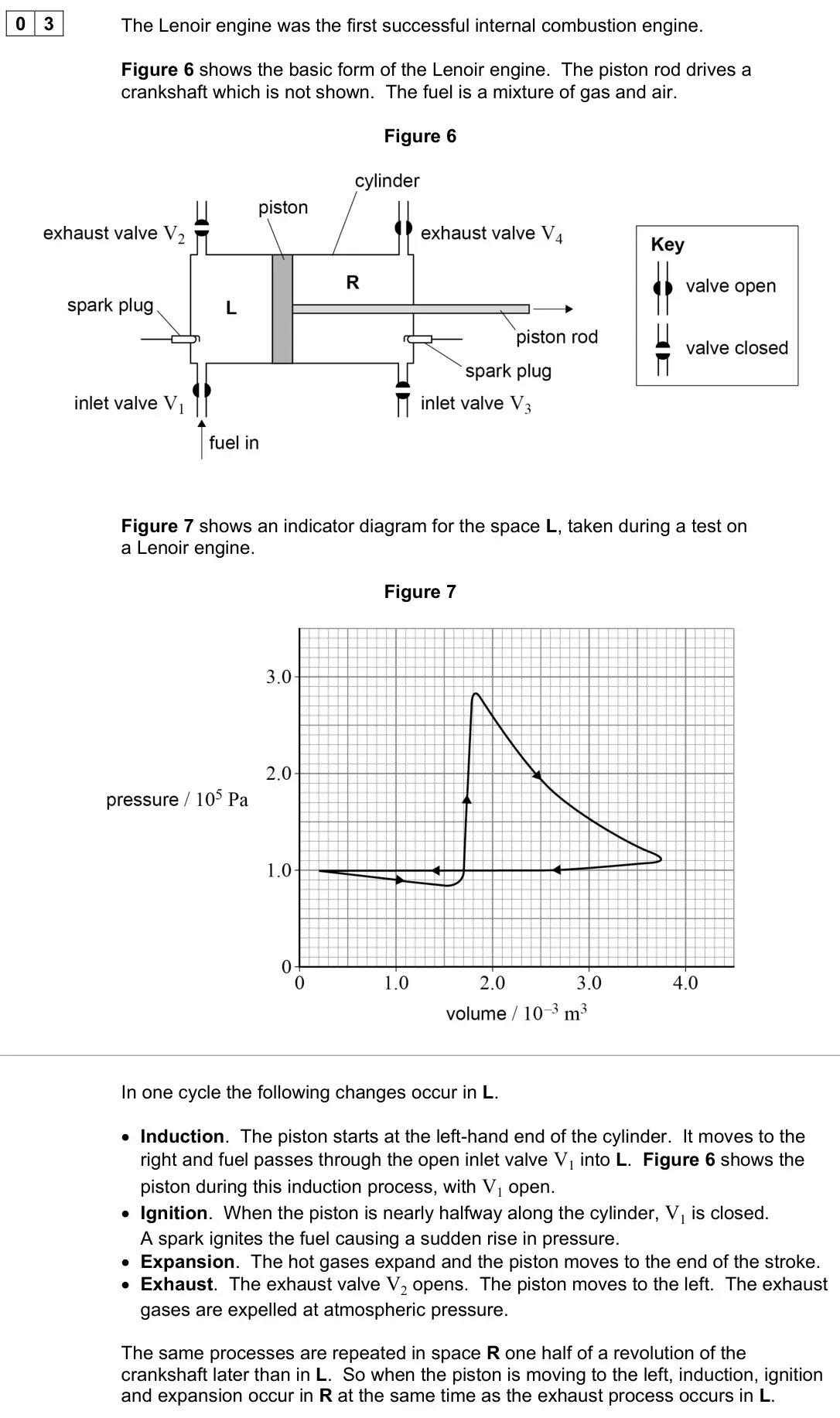
Q03.2
The whole paper ↗Q03.3
The whole paper ↗Q03.4
The whole paper ↗Q03.3
The whole paper ↗Q03.4
The whole paper ↗Q03.5
The whole paper ↗Q03.6
The whole paper ↗Q03.1
The whole paper ↗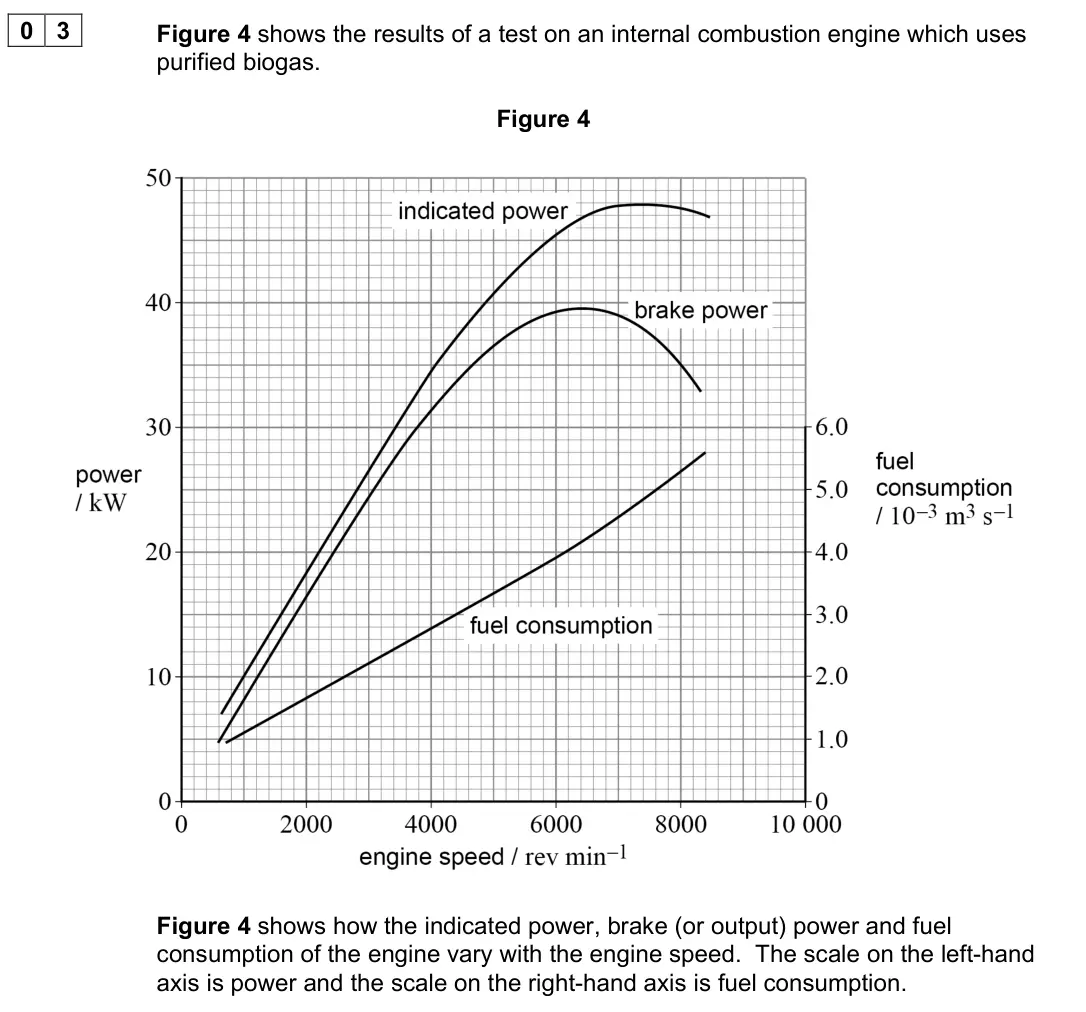
Q03.2
The whole paper ↗Q03.1
The whole paper ↗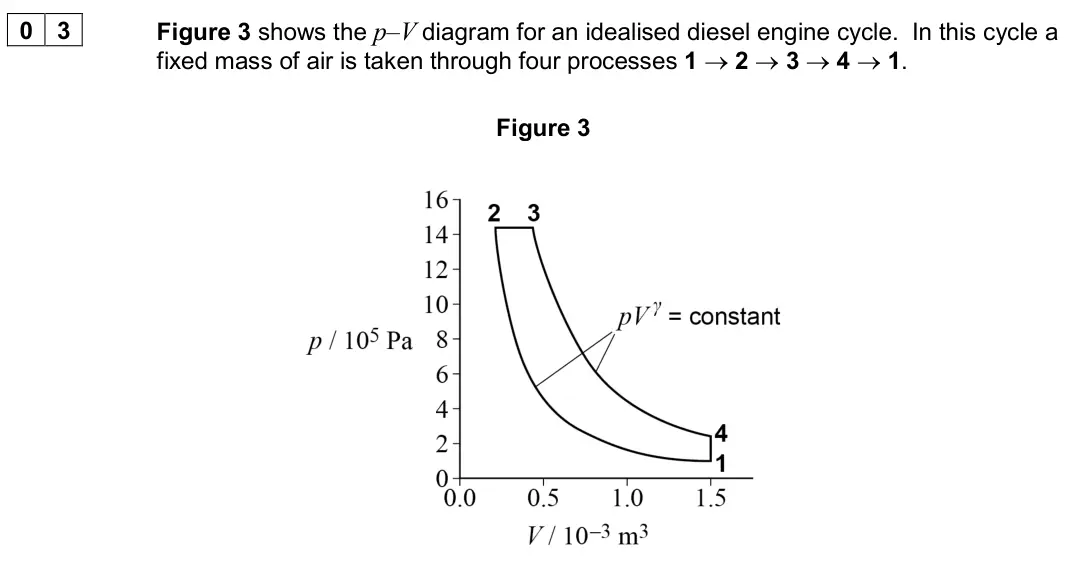
Q03.2
The whole paper ↗Q03.5
The whole paper ↗Q03.2
The whole paper ↗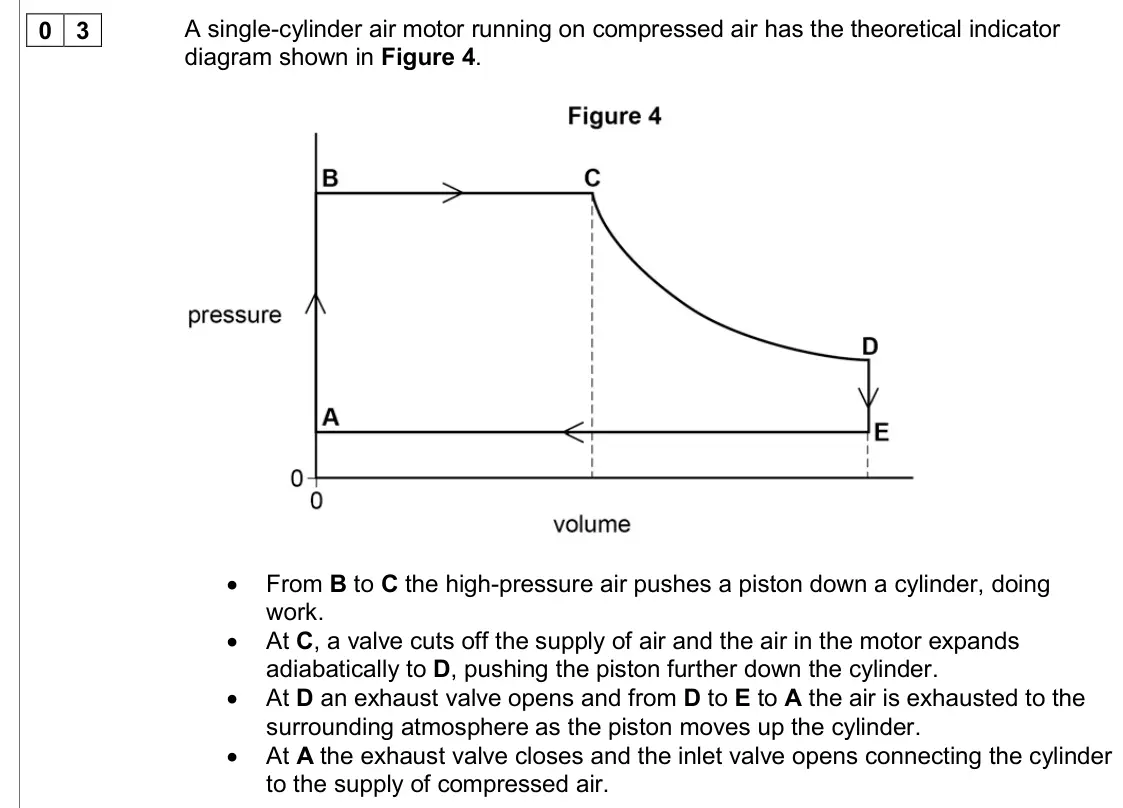
Q03.3
The whole paper ↗Q03.4
The whole paper ↗
All 37 questions on Engine cycles, as a list
- June 2025, Paper 3 Engineering physics, Q03.6 (6 marks): The overall efficiency of a heat engine is defined as overall efficiency = net work output in one cycle energy supplied by heat transfer in one cycle An enginee
- June 2024, Paper 3 Engineering physics, Q03.1 (5 marks): The indicator diagram is for a rotational speed of the crankshaft of 120 rev min−1. Determine, using Figure 7, the indicated power of the engine. Assume that th
- June 2024, Paper 3 Engineering physics, Q03.2 (2 marks): The following data are taken during the test on the engine: fuel consumption = 6.44 × 10⁻⁴ m3 s−1 calorific value of fuel = 18.0 × 10⁶ J m−3 torque at crankshaf
- June 2024, Paper 3 Engineering physics, Q03.3 (2 marks): The output power of a four-stroke petrol engine of a similar working volume to that of the Lenoir engine is about 150 kW. Suggest two reasons for the very low o
- June 2024, Paper 3 Engineering physics, Q03.4 (1 mark): Which statement is correct? Tick () one box. [1 mark]
- June 2023, Paper 3 Engineering physics, Q04 (6 marks): Figure 7 shows the p–V diagram for a theoretical diesel engine cycle. Figure 8 shows the indicator diagram for a real four-stroke diesel engine working between
- June 2022, Paper 3 Engineering physics, Q03.3 (2 marks): Explain why the compression ratio for a diesel engine must be greater than the compression ratio for a petrol engine. [2 marks]
- June 2022, Paper 3 Engineering physics, Q03.4 (2 marks): Draw, on Figure 5, a typical indicator diagram for a real four-stroke diesel engine with the same values of V1 and V2. [2 marks] Figure 5
- June 2022, Paper 3 Engineering physics, Q03.5 (1 mark): Mark with an X on your diagram the point where the injection of fuel starts. [1 mark]
- June 2022, Paper 3 Engineering physics, Q03.6 (2 marks): Explain two differences between the ideal cycle and the indicator diagram for the real engine. [2 marks] 1 2
- November 2021, Paper 3 Engineering physics, Q03.1 (6 marks): Figure 4 can be used to analyse the performance of the engine. Determine, for the speed at which the engine develops its maximum brake power: • the overall effi
- November 2021, Paper 3 Engineering physics, Q03.2 (2 marks): Explain why it is not advisable to run this engine at speeds above 7000 rev min−1. Refer to Figure 4 in your answer. [2 marks]
- November 2020, Paper 3 Engineering physics, Q03 (6 marks): Figure 4 shows some of the equipment used to investigate the thermal and mechanical efficiencies of a single-cylinder four-stroke petrol engine. Figure 4 • Petr
- June 2018, Paper 3 Engineering physics, Q03.1 (1 mark): Which statement about this cycle is true? Tick () the correct answer. [1 mark]
- June 2018, Paper 3 Engineering physics, Q03.2 (5 marks): The cycle in Figure 3 may be modified by allowing the air to continue to expand adiabatically from state 4 until it is at atmospheric pressure at state 5. Figur
- June 2018, Paper 3 Engineering physics, Q03.5 (3 marks): 0.060 mol of air is taken through the cycle. Determine the maximum temperature in the cycle. [3 marks] maximum temperature = K
- June 2017, Paper 3 Engineering physics, Q04 (6 marks): Figure 5 shows the p—V diagram for a theoretical petrol engine cycle compared to the indicator diagram for a real four-stroke petrol engine with the same maximu
- Specimen, Paper 3 Engineering physics, Q03.2 (6 marks): A single-cylinder air motor running on compressed air has the theoretical indicator diagram shown in Figure 4. • From B to C the high-pressure air pushes a pist
- Specimen, Paper 3 Engineering physics, Q03.3 (4 marks): A single-cylinder air motor running on compressed air has the theoretical indicator diagram shown in Figure 4. • From B to C the high-pressure air pushes a pist
- Specimen, Paper 3 Engineering physics, Q03.4 (1 mark): A single-cylinder air motor running on compressed air has the theoretical indicator diagram shown in Figure 4. • From B to C the high-pressure air pushes a pist
- June 2016, PHYA5 Applied physics (old spec), Q4(a) (2 marks): Explain the basic differences in operation between a petrol engine and a diesel engine. [2 marks] ______________________________________________________________
- June 2016, PHYA5 Applied physics (old spec), Q4(b)(i) (1 mark): Draw an X on Figure 5 to show where in the cycle the spark would occur. [1 mark]
- June 2016, PHYA5 Applied physics (old spec), Q4(b)(ii) (4 marks): Calculate the indicated power of the engine. [4 marks] power = ___________________________ W
- June 2016, PHYA5 Applied physics (old spec), Q4(b)(iii) (2 marks): Calculate the thermal efficiency of the engine. [2 marks] thermal efficiency = _____________________________
- June 2016, PHYA5 Applied physics (old spec), Q4(c) (1 mark): Copyright Information For confidentiality purposes, from the November 2015 examination series, acknowledgements of third party copyright material will be publis
- June 2014, PHYA5 Applied physics (old spec), Q3(c) (1 mark): The overall efficiency of an engine is defined as net work output in one cycle energy supplied by heating from an external source in one cycle Calculate the ove
- June 2013, PHYA5 Applied physics (old spec), Q3(b)(iii) (1 mark): Explain why, in a diesel engine, the fuel starts to be injected into the cylinder slightly before the piston reaches its highest point in the cylinder. (1 mark)
- June 2013, PHYA5 Applied physics (old spec), Q3(c) (6 marks): Figure 4 shows the indicator (p – V) diagram for a real diesel engine compared to the p – V diagram for a theoretical diesel cycle of the same maximum and minim
- June 2012, PHYA5 Applied physics (old spec), Q4(a)(i) (4 marks): Determine the indicated power of the engine, assuming all cylinders give the same power. answer = kW (4 marks)
- June 2012, PHYA5 Applied physics (old spec), Q4(a)(ii) (3 marks): Calculate the overall efficiency of the engine. answer = (3 marks)
- June 2012, PHYA5 Applied physics (old spec), Q4(b) (1 mark): Account for the difference between the indicated power and brake power. (1 mark)
- June 2012, PHYA5 Applied physics (old spec), Q4(c) (1 mark): What is represented by the line AB on Figure 5? (1 mark)
- June 2011, PHYA5 Applied physics (old spec), Q3(d) (2 marks): Several inventors have tried to build an engine that works on this cycle. Give two reasons why they have been unsuccessful. (2 marks)
- June 2010, PHYA5 Applied physics (old spec), Q5(a) (6 marks): Figure 3 shows the indicator diagram for a theoretical or ideal four-stroke petrol engine (Otto) cycle. Figure 3 Use Figure 3 to describe the process that occur
- June 2010, PHYA5 Applied physics (old spec), Q5(b) (2 marks): Show, on Figure 4, how the indicator diagram might be expected to appear if measurements of pressure and volume were made on a real four-stroke petrol engine of
- June 2008, PHA7W (2008 spec), Q5(a) (4 marks): 5 (a) (i) Use Figure 6 to determine the indicated work done by the engine in one cycle. 5 (a) (ii) It took 6.0 seconds for the engine to complete one cycle. Cal
- June 2008, PHA7W (2008 spec), Q5(b) (2 marks): 5 (b) In each cycle, a mass of 7600 kg of water was raised a height of 1.8 m. Determine for this engine. 5 (b) (i) the output power, 5 (b) (ii) the mechanical e
Questions, mark schemes and examiner’s reports are © AQA, from their published past papers. Plumi isn’t affiliated with any exam board. Want whole papers? AQA A-Level Physics past papers.
The Plumi iPad app also offers exam-style questions with AI feedback on your handwritten working.