 plumi
Ozone depletion: AQA A‑Level Chemistry questions
AQA A-Level Chemistry past-paper questions on 3.3.3.3 Ozone depletion, 2008–2025, with mark schemes and examiner’s reports where available.
Paper
All papers
Exam
All years
Calculations
Q03.3
The whole paper ↗
Q03.4
The whole paper ↗Q03.5
The whole paper ↗Q02.5
The whole paper ↗
Q09.1
The whole paper ↗
Q09.2
The whole paper ↗Q09.3
The whole paper ↗Q04.2
The whole paper ↗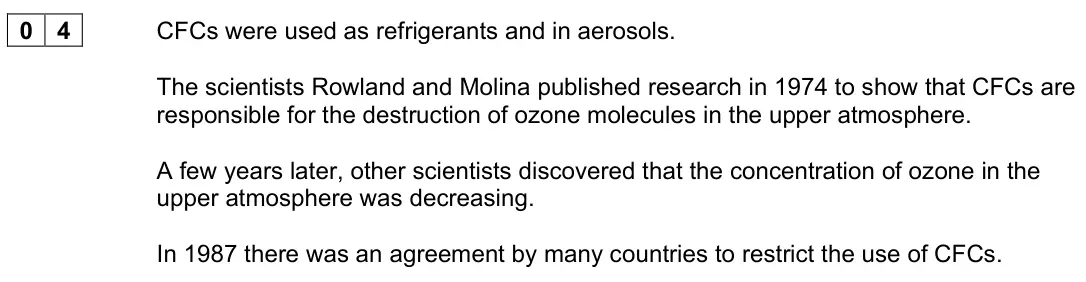
Q04.4
The whole paper ↗Q04.5
The whole paper ↗Q09.1
The whole paper ↗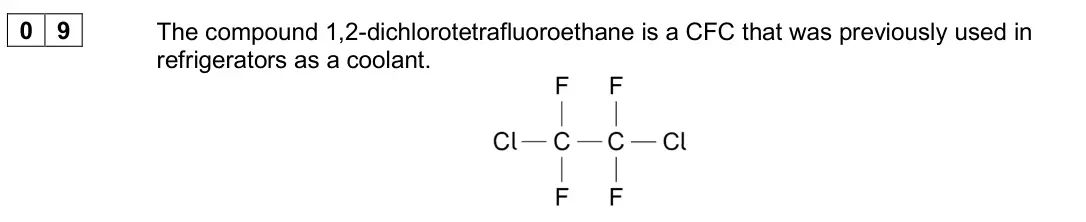
Q09.2
The whole paper ↗Q01.4
The whole paper ↗
Q05.1
The whole paper ↗Q05.2
The whole paper ↗
All 43 questions on Ozone depletion, as a list
- June 2025, AS Paper 2, Q15 (1 mark): Which equation shows a step in the decomposition of ozone by free radicals formed from CFCs in the upper atmosphere? [1 mark] A Cl● + O3 → O2 + ClO● B Cl● + O3
- June 2024, AS Paper 2, Q03.3 (1 mark): In the presence of ultraviolet radiation, CFCl3 breaks down in the upper atmosphere to form chlorine free radicals. Give an equation for this reaction. [1 mark]
- June 2024, AS Paper 2, Q03.4 (2 marks): Chlorine free radicals catalyse the decomposition of ozone. Give two equations to show how chlorine free radicals decompose ozone. [2 marks] Equation 1 Equation
- June 2024, AS Paper 2, Q03.5 (1 mark): The production and use of CFCs have been banned in many countries because they decrease the amount of ozone in the upper atmosphere. State why ozone in the uppe
- June 2023, Paper 3, Q30 (1 mark): Most scientists believe that the concentration of ozone in the upper atmosphere should not be allowed to decrease. Which statement is a correct reason for this
- June 2023, AS Paper 2, Q12 (1 mark): Most scientists believe that ozone in the upper atmosphere should not be allowed to become depleted. Which is a valid reason for this belief? [1 mark] A Ozone a
- June 2022, Paper 2, Q02.5 (2 marks): Chemists provided evidence that was used to support a ban on the use of chlorodifluoromethane as a refrigerant. Many refrigerators now use pentane as a refriger
- November 2021, Paper 2, Q09.1 (1 mark): State why the ozone layer is beneficial for living organisms. [1 mark]
- November 2021, Paper 2, Q09.2 (1 mark): State how chlorofluorocarbons (CFCs) form chlorine atoms in the upper atmosphere. [1 mark]
- November 2021, Paper 2, Q09.3 (2 marks): Give equations to show how chlorine atoms catalyse the decomposition of ozone. [2 marks]
- November 2021, AS Paper 2, Q04.2 (1 mark): A molecule of CFC-11 breaks down in the upper atmosphere to form a chlorine free radical. Give the equation for this reaction. [1 mark]
- November 2021, AS Paper 2, Q04.4 (1 mark): State the benefit to life on Earth of ozone in the upper atmosphere. [1 mark]
- November 2021, AS Paper 2, Q04.5 (1 mark): Suggest one reason why the use of CFCs was not restricted until several years after Rowland and Molina published their research. [1 mark]
- November 2020, AS Paper 2, Q10 (1 mark): Which statement is not correct about ozone? [1 mark] A It absorbs harmful ultraviolet radiation in the upper atmosphere. B It decomposes to form oxygen. C Its d
- June 2019, AS Paper 2, Q09.1 (1 mark): Molecules of 1,2-dichlorotetrafluoroethane can break down in the upper atmosphere to form chlorine radicals. Give an equation to show the breakdown of one molec
- June 2019, AS Paper 2, Q09.2 (2 marks): Give two equations to show how chlorine radicals catalyse the decomposition of ozone. [2 marks]
- June 2018, Paper 2, Q01.4 (4 marks): Chlorofluorocarbons (CFCs) are a group of halogenoalkanes currently banned in many countries. They cannot be used as solvents or refrigerants because of their e
- June 2018, AS Paper 2, Q23 (1 mark): Which equation represents an initiation step? [1 mark] A B C D
- June 2016, AS Paper 2, Q05.1 (2 marks): Write two equations to show how chlorine radicals react with ozone molecules in the upper atmosphere. [2 marks] 1 2
- June 2016, AS Paper 2, Q05.2 (1 mark): Chloropentafluoroethane is a CFC that has been used as a refrigerant. Draw its displayed formula. [1 mark]
- June 2016, AS Paper 2, Q05.3 (1 mark): 1,1,1-trifluoroethane (CF3CH3) is one of the molecules that has been used as a refrigerant in place of CFCs. Explain why 1,1,1-trifluoroethane does not lead to
- June 2016, CHEM2 (old spec), Q3(b)(i) (1 mark): Write an equation to show how CClF3 decomposes to form the reactive intermediate. [1 mark]
- June 2016, CHEM2 (old spec), Q3(b)(ii) (2 marks): Write two equations to show how this reactive intermediate is involved in catalysing the decomposition of ozone. [2 marks] 1 2
- June 2015, CHEM2 (old spec), Q5(b)(i) (1 mark): Draw an appropriate displayed formula in the space provided to complete the following equation to show how CBrF3 may produce bromine atoms in the upper atmosphe
- June 2015, CHEM2 (old spec), Q5(b)(ii) (1 mark): In the upper atmosphere, it is more likely for CBrF3 to produce bromine atoms than it is for CClF3 to produce chlorine atoms. Suggest one reason for this. [1 ma
- June 2015, CHEM2 (old spec), Q5(b)(iii) (3 marks): Bromine atoms have a similar role to chlorine atoms in the decomposition of ozone. The overall equation for the decomposition of ozone is 2O3 3O2 Write two equa
- June 2014, CHEM2 (old spec), Q5(b)(i) (1 mark): Identify the species formed from CClF3 that is responsible for the catalytic decomposition of ozone in the upper atmosphere. [1 mark]
- June 2014, CHEM2 (old spec), Q5(b)(ii) (1 mark): Write an overall equation to represent the decomposition of ozone into oxygen. [1 mark]
- June 2013, CHEM2 (old spec), Q7(b)(i) (1 mark): Name the type of reactive intermediate that acts as a catalyst in this reaction. (1 mark)
- June 2013, CHEM2 (old spec), Q7(b)(ii) (2 marks): Write two equations to show how this intermediate is involved as a catalyst in the decomposition of ozone. Equation 1 Equation 2 (2 marks)
- January 2013, CHEM2 (old spec), Q7(c)(i) (1 mark): Write the overall equation for this decomposition. (1 mark)
- January 2013, CHEM2 (old spec), Q7(c)(ii) (1 mark): Use the overall equation to deduce Step 3 in the following mechanism that shows how nitrogen monoxide catalyses this decomposition. Step 1 O3 NO + O2 Step 2 NO
- June 2012, CHEM2 (old spec), Q6(c) (4 marks): Explain, with the aid of equations and the intermediates that form in the ozone layer, why the European Union has banned the use of chlorodifluoromethane (CHClF
- June 2012, CHEM2 (old spec), Q6(d)(ii) (1 mark): Give one reason why 2,3,3,3-tetrafluoropropene is a more environmentally acceptable refrigerant than chlorodifluoromethane. (1 mark)
- June 2011, CHEM2 (old spec), Q7(b)(ii) (3 marks): Identify a bond in a CFC that is broken by ultra-violet radiation to produce a reactive intermediate. Give the name of this reactive intermediate that catalyses
- January 2011, CHEM2 (old spec), Q1(a)(ii) (1 mark): Complete the following equation that shows the formation of a chlorine atom from a molecule of CF3Cl (1 mark) → C Cl + Cl• F F F
- January 2011, CHEM2 (old spec), Q1(a)(iii) (1 mark): State what the • represents in Cl• (1 mark)
- January 2011, CHEM2 (old spec), Q1(b) (2 marks): Write two equations that show how chlorine atoms catalyse the decomposition of ozone into oxygen. Equation 1 Equation 2 (2 marks)
- January 2011, CHEM2 (old spec), Q1(d) (1 mark): Chemists supported the legislation to ban the use of CFCs. Modern refrigerators use pentane rather than CFCs as refrigerants. With reference to its formula, sta
- June 2009, CHEM2 (old spec), Q11(b) (6 marks): 11 (b) Explain how chlorine atoms are formed from chlorine-containing organic compounds in the upper atmosphere. Explain, with the aid of equations, how chlorin
- June 2009, CHEM2 (old spec), Q11(c) (2 marks): 11 (c) Use the formulae of the two anaesthetics, halothane and desflurane, to help to explain why desflurane is considered to be a more environmentally acceptab
- June 2008, CHM3W (2008 spec), Q3(b)(ii) (1 mark): 3 (b) (ii) Name the type of reactive intermediate shown in each of these three steps. (1 mark)
- June 2008, CHM3W (2008 spec), Q3(b)(iii) (1 mark): 3 (b) (iii) Name the type of mechanistic step illustrated by Step 3 of this mechanism. (1 mark)
Questions, mark schemes and examiner’s reports are © AQA, from their published past papers. Plumi isn’t affiliated with any exam board. Want whole papers? AQA A-Level Chemistry past papers.
The Plumi iPad app also offers exam-style questions with AI feedback on your handwritten working.