 plumi
Chlorination of alkanes: AQA A‑Level Chemistry questions
AQA A-Level Chemistry past-paper questions on 3.3.2.4 Chlorination of alkanes, 2008–2025, with mark schemes and examiner’s reports where available.
Paper
All papers
Exam
All years
Calculations
Q01.1
The whole paper ↗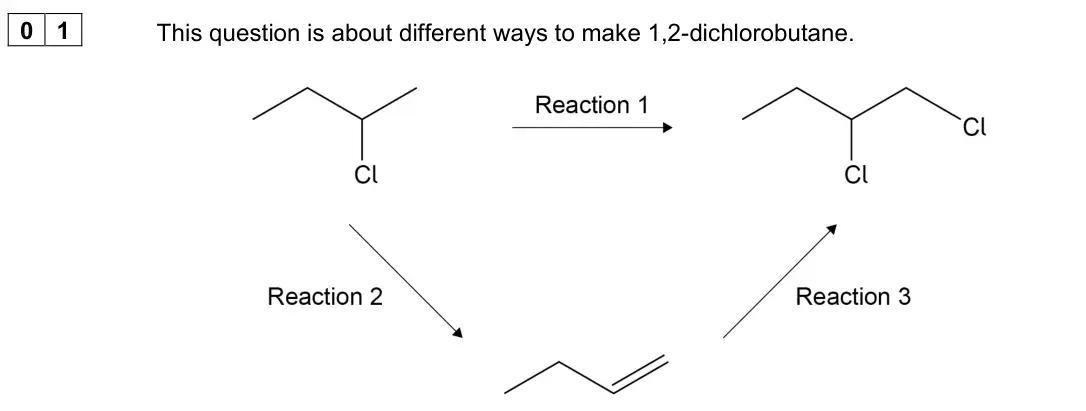
Q01.2
The whole paper ↗Q01.3
The whole paper ↗Q03.2
The whole paper ↗
Q10.3
The whole paper ↗
Q06.2
The whole paper ↗
Q06.3
The whole paper ↗Q09.4
The whole paper ↗
Q01.3
The whole paper ↗
Q01.3
The whole paper ↗
All 60 questions on Chlorination of alkanes, as a list
- June 2025, Paper 2, Q01.1 (2 marks): Give the name of the mechanism for reaction 1. State one essential condition needed for reaction 1. [2 marks] Name of mechanism Essential condition
- June 2025, Paper 2, Q01.2 (3 marks): Give equations to show three essential steps in the mechanism for reaction 1. [3 marks]
- June 2025, Paper 2, Q01.3 (2 marks): Suggest two reasons why using reaction 1 is likely to give a low yield of 1,2-dichlorobutane. [2 marks] Reason 1 Reason 2
- June 2025, AS Paper 2, Q21 (1 mark): Which equation for the reaction of chlorine with excess ethane in the presence of ultraviolet light is correct? [1 mark] A C2H6 + 1 2 Cl2 → C2H5Cl + 1 2 H2 B C2
- June 2024, AS Paper 2, Q03.2 (2 marks): Give an equation for each of the two propagation steps in the conversion of CHFCl2 into CFCl3 [2 marks] Equation 1 Equation 2
- June 2024, AS Paper 2, Q14 (1 mark): 1,1-Dichloroethane (Y) reacts with chlorine to form hexachloroethane (Z). Which is the correct equation for this reaction? [1 mark] A Y + 6 Cl2 → Z + 6 HCl B Y
- June 2023, AS Paper 2, Q10 (1 mark): Which equation represents a propagation step in the chlorination of methane? [1 mark] A ●H + Cl2 → HCl + ●Cl B ●Cl + CH4 → CH3Cl + ●H C ●CH3 + Cl2 → CH3Cl + ●Cl
- June 2023, AS Paper 2, Q11 (1 mark): Which is the overall equation for the reaction of CCl3CH2CCl3 with an excess of chlorine in ultraviolet radiation? [1 mark] A CCl3CH2CCl3 + 1 2 Cl2 → CCl3CHClCC
- June 2022, Paper 2, Q10.3 (2 marks): Name the reagent for step 4. State a necessary condition for step 4. [2 marks] Reagent Condition
- June 2022, Paper 3, Q22 (1 mark): 2-Bromopropane reacts with bromine to form 2,2-dibromopropane. What is the name of the mechanism of this reaction? [1 mark] A Electrophilic addition B Eliminati
- June 2022, AS Paper 2, Q06.2 (2 marks): An intermediate in this alternative synthesis is dichlorofluoromethane (CHCl2F) Give equations to represent the two propagation steps in the conversion of CHCl2
- June 2022, AS Paper 2, Q06.3 (1 mark): Analysis of the products of this reaction shows the formation of a compound with the empirical formula CCl2F Give an equation to represent a termination step fo
- November 2021, Paper 2, Q09.4 (3 marks): Hydrochlorofluorocarbons (HCFCs) have been used in place of CFCs. In the mechanism to make an HCFC from a fluoroalkane, two incomplete steps are shown. Complete
- November 2021, AS Paper 2, Q12 (1 mark): Which is a propagation step in the chlorination of methane? [1 mark] A H● + Cl2 → HCl + Cl● B Cl● + CH4 → CH3Cl + H● C ●CH3 + Cl● → CH3Cl D ●CH3 + Cl2 → CH3Cl +
- November 2020, Paper 3, Q23 (1 mark): Which is the mechanism for this conversion? [1 mark] A Addition-elimination B Electrophilic substitution C Free-radical substitution D Nucleophilic substitution
- November 2020, AS Paper 2, Q01.3 (3 marks): 1-chloropropane can also be produced by the reaction between propane and chlorine in the presence of ultraviolet light. State why ultraviolet light is needed fo
- November 2020, AS Paper 2, Q14 (1 mark): An excess of methane reacts with chlorine in the presence of ultraviolet radiation. What are the main products of this reaction? [1 mark] A CCl4 and H2 B CCl4 a
- June 2019, AS Paper 2, Q15 (1 mark): Which equation represents a propagation step? [1 mark] A •CH2Cl + Cl• CH2Cl2 B •CH3 + •CH3 C2H6 C Cl2 Cl• + Cl• D CH3Cl + Cl• •CH2Cl + HCl
- June 2018, Paper 2, Q01.3 (2 marks): Alkanes can be used in free-radical substitution reactions to produce halogenoalkanes. Give equations for the propagation steps in the reaction of butane to for
- June 2018, Paper 3, Q09 (1 mark): Which equation represents a termination step? [1 mark] A B C D
- June 2018, AS Paper 2, Q23 (1 mark): Which equation represents an initiation step? [1 mark] A B C D
- June 2017, AS Paper 2, Q15 (1 mark): Which equation is a propagation step in the conversion of trichloromethane into tetrachloromethane by reaction with chlorine in the presence of ultraviolet ligh
- June 2016, AS Paper 2, Q05.4 (2 marks): One of the steps in the synthesis of 1,1,1-trifluoroethane (CF3CH3) is the reaction of 1,1-difluoroethane (CHF2CH3) with fluorine in a free-radical substitution
- Specimen, Paper 2, Q03.5 (2 marks): Number of monochloro isomers Structure
- Specimen, Paper 2, Q03.6 (1 mark): 0
- Specimen, Paper 3, Q25 (1 mark): Which molecule is not produced when ethane reacts with bromine in the presence of ultraviolet light? [1 mark] A C2H4Br2 B HBr C H2 D C4H10 2 5
- June 2016, CHEM2 (old spec), Q3(a)(i) (1 mark): Write an overall equation for the formation of trichloromethane by the reaction of chloromethane with chlorine. [1 mark]
- June 2016, CHEM2 (old spec), Q3(a)(ii) (1 mark): Name the mechanism for this formation of trichloromethane. [1 mark]
- June 2016, CHEM2 (old spec), Q3(a)(iii) (4 marks): Dichloromethane (CH2Cl2) is an intermediate in this formation of trichloromethane. Write an equation for each of the following steps in the mechanism for the re
- June 2015, CHEM2 (old spec), Q5(a)(i) (4 marks): Write an equation for each of the following steps in the mechanism for the reaction of CHF3 with Br2 [4 marks] Initiation step First propagation step Second pro
- June 2015, CHEM2 (old spec), Q5(a)(ii) (1 mark): State one condition necessary for the initiation of this reaction. [1 mark]
- June 2014, CHEM1 (old spec), Q5(f) (1 mark): Dodecane can be converted into halododecanes. Deduce the formula of a substance that could be reacted with dodecane to produce 1-chlorododecane and hydrogen chl
- June 2014, CHEM2 (old spec), Q5(a)(i) (4 marks): Write an equation for each of the following steps in the mechanism for the reaction of CHF3 with Cl2 [4 marks] Initiation step First propagation step Second pro
- June 2014, CHEM2 (old spec), Q5(a)(ii) (1 mark): Give one essential condition for this reaction. [1 mark]
- June 2013, CHEM2 (old spec), Q7(a) (4 marks): Write an equation for each of the following steps in the mechanism for the reaction of chloromethane (CH3Cl) with chlorine to form dichloromethane (CH2Cl2). Ini
- January 2013, CHEM2 (old spec), Q7(a)(i) (1 mark): The mechanism for the reaction of fluorine with either an alkane or a fluoroalkane is similar to that for the reaction of chlorine with methane. Name the type o
- January 2013, CHEM2 (old spec), Q7(a)(ii) (4 marks): Write equations for the following steps in the mechanism for the reaction of fluorine with fluoromethane (CH3F) to form difluoromethane (CH2F2). Initiation step
- January 2013, CHEM2 (old spec), Q7(a)(iii) (1 mark): Write an overall equation for the reaction of fluorine with ethane to form pentafluoroethane (CF3CHF2) by this mechanism. (1 mark)
- June 2012, CHEM2 (old spec), Q6(a)(i) (3 marks): Write an equation for each of the following steps in the mechanism for this reaction. Initiation step First propagation step Second propagation step (3 marks)
- June 2012, CHEM2 (old spec), Q6(a)(ii) (2 marks): Give one essential condition for this reaction and name the type of mechanism. Essential condition Type of mechanism (2 marks)
- June 2012, CHEM2 (old spec), Q6(b)(i) (1 mark): Write an equation for the overall reaction of chlorine with trichloromethane to form X, by the same mechanism as that outlined in part (a) (i). (1 mark)
- January 2012, CHEM1 (old spec), Q3(d)(i) (1 mark): Both the products are hazardous. The organic product would be labelled ‘flammable’. Suggest the most suitable hazard warning for the other product. (1 mark)
- January 2012, CHEM2 (old spec), Q10(d) (5 marks): Cyclohexane (A) can be converted into bromocyclohexane (E) by a reaction that is similar to the reaction of methane either with chlorine or with bromine. Name a
- June 2011, CHEM2 (old spec), Q7(a)(i) (1 mark): Write the overall equation for the reaction of fluorine with methane to form trifluoromethane (CHF3). (1 mark)
- June 2011, CHEM2 (old spec), Q7(a)(ii) (4 marks): Write equations for the following steps in the mechanism for the reaction of fluorine with trifluoromethane (CHF3) to form tetrafluoromethane (CF4). Initiation
- January 2011, CHEM2 (old spec), Q7(a)(i) (1 mark): Name the type of mechanism in this reaction. (1 mark)
- January 2011, CHEM2 (old spec), Q7(a)(ii) (1 mark): Give an essential condition for Step 1 to occur. (1 mark)
- January 2011, CHEM2 (old spec), Q7(a)(iii) (1 mark): Name the type of step illustrated by Steps 2 and 3. (1 mark)
- January 2011, CHEM2 (old spec), Q7(a)(iv) (2 marks): In this mechanism, a different type of step occurs in which free radicals combine. Name this type of step. Write an equation to show how hexane could be formed
- January 2011, CHEM2 (old spec), Q7(a)(v) (1 mark): Write an overall equation for the reaction between bromine and propane by the same mechanism to produce octabromopropane (C3Br8). (1 mark)
- June 2010, CHEM2 (old spec), Q7(a)(i) (4 marks): Write equations for the following steps in the mechanism for the reaction of chlorine with ethane to form chloroethane (CH3CH2Cl). Initiation step First propaga
- June 2010, CHEM2 (old spec), Q7(a)(ii) (2 marks): Give one essential condition and name the type of mechanism in this reaction of chlorine with ethane. Essential condition Type of mechanism (2 marks)
- January 2010, CHEM2 (old spec), Q6(d)(i) (1 mark): Name the type of mechanism in the reaction of chlorine with methane. (1 mark)
- January 2010, CHEM2 (old spec), Q6(d)(ii) (4 marks): Write an equation for each of the following steps in the mechanism for the reaction of chlorine with propane to form l-chloropropane (CH3CH2CH2Cl). Initiation s
- June 2009, CHEM2 (old spec), Q11(a) (5 marks): 11 (a) Name and outline a mechanism for the reaction of chlorine with methane to form chloromethane (CH3Cl). Write an overall equation for the reaction of chlor
- June 2008, CHM3W (2008 spec), Q3(a)(i) (1 mark): 3 (a) (i) Name the type of mechanism for this reaction. (1 mark)
- June 2008, CHM3W (2008 spec), Q3(a)(ii) (4 marks): 3 (a) (ii) Outline the following steps in the mechanism for the reaction of chlorine with CHCl3 to form CCl4 Initiation step First propagation step Second propa
- January 2008, CHM3W (2008 spec), Q5(a) (3 marks): (a) Write equations for the following steps in the mechanism for the reaction of bromine with CH3Br to form CH2Br2 Initiation step First propagation step Second
- January 2008, CHM3W (2008 spec), Q5(b)(i) (1 mark): (i) Write an overall equation for the conversion of bromomethane into tetrabromomethane, CBr4 (1 mark)
- January 2008, CHM3W (2008 spec), Q5(b)(ii) (1 mark): (ii) State how the reaction conditions would have to be adjusted to produce the highest possible yield of tetrabromomethane. (1 mark)
Questions, mark schemes and examiner’s reports are © AQA, from their published past papers. Plumi isn’t affiliated with any exam board. Want whole papers? AQA A-Level Chemistry past papers.
The Plumi iPad app also offers exam-style questions with AI feedback on your handwritten working.