 plumi
Effect of concentration and pressure: AQA A‑Level Chemistry questions
AQA A-Level Chemistry past-paper questions on 3.1.5.4 Effect of concentration and pressure, 2008–2025, with mark schemes and examiner’s reports where available.
Paper
All papers
Exam
All years
Calculations
Q01.3
The whole paper ↗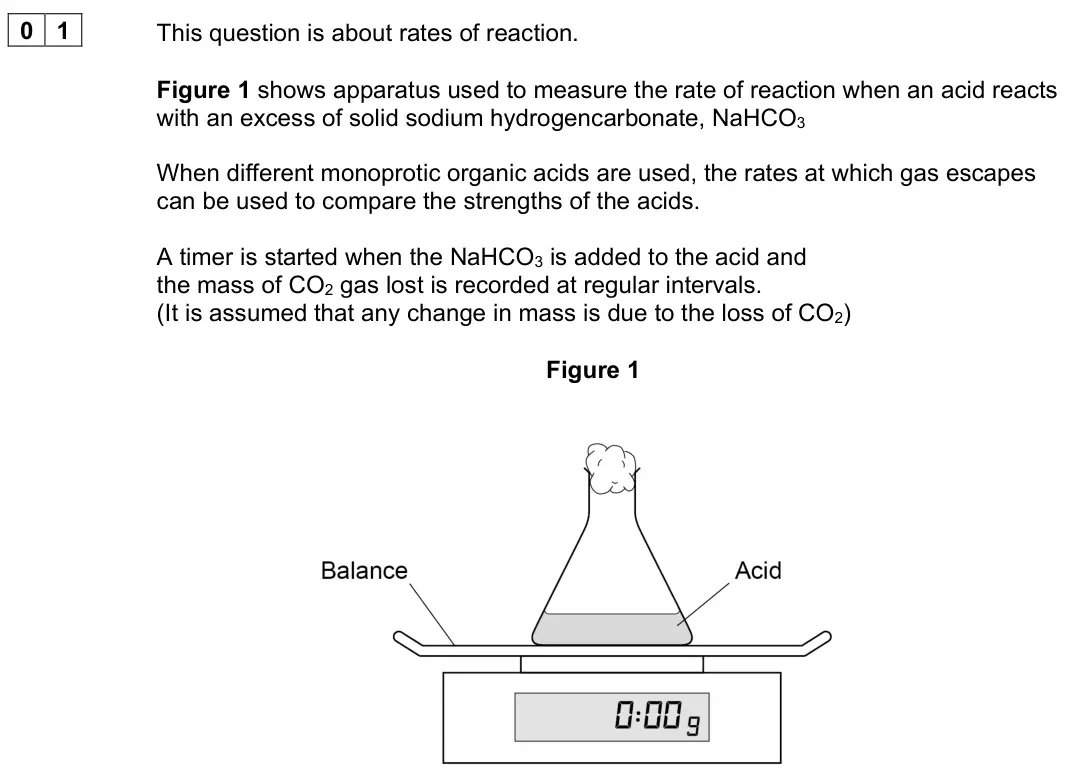
Q04.1
The whole paper ↗
Q01.2
The whole paper ↗
Q01.3
The whole paper ↗Q08.2
The whole paper ↗Q4(a)(ii)
The whole paper ↗
Q1(c)(ii)
The whole paper ↗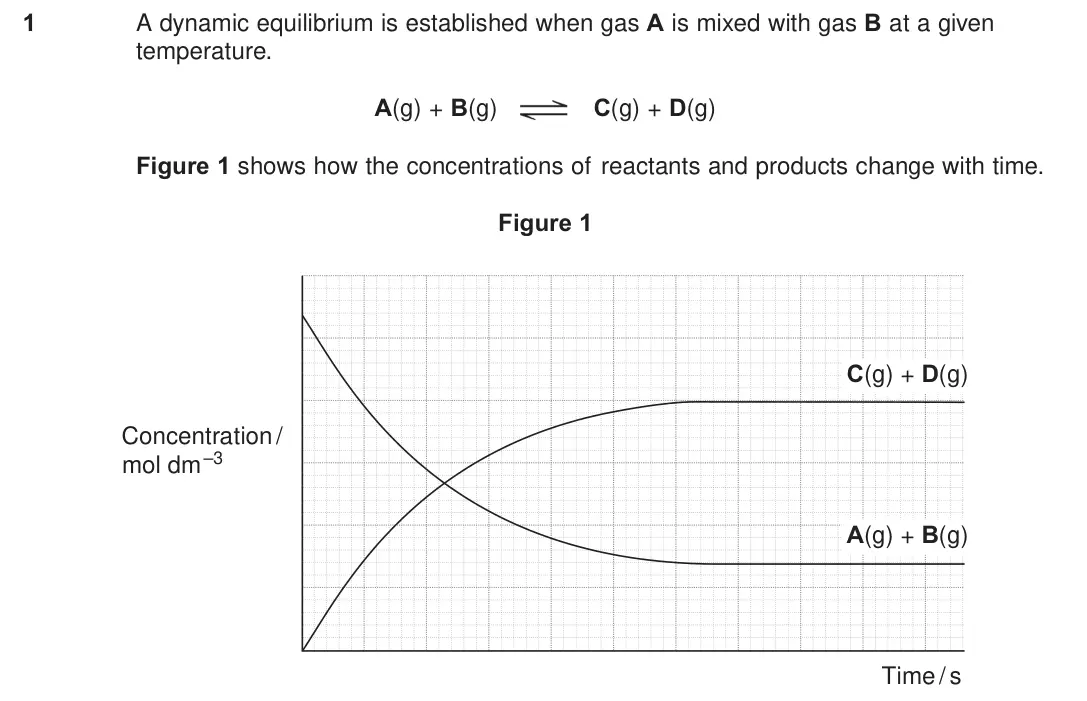
Q1(a)(iii)
The whole paper ↗Q1(a)
The whole paper ↗
Q1(b)
The whole paper ↗Q1(d)
The whole paper ↗Q1(b)(ii)
The whole paper ↗
Q1(c)
The whole paper ↗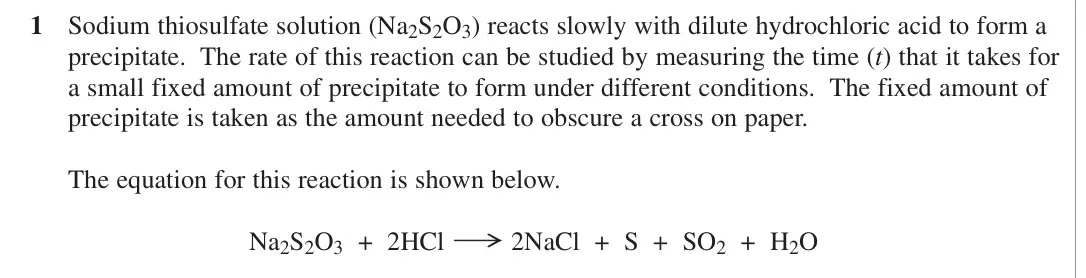
All 16 questions on Effect of concentration and pressure, as a list
- June 2025, AS Paper 2, Q20 (1 mark): A student adds 0.48 g of magnesium ribbon to 100 cm3 of 1.0 mol dm–3 hydrochloric acid. The student records the volume of hydrogen collected at regular time int
- June 2023, Paper 2, Q01.3 (3 marks): Chloroethanoic acid is a stronger acid than ethanoic acid. Sketch, on Figure 2, the curve you would expect when 25.0 cm3 of a 2.23 mol dm–3 solution of chloroet
- June 2023, AS Paper 2, Q19 (1 mark): Magnesium reacts with an acid to form hydrogen gas. Line X on the graph shows how the volume of hydrogen gas varies with time when 50 cm3 of 0.50 mol dm–3 acid
- June 2022, Paper 3, Q04.1 (2 marks): Explain why the reaction is fastest at the start. [2 marks]
- November 2021, AS Paper 2, Q21 (1 mark): An excess of magnesium reacts with hydrochloric acid to form hydrogen gas. Line X on the graph shows how the volume of hydrogen produced changes with time as ma
- June 2018, AS Paper 2, Q01.2 (2 marks): Draw two lines on Figure 1 to show how the volume of oxygen collected varied with time in Experiments 2 and 3. Label each line with the experiment number. [2 ma
- June 2018, AS Paper 2, Q01.3 (2 marks): Explain, in terms of collision theory, the effect of increasing the concentration of hydrogen peroxide on the rate of reaction. [2 marks]
- June 2016, AS Paper 2, Q08.2 (2 marks): The reaction was repeated using 20 cm3 of 0.800 mol dm−3 of ethanoic acid solution with all other conditions the same. The magnesium was still in excess. Sketch
- June 2015, CHEM2 (old spec), Q4(a)(ii) (2 marks): Le Chatelier’s principle suggests that a high pressure will produce a low yield of hydrogen in this first stage. Explain, in terms of the behaviour of particles
- June 2014, CHEM2 (old spec), Q1(c)(ii) (3 marks): State and explain the effect, if any, of this change on the time taken to reach this equilibrium. [3 marks] Effect Explanation
- January 2013, CHEM2 (old spec), Q1(a)(iii) (2 marks): In terms of collision theory explain why, at a fixed temperature, the rate of this reaction doubles when the concentration of the hydrochloric acid doubles.
- June 2012, CHEM2 (old spec), Q1(a) (2 marks): Draw a curve on Figure 1 to show how the total volume of oxygen collected will change with time if the experiment is repeated at 298 K using 100 cm3 of a 2.0 mo
- June 2012, CHEM2 (old spec), Q1(b) (2 marks): Draw a curve on Figure 2 to show how the total volume of oxygen collected will change with time if the experiment is repeated at 298 K using 100 cm3 of a 0.4 mo
- June 2012, CHEM2 (old spec), Q1(d) (2 marks): Explain why the slope (gradient) of curve R decreases as time increases.
- June 2010, CHEM2 (old spec), Q1(b)(ii) (3 marks): State and explain the effect of an increase in total pressure on the rate of attainment of this equilibrium. Effect of an increase in pressure on rate Explanati
- June 2009, CHEM2 (old spec), Q1(c) (2 marks): 1 (c) In terms of particles, explain why, at a fixed temperature, you might expect the rate of this reaction to double when the concentration of sodium thiosulf
Questions, mark schemes and examiner’s reports are © AQA, from their published past papers. Plumi isn’t affiliated with any exam board. Want whole papers? AQA A-Level Chemistry past papers.
The Plumi iPad app also offers exam-style questions with AI feedback on your handwritten working.