 plumi
Amino acids: AQA A‑Level Chemistry questions
AQA A-Level Chemistry past-paper questions on 3.3.13.1 Amino acids, 2008–2025, with mark schemes and examiner’s reports where available.
Paper
All papers
Exam
All years
Calculations
Q06.2
The whole paper ↗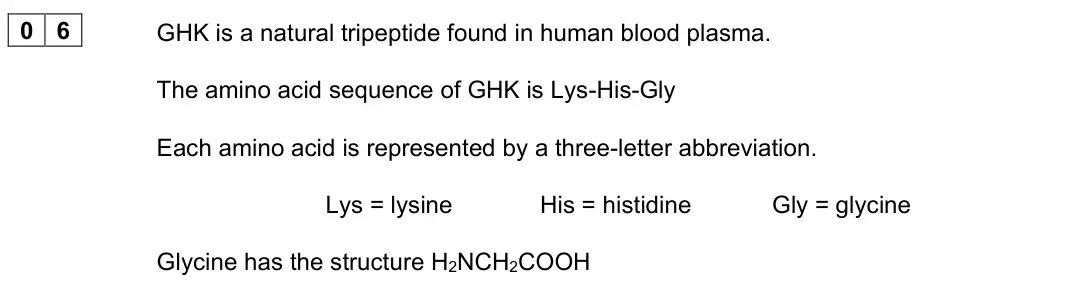
Q03.2
The whole paper ↗
Q08.4
The whole paper ↗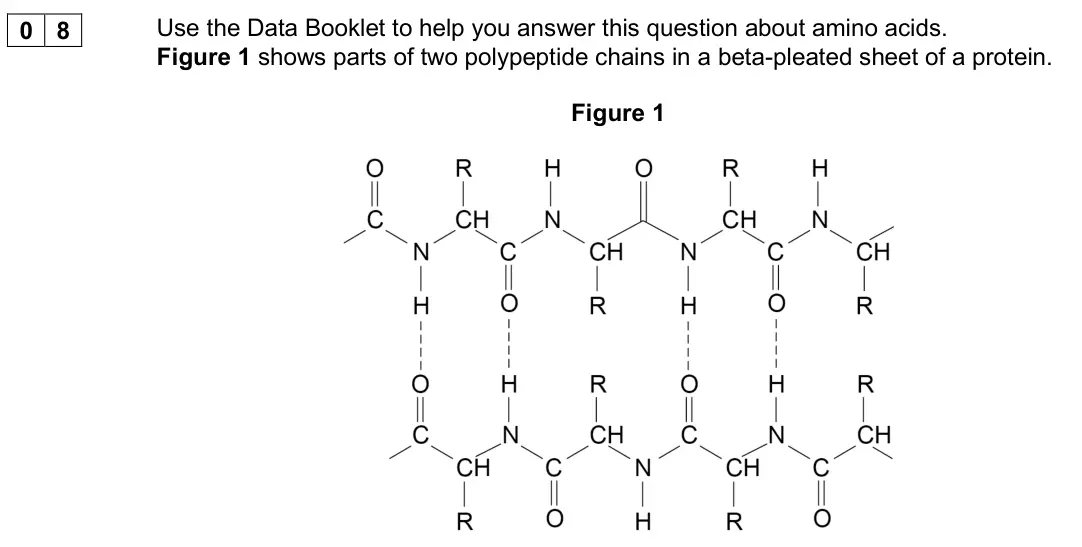
Q06.1
The whole paper ↗
Q06.2
The whole paper ↗Q06.2
The whole paper ↗Q06.3
The whole paper ↗Q06.4
The whole paper ↗Q06.5
The whole paper ↗Q5(b)(i)
The whole paper ↗
Q5(b)(ii)
The whole paper ↗
All 56 questions on Amino acids, as a list
- June 2025, Paper 2, Q06.2 (1 mark): Use Figure 6 to determine the structure of the amino acid histidine, His [1 mark]
- June 2024, Paper 3, Q33 (1 mark): Which structure shows a zwitterion of an amino acid? [1 mark] A B C D
- June 2024, Paper 3, Q35 (1 mark): Which structure is formed by phenylalanine in solution at pH = 3? [1 mark] A B C D
- June 2023, Paper 3, Q03.2 (1 mark): Use the structure in Figure 2 to draw the skeletal formula of proline, Pro. [1 mark]
- June 2022, Paper 3, Q29 (1 mark): Which is the main species present in an aqueous solution of aspartic acid at pH = 14? [1 mark] A B C D
- June 2022, Paper 3, Q33 (1 mark): Which statement about HOCH2CH(NH2)COOH is correct? [1 mark] A It decolourises bromine water. B It is a component of DNA. C It is insoluble in water. D It reacts
- June 2022, Paper 3, Q35 (1 mark): Which compound is not a 2-aminocarboxylic acid? [1 mark] A CH3CH(NH2)COOH B CH3CH(NH2)CH2COOH C CH3CH2CH(NH2)COOH D (CH3)2CHCH(NH2)COOH
- November 2021, Paper 3, Q35 (1 mark): Which is the structure of a zwitterion of an amino acid? [1 mark] A B C D
- November 2020, Paper 3, Q30 (1 mark): Which structure shows the zwitterion of an amino acid? [1 mark] A B C D
- June 2019, Paper 3, Q35 (1 mark): Use the Data Booklet to help you answer this question Which is the main aspartic acid species present in an aqueous solution at pH = 14? [1 mark] A B C D
- June 2018, Paper 2, Q08.4 (2 marks): Draw the structure of the zwitterion of a dipeptide formed by alanine and serine. [2 marks]
- June 2018, Paper 3, Q15 (1 mark): Which structure is formed by aspartic acid in solution at pH 12? [1 mark] A B C D
- June 2017, Paper 2, Q06.1 (1 mark): Draw the structure of the zwitterion formed by phenylalanine. [1 mark
- June 2017, Paper 2, Q06.2 (1 mark): Draw the structure of serine at high pH. [1 mark
- Specimen, Paper 2, Q06.2 (1 mark): Draw the zwitterion of glycine. [1 mark] 0 6 . 2
- Specimen, Paper 2, Q06.3 (1 mark): Draw the structure of the species formed when glycine reacts with an excess of bromomethane. [1 mark] 0 6 . 3
- Specimen, Paper 2, Q06.4 (1 mark): Deduce the IUPAC name of threonine. [1 mark] 0 6 . 4
- Specimen, Paper 2, Q06.5 (1 mark): 6
- June 2016, CHEM4 (old spec), Q5(b)(i) (1 mark): Give the IUPAC name of leucine. [1 mark]
- June 2016, CHEM4 (old spec), Q5(b)(ii) (1 mark): Draw the structure of the zwitterion of serine. [1 mark]
- June 2016, CHEM4 (old spec), Q5(b)(iii) (1 mark): Draw the structure of the ester formed by two molecules of serine. [1 mark]
- June 2016, CHEM4 (old spec), Q5(b)(iv) (1 mark): Draw the structure of the species formed by glutamic acid at low pH. [1 mark]
- June 2015, CHEM4 (old spec), Q7(a)(i) (1 mark): Draw the structure of the zwitterion of proline. [1 mark]
- June 2014, CHEM4 (old spec), Q6(a) (1 mark): Give the IUPAC name of lysine. [1 mark]
- June 2014, CHEM4 (old spec), Q6(b)(i) (1 mark): an excess of aqueous HCl [1 mark]
- June 2014, CHEM4 (old spec), Q6(b)(ii) (1 mark): an excess of aqueous NaOH [1 mark]
- June 2014, CHEM4 (old spec), Q6(b)(iii) (1 mark): methanol in the presence of a small amount of concentrated H2SO4 [1 mark]
- June 2013, CHEM4 (old spec), Q6(a) (1 mark): Draw the structure of the zwitterion formed by alanine. (1 mark)
- June 2013, CHEM4 (old spec), Q6(b) (1 mark): Draw the structure of the compound formed when alanine reacts with methanol in the presence of a small amount of concentrated sulfuric acid. (1 mark)
- June 2013, CHEM4 (old spec), Q6(c) (1 mark): Draw the structure of the species formed by aspartic acid at high pH. (1 mark)
- June 2013, CHEM4 (old spec), Q6(d) (1 mark): Draw the structure of a dipeptide formed by two aspartic acid molecules. (1 mark)
- January 2013, CHEM4 (old spec), Q4(a)(ii) (1 mark): Draw the zwitterion of alanine. (1 mark)
- January 2013, CHEM4 (old spec), Q4(a)(iii) (1 mark): Give the IUPAC name of threonine. (1 mark)
- January 2013, CHEM4 (old spec), Q4(a)(iv) (1 mark): Draw the species formed by lysine at low pH. (1 mark)
- June 2012, CHEM4 (old spec), Q5(d)(i) (1 mark): Draw the structure of the species present in the solid amino acid. (1 mark)
- June 2012, CHEM4 (old spec), Q5(d)(ii) (2 marks): With reference to your answer to part (d) (i), explain why the melting point of the amino acid X is higher than the melting point of CH3CH2CH(OH)COOH
- January 2012, CHEM4 (old spec), Q7(b) (1 mark): Give the IUPAC name of aspartic acid. (1 mark)
- January 2012, CHEM4 (old spec), Q7(c) (1 mark): Draw the organic species formed by aspartic acid at high pH. (1 mark)
- January 2012, CHEM4 (old spec), Q7(d) (1 mark): Draw the zwitterion of phenylalanine. (1 mark)
- June 2011, CHEM4 (old spec), Q4(d)(i) (1 mark): Give the IUPAC name of serine. (1 mark)
- June 2011, CHEM4 (old spec), Q4(d)(ii) (1 mark): Draw the structure of the species formed when aspartic acid reacts with aqueous sodium hydroxide. (1 mark)
- June 2011, CHEM4 (old spec), Q4(d)(iii) (1 mark): Draw the structure of the species formed when serine reacts with dilute hydrochloric acid. (1 mark)
- June 2011, CHEM4 (old spec), Q4(d)(iv) (1 mark): Draw the structure of the species formed when serine reacts with an excess of bromomethane. (1 mark)
- January 2011, CHEM4 (old spec), Q4(d) (1 mark): At room temperature, 2-aminobutanoic acid exists as a solid. Draw the structure of the species present in the solid form. (1 mark)
- January 2011, CHEM4 (old spec), Q4(e)(i) (1 mark): an excess of sodium hydroxide (1 mark)
- January 2011, CHEM4 (old spec), Q4(e)(ii) (1 mark): an excess of methanol in the presence of concentrated sulfuric acid (1 mark)
- June 2010, CHEM4 (old spec), Q6(a)(ii) (1 mark): Give the IUPAC name for the amino acid K. (1 mark)
- June 2010, CHEM4 (old spec), Q6(a)(iii) (1 mark): Draw the structure of the zwitterion of amino acid L. (1 mark)
- June 2010, CHEM4 (old spec), Q6(a)(iv) (1 mark): Draw the structure of the species formed by amino acid M at low pH. (1 mark)
- June 2010, CHEM4 (old spec), Q6(b)(i) (1 mark): Draw the structure of the product formed when serine reacts with an excess of CH3Br (1 mark)
- January 2010, CHEM4 (old spec), Q6(a)(i) (1 mark): Draw the zwitterion of alanine. (1 mark)
- January 2010, CHEM4 (old spec), Q6(a)(ii) (1 mark): Draw the species formed when valine is dissolved in an alkaline solution. (1 mark)
- January 2010, CHEM4 (old spec), Q6(a)(iii) (1 mark): Draw the species formed by lysine at low pH. (1 mark)
- June 2008, CHM4 (2008 spec), Q4(c) (6 marks): 4 (c) The amino acids alanine and serine are shown below. COOH H2N C CH3 H COOH H2N C CH2OH H alanine serine 4 (c) (i) Draw the structures of the two dipeptides
- June 2008, CHM6W (2008 spec), Q32 (1 mark): 32 The artificial sweetener aspartame has the structure Correct statements about aspartame include 1 it can form a zwitterion. 2 it can undergo alkaline hydroly
- January 2008, CHM4 (2008 spec), Q5(a) (4 marks): (a) (i) Polymer P is formed from the single amino acid, 2-aminopropanoic acid. Draw the structure of the zwitterion of this amino acid. (ii) One other polymer r
Questions, mark schemes and examiner’s reports are © AQA, from their published past papers. Plumi isn’t affiliated with any exam board. Want whole papers? AQA A-Level Chemistry past papers.
The Plumi iPad app also offers exam-style questions with AI feedback on your handwritten working.