 plumi
Proteins: AQA A‑Level Chemistry questions
AQA A-Level Chemistry past-paper questions on 3.3.13.2 Proteins, 2008–2025, with mark schemes and examiner’s reports where available.
Paper
All papers
Exam
All years
Calculations
Q06.3
The whole paper ↗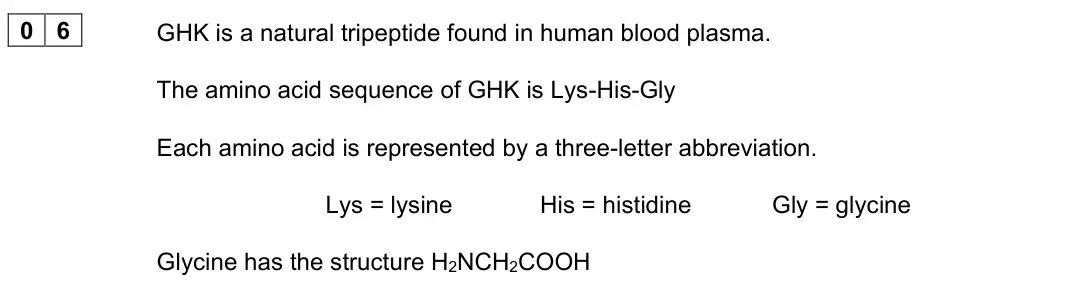
Q03.1
The whole paper ↗
Q03.3
The whole paper ↗Q04.1
The whole paper ↗
Q04.2
The whole paper ↗Q04.3
The whole paper ↗Q04.4
The whole paper ↗Q04.5
The whole paper ↗Q09.1
The whole paper ↗
Q08.1
The whole paper ↗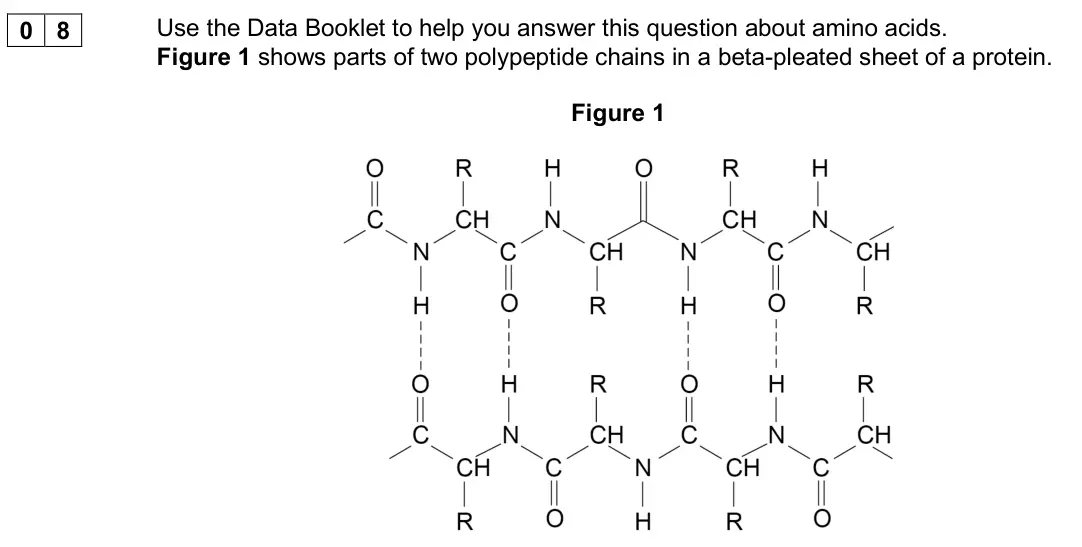
Q08.2
The whole paper ↗Q08.3
The whole paper ↗Q08.4
The whole paper ↗Q06.3
The whole paper ↗
Q05.1
The whole paper ↗Q05.2
The whole paper ↗
All 32 questions on Proteins, as a list
- June 2025, Paper 2, Q06.3 (2 marks): Increasing the temperature of an alkaline solution of poly(lysine) changes the type of secondary structure in poly(lysine), as shown. Name the type of secondary
- June 2025, Paper 3, Q29 (1 mark): What is the structure of a dipeptide formed from the two amino acids shown? [1 mark] A B C D
- June 2025, Paper 3, Q33 (1 mark): The diagram shows part of the tertiary structure for a protein. Some of the amino acids in this structure are shown using the first three letters of their names
- June 2023, Paper 3, Q03.1 (2 marks): The –NH2 at the end of the amino acid sequence of endomorphin-2 shows that the terminal functional group is an amide, not an acid. Complete the structure of end
- June 2023, Paper 3, Q03.3 (2 marks): State a reagent and the conditions needed for the hydrolysis. [2 marks] Reagent Conditions
- June 2022, Paper 2, Q04.1 (1 mark): Identify the type of protein structure shown. [1 mark] Tick () one box. Primary Secondary Tertiary
- June 2022, Paper 2, Q04.2 (2 marks): Draw a structure for the –Cys–Ser– section of the protein. Use the Data Booklet to help you answer this question. [2 marks]
- June 2022, Paper 2, Q04.3 (1 mark): Name the other substance formed when two amino acids react together to form part of a protein chain. [1 mark]
- June 2022, Paper 2, Q04.4 (4 marks): Explain why the strength of the interaction between two cysteine R groups differs from the strength of the interaction between a serine R group and an aspartic
- June 2022, Paper 2, Q04.5 (1 mark): Deduce the type of interaction that occurs between a lysine R group and an aspartic acid R group. [1 mark]
- June 2022, Paper 3, Q32 (1 mark): Which type of interaction between polypeptide chains is mainly responsible for maintaining the secondary structure of a protein in the form of an alpha helix? [
- June 2019, Paper 2, Q09.1 (1 mark): Suggest a suitable reagent for the hydrolysis of a protein. [1 mark]
- June 2019, Paper 3, Q29 (1 mark): Which structure shows part of a peptide link in a protein? [1 mark] A B C D
- June 2018, Paper 2, Q08.1 (2 marks): The polypeptide chains are held together by hydrogen bonding as shown in Figure 1. Explain how these hydrogen bonds form. [2 marks]
- June 2018, Paper 2, Q08.2 (1 mark): A different type of bond can form between two polypeptide chains when the chains each contain the amino acid cysteine. Complete the structure to show the bond t
- June 2018, Paper 2, Q08.3 (1 mark): The type of bond in Question 08.2 between two polypeptide chains influences the three-dimensional structure of the protein. Name this type of protein structure.
- June 2018, Paper 2, Q08.4 (2 marks): Draw the structure of the zwitterion of a dipeptide formed by alanine and serine. [2 marks]
- June 2017, Paper 2, Q06.3 (2 marks): Draw the structures of both dipeptides formed when phenylalanine reacts with serine. In each structure show all the atoms and bonds in the amide link. [2 marks
- Specimen, Paper 2, Q05.1 (1 mark): 5 Figure 3 shows a simplified representation of the arrangement of some amino acids in a portion of a protein structure in the form of an α-helix. Figure 3 Name
- Specimen, Paper 2, Q05.2 (4 marks): 5
- Specimen, Paper 2, Q06.1 (1 mark): 6 The tripeptide shown in Figure 4 is formed from the amino acids glycine, threonine and lysine. Figure 4 H2N C H H C O N H C CHOH H C CH3 O N H C (CH2)4 H COOH
- June 2016, CHEM4 (old spec), Q5(a)(i) (2 marks): A section of a protein is formed from one molecule of each of the amino acids glycine (H2NCH2COOH) and alanine (H2NCH(CH3)COOH). Add bonds and atoms to the diag
- June 2016, CHEM4 (old spec), Q5(a)(ii) (1 mark): Draw a diagram to show how an amino acid chain can form a hydrogen bond with another amino acid chain. Your diagram need only show the relevant atoms from one a
- June 2015, CHEM4 (old spec), Q7(a)(ii) (2 marks): Draw the structure of the tripeptide formed when a proline molecule bonds to two alanine molecules, one on each side. [2 marks]
- June 2014, CHEM4 (old spec), Q6(d) (1 mark): Draw a dipeptide formed from one molecule of lysine and one molecule of alanine. [1 mark]
- June 2013, CHEM4 (old spec), Q6(d) (1 mark): Draw the structure of a dipeptide formed by two aspartic acid molecules. (1 mark)
- January 2012, CHEM4 (old spec), Q7(a) (1 mark): Apart from the release of methanol, suggest why aspartame is not used to sweeten foods that are to be cooked. (1 mark)
- June 2011, CHEM4 (old spec), Q4(c) (1 mark): The dipeptide shown below is formed from two different amino acids. Draw the structure of the alternative dipeptide that could be formed by these two amino acid
- June 2010, CHEM4 (old spec), Q6(a)(i) (1 mark): Name the process by which the tripeptide is split into three amino acids. (1 mark)
- June 2010, CHEM4 (old spec), Q6(b)(ii) (1 mark): Draw the structure of the dipeptide formed by two molecules of serine. (1 mark) Section B Answer all questions in the spaces provided.
- January 2010, CHEM4 (old spec), Q6(b) (2 marks): Draw the two dipeptides formed by the reaction of alanine with valine. (2 marks)
- June 2008, CHM4 (2008 spec), Q4(c) (6 marks): 4 (c) The amino acids alanine and serine are shown below. COOH H2N C CH3 H COOH H2N C CH2OH H alanine serine 4 (c) (i) Draw the structures of the two dipeptides
Questions, mark schemes and examiner’s reports are © AQA, from their published past papers. Plumi isn’t affiliated with any exam board. Want whole papers? AQA A-Level Chemistry past papers.
The Plumi iPad app also offers exam-style questions with AI feedback on your handwritten working.