 plumi
Elimination: AQA A‑Level Chemistry questions
AQA A-Level Chemistry past-paper questions on 3.3.5.3 Elimination, 2008–2025, with mark schemes and examiner’s reports where available.
Paper
All papers
Exam
All years
Calculations
Q06.8
The whole paper ↗
Q02.1
The whole paper ↗
Q02.2
The whole paper ↗Q02.4
The whole paper ↗Q02.5
The whole paper ↗Q02.6
The whole paper ↗Q07.1
The whole paper ↗
Q07.2
The whole paper ↗Q08.1
The whole paper ↗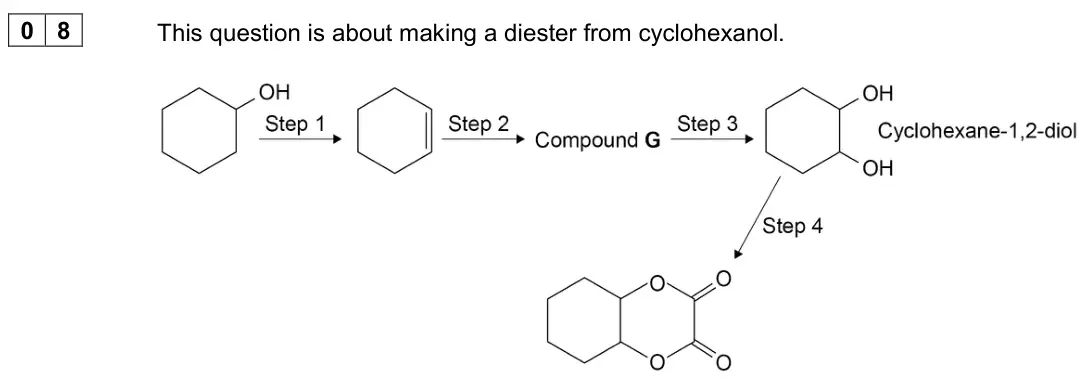
Q07.2
The whole paper ↗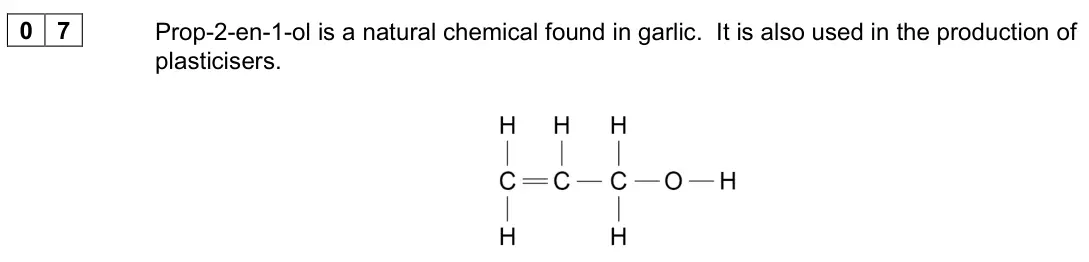
Q06.3
The whole paper ↗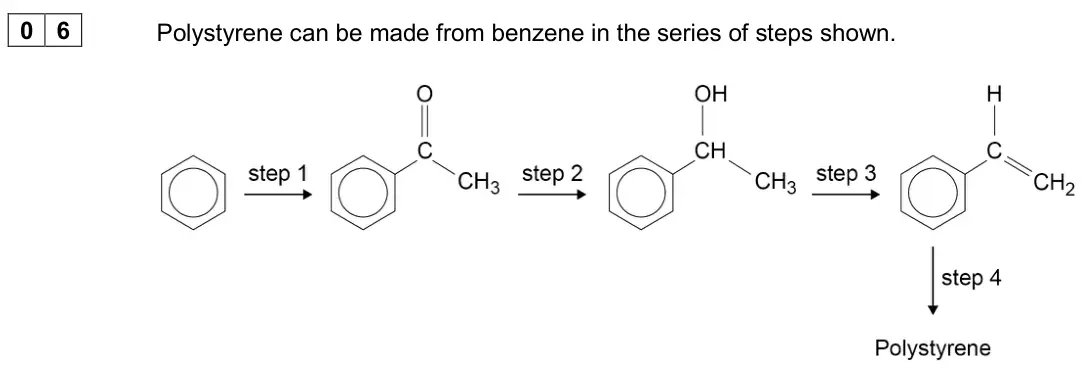
Q04.2
The whole paper ↗
Q02.1
The whole paper ↗
Q02.2
The whole paper ↗Q02.3
The whole paper ↗Q02.4
The whole paper ↗Q04.3
The whole paper ↗
All 41 questions on Elimination, as a list
- June 2025, AS Paper 2, Q06.8 (1 mark): The cyclohexanol can be dehydrated to re-form cyclohexene by heating with concentrated phosphoric acid. Name the mechanism for this reaction. [1 mark]
- June 2023, Paper 3, Q02.1 (1 mark): Draw the displayed formula of an unbranched position isomer of pentan-2-ol that can be dehydrated to form a single alkene. [1 mark]
- June 2023, Paper 3, Q02.2 (1 mark): Draw the skeletal formula of a chain isomer of pentan-2-ol that can be dehydrated to form a mixture of alkenes. [1 mark]
- June 2023, Paper 3, Q02.4 (1 mark): Another isomer of pentan-2-ol is an alcohol that is not dehydrated when heated with concentrated sulfuric acid. Draw the structure of this isomer. [1 mark]
- June 2023, Paper 3, Q02.5 (3 marks): An incomplete mechanism for the dehydration of a compound is shown. Complete the mechanism for this reaction by drawing two curly arrows on the intermediate. Na
- June 2023, Paper 3, Q02.6 (1 mark): An isomer of the final product can also form in the reaction in Question 02.5. Draw the structure of this isomer. [1 mark]
- June 2023, AS Paper 2, Q07.1 (2 marks): Explain why the water should enter the condenser at the bottom and not at the top. [2 marks]
- June 2023, AS Paper 2, Q07.2 (4 marks): Name and complete the mechanism for this reaction. [4 marks] Name of mechanism
- June 2022, Paper 3, Q34 (1 mark): Which compound can be dehydrated to form an alkene? [1 mark] A CH3CHO B CH3COOH C CH3CH2OH D CH3COOCH3
- June 2022, AS Paper 2, Q12 (1 mark): Which alcohol when dehydrated forms a mixture of alkenes? [1 mark] A propan-1-ol B propan-2-ol C pentan-1-ol D pentan-2-ol
- November 2021, Paper 2, Q08.1 (2 marks): State the type of reaction in step 1. Give the name of the reagent needed for step 1. [2 marks] Type of reaction Reagent
- November 2021, AS Paper 2, Q07.2 (4 marks): Prop-2-en-1-ol can also be formed from HOCH2CH2CH2OH in the presence of an acid catalyst. HOCH2CH2CH2OH ⟶ CH2=CHCH2OH + H2O Name and outline a mechanism for thi
- November 2020, Paper 2, Q06.3 (3 marks): The organic product of step 2 is reacted with concentrated sulfuric acid in step 3. Outline the mechanism for step 3. [3 marks]
- November 2020, AS Paper 2, Q04.2 (5 marks): Pent-1-ene is formed by the elimination of water from pentan-2-ol. State the reagent and condition for this reaction. Outline the mechanism for this reaction. [
- June 2019, Paper 2, Q02.1 (2 marks): Complete the diagram of the apparatus used to distil the cyclohexene from the reaction mixture at 83 °C. [2 marks]
- June 2019, Paper 2, Q02.2 (1 mark): The distillate was shaken with saturated sodium chloride solution. The cyclohexene was separated from the aqueous solution using a separating funnel. State why
- June 2019, Paper 2, Q02.3 (1 mark): The cyclohexene separated in Question 02.2 was obtained as a cloudy liquid. The student dried this cyclohexene by adding a few lumps of anhydrous calcium chlori
- June 2019, Paper 2, Q02.4 (5 marks): In this preparation, the student added an excess of concentrated phosphoric acid to 14.4 g of cyclohexanol (Mr = 100.0). The student obtained 4.15 cm3 of cycloh
- June 2019, Paper 3, Q04.3 (2 marks): 2-Hydroxypropanenitrile can be used in the synthesis of the monomer, acrylonitrile, CH2=CHCN Suggest a suitable reagent and conditions for the conversion of 2-h
- June 2019, AS Paper 2, Q20 (1 mark): Which alcohol forms a mixture of alkenes when dehydrated? [1 mark] A propan-1-ol B propan-2-ol C pentan-1-ol D pentan-2-ol
- June 2018, Paper 2, Q03.5 (4 marks): A mixture of isomeric alkenes is produced when pentan-2-ol is dehydrated in the presence of hot concentrated sulfuric acid. Pent-1-ene is one of the isomers pro
- June 2018, Paper 2, Q03.6 (2 marks): A pair of stereoisomers is also formed in the reaction in Question 03.5. Name the less polar stereoisomer formed. Explain how this type of stereoisomerism arise
- June 2018, Paper 3, Q03.1 (3 marks): The student collected 5.97 g of cyclohexene in the experiment. Calculate the percentage yield of cyclohexene. [3 marks] Percentage yield %
- June 2018, Paper 3, Q03.3 (1 mark): Suggest why sodium carbonate solution was used to wash the distillate. [1 mark]
- June 2018, Paper 3, Q03.4 (1 mark): Explain why it is important to open the tap of the separating funnel periodically. [1 mark]
- June 2018, Paper 3, Q03.5 (1 mark): Give a property of anhydrous calcium chloride, other than its ability to absorb water, that makes it suitable as a drying agent in this preparation. [1 mark]
- June 2018, Paper 3, Q03.6 (2 marks): Describe the apparatus used to remove the drying agent by filtration under reduced pressure. Your description of the apparatus can be either a labelled diagram
- June 2017, Paper 3, Q02.5 (3 marks): Butan-2-ol reacts with concentrated sulfuric acid to form a mixture of three isomeric alkenes. Two of the alkenes are stereoisomers. Draw the skeletal formula o
- June 2017, AS Paper 2, Q07.1 (4 marks): Complete the mechanism for the conversion of 2-methylcyclohexanol into 1-methylcyclohexene via carbocation D by drawing • the structure of the missing intermedi
- June 2017, AS Paper 2, Q07.2 (1 mark): Draw the structure of a different cyclic alkene formed from carbocation D. [1 mark]
- June 2017, AS Paper 2, Q07.3 (2 marks): Carbocation D can undergo a type of reaction called a rearrangement to form carbocation E. In this reaction, a hydrogen atom and its bonding pair of electrons m
- June 2017, AS Paper 2, Q07.4 (1 mark): As a result of the rearrangement in Question 7.3, a third alkene is formed in this reaction. Draw the structure of this third alkene. [1 mark]
- June 2017, AS Paper 2, Q17 (1 mark): Which alcohol can be oxidised by acidified potassium dichromate(VI) but cannot be dehydrated by heating with concentrated sulfuric acid? [1 mark] A 2,3-dimethyl
- Specimen, Paper 2, Q04.3 (1 mark): Two isomeric alkenes, C and D, are formed when A is dehydrated in the reaction with concentrated sulfuric acid. Name the mechanism for this dehydration reaction
- Specimen, Paper 2, Q04.4 (2 marks): Isomer C Isomer D 3
- Specimen, Paper 2, Q04.8 (1 mark): Draw the structure of the isomer of A that cannot be dehydrated to form an alkene by reaction with concentrated sulfuric acid. [1 mark] 0 4 . 8
- June 2016, CHEM2 (old spec), Q4(c) (4 marks): Isomer C is resistant to oxidation. Isomer C reacts to form compound R that has an absorption in its infrared spectrum in the range 1620–1680 cm–1. State the bo
- January 2012, CHEM4 (old spec), Q11 (8 marks): Chemists have to design synthetic routes to convert one organic compound into another. Propanone can be converted into 2-bromopropane by a three-step synthesis.
- January 2011, CHEM4 (old spec), Q4(c)(ii) (1 mark): Write the displayed formula for the organic product of this elimination reaction. (1 mark)
- June 2008, CHM3W (2008 spec), Q6(d) (3 marks): 6 (d) The reaction of aqueous glucose to form ethanol produces a dilute aqueous solution. Name the process used to separate ethanol from this dilute aqueous sol
- January 2008, CHM3W (2008 spec), Q4(e) (2 marks): (e) Write an equation for the elimination of water from butan-1-ol showing the structures of the organic compounds. Identify a catalyst used in this reaction. E
Questions, mark schemes and examiner’s reports are © AQA, from their published past papers. Plumi isn’t affiliated with any exam board. Want whole papers? AQA A-Level Chemistry past papers.
The Plumi iPad app also offers exam-style questions with AI feedback on your handwritten working.