 plumi
Chemical equilibria and Le Chatelier's principle: AQA A‑Level Chemistry questions
AQA A-Level Chemistry past-paper questions on 3.1.6.1 Chemical equilibria and Le Chatelier's principle, 2008–2025, with mark schemes and examiner’s reports where available.
Paper
All papers
Exam
All years
Calculations
Q04.5
The whole paper ↗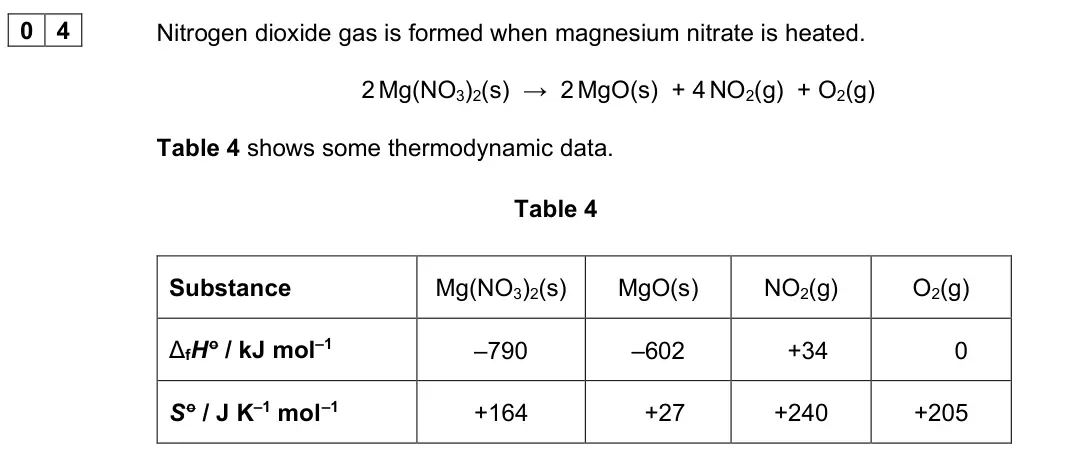
Q07.1
The whole paper ↗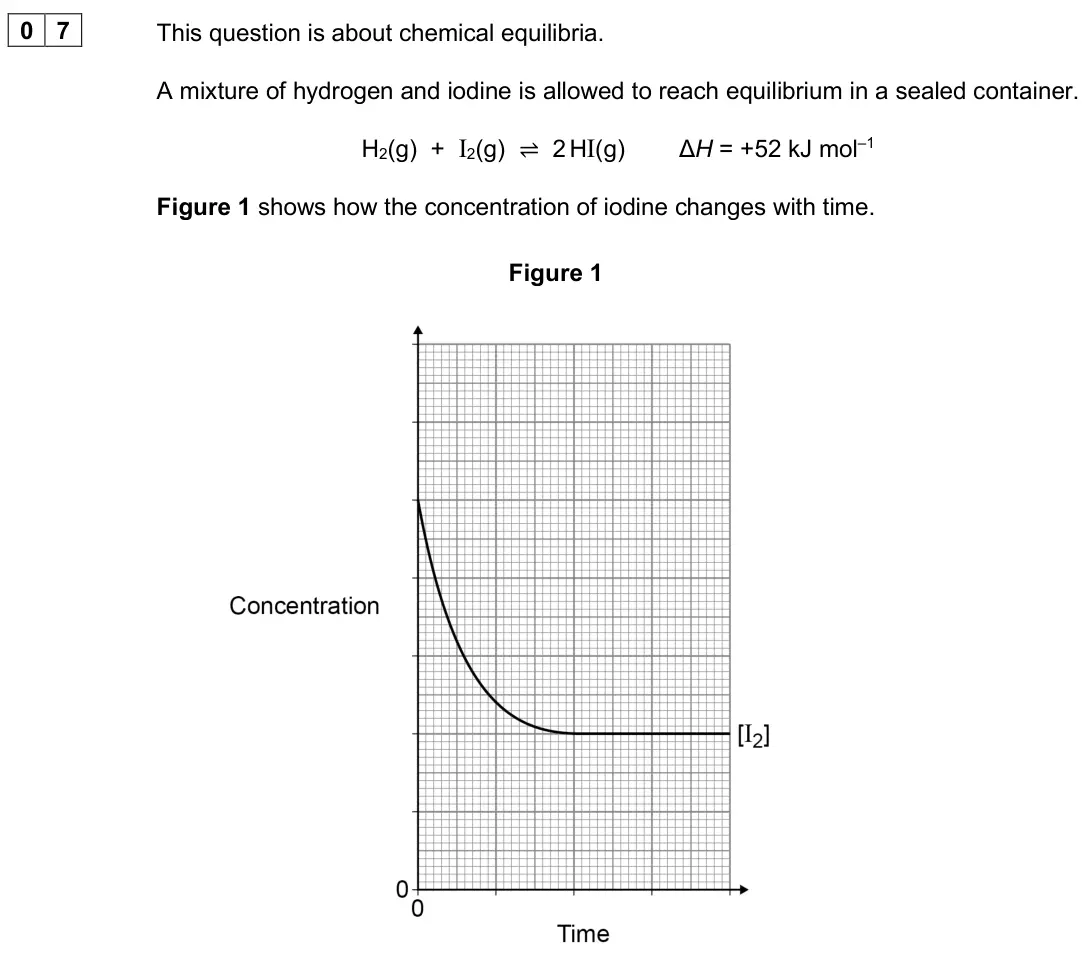
Q07.2
The whole paper ↗Q04.3
The whole paper ↗
Q02.3
The whole paper ↗
Q07.8
The whole paper ↗
Q04.4
The whole paper ↗
Q04.5
The whole paper ↗Q01.1
The whole paper ↗
Q01.2
The whole paper ↗Q02.4
The whole paper ↗
Q07.1
The whole paper ↗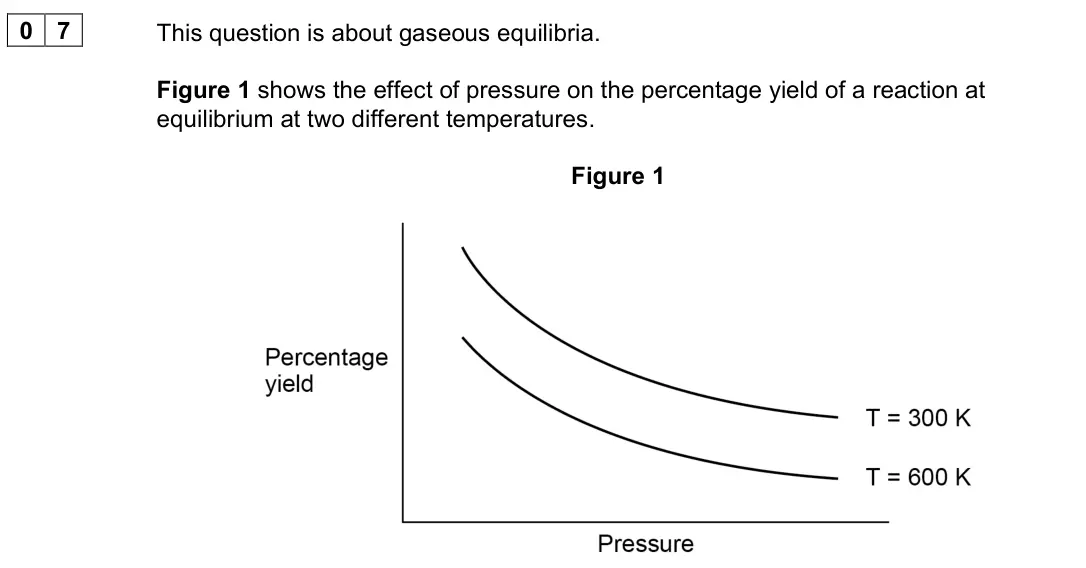
Q07.2
The whole paper ↗Q07.3
The whole paper ↗Q05.1
The whole paper ↗
All 121 questions on Chemical equilibria and Le Chatelier's principle, as a list
- June 2025, Paper 1, Q04.5 (2 marks): Some ammonia and oxygen are reacted and the mixture is left to reach equilibrium at a fixed temperature. Explain why increasing the temperature of this equilibr
- June 2025, AS Paper 1, Q07.1 (2 marks): Draw a line on Figure 1 to show how the concentration of hydrogen iodide changes with time. [2 marks]
- June 2025, AS Paper 1, Q07.2 (3 marks): State and explain the effect of increasing the temperature on the equilibrium yield of hydrogen iodide. [3 marks] Effect on yield Explanation
- June 2025, AS Paper 1, Q15 (1 mark): Which equilibrium has a lower yield of product when the pressure in the system is increased at constant temperature? [1 mark] A 2 NOCl(g) ⇌ 2 NO(g) + Cl2(g) B 2
- June 2024, Paper 1, Q04.3 (1 mark): The temperature of the equilibrium mixture formed in Question 04.1 is increased. How does the amount of H2(g) change when the new position of equilibrium is rea
- June 2024, Paper 2, Q02.3 (2 marks): Explain why the amount of S increases when water is added to the equilibrium mixture. [2 marks]
- June 2024, Paper 3, Q29 (1 mark): Which statement about the industrial production of ethanol from ethene at 300 °C is correct? C2H4(g) + H2O(g) ⇌ C2H5OH(g) ΔH = –46 kJ mol–1 [1 mark] A The use o
- June 2024, AS Paper 2, Q07.8 (3 marks): Predict the effect of increasing the temperature on the yield of propanoic acid. Explain your answer. [3 marks] Effect on yield Explanation Section B Answer all
- June 2023, Paper 1, Q04.4 (2 marks): The equilibrium mixture in Question 04.3 is compressed into a smaller volume. Deduce the effect, if any, of this change on the equilibrium yield of oxygen and o
- June 2023, Paper 1, Q04.5 (2 marks): The equilibrium mixture in Question 04.3 is allowed to reach equilibrium at a lower temperature. Explain why the equilibrium yield of oxygen decreases. [2 marks
- June 2023, Paper 3, Q25 (1 mark): Which statement about catalysts used in reactions at equilibrium, at a constant temperature, is correct? [1 mark] A They are always used in the solid state. B T
- June 2023, AS Paper 2, Q16 (1 mark): Which statement about the industrial production of ethanol from ethene at 300 °C is correct? C2H4(g) + H2O(g) ⇌ C2H5OH(g) ΔH= –46 kJ mol –1 [1 mark] A An increa
- June 2022, Paper 1, Q01.1 (2 marks): Give two features of a reaction in dynamic equilibrium. [2 marks] Feature 1 Feature 2
- June 2022, Paper 1, Q01.2 (1 mark): A gas-phase reaction is at equilibrium. When the pressure is increased the yield of product decreases. State what can be deduced about the chemical equation for
- June 2022, Paper 2, Q02.4 (3 marks): State and explain the effect of using a higher temperature on the equilibrium yield of tetrafluoroethene. [3 marks] Effect on yield Explanation
- June 2022, AS Paper 1, Q07.1 (2 marks): Explain how Figure 1 shows that the forward reaction in this equilibrium is exothermic. [2 marks]
- June 2022, AS Paper 1, Q07.2 (3 marks): State whether the forward reaction in this equilibrium results in an increase, decrease or no change in the amount, in moles, of gas. Explain your answer. [3 ma
- June 2022, AS Paper 1, Q07.3 (1 mark): Explain why using a catalyst has no effect on the percentage yield. [1 mark]
- June 2022, AS Paper 2, Q20 (1 mark): Which change in condition will decrease the equilibrium yield of methanol? [1 mark] A Increase the amount of CO in the equilibrium mixture. B Increase the press
- November 2021, Paper 1, Q05.1 (3 marks): State and explain the effect, if any, of a decrease in overall pressure on the equilibrium yield of SO3 [3 marks] Effect Explanation
- November 2021, Paper 3, Q20 (1 mark): Which statement about the addition of a catalyst to an equilibrium mixture is correct? [1 mark] A The activation energy for the reverse reaction increases. B Th
- November 2021, AS Paper 1, Q09 (6 marks): Hydrogen can be prepared on an industrial scale using the reversible reaction between methane and steam. CH4(g) + H2O(g) ⇌ CO(g) + 3 H2(g) ΔH = +206 kJ mol−1 Th
- November 2021, AS Paper 2, Q19 (1 mark): Which statement is not correct about the industrial production of ethanol from ethene at 300 °C? C2H4(g) + H2O(g) ⇌ C2H5OH(g) ΔH = −46 kJ mol–1 [1 mark] A The r
- November 2021, AS Paper 2, Q20 (1 mark): Which statement about the use of a catalyst in a reversible reaction is correct? [1 mark] A The activation energy for the reverse reaction is increased. B The e
- November 2020, Paper 1, Q06.1 (1 mark): Draw a cross (x) on the appropriate axis of Figure 3 when the mixture reaches equilibrium. [1 mark]
- November 2020, AS Paper 1, Q19 (1 mark): Which statement is not always correct for a reaction at equilibrium? reactants ⇌ products [1 mark] A The concentrations of the reactants and products are equal.
- November 2020, AS Paper 2, Q08.3 (4 marks): The pressure of the equilibrium mixture was increased by reducing the volume of the container at constant temperature. Predict the effect of increasing the pres
- June 2019, Paper 3, Q02.5 (2 marks): Some sodium sulfate is dissolved in a sample of the solution from question 02.4. Explain why this increases the pH of the solution. [2 marks]
- June 2019, Paper 3, Q09 (1 mark): Which change leads to a higher concentration of SO3 in this equilibrium mixture? 2 SO2(g) + O2(g) ⇌ 2 SO3(g) ∆H = −188 kJ mol−1 [1 mark] A higher concentration
- June 2019, AS Paper 2, Q05.3 (6 marks): Methanol is made by the reaction of carbon monoxide with hydrogen. CO + 2 H2 ⇌ CH3OH ∆H = –91 kJ mol–1 The reaction uses a copper-based catalyst, a pressure of
- June 2018, Paper 2, Q04.4 (3 marks): Justify the statement that adding more water to the equilibrium mixture in Question 04.3 will lower the amount of A in the mixture. [3 marks]
- June 2018, Paper 3, Q34 (1 mark): For this reaction at equilibrium, which combination of temperature and pressure would give the greatest equilibrium yield of products? W(g) + X(g) ⇌ 2Y(g) + Z(g
- June 2018, AS Paper 1, Q05.1 (2 marks): State the time, to the nearest minute, when equilibrium is first established. Explain your answer. [2 marks] Time minutes Explanation
- June 2018, AS Paper 1, Q05.2 (2 marks): Sketch on the graph in Figure 4 how the concentration of sulfur dioxide changes over these 6 minutes at temperature T1 [2 marks]
- June 2018, AS Paper 1, Q05.3 (2 marks): The temperature of the mixture was changed to T2 and the mixture left to establish a new equilibrium. In the new equilibrium mixture the concentration of sulfur
- June 2018, AS Paper 2, Q08.1 (2 marks): State and explain the effect of using a catalyst on the yield of methanol in this equilibrium. [2 marks]
- June 2018, AS Paper 2, Q12 (1 mark): Which statement is not correct about the industrial preparation of ethanol by the hydration of ethene at 300 °C? C2H4(g) + H2O(g) ⇌ C2H5OH(g) ∆H = – 46 kJ mol–1
- June 2017, Paper 1, Q09.1 (6 marks): The first stage involves a gaseous equilibrium between the reactants (methane and steam), and some gaseous products. Figures 1 and 2 show the percentage convers
- June 2017, Paper 3, Q20 (1 mark): An equilibrium mixture is prepared in a container of fixed volume. CO(g) + Cl2(g) ⇌ COCl2(g) ΔH = −108 kJ mol−1 The temperature of this mixture is decreased and
- June 2017, AS Paper 1, Q19 (1 mark): 1 9 The forward reaction in this equilibrium is endothermic COCl2 (g) ⇌ CO(g) + Cl2 (g) Which statement is correct? [1 mark] A If the total pressure is increase
- June 2016, AS Paper 1, Q19 (1 mark): 1 9 A pale brown mixture of NO2 and N2O4 is allowed to reach equilibrium in a sealed gas syringe according to the following equation. 2NO2(g) ⇌ N2O4(g) When the
- June 2016, AS Paper 2, Q21 (1 mark): Which of the following shows how the equilibrium yield of hydrogen and the value of the equilibrium constant are affected by the changes shown? [1 mark] Change
- Specimen, Paper 1, Q04.4 (3 marks): Use Le Chatelier's principle to justify why the reaction is carried out at a high pressure rather than at atmospheric pressure. [3 marks] 0 4 . 4
- June 2016, CHEM5 (old spec), Q3(c) (3 marks): Solubility is the measure of how much of a substance can be dissolved in water to make a saturated solution. A salt solution is saturated when an undissolved so
- June 2016, CHEM2 (old spec), Q5(b)(i) (3 marks): State and explain the effect of a higher pressure on the equilibrium yield of methanol. [3 marks]
- June 2016, CHEM2 (old spec), Q5(b)(ii) (2 marks): By considering both rate and yield, state why the reaction is carried out at a temperature of 300 ºC rather than at a higher temperature. [2 marks]
- June 2015, CHEM4 (old spec), Q2(c)(ii) (3 marks): State the effect, if any, of using a smaller flask on the amount of sulfur trioxide at equilibrium. Explain your answer. [3 marks] Effect Explanation
- June 2015, CHEM2 (old spec), Q4(a)(i) (3 marks): Use Le Chatelier’s principle to state whether a high or low temperature should be used to obtain the highest possible equilibrium yield of hydrogen from this fi
- June 2015, CHEM2 (old spec), Q4(b) (2 marks): The second stage is carried out in a separate reactor. Carbon monoxide is converted into carbon dioxide and more hydrogen is formed. The equation for this react
- June 2014, CHEM4 (old spec), Q1(d) (3 marks): The mixture in Question 1 (c) was allowed to reach equilibrium at temperature T1 in a different container of volume 3.00 dm3. State whether the amount of G in t
- June 2014, CHEM4 (old spec), Q1(e) (3 marks): The mixture in Question 1 (c) was allowed to reach equilibrium at temperature T2 in the original container of volume 1.50 dm3. The value of Kc for the equilibri
- June 2014, CHEM2 (old spec), Q1(a)(i) (1 mark): On the appropriate axis of Figure 1, place an X to show the time when equilibrium is first established. [1 mark]
- June 2014, CHEM2 (old spec), Q1(a)(ii) (1 mark): State how the rate of the forward reaction and the rate of the reverse reaction are related to each other at equilibrium. [1 mark]
- June 2014, CHEM2 (old spec), Q1(b) (1 mark): Give the meaning of the term dynamic in the context of a dynamic equilibrium. [1 mark]
- June 2014, CHEM2 (old spec), Q1(c)(i) (2 marks): State and explain the effect, if any, of this change on the position of this equilibrium. [2 marks] Effect Explanation
- June 2014, CHEM2 (old spec), Q8(c)(i) (3 marks): Use Le Chatelier’s principle to explain why a 1 to 10 mole ratio is used. In your explanation, you should not refer to cost. [3 marks]
- June 2013, CHEM2 (old spec), Q1(a)(i) (3 marks): State and explain the effect of a decrease in temperature on the equilibrium yield of SO3 Effect of a decrease in temperature on yield Explanation
- June 2013, CHEM2 (old spec), Q1(a)(ii) (2 marks): Give two features of a reaction at equilibrium. Feature 1
- June 2013, CHEM2 (old spec), Q10(a)(ii) (3 marks): Use your knowledge of equilibrium reactions to explain why a manufacturer might consider using an excess of steam in this process, under the same operating cond
- January 2013, CHEM4 (old spec), Q2(b)(iv) (3 marks): The dissociation of methanoic acid in aqueous solution is endothermic. Deduce whether the pH of a solution of methanoic acid will increase, decrease or stay the
- January 2013, CHEM4 (old spec), Q3(b)(ii) (2 marks): The total volume of the mixture in part (b) (i) was doubled by the addition of more of the inert solvent. State and explain the effect of this addition on the e
- January 2013, CHEM1 (old spec), Q5(e) (1 mark): Give one reason why excess air is used in the Ostwald Process. (1 mark)
- January 2013, CHEM2 (old spec), Q2(a) (1 mark): State Le Chatelier’s principle.
- January 2013, CHEM2 (old spec), Q2(b)(ii) (1 mark): State the effect, if any, of a catalyst on the time taken to reach equilibrium. (1 mark)
- January 2013, CHEM2 (old spec), Q2(b)(iii) (1 mark): State the effect, if any, of a catalyst on the position of an equilibrium. (1 mark)
- January 2013, CHEM2 (old spec), Q2(c)(i) (1 mark): A decrease in temperature at constant pressure shifts the position of this equilibrium from right to left. (1 mark)
- January 2013, CHEM2 (old spec), Q2(c)(ii) (1 mark): This equilibrium uses concentrated phosphoric acid as a catalyst in a hydration reaction. (1 mark)
- January 2013, CHEM2 (old spec), Q2(c)(iii) (1 mark): A decrease in pressure at constant temperature shifts the position of this equilibrium from left to right. (1 mark)
- January 2013, CHEM2 (old spec), Q2(c)(iv) (1 mark): There is no change in the position of this equilibrium when the pressure is increased at constant temperature. (1 mark)
- January 2013, CHEM2 (old spec), Q2(c)(v) (1 mark): An increase in the concentration of steam at constant temperature and constant pressure shifts the position of this equilibrium from right to left. (1 mark)
- June 2012, CHEM4 (old spec), Q1(b)(i) (1 mark): Change: increase the temperature of the equilibrium mixture at constant pressure. H2(g) + l2(g) 2Hl(g) ΔH = +52 kJ mol–1 (1 mark)
- June 2012, CHEM4 (old spec), Q1(b)(ii) (1 mark): Change: increase the total pressure of the equilibrium mixture at constant temperature. 3H2(g) + N2(g) 2NH3(g) ΔH = –92 kJ mol–1 (1 mark)
- June 2012, CHEM4 (old spec), Q1(b)(iii) (1 mark): Change: add a catalyst to the equilibrium mixture at constant temperature. CO(g) + H2O(g) CO2(g) + H2(g) ΔH = – 41 kJ mol–1 (1 mark)
- June 2012, CHEM4 (old spec), Q1(b)(iv) (1 mark): Change: add chlorine to the equilibrium mixture at constant temperature. PCl5(g) PCl3(g) + Cl2(g) ΔH = +93 kJ mol–1 (1 mark)
- June 2012, CHEM2 (old spec), Q2(b) (3 marks): State and explain what happens to the yield of methanol when the total pressure is increased in this synthesis. CO2(g) + 3H2(g) CH3OH(g) + H2O(g) Effect on yiel
- June 2012, CHEM2 (old spec), Q2(c) (3 marks): The hydrogen required for this synthesis is formed from methane and steam in a reversible reaction. The equation for this reaction is shown below. CH4(g) + H2O(
- June 2012, CHEM2 (old spec), Q9(b)(iii) (3 marks): The student knew that bromine can be used for killing microorganisms in swimming pool water. The following equilibrium is established when bromine is added to c
- January 2012, CHEM4 (old spec), Q2(b)(i) (1 mark): the amount, in moles, of oxygen in the new equilibrium mixture (1 mark)
- January 2012, CHEM4 (old spec), Q2(c) (3 marks): The experiment was repeated in the original container but at temperature T2 The value of Kc was smaller than the value at temperature T1 State which is the high
- January 2012, CHEM2 (old spec), Q2(a) (2 marks): Give two features of a reaction at equilibrium. Feature 1
- January 2012, CHEM2 (old spec), Q2(b) (2 marks): Explain why a catalyst has no effect on the position of an equilibrium.
- January 2012, CHEM2 (old spec), Q2(c)(i) (3 marks): Use the diagram to state the effect of an increase in pressure at constant temperature on the yield of ammonia. Use Le Chatelier’s principle to explain this eff
- January 2012, CHEM2 (old spec), Q2(c)(ii) (3 marks): Use the diagram to state the effect of an increase in temperature at constant pressure on the yield of ammonia. Use Le Chatelier’s principle to explain this eff
- January 2012, CHEM2 (old spec), Q2(d)(i) (1 mark): State why industry uses a temperature higher than 600 K. (1 mark)
- January 2012, CHEM2 (old spec), Q2(d)(ii) (1 mark): State why industry uses a pressure lower than 35 MPa. Do not include references to safety. (1 mark)
- June 2011, CHEM4 (old spec), Q3(a) (2 marks): Give the meaning of the term dynamic equilibrium.
- June 2011, CHEM4 (old spec), Q3(d) (1 mark): State the effect, if any, on the equilibrium amount of P of increasing the temperature. All other factors are unchanged. (1 mark)
- June 2011, CHEM4 (old spec), Q3(e) (1 mark): State the effect, if any, on the equilibrium amount of P of using a container of larger volume. All other factors are unchanged. (1 mark)
- June 2011, CHEM2 (old spec), Q5(b)(i) (2 marks): Give two features of a reaction at equilibrium. Feature 1
- June 2011, CHEM2 (old spec), Q5(b)(ii) (2 marks): Use Le Chatelier’s principle to explain why the mixture of gases becomes darker in colour when the mixture is heated at constant pressure.
- June 2011, CHEM2 (old spec), Q5(b)(iii) (2 marks): Use Le Chatelier’s principle to explain why the amount of NO2 decreases when the pressure is increased at constant temperature.
- January 2011, CHEM4 (old spec), Q3(c) (3 marks): The temperature of the mixture in part 3 (b) was changed to T2 and the mixture was left to reach a new equilibrium position. At this new temperature the equilib
- January 2011, CHEM2 (old spec), Q1(c)(i) (1 mark): State Le Chatelier’s principle. (1 mark)
- January 2011, CHEM2 (old spec), Q1(c)(ii) (2 marks): Use Le Chatelier’s principle to explain how an increase in temperature causes an increase in the equilibrium yield of ozone.
- January 2011, CHEM2 (old spec), Q10(b)(ii) (2 marks): Deduce what happens to this equilibrium as the HClO reacts with bacteria in the water supply. Explain your answer.
- June 2010, CHEM4 (old spec), Q2(c) (3 marks): The mixture in part (b) was placed in a flask of volume greater than 5.0dm3 and allowed to reach equilibrium at temperature T. State and explain the effect on t
- June 2010, CHEM4 (old spec), Q2(d) (2 marks): Explain why the amount of hydrogen decreases when the mixture in part (b) reaches equilibrium at a lower temperature.
- June 2010, CHEM5 (old spec), Q1(d)(ii) (3 marks): Predict whether raising the temperature will increase, decrease or have no effect on the amount of solid calcium chloride that can dissolve in a fixed mass of w
- June 2010, CHEM2 (old spec), Q3(b) (3 marks): In the second stage of the manufacture of sulfuric acid, sulfur dioxide reacts with oxygen. The equation for the equilibrium that is established is shown below.
- June 2010, CHEM2 (old spec), Q9(a) (3 marks): In the first stage of Extraction process 1 the following equilibrium is established when zinc carbonate is heated in a closed container. ZnCO3(s) ZnO(s) + CO2(g
- January 2010, CHEM4 (old spec), Q1(b)(i) (1 mark): the amount, in moles, of ester at equilibrium (1 mark)
- January 2010, CHEM4 (old spec), Q1(b)(ii) (1 mark): the time taken to reach equilibrium (1 mark)
- January 2010, CHEM2 (old spec), Q1(c)(i) (1 mark): State Le Chatelier’s principle. (1 mark)
- January 2010, CHEM2 (old spec), Q1(c)(ii) (2 marks): Use Le Chatelier’s principle to explain why an increase in the total pressure of this equilibrium results in an increase in the equilibrium yield of ammonia.
- January 2010, CHEM2 (old spec), Q5(b) (2 marks): In the second stage, nitrogen monoxide is converted into nitrogen dioxide. The equation for the equilibrium that is established is shown below. 2NO(g) + O2(g) 2
- January 2010, CHEM2 (old spec), Q10(a) (3 marks): When chlorine gas dissolves in cold water, a pale green solution is formed. In this solution, the following equilibrium is established. Cl2(g) + H2O(l) H+(aq) +
- June 2009, CHEM2 (old spec), Q4(a) (2 marks): 4 (a) Give two features of a reaction at equilibrium. Feature 1 Feature 2 (2 marks)
- June 2009, CHEM2 (old spec), Q4(b) (2 marks): 4 (b) Explain why an increase in temperature causes a decrease in the equilibrium yield of methanol. (2 marks)
- June 2009, CHEM2 (old spec), Q4(c)(ii) (1 mark): 4 (c) (ii) State the effect, if any, of the copper catalyst on the position of this equilibrium at a fixed temperature. (1 mark)
- June 2008, CHM2 (2008 spec), Q4(a) (1 mark): 4 (a) Explain why the concentrations of the reactants and the products remain constant when equilibrium is established. (1 mark)
- June 2008, CHM2 (2008 spec), Q4(b)(i) (2 marks): 4 (b) (i) Explain why a high temperature is needed to produce a high equilibrium yield of hydrogen. (2 marks)
- June 2008, CHM2 (2008 spec), Q4(b)(ii) (1 mark): 4 (b) (ii) Give one disadvantage of using temperatures much higher than 1000°C. (1 mark)
- June 2008, CHM2 (2008 spec), Q4(c) (3 marks): 4 (c) State and explain how the overall pressure must be changed to produce an increase in the equilibrium yield of hydrogen. Change in pressure Explanation (3
- June 2008, CHM2 (2008 spec), Q4(d) (2 marks): 4 (d) Explain why the addition of a catalyst has no effect on the equilibrium yield of hydrogen in the reaction. (2 marks) SECTION B Answer the question below i
- June 2008, CHM6W (2008 spec), Q29 (1 mark): 29 Chlorine trifluoride can be decomposed into its elements: 2ClF3(g) Cl2(g) 3F2(g) ∆H = +159 kJ mol–1 colourless green yellow gas gas gas Correct statements in
- January 2008, CHM2 (2008 spec), Q2(a) (3 marks): (a) State and explain the effect of decreasing the temperature on the equilibrium yield of hydrogen iodide. Effect on yield of hydrogen iodide Explanation (3 ma
- January 2008, CHM2 (2008 spec), Q2(b) (2 marks): (b) State and explain the effect of increasing the pressure on the equilibrium yield of hydrogen iodide. Effect on yield of hydrogen iodide Explanation (2 marks
- January 2008, CHM2 (2008 spec), Q2(c) (1 mark): (c) Explain why an increase in the concentration of hydrogen gas increases the equilibrium yield of hydrogen iodide. Explanation (1 mark)
- January 2008, CHM2 (2008 spec), Q2(d) (2 marks): (d) Explain why the addition of a catalyst does not alter the position of equilibrium. (2 marks)
- January 2008, CHM4 (2008 spec), Q3(c) (2 marks): (c) State the effect of an increase in temperature on the position of this equilibrium and on the value of Kc for this reaction. Effect on position of equilibri
- January 2008, CHM4 (2008 spec), Q3(d) (2 marks): (d) State the effect of an increase in pressure on the position of this equilibrium and on the value of Kc for this reaction. Effect on position of equilibrium
Questions, mark schemes and examiner’s reports are © AQA, from their published past papers. Plumi isn’t affiliated with any exam board. Want whole papers? AQA A-Level Chemistry past papers.
The Plumi iPad app also offers exam-style questions with AI feedback on your handwritten working.