 plumi
Identities and algebraic proof: OCR GCSE Maths questions
Every OCR GCSE Maths exam question on A6 Identities and algebraic proof, 2017–2025, with its mark scheme and examiner’s report.
Find questions921
Exam
All years
Calculator






All 12 questions on Identities and algebraic proof, as a list
- November 2024, Paper 5, Q22 (6 marks): A sequence has nth term n 2 1 Prove algebraically that the sum of any two consecutive terms in this sequence is always a multiple of 4.
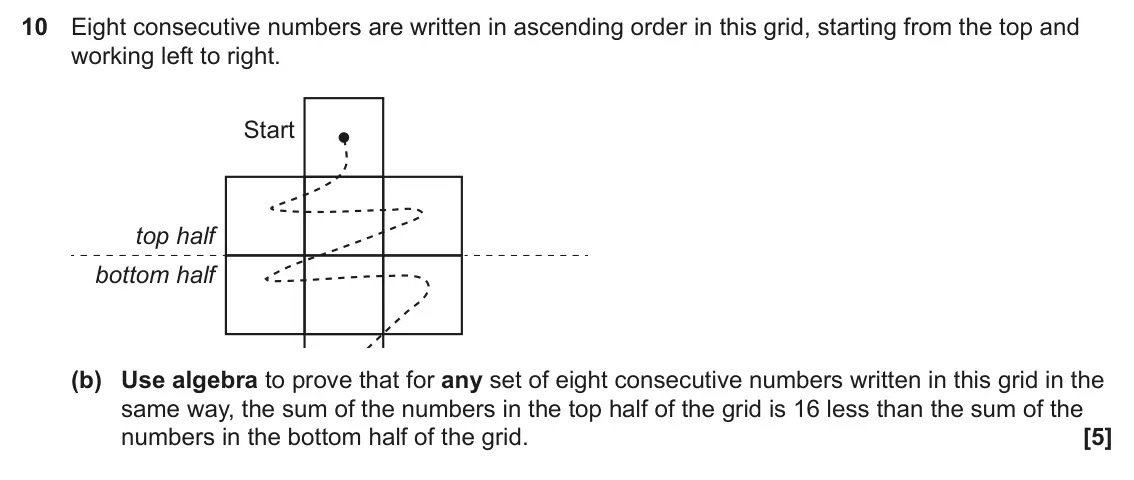
- June 2024, Paper 6, Q10 (5 marks): Eight consecutive numbers are written in ascending order in this grid, starting from the top and working left to right. Start top half bottom half (b) Use algeb
- June 2022, Paper 4, Q15 (4 marks): Use algebra to prove that an odd number multiplied by a different odd number always gives an answer that is an odd number.
- November 2021, Paper 5, Q22 (6 marks): n is a positive integer. Prove that ( 2 n 1 )( n 3 )( n 2 ) 3 n n ( 7 ) is always even. + - + + +
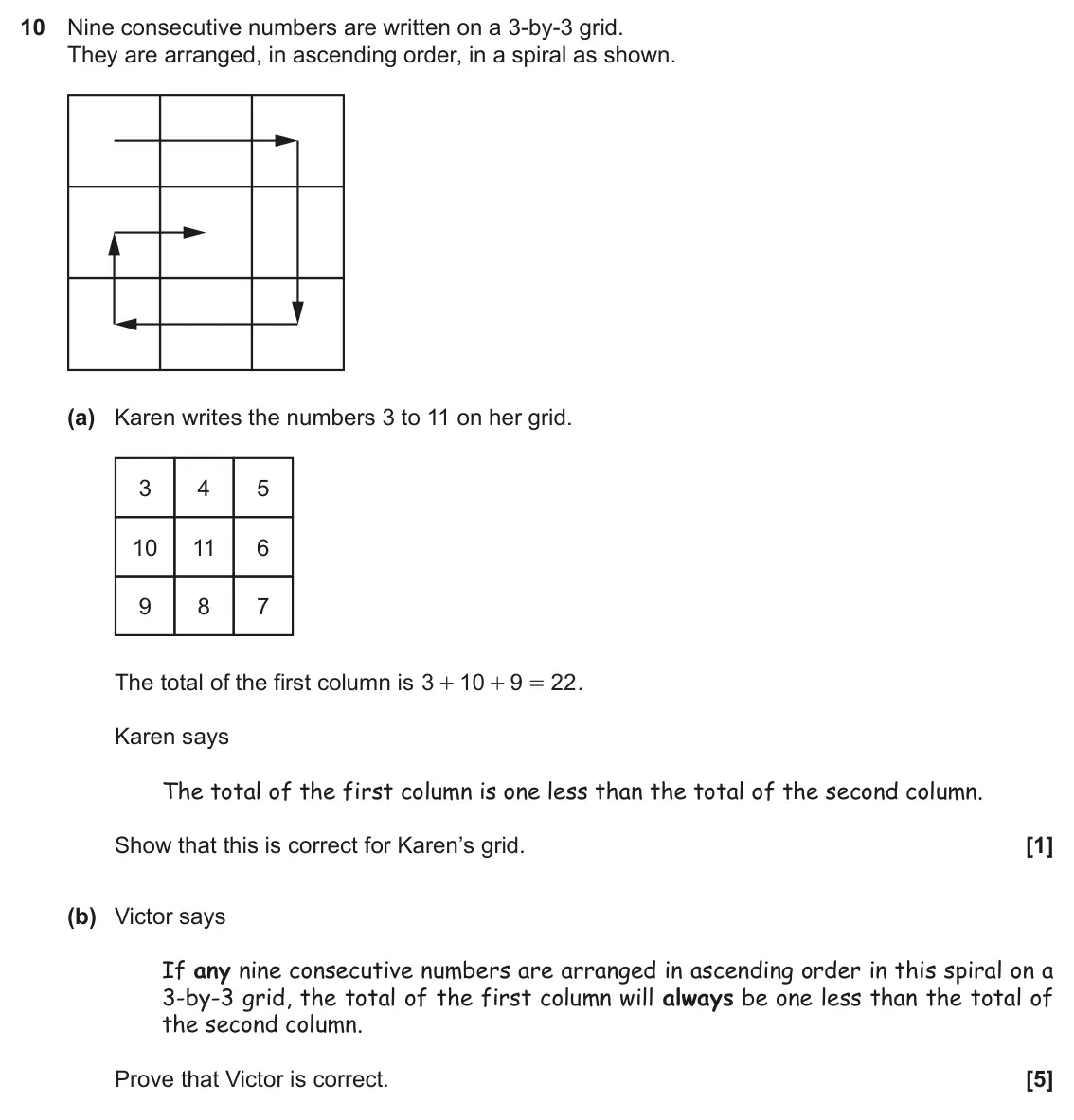
- November 2019, Paper 6, Q10 (6 marks): Nine consecutive numbers are written on a 3-by-3 grid. They are arranged, in ascending order, in a spiral as shown. (a) Karen writes the numbers 3 to 11 on her
- June 2019, Paper 6, Q13 (4 marks): Prove that the mean of any four consecutive even integers is an integer.
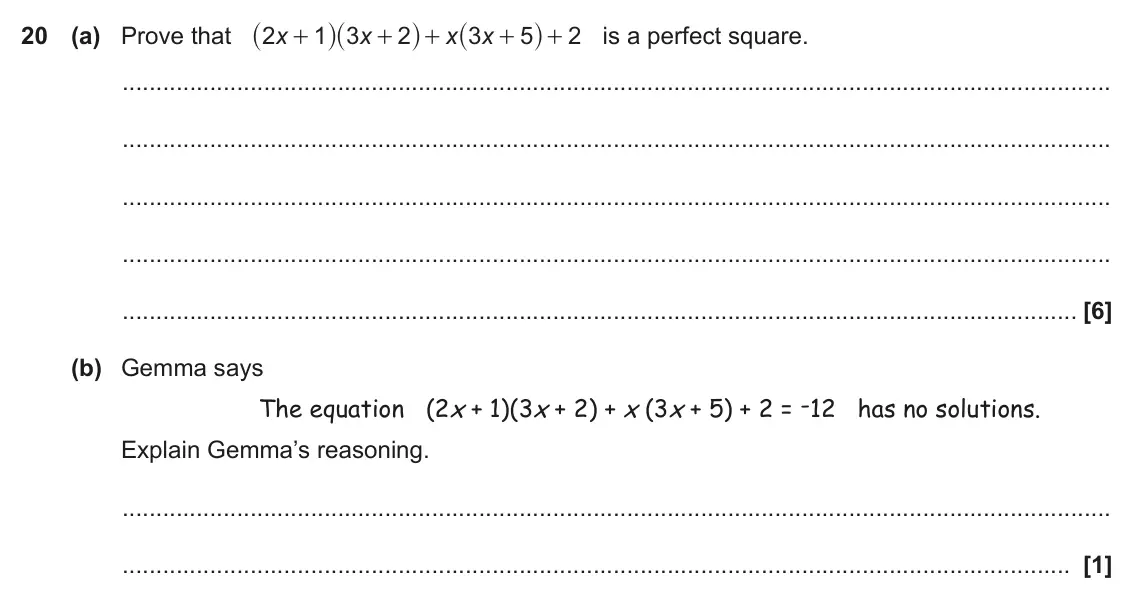
- November 2018, Paper 5, Q20 (7 marks): (a) Prove that 2 x 1 3 x 2 x 3 x 5 2 is a perfect square. + + + + + (b) Gemma says The equation (2x + 1)(3x + 2) + x (3x + 5) + 2 = -12 has no solutions. Explai
- June 2018, Paper 5, Q15 (4 marks): n is a positive integer. Prove that 13 n 3 ( 3 n 5 2 )( n 3 ) is a multiple of 6. + + - +
- November 2017, Paper 5, Q18 (4 marks): Prove that the difference between two consecutive square numbers is always odd.
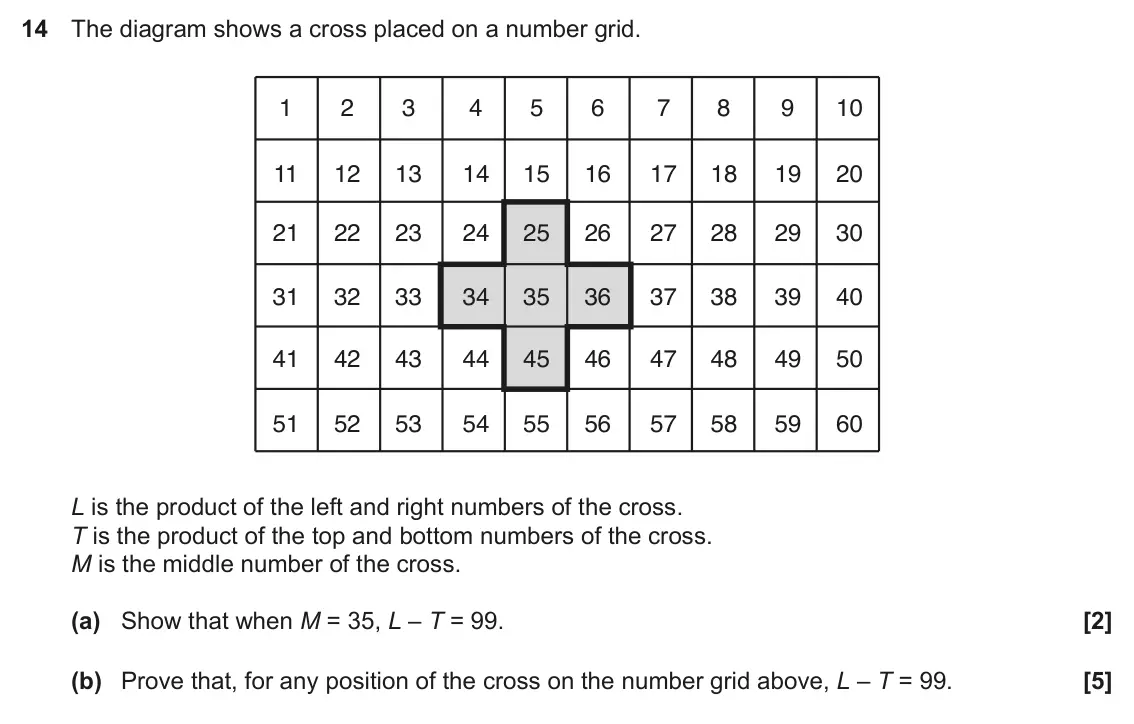
- November 2017, Paper 6, Q14 (7 marks): The diagram shows a cross placed on a number grid. 1 2 3 4 5 6 7 8 9 10 11 12 13 14 15 16 17 18 19 20 21 22 23 24 25 26 27 28 29 30 31 32 33 34 35 36 37 38 39 4
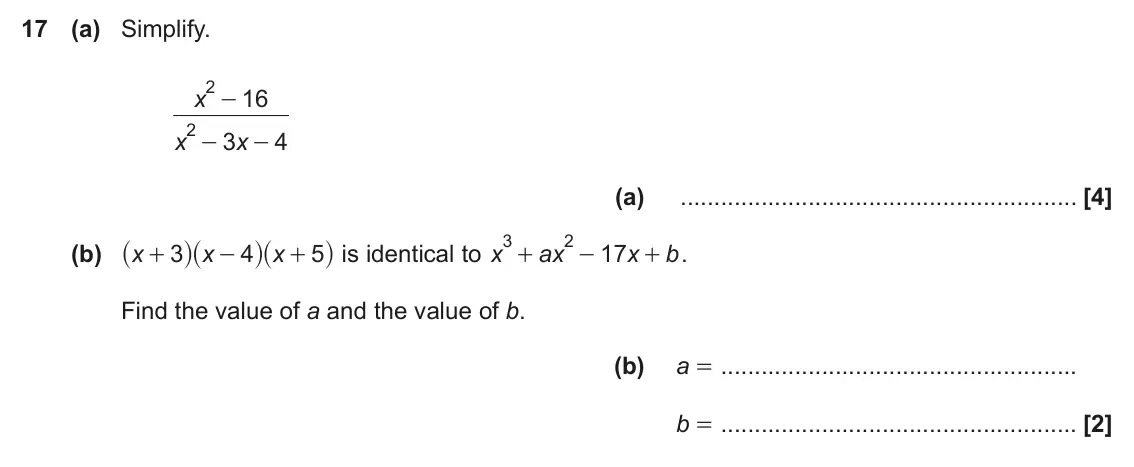
- June 2017, Paper 5, Q17 (6 marks): (a) Simplify. 2 x 16 - 2 3 4 x x - - (a) _ i _ i _ i is identical to x 3 2 (b) x 3 x 4 x 5 ax 17 x b . + - + + - + Find the value of a and the value of b. (b) a
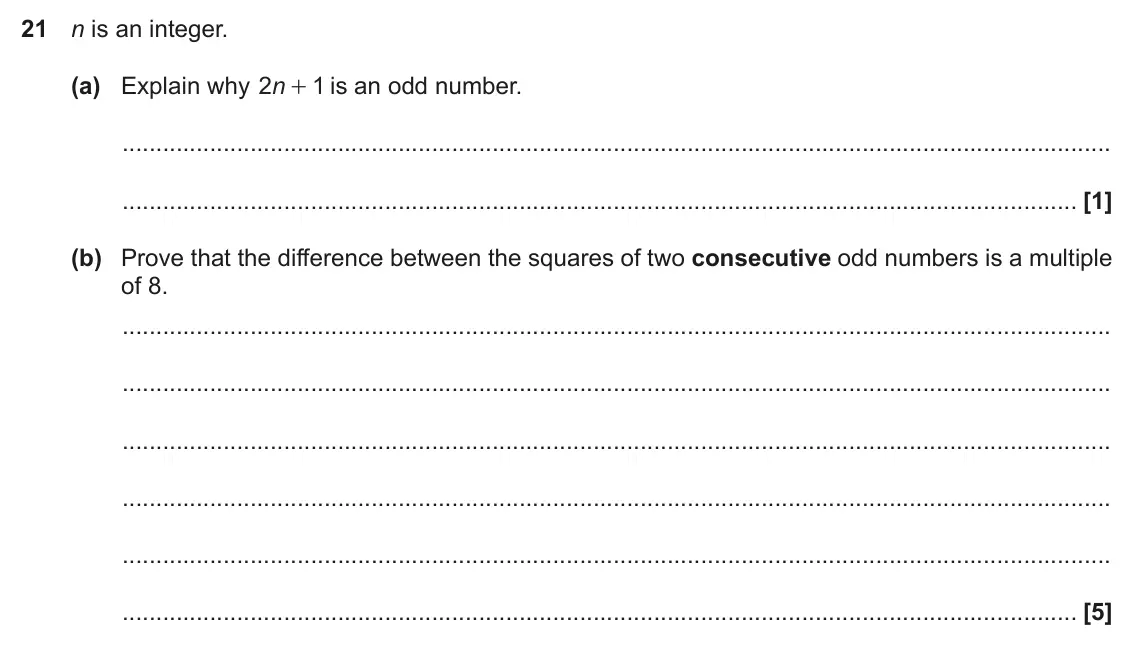
- June 2017, Paper 5, Q21 (6 marks): n is an integer. (a) Explain why n 2 + is an odd number. 1 (b) Prove that the difference between the squares of two consecutive odd numbers is a multiple of 8.
Questions, mark schemes and examiner’s reports are © OCR, from their published past papers. Plumi isn’t affiliated with any exam board. Want whole papers? Every OCR GCSE Maths paper.
Rather write your answers by hand on iPad? Plumi marks them against the same mark schemes.