 plumi
Generating sequences: OCR GCSE Maths questions
Every OCR GCSE Maths exam question on A23 Generating sequences, 2017–2025, with its mark scheme and examiner’s report.
Find questions921
Exam
All years
Calculator
All 6 questions on Generating sequences, as a list
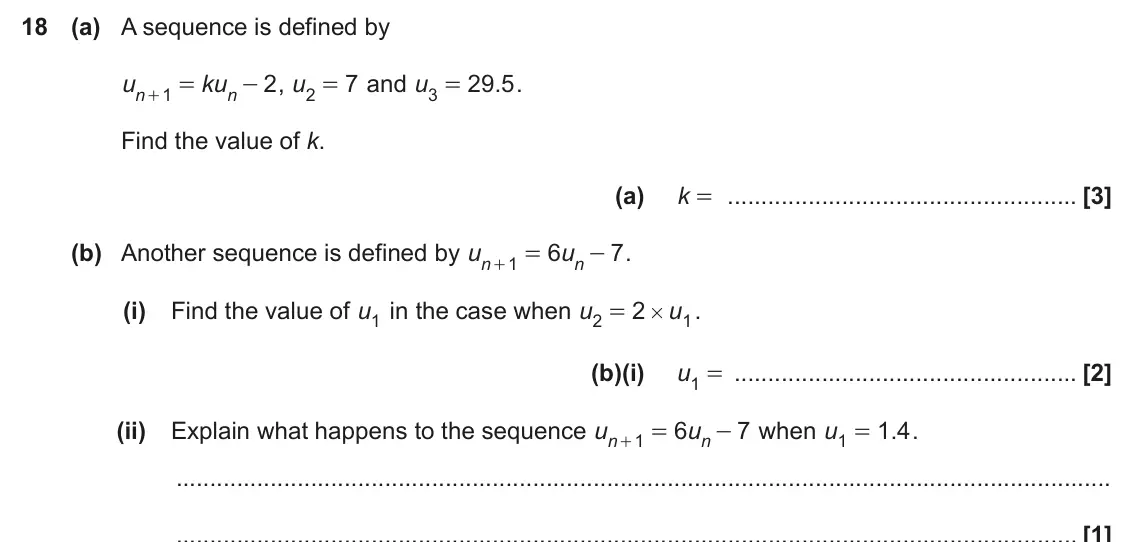
- June 2025, Paper 4, Q18 (6 marks): (a) A sequence is defined by u ku 2 , u 7 and u 29 5 . . 1 = - 2 = 3 = n n + Find the value of k. (a) k = (b) Another sequence is defined by u 6 u 7 . 1 = - n n
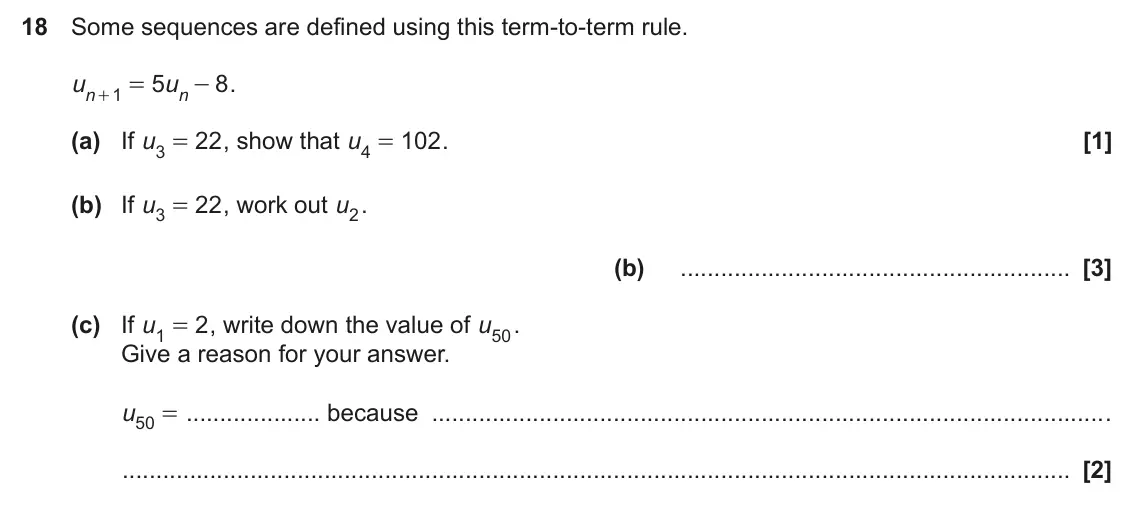
- November 2024, Paper 4, Q18 (6 marks): Some sequences are defined using this term-to-term rule. u 5 u 8 . 1 = - n n + (a) If u 22 , show that u 102 . 3 = 4 = (b) If u 22 , work out u2. 3 = (b) (c) If
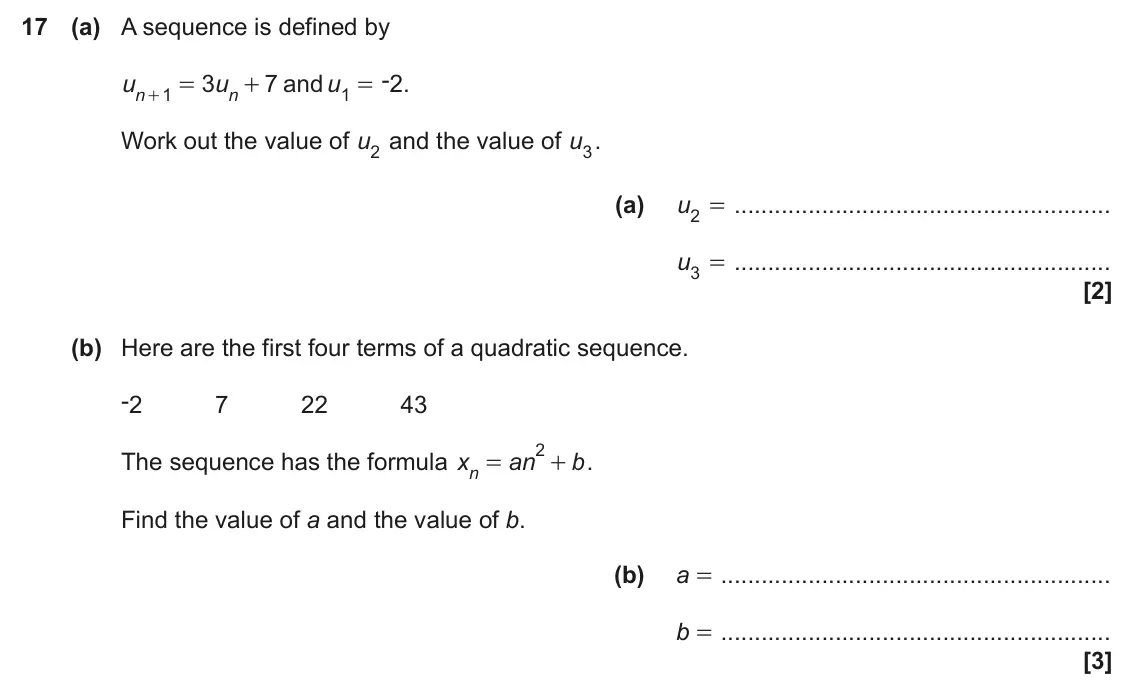
- November 2023, Paper 4, Q17 (5 marks): (a) A sequence is defined by -2. u 3 u 7 and u = + = n 1 n 1 + Work out the value of u2 and the value of u3. (a) u2 = u3 = (b) Here are the first four terms of
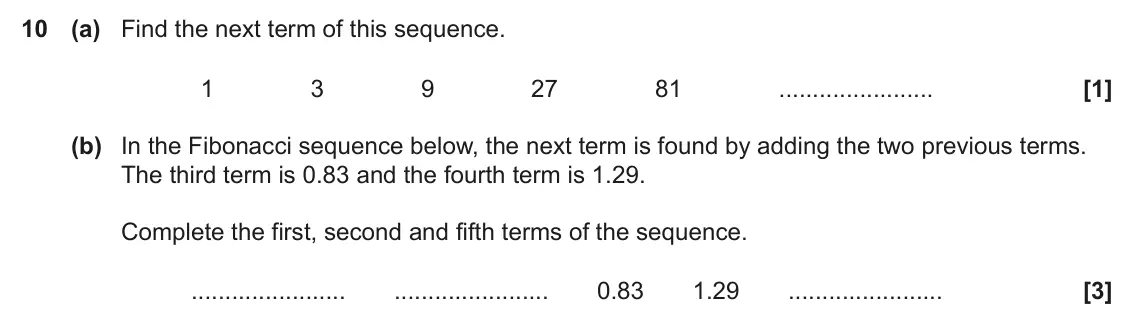
- November 2023, Paper 5, Q10 (4 marks): (a) Find the next term of this sequence. 1 3 9 27 81 (b) In the Fibonacci sequence below, the next term is found by adding the two previous terms. The third ter
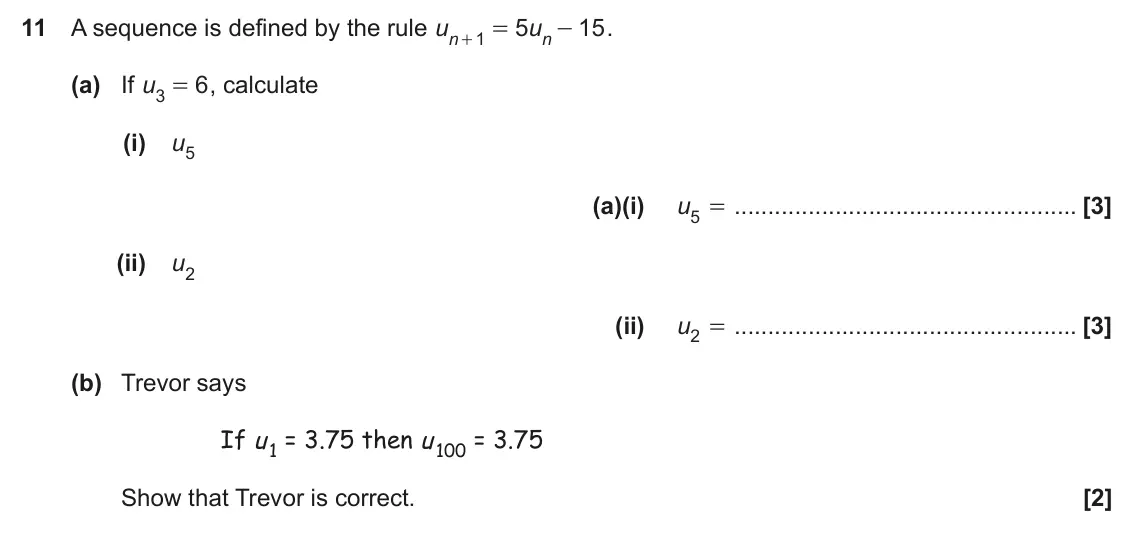
- November 2019, Paper 6, Q11 (8 marks): A sequence is defined by the rule u 5 u 15 . 1 = - n n + (a) If u 6 , calculate 3 = (i) u5 (a)(i) u5 = (ii) u2 (ii) u2 = (b) Trevor says If u 1 = 3.75 then u 10
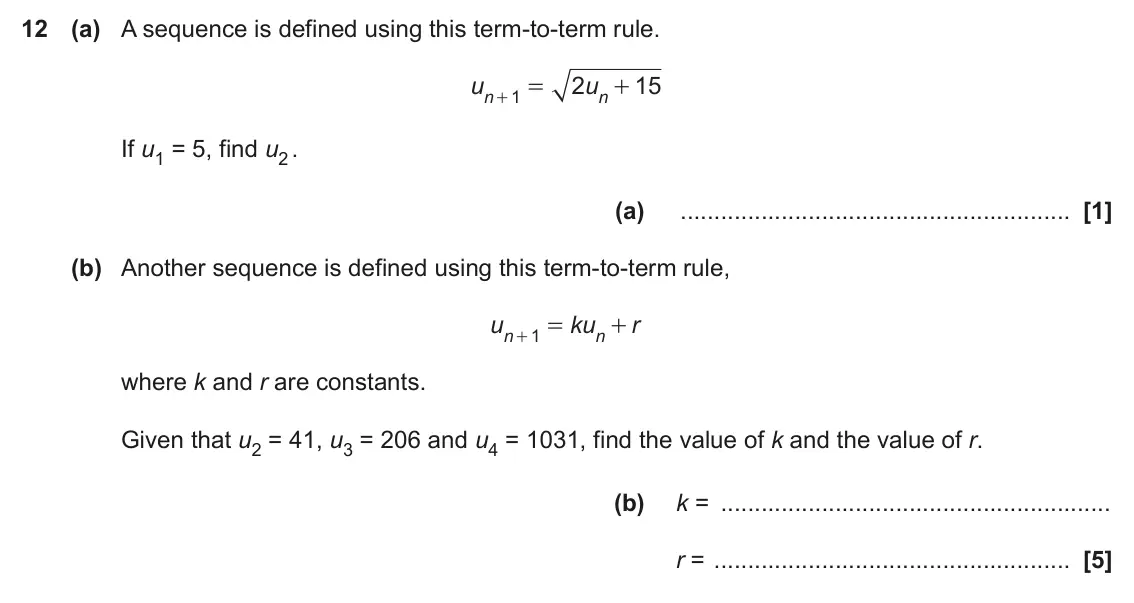
- November 2017, Paper 6, Q12 (6 marks): (a) A sequence is defined using this term-to-term rule. u 2 u 15 1 = + n n + If u1 = 5, find u2 . (a) (b) Another sequence is defined using this term-to-term ru
Questions, mark schemes and examiner’s reports are © OCR, from their published past papers. Plumi isn’t affiliated with any exam board. Want whole papers? Every OCR GCSE Maths paper.
Rather write your answers by hand on iPad? Plumi marks them against the same mark schemes.