 plumi
What happens during photosynthesis?: OCR GCSE Combined Science B questions
Every OCR GCSE Combined Science B exam question on B3.1 What happens during photosynthesis?, 2018–2025, with its mark scheme and examiner’s report.
Paper
All papers
Exam
All years
Calculations
Q9(a)
The whole paper ↗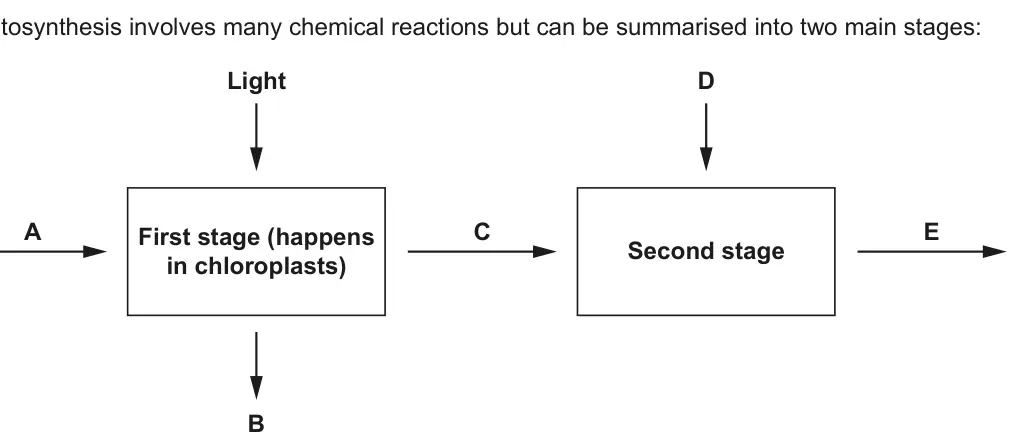
Q9(b)(i)
The whole paper ↗Q9(b)(ii)
The whole paper ↗Q9(b)(iii)
The whole paper ↗Q9(c)
The whole paper ↗Q6(a)
The whole paper ↗
Q8(a)(i)
The whole paper ↗Q8(a)(ii)
The whole paper ↗Q7(a)(i)
The whole paper ↗
Q7(a)(ii)
The whole paper ↗Q7(b)(i)
The whole paper ↗Q7(b)(ii)
The whole paper ↗Q7(b)(iii)
The whole paper ↗Q7(c)(i)
The whole paper ↗Q7(c)(ii)
The whole paper ↗Q6(a)
The whole paper ↗
Q3(a)
The whole paper ↗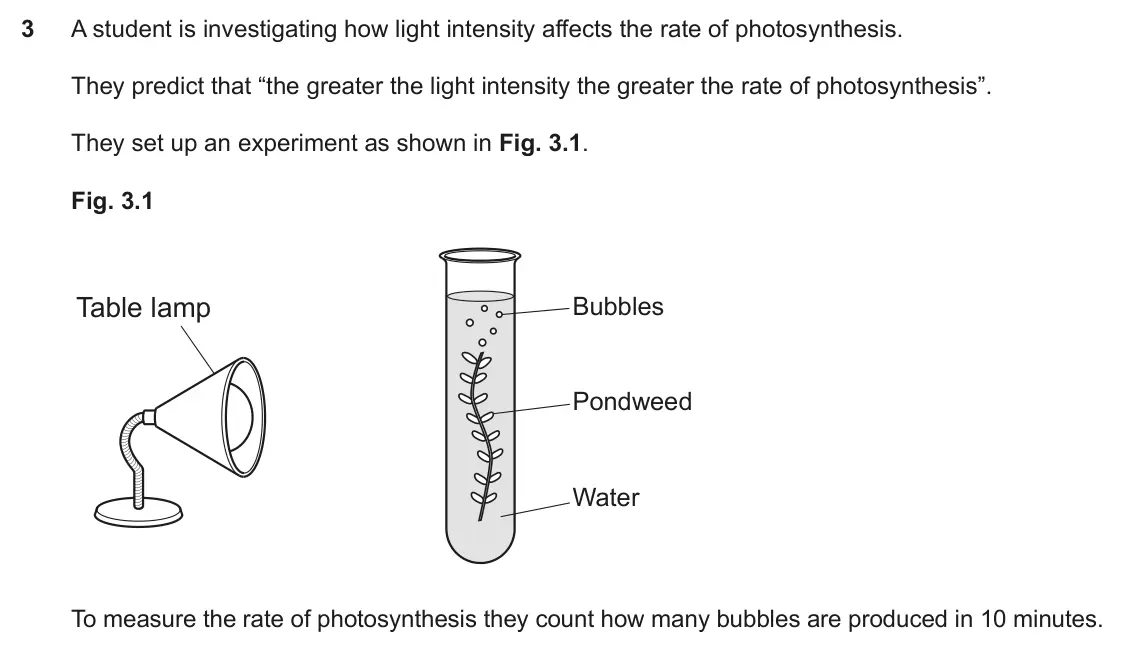
Q3(b)
The whole paper ↗Q3(c)(i)
The whole paper ↗Q3(c)(ii)
The whole paper ↗
All 74 questions on What happens during photosynthesis?, as a list
- June 2025, Biology Paper 5 Higher, Q9(a) (3 marks): Complete the table to describe the process of photosynthesis, including the inputs and outputs of the two stages. Use words from the list. carbon dioxide glucos
- June 2025, Biology Paper 5 Higher, Q9(b)(i) (3 marks): Calculate the distance from the light source at which the light intensity is 0.0064. Use the equation: light intensity = 1 d2 Distance = cm [3]
- June 2025, Biology Paper 5 Higher, Q9(b)(ii) (1 mark): Use the table and the equation to explain why the rate of photosynthesis changes with distance from the light source. [1]
- June 2025, Biology Paper 5 Higher, Q9(b)(iii) (2 marks): There are different methods that can be used to collect the gas produced by the pondweed. Describe a different method that the student could use and explain why
- June 2025, Biology Paper 5 Higher, Q9(c) (2 marks): The graph shows the effects of light intensity and temperature on the rate of photosynthesis. Max 30 °C A 20 °C B Rate of photosynthesis X Light intensity Expla
- June 2024, Biology Paper 5 Higher, Q6(a) (2 marks): Explain how digestive enzymes remove food stains. [2]
- June 2024, Biology Paper 5 Higher, Q8(a)(i) (2 marks): Explain why increasing the rate of photosynthesis would increase the amount of food available for humans. [2]
- June 2024, Biology Paper 5 Higher, Q8(a)(ii) (2 marks): Temperature and water can be limiting factors of photosynthesis. Complete the table to describe two other limiting factors and explain why increasing the amount
- June 2024, Combined Science Paper 8 Higher, Q7(a)(i) (3 marks): Calculate the rate of reaction. Rate of reaction = cm3 / s [3]
- June 2024, Combined Science Paper 8 Higher, Q7(a)(ii) (2 marks): Describe the chemical test that the students can do to prove that the gas produced is oxygen. [2]
- June 2024, Combined Science Paper 8 Higher, Q7(b)(i) (2 marks): A student writes: “The greater the distance of the lamp from the pondweed the slower the rate of photosynthesis.” Evaluate the student’s statement. [2]
- June 2024, Combined Science Paper 8 Higher, Q7(b)(ii) (2 marks): State two factors that need to be controlled in this light intensity experiment. Factor 1 Factor 2 [2]
- June 2024, Combined Science Paper 8 Higher, Q7(b)(iii) (2 marks): Calculate the rate of photosynthesis when the lamp is 0.30 m from the beaker. Rate of photosynthesis = cm3 / min [2]
- June 2024, Combined Science Paper 8 Higher, Q7(c)(i) (1 mark): At which times of the day are the rate of respiration and the rate of photosynthesis equal in winter? Use Fig. 7.3. [1]
- June 2024, Combined Science Paper 8 Higher, Q7(c)(ii) (2 marks): In the summer the hours of daylight are longer and the temperature is warmer. Sketch a curve on Fig. 7.3 for the rate of photosynthesis over a 24 hour period in
- June 2023, Biology Paper 1 Foundation, Q6(a) (2 marks): Complete the table to describe how each substance is related to photosynthesis. Tick (3) the correct boxes. Carbon dioxide Oxygen Water Used for photosynthesis
- June 2023, Combined Science Paper 4 Foundation, Q3(a) (2 marks): Which two factors will the student need to control to make the student’s investigation valid? Tick (✓) two boxes. Number of bubbles produced Temperature of the
- June 2023, Combined Science Paper 4 Foundation, Q3(b) (2 marks): The student sets up a second experiment using the equipment in Fig. 3.2. Fig. 3.2 Explain how this second experiment will improve the quality of the data collec
- June 2023, Combined Science Paper 4 Foundation, Q3(c)(i) (3 marks): Plot the results from the table on the graph. Include a line of best fit. Volume of gas produced (cm3) Time (minutes) [3]
- June 2023, Combined Science Paper 4 Foundation, Q3(c)(ii) (3 marks): Calculate the rate of photosynthesis. Give your answer to 1 decimal place. Rate of photosynthesis = cm3 / minute [3]
- June 2023, Combined Science Paper 4 Foundation, Q3(c)(iii) (2 marks): The temperature of the water used in this experiment was 20 °C. The student repeats the experiment at 30 °C. What would you expect the gradient of the graph to
- June 2023, Biology Paper 5 Higher, Q8(a) (2 marks): Explain how chloroplasts in leaf cells are related to photosynthesis. [2]
- June 2022, Biology Paper 1 Foundation, Q2(a) (3 marks): Which carbohydrate, A, B, C or D, will be broken down by the enzyme? Explain your answer. Carbohydrate Explanation [3]
- June 2022, Biology Paper 1 Foundation, Q7(a) (2 marks): Photosynthesis in the leaf makes food, which allows the plant to reproduce. Some students want to find out the pH at which duckweed photosynthesises best. They
- June 2022, Biology Paper 1 Foundation, Q7(b) (2 marks): After seven days the students count the number of living duckweed plants in each beaker. The table shows their results. pH Number of living duckweed plants 2 0
- November 2021, Biology Paper 5 Higher, Q8(c)(i) (4 marks): The Amazon rainforest is a major carbon sink. This means it removes carbon dioxide from the atmosphere and stores it. Describe the process of photosynthesis to
- November 2021, Biology Paper 5 Higher, Q9(b) (3 marks): Starch is a large, insoluble, long-chain carbohydrate made from glucose molecules. Explain the importance of synthesising and storing starch inside plant cells.
- November 2021, Combined Science Paper 8 Higher, Q8(a)(i) (2 marks): Identify two control variables that are needed to ensure Amaya collects valid data. 1 2 [2]
- November 2021, Combined Science Paper 8 Higher, Q8(a)(ii) (1 mark): Describe how to change the independent variable in Amaya’s investigation. [1]
- November 2021, Combined Science Paper 8 Higher, Q8(b) (2 marks): Complete the sentence to explain why the rate of photosynthesis changes when the distance from the light source changes. Use the words. You can use each word on
- November 2021, Combined Science Paper 8 Higher, Q8(c)(i) (2 marks): Plot Amaya’s results on the graph, and draw a line of best fit. [2] 2.0 1.5 Mean rate of 1.0 photosynthesis (arbitrary units) 0.5 0 0 100 200 300 400 500 600 70
- November 2021, Combined Science Paper 8 Higher, Q8(c)(ii) (3 marks): Explain the pattern shown in the data for a carbon dioxide concentration of over 600 ppm. [3]
- November 2020, Biology Paper 1 Foundation, Q7(c) (1 mark): Some of the sugars that are made by photosynthesis are joined together to make a large storage molecule. What is the name of this large storage molecule? Tick (
- November 2020, Biology Paper 1 Foundation, Q9(a) (3 marks): Complete the sentences to describe the process of photosynthesis. Use words from the list. You may use the words once, more than once or not at all. carbon diox
- November 2020, Biology Paper 1 Foundation, Q9(b)(i) (2 marks): Which tube, A, B or C, shows that carbon dioxide is needed for photosynthesis to occur? Explain your answer. Tube Explanation [2]
- November 2020, Biology Paper 1 Foundation, Q9(b)(ii) (2 marks): Which tube, A, B or C, shows that light is needed for photosynthesis to occur? Explain your answer. Tube Explanation [2]
- November 2020, Biology Paper 1 Foundation, Q9(b)(iii) (2 marks): Explain why the indicator in Tube C does not change colour. [2]
- November 2020, Biology Paper 1 Foundation, Q9(b)(iv) (1 mark): Identify one variable that should be kept the same in the student’s investigation. [1]
- November 2020, Biology Paper 5 Higher, Q2(a) (3 marks): Complete the sentences to describe the process of photosynthesis. Use words from the list. You may use the words once, more than once or not at all. chlorophyll
- November 2020, Biology Paper 5 Higher, Q2(b)(i) (2 marks): Which tube, A, B or C, shows that carbon dioxide is needed for photosynthesis to occur? Explain your answer. Tube Explanation [2]
- November 2020, Biology Paper 5 Higher, Q2(b)(ii) (2 marks): Which tube, A, B or C, shows that light is needed for photosynthesis to occur? Explain your answer. Tube Explanation [2]
- November 2020, Biology Paper 5 Higher, Q2(b)(iii) (2 marks): Explain why the indicator in Tube C does not change colour. [2]
- November 2020, Biology Paper 5 Higher, Q2(b)(iv) (1 mark): Identify one variable that should be kept the same in the student’s investigation. [1]
- November 2020, Combined Science Paper 8 Higher, Q1(d)(ii) (2 marks): Biofuels are carbon neutral. This means that their use does not increase carbon dioxide levels in the atmosphere. Coal is not carbon neutral. Which two statemen
- June 2019, Biology Paper 1 Foundation, Q1(b)(i) (2 marks): Biomass is made by photosynthesis. Complete the word equation for photosynthesis. sunlight carbon dioxide + oxygen + chlorophyll [2]
- June 2019, Biology Paper 1 Foundation, Q1(b)(ii) (2 marks): The sentences describe photosynthesis. Put a ring around the correct choice to complete each sentence. Light is needed for the first / the second / both stage(s
- June 2019, Biology Paper 1 Foundation, Q7(c) (3 marks): Mia’s method lacks the detail needed for another scientist to reproduce her findings. Suggest additional detail which would allow another student to follow the
- June 2019, Biology Paper 1 Foundation, Q7(d) (2 marks): Bubbles form on the paper disc when it is in the H2O2 solution. This causes the disc to rise to the surface of the solution. Mia thinks that if a disc rises mor
- June 2019, Biology Paper 1 Foundation, Q7(e)(i) (3 marks): Calculate the rate of reaction for 6.00% H2O2 solution. Give your answer to 3 significant figures. Rate = s–1 [3]
- June 2019, Biology Paper 1 Foundation, Q7(e)(ii) (2 marks): Which conclusions are supported by the data in the table? Tick (✓) two boxes. Between 0.75% and 6.00% H2O2 the reaction rate increases by approximately 2.5 time
- June 2019, Biology Paper 1 Foundation, Q7(f) (1 mark): Describe what Mia could do to increase confidence in her data. [1]
- June 2019, Biology Paper 1 Foundation, Q7(g) (4 marks): Use the lock and key model to explain why the enzyme catalase can only break down H2O2. [4]
- June 2019, Biology Paper 5 Higher, Q1(c) (3 marks): Mia’s method lacks the detail needed for another scientist to reproduce her findings. Suggest additional detail which would allow another student to follow the
- June 2019, Biology Paper 5 Higher, Q1(d) (2 marks): Bubbles form on the paper disc when it is in the H2O2 solution. This causes the disc to rise to the surface of the solution. Mia thinks that if a disc rises mor
- June 2019, Biology Paper 5 Higher, Q1(e)(i) (3 marks): Calculate the rate of reaction for 6.00% H2O2 solution. Give your answer to 3 significant figures. Rate = s–1 [3]
- June 2019, Biology Paper 5 Higher, Q1(e)(ii) (2 marks): Which conclusions are supported by the data in the table? Tick (✓) two boxes. Between 0.75% and 6.00% H2O2 the reaction rate increases by approximately 2.5 time
- June 2019, Biology Paper 5 Higher, Q1(f) (1 mark): Describe what Mia could do to increase confidence in her data. [1]
- June 2019, Biology Paper 5 Higher, Q1(g) (4 marks): Use the lock and key model to explain why the enzyme catalase can only break down H2O2. [4]
- June 2019, Biology Paper 5 Higher, Q2(a)(iii) (1 mark): What is the correct name for the process that produces food and biomass in food chains? Put a ring around the correct answer. Diffusion Osmosis Photosynthesis R
- June 2018, Biology Paper 1 Foundation, Q7(a)(i) (2 marks): Amaya plans to investigate four different temperatures. Room temperature is 20 °C. Describe how Amaya can set up her experiment at the other temperatures. [2]
- June 2018, Biology Paper 1 Foundation, Q7(a)(ii) (2 marks): Which factors should Amaya keep the same to make sure she collects valid data? Tick (✓) two boxes. The brightness of the lamp. The level of carbon dioxide in th
- June 2018, Biology Paper 1 Foundation, Q7(b)(i) (1 mark): What is the range for the results at 30 °C? Range = [1]
- June 2018, Biology Paper 1 Foundation, Q7(b)(ii) (1 mark): Calculate the mean number of bubbles at 30 °C. Mean number of bubbles = [1]
- June 2018, Biology Paper 1 Foundation, Q7(b)(iii) (4 marks): Describe the pattern of results shown in Table 7.1 and use ideas about enzymes to explain the pattern of results. [4]
- June 2018, Biology Paper 1 Foundation, Q7(b)(iv) (2 marks): Amaya repeats her investigation at a temperature of 50 °C. She finds a lower mean number of bubbles. Explain why. [2]
- June 2018, Biology Paper 1 Foundation, Q7(c) (2 marks): A plant makes glucose when it photosynthesises. The glucose is then turned into starch for storage. A student wants to show that there is both glucose and starc
- June 2018, Biology Paper 5 Higher, Q6(a)(i) (1 mark): The bubbles contain oxygen gas. During which stage of photosynthesis is oxygen gas formed? [1]
- June 2018, Biology Paper 5 Higher, Q6(a)(ii) (2 marks): What factors should Amaya keep the same in each repeat to make sure her investigation produces valid data? [2]
- June 2018, Biology Paper 5 Higher, Q6(a)(iii) (2 marks): There are different methods that can be used to collect the gas produced by the pondweed. Describe a different method that Amaya could use and explain why it is
- June 2018, Biology Paper 5 Higher, Q6(b)(i) (2 marks): Use the graph to calculate the rate of gas production at 40 °C. Rate = bubbles per minute [2]
- June 2018, Biology Paper 5 Higher, Q6(b)(ii) (2 marks): Amaya concludes that increasing the temperature above 30 °C does not cause a large increase in the number of bubbles produced. Use your knowledge of the require
- June 2018, Biology Paper 5 Higher, Q6(b)(iii) (2 marks): Amaya does a second investigation into the effect of temperature on the rate of photosynthesis. For this investigation she adds sodium hydrogen carbonate to the
- June 2018, Biology Paper 5 Higher, Q6(c) (2 marks): Amaya repeats the investigation again, but this time at 60 °C. Write a testable hypothesis for the investigation at 60 °C and explain why this occurs. [2]
- June 2018, Biology Paper 5 Higher, Q6(d) (1 mark): Glucose is a product of photosynthesis. Write down the name of the reagent you would use to test for the presence of glucose. [1]
Questions, mark schemes and examiner’s reports are © OCR, from their published past papers. Plumi isn’t affiliated with any exam board. Want whole papers? Full past papers.
Rather write your answers by hand on iPad? Plumi marks them against the same mark schemes.