 plumi
How do producers get the substances they need?: OCR GCSE Combined Science B questions
Every OCR GCSE Combined Science B exam question on B3.2 How do producers get the substances they need?, 2018–2025, with its mark scheme and examiner’s report.
Paper
All papers
Exam
All years
Calculations
Q10(a)
The whole paper ↗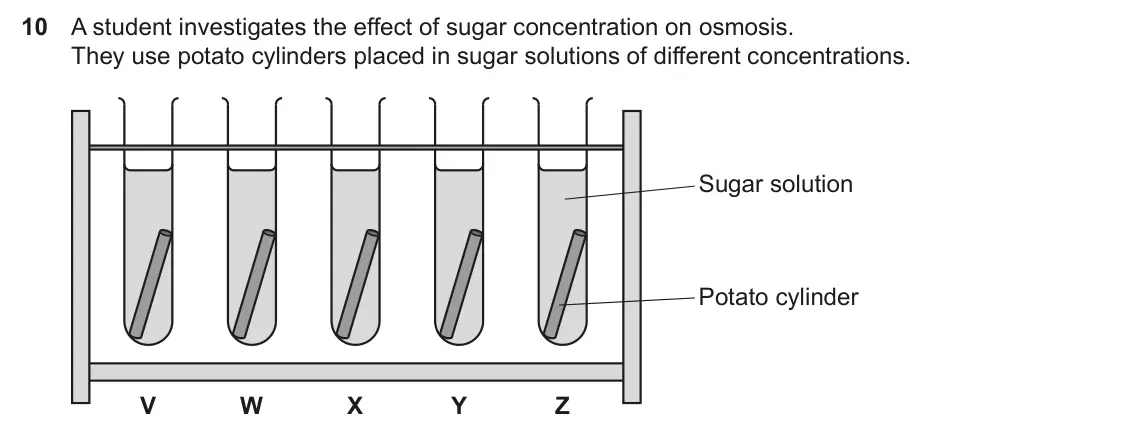
Q10(b)(i)
The whole paper ↗Q10(b)(ii)
The whole paper ↗Q10(c)(i)
The whole paper ↗Q10(c)(ii)
The whole paper ↗Q10(c)(iii)
The whole paper ↗Q10(d)(i)
The whole paper ↗Q10(d)(ii)
The whole paper ↗Q2(a)
The whole paper ↗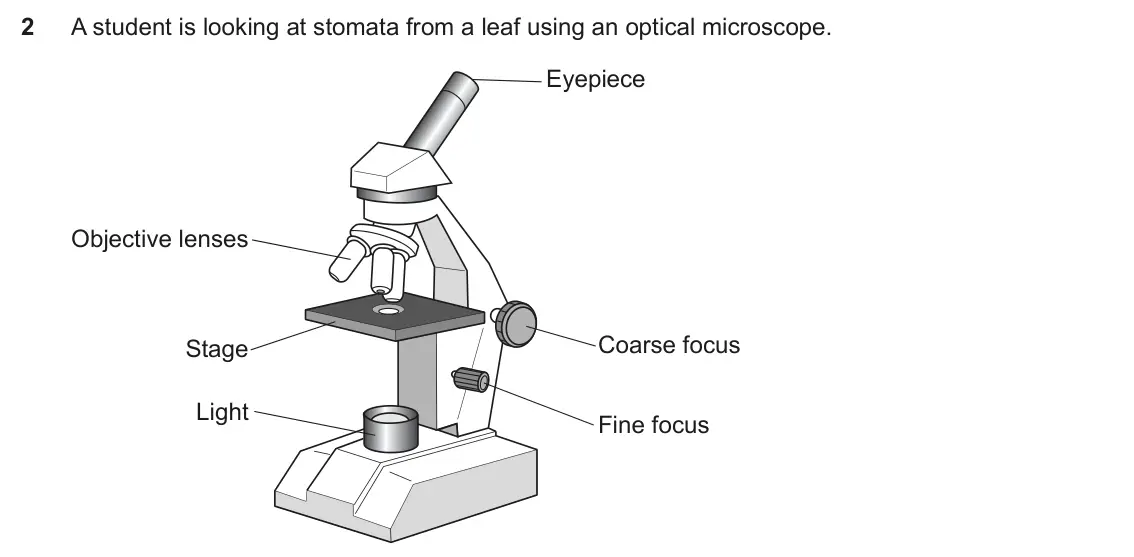
Q2(c)
The whole paper ↗Q2(d)(i)
The whole paper ↗Q2(d)(ii)
The whole paper ↗Q2(a)
The whole paper ↗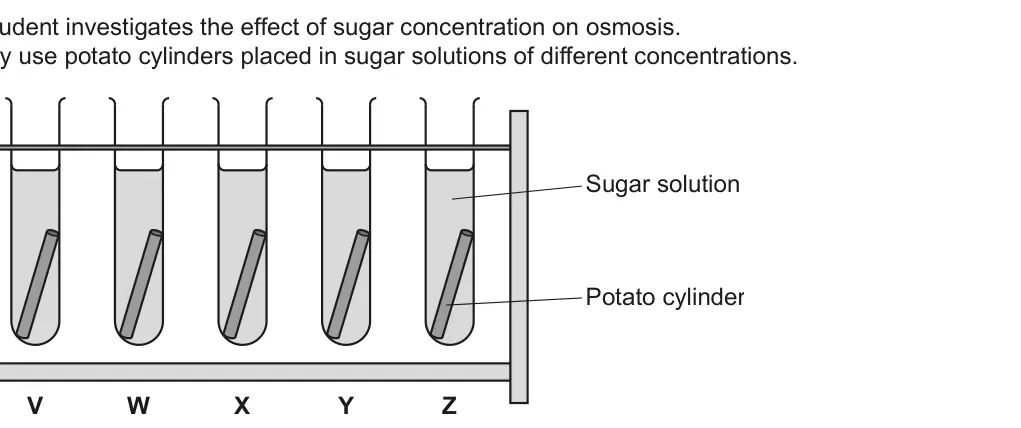
Q2(b)(i)
The whole paper ↗Q2(b)(ii)
The whole paper ↗Q2(c)(i)
The whole paper ↗Q2(c)(ii)
The whole paper ↗Q2(c)(iii)
The whole paper ↗Q2(d)(i)
The whole paper ↗Q2(d)(ii)
The whole paper ↗
All 79 questions on How do producers get the substances they need?, as a list
- June 2025, Biology Paper 1 Foundation, Q10(a) (3 marks): Statements A to E describe how the student does the investigation. The statements are not in the correct order. A Cut five potato cylinders. B Calculate the cha
- June 2025, Biology Paper 1 Foundation, Q10(b)(i) (1 mark): State one variable that the student should control in this investigation. [1]
- June 2025, Biology Paper 1 Foundation, Q10(b)(ii) (1 mark): Suggest why the student dries the potato cylinders before measuring their final mass. [1]
- June 2025, Biology Paper 1 Foundation, Q10(c)(i) (1 mark): Calculate the change in mass for potato cylinders W and Y. [1]
- June 2025, Biology Paper 1 Foundation, Q10(c)(ii) (1 mark): The student uses the change in mass to conclude which sugar solution had the largest effect on the potato cylinders. Suggest why the student cannot make a valid
- June 2025, Biology Paper 1 Foundation, Q10(c)(iii) (2 marks): Suggest two ways in which the student could improve their method so they can make a valid comparison between potato cylinders. 1 2 [2]
- June 2025, Biology Paper 1 Foundation, Q10(d)(i) (2 marks): Explain why some of the potato cylinders decreased in mass. Use ideas about osmosis. [2]
- June 2025, Biology Paper 1 Foundation, Q10(d)(ii) (1 mark): The potato cylinder placed in sugar solution X did not change in mass. Suggest one reason why this might have happened. [1]
- June 2025, Combined Science Paper 4 Foundation, Q2(a) (2 marks): This is the student’s method but it is not in the correct order: A Focus using the coarse focus knob. B Spread nail varnish on the underside of a leaf and allow
- June 2025, Combined Science Paper 4 Foundation, Q2(c) (2 marks): The student looks down the microscope and counts how many stomata they can see. They repeat this measurement in four other areas of the leaf. The table shows th
- June 2025, Combined Science Paper 4 Foundation, Q2(d)(i) (1 mark): Describe the trend shown by the graph. [1]
- June 2025, Combined Science Paper 4 Foundation, Q2(d)(ii) (1 mark): Stomata may open and close in response to environmental conditions. Use the graph to suggest one environmental condition that may cause stomata to open. [1]
- June 2025, Biology Paper 5 Higher, Q2(a) (3 marks): Statements A to E describe how the student does the investigation. The statements are not in the correct order. A Cut five potato cylinders. B Calculate the cha
- June 2025, Biology Paper 5 Higher, Q2(b)(i) (1 mark): State one variable that the student should control in this investigation. [1]
- June 2025, Biology Paper 5 Higher, Q2(b)(ii) (1 mark): Suggest why the student dries the potato cylinders before measuring their final mass. [1]
- June 2025, Biology Paper 5 Higher, Q2(c)(i) (1 mark): Calculate the change in mass for potato cylinders W and Y. [1]
- June 2025, Biology Paper 5 Higher, Q2(c)(ii) (1 mark): The student uses the change in mass to conclude which sugar solution had the largest effect on the potato cylinders. Suggest why the student cannot make a valid
- June 2025, Biology Paper 5 Higher, Q2(c)(iii) (2 marks): Suggest two ways in which the student could improve their method so they can make a valid comparison between potato cylinders. 1 2 [2]
- June 2025, Biology Paper 5 Higher, Q2(d)(i) (2 marks): Explain why some of the potato cylinders decreased in mass. Use ideas about osmosis. [2]
- June 2025, Biology Paper 5 Higher, Q2(d)(ii) (1 mark): The potato cylinder placed in sugar solution X did not change in mass. Suggest one reason why this might have happened. [1]
- June 2025, Biology Paper 5 Higher, Q6(c)(i) (2 marks): State the names of the processes that move water and mineral ions into root hair cells. Water Mineral ions [2]
- June 2025, Biology Paper 5 Higher, Q6(c)(ii) (2 marks): Plants have transport vessels called xylem and phloem. Xylem vessels are involved in transpiration. Phloem vessels are used for the translocation of sugars. Xyl
- June 2023, Biology Paper 1 Foundation, Q6(b) (1 mark): Jack does a practice attempt with the apparatus. His results are shown in the table. Time since start of Position of air bubble practice attempt (min) on scale
- June 2023, Biology Paper 1 Foundation, Q6(c)(i) (1 mark): At which temperature was this experiment done? Use the graph. Temperature = °C [1]
- June 2023, Biology Paper 1 Foundation, Q6(c)(ii) (2 marks): Calculate the average rate at which the 20 mm of water was taken up over the 20 minutes in this experiment. Rate = mm / min [2]
- June 2023, Biology Paper 1 Foundation, Q6(d) (3 marks): Explain why water was taken up more quickly by the shoot at higher temperatures. [3]
- June 2023, Combined Science Paper 4 Foundation, Q2(b) (1 mark): Plants make small organic molecules including sugars, fatty acids, glycerol and amino acids. Why is it important for plants to be able to make their own amino a
- June 2023, Biology Paper 5 Higher, Q8(b) (1 mark): State the name of the process that moves water up through a plant to its leaves. [1] A student measures the rate of water uptake by a leafy plant shoot at diffe
- June 2023, Biology Paper 5 Higher, Q8(c)(i) (1 mark): Between which measured distances can the relationship between the distance and the rate of water uptake be represented by the equation y = mx + c? Between and c
- June 2023, Biology Paper 5 Higher, Q8(c)(ii) (3 marks): Calculate the rate of water uptake in litres per hour when the distance from the lamp was 0 cm. 1 mm3 is 0.000001 litres. Give your answer in standard form. Rat
- June 2023, Biology Paper 5 Higher, Q8(c)(iii) (2 marks): Calculate the change in the rate of water uptake per cm when the lamp was moved from 0 cm to 100 cm away. Change in rate = mm3 / hour / cm [2]
- June 2023, Biology Paper 5 Higher, Q8(d)(i) (2 marks): Calculate the percentage change in mass of the shoot if the water caused its mass to increase by 0.4 g. Percentage change = % [2]
- June 2023, Biology Paper 5 Higher, Q8(d)(ii) (2 marks): At the end of the day, the student observed that the mass of the shoot had not increased by 0.4 g. It had only increased by an amount much smaller than this. Su
- June 2023, Combined Science Paper 8 Higher, Q6(d) (2 marks): Plants take in carbon dioxide and water for photosynthesis. Describe how the carbon dioxide needed for photosynthesis enters the plant. [2]
- June 2022, Biology Paper 1 Foundation, Q10(a) (3 marks): Complete the sentences to describe transpiration. Put a ring around each correct answer. Water is absorbed / lost / translocated through the stomata in a plant’
- June 2022, Biology Paper 1 Foundation, Q10(b) (1 mark): Fig. 10.1 shows one of the stomata from a leaf. Fig. 10.1 Add two labels to Fig. 10.1. Label 1 The pore through which water diffuses. Label 2 A guard cell. [1]
- June 2022, Biology Paper 1 Foundation, Q10(d)(i) (2 marks): Describe the two measurements Amir would need to make. 1 2 [2]
- June 2022, Biology Paper 1 Foundation, Q10(d)(ii) (2 marks): Suggest the purpose of the reservoir and tap. [2]
- June 2022, Biology Paper 1 Foundation, Q10(e)(i) (2 marks): Discuss arguments for and against ignoring the result of 0.75mm/s for experiment D. For Against [2]
- June 2022, Biology Paper 1 Foundation, Q10(e)(ii) (3 marks): Amir decides to keep all three results for experiment D. Calculate the mean rate for experiment D. Give your answer to two decimal places. Mean rate = mm / s [3
- June 2022, Biology Paper 1 Foundation, Q10(f) (1 mark): Amir wants to make a conclusion about the effect of light level on the rate of transpiration. Explain why he can only do this by comparing experiments A and B.
- June 2022, Biology Paper 1 Foundation, Q11 (3 marks): Plants need to absorb nitrate ions to stay alive. Complete the sentences to explain why a plant needs oxygen to absorb nitrate ions. Use words from the list. ac
- June 2022, Biology Paper 5 Higher, Q1(a) (3 marks): Complete the sentences to describe transpiration. Put a (ring) around each correct answer. Water is absorbed / lost / translocated through the stomata in a plan
- June 2022, Biology Paper 5 Higher, Q1(b) (1 mark): Fig. 1.1 shows one of the stomata from a leaf. ( Fig. 1.1 Add two labels to Fig. 1.1. Label 1 The pore through which water diffuses. Label 2 A guard cell. [1]
- June 2022, Biology Paper 5 Higher, Q1(c) (2 marks): Complete the sentences to describe how to set up a light microscope to look at a slide of stomata from a leaf. Put a (ring) around each correct answer. First, t
- June 2022, Biology Paper 5 Higher, Q1(d)(i) (2 marks): Describe the two measurements Amir would need to make. 1 2 [2]
- June 2022, Biology Paper 5 Higher, Q1(d)(ii) (2 marks): Suggest the purpose of the reservoir and tap. . [2]
- June 2022, Biology Paper 5 Higher, Q1(e)(i) (2 marks): Discuss arguments for and against ignoring the result of 0.75 mm / s for experiment D. For Against [2]
- June 2022, Biology Paper 5 Higher, Q1(e)(ii) (3 marks): Amir decides to keep all three results for experiment D. Calculate the mean rate for experiment D. Give your answer to two decimal places. Mean rate = mm / s [3
- June 2022, Biology Paper 5 Higher, Q1(f) (1 mark): Amir wants to make a conclusion about the effect of light level on the rate of transpiration. Explain why he can only do this by comparing experiments A and B.
- June 2022, Biology Paper 5 Higher, Q2 (3 marks): Plants need to absorb nitrate ions to stay alive. Complete the sentences to explain why a plant needs oxygen to absorb nitrate ions. Use words from the list. ac
- November 2021, Biology Paper 1 Foundation, Q12(b) (2 marks): Explain how the xylem is adapted to its function. [2]
- November 2021, Biology Paper 1 Foundation, Q12(c)(i) (2 marks): Explain how the ‘root hair’ is adapted to its function. [2]
- November 2021, Biology Paper 1 Foundation, Q12(c)(ii) (2 marks): Explain why mitochondria are required for the uptake of some mineral ions by root hair cells. [2]
- November 2021, Biology Paper 1 Foundation, Q12(d) (1 mark): Which statement about diffusion across the partially permeable membrane of root hair cells is correct? Tick (✓) one box. Both water and nitrate ions can diffuse
- November 2021, Biology Paper 5 Higher, Q2(b) (2 marks): Explain how the xylem is adapted to its function. [2]
- November 2021, Biology Paper 5 Higher, Q2(c)(i) (2 marks): Explain how the ‘root hair’ is adapted to its function. [2]
- November 2021, Biology Paper 5 Higher, Q2(c)(ii) (2 marks): Explain why mitochondria are required for the uptake of some mineral ions by root hair cells. [2]
- November 2021, Biology Paper 5 Higher, Q2(d) (1 mark): Which statement about diffusion across the partially permeable membrane of root hair cells is correct? Tick (3) one box. Both water and nitrate ions can diffuse
- November 2020, Biology Paper 1 Foundation, Q7(a) (3 marks): Fig. 7.1 shows a labelled cross section of a leaf. Sunlight Upper layer Palisade layer Chloroplast Spongy layer Air space Lower layer Exchange of gases through
- November 2020, Biology Paper 1 Foundation, Q7(b)(i) (1 mark): Name the transport tissue that transports water and minerals. [1]
- November 2020, Biology Paper 1 Foundation, Q7(b)(ii) (1 mark): Name the transport tissue that transports sugars. [1]
- November 2020, Biology Paper 1 Foundation, Q7(b)(iii) (1 mark): The sugars that are made by photosynthesis move into a transport tissue to go to the rest of the plant. Which process moves sugars into the transport tissue? Pu
- November 2020, Biology Paper 1 Foundation, Q7(b)(iv) (1 mark): A student uses a microscope to count the number of stomata in a field of view. The student counts the number of stomata in three other fields of view, and his r
- November 2020, Combined Science Paper 4 Foundation, Q2(a)(i) (1 mark): Ben says the value for repeat 5 is an outlier. Give one reason why Ben says this. [1]
- November 2020, Combined Science Paper 4 Foundation, Q2(a)(ii) (1 mark): Suggest what has caused the outlier. [1]
- November 2020, Combined Science Paper 4 Foundation, Q2(a)(iii) (1 mark): Calculate the mean rate of water uptake by the plant in Ben’s experiment. Use data from the table. Mean rate of water uptake = mm3 / min [1]
- November 2020, Combined Science Paper 4 Foundation, Q2(a)(iv) (3 marks): Ben wants to investigate the different factors that speed up the rate of water uptake by the plant. Suggest three ways he can change his experiment to speed up
- November 2020, Combined Science Paper 8 Higher, Q2(a)(i) (1 mark): Suggest one addition to the diagram before Ben starts his investigation. [1]
- November 2020, Combined Science Paper 8 Higher, Q2(a)(ii) (1 mark): Explain your answer to (a)(i). . [1]
- November 2020, Combined Science Paper 8 Higher, Q2(b)(i) (1 mark): The result in Experiment 5 is significantly higher than the other results, and could be due to a higher temperature. Explain the effect of a higher temperature
- November 2020, Combined Science Paper 8 Higher, Q2(b)(ii) (2 marks): Suggest two other environmental conditions which Ben could have changed to significantly increase the rate of water uptake by the plant in Experiment 5. 1 2 [2]
- November 2020, Combined Science Paper 8 Higher, Q2(c) (2 marks): Ben conducts one of the experiments at a much higher temperature. In these conditions many of the stomata will close. Which experiment shows the expected data f
- November 2020, Combined Science Paper 8 Higher, Q2(d) (3 marks): The internal cross-section of the capillary tube has an area of 0.8 mm2. Calculate the rate of water uptake in Experiment 2. Rate of water uptake = mm3 / min [3
- November 2020, Combined Science Paper 8 Higher, Q2(e) (4 marks): What steps does Ben need to follow to make a valid comparison of the rate of transpiration for two different species of plant? Include the control variables and
- June 2019, Biology Paper 5 Higher, Q7(a)(i) (1 mark): Which numbered arrow in Fig. 7.1 shows active transport? Tick (✓) one box. 1 2 3 4 [1]
- June 2019, Biology Paper 5 Higher, Q7(a)(ii) (1 mark): Which numbered arrows in Fig. 7.1 show osmosis? Tick (✓) two boxes. 1 2 3 4 [1]
- June 2019, Biology Paper 5 Higher, Q7(a)(iii) (2 marks): Explain why active transport can take place in phloem but not in xylem. [2]
- June 2019, Biology Paper 5 Higher, Q7(a)(iv) (1 mark): Companion cells contain soluble proteins. Explain why these proteins cannot diffuse across the cell membrane into the phloem. [1]
Questions, mark schemes and examiner’s reports are © OCR, from their published past papers. Plumi isn’t affiliated with any exam board. Want whole papers? Full past papers.
Rather write your answers by hand on iPad? Plumi marks them against the same mark schemes.