 plumi
What useful products can be made from acids?: OCR GCSE Chemistry B questions
Every OCR GCSE Chemistry B exam question on C6.1 What useful products can be made from acids?, 2018–2025, with its mark scheme and examiner’s report.
Paper
All papers
Exam
All years
Calculations
Q2(b)(iii)
The whole paper ↗
Q1(a)(i)
The whole paper ↗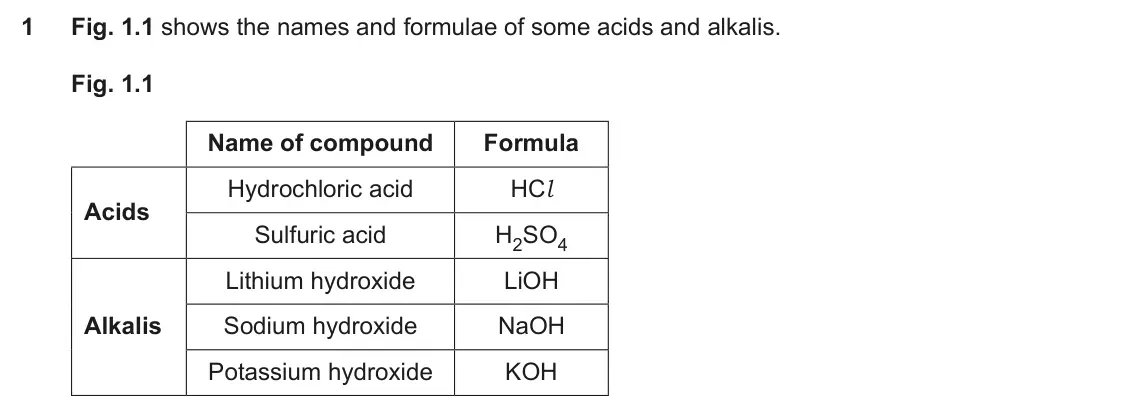
Q1(a)(ii)
The whole paper ↗Q1(a)(iv)
The whole paper ↗Q1(b)
The whole paper ↗Q10(a)(i)
The whole paper ↗
Q10(a)(iii)
The whole paper ↗Q10(b)(i)
The whole paper ↗Q10(b)(ii)
The whole paper ↗Q10(c)
The whole paper ↗Q9(c)(iii)
The whole paper ↗
Q6(a)(i)
The whole paper ↗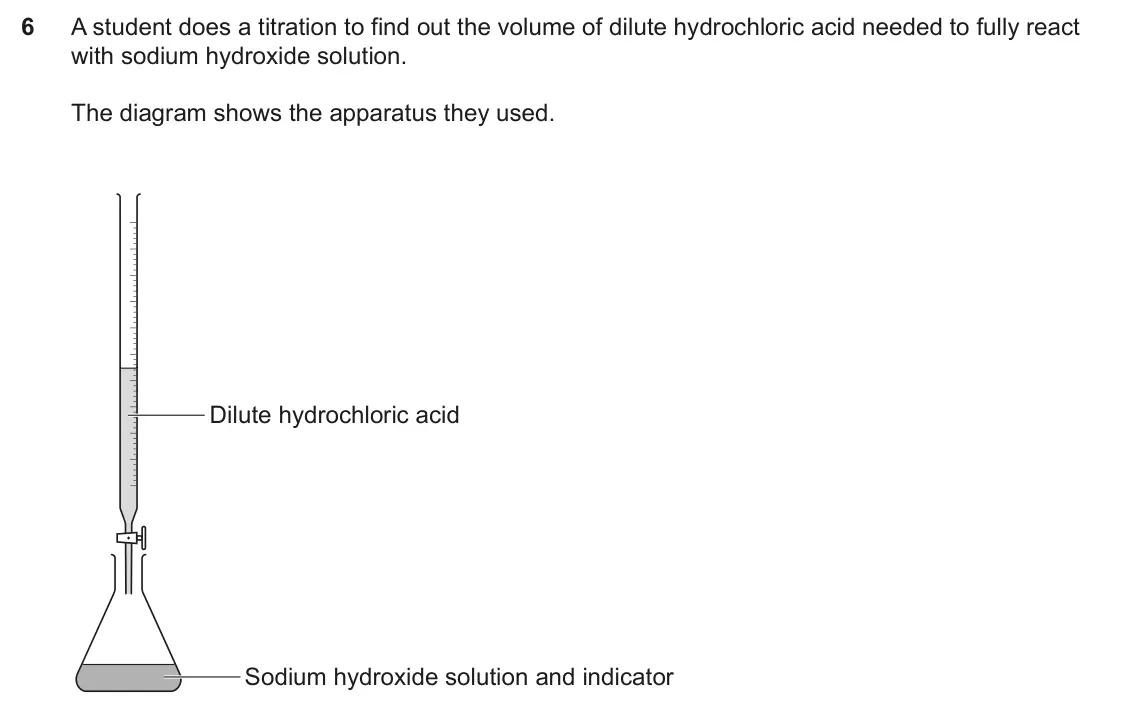
Q6(a)(ii)
The whole paper ↗Q5(b)
The whole paper ↗Q6(a)(i)
The whole paper ↗
Q11(a)
The whole paper ↗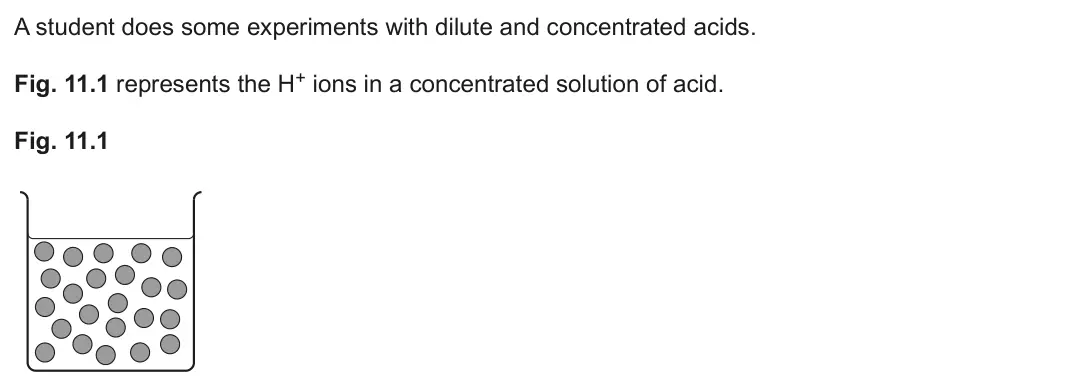
Q11(b)(i)
The whole paper ↗Q11(b)(ii)
The whole paper ↗Q11(c)(i)
The whole paper ↗Q11(c)(ii)
The whole paper ↗
All 103 questions on What useful products can be made from acids?, as a list
- June 2025, Paper 1 Foundation, Q2(b)(iii) (1 mark): Complete the word equation for the reaction of potassium with dilute hydrochloric acid. potassium + hydrochloric acid hydrogen + [1]
- June 2025, Paper 2 Foundation, Q1(a)(i) (1 mark): Which compound has a formula with 2 atoms? [1]
- June 2025, Paper 2 Foundation, Q1(a)(ii) (1 mark): Which alkali reacts with hydrochloric acid to make sodium chloride? [1]
- June 2025, Paper 2 Foundation, Q1(a)(iv) (1 mark): Which two compounds can each react with magnesium metal to make hydrogen? and [1]
- June 2025, Paper 2 Foundation, Q1(b) (3 marks): Which statements are true and which are false? Tick (✓) one box in each row. True False Acids form hydrogen ions when they dissolve in water. All neutralisation
- June 2025, Paper 3 Higher, Q10(a)(i) (2 marks): Complete the balanced symbol equation for this reaction. HCl + NaOH + [2]
- June 2025, Paper 3 Higher, Q10(a)(iii) (1 mark): The salt formed in the reaction is soluble in water. Suggest one way to prepare pure dry crystals of the salt produced in the titration. [1]
- June 2025, Paper 3 Higher, Q10(b)(i) (1 mark): Which two statements about strong acids are true? Tick (✓) two boxes. Strong acids contain only covalent bonds. Strong acids have a pH <7. Strong acids have OH-
- June 2025, Paper 3 Higher, Q10(b)(ii) (1 mark): An acid with a pH of 1 has a hydrogen ion concentration of 0.1 mol / dm3. What is the pH of a solution with a hydrogen ion concentration of 0.0001 mol / dm3? [1
- June 2025, Paper 3 Higher, Q10(c) (2 marks): A student measures the reaction time when magnesium reacts with two different acids, dilute hydrochloric acid and a dilute weak acid. The student keeps the same
- June 2025, Paper 4 Higher, Q9(c)(iii) (3 marks): The concentration of hydrogen ions is the same as the concentration of acid for some dilute acids but different for others. Explain why. Use examples from Table
- June 2024, Paper 1 Foundation, Q6(a)(i) (1 mark): What type of reaction occurs when sodium hydroxide reacts with hydrochloric acid? [1]
- June 2024, Paper 1 Foundation, Q6(a)(ii) (1 mark): Name the salt formed in the reaction. [1]
- June 2024, Paper 2 Foundation, Q5(b) (1 mark): Ammonium sulfate can also be made in a laboratory by reacting ammonia with a dilute acid: ammonia + dilute acid ammonium sulfate Which dilute acid reacts with a
- June 2024, Paper 3 Higher, Q6(a)(i) (1 mark): Write the chemical formula for X. [1]
- June 2024, Paper 3 Higher, Q11(a) (1 mark): Complete Fig. 11.2 to show the H+ ions in a dilute solution of acid. Fig. 11.2 [1]
- June 2024, Paper 3 Higher, Q11(b)(i) (1 mark): The student says that all concentrated acids are strong acids and all dilute acids are weak acids. Explain why they are incorrect. [1]
- June 2024, Paper 3 Higher, Q11(b)(ii) (3 marks): The student adds a carbonate to three dilute acids, A, B and C, with the same concentration. They record the pH of each acid and the time taken for each reactio
- June 2024, Paper 3 Higher, Q11(c)(i) (1 mark): Describe how to use Universal indicator to measure the pH of a solution. [1]
- June 2024, Paper 3 Higher, Q11(c)(ii) (1 mark): A solution of pH 1 has a hydrogen ion concentration of 0.1 mol / dm3. What is the hydrogen ion concentration of a solution of pH 3? Put a ring around the correc
- June 2024, Paper 4 Higher, Q11(a) (2 marks): Ammonium sulfate, (NH4)2SO4, is made in an industrial process for use as a fertiliser. Aqueous ammonium carbonate reacts with excess solid calcium sulfate. (NH4
- June 2024, Paper 4 Higher, Q11(b) (2 marks): Ammonium sulfate can also be made on a small scale in a laboratory. Aqueous ammonia, NH3(aq), reacts with dilute sulfuric acid to make aqueous ammonium sulfate.
- June 2023, Paper 1 Foundation, Q10(b) (1 mark): Ling and Taylor dip a piece of universal indicator paper into a solution of formic acid. What pH value could the solution of formic acid be? [1]
- June 2023, Paper 1 Foundation, Q10(c)(i) (1 mark): Name the gas that causes the fizzing. [1]
- June 2023, Paper 1 Foundation, Q10(c)(ii) (1 mark): A salt called calcium formate is also formed when formic acid reacts with calcium carbonate. The formula of the calcium ion is Ca2+. The formula of the formate
- June 2023, Paper 1 Foundation, Q10(d) (2 marks): Calcium carbonate is insoluble in water. Calcium formate is soluble in water. Sam wants to make some calcium formate crystals. This is the method: • stir calciu
- June 2023, Paper 1 Foundation, Q10(e)(i) (1 mark): Umi and Zayn have a dilute solution of calcium formate. They want to make dry crystals of calcium formate. Name one separation technique they must use. [1]
- June 2023, Paper 3 Higher, Q2(b) (1 mark): Ling and Taylor dip a piece of universal indicator paper into a solution of formic acid. What pH value could the solution of formic acid be? [1]
- June 2023, Paper 3 Higher, Q2(c)(i) (1 mark): Name the gas that causes the fizzing. [1]
- June 2023, Paper 3 Higher, Q2(c)(ii) (1 mark): A salt called calcium formate is also formed when formic acid reacts with calcium carbonate. The formula of the calcium ion is Ca2+. The formula of the formate
- June 2023, Paper 3 Higher, Q2(d) (2 marks): Calcium carbonate is insoluble in water. Calcium formate is soluble in water. Sam wants to make some calcium formate crystals. This is the method: • stir calciu
- June 2023, Paper 3 Higher, Q2(e)(i) (1 mark): Umi and Zayn have a dilute solution of calcium formate. They want to make dry crystals of calcium formate. Name one separation technique they must use. [1]
- June 2022, Paper 1 Foundation, Q7(a) (1 mark): Complete the sentence. The gas made when the reaction fizzes is called carbon . [1]
- June 2022, Paper 1 Foundation, Q7(d) (2 marks): At the end of Experiment 2, the mixture formed contains a solution of zinc sulfate with some unreacted solid zinc carbonate. Jack filters the mixture to remove
- June 2022, Paper 1 Foundation, Q8(a) (1 mark): Which word describes the reaction between sodium hydroxide and hydrochloric acid? Tick (✓) one box. Oxidation Reduction Neutralisation Condensation [1]
- June 2022, Paper 1 Foundation, Q11(a) (2 marks): Complete the symbol equation for the reaction. Include a state symbol. Zn(s) + H2SO4(aq) ZnSO4(aq) + [2]
- June 2022, Paper 2 Foundation, Q2(a) (2 marks): What are the correct state symbols for copper sulfate and copper hydroxide in this experiment? Tick (3) one box in each row. State symbol Substance (s) (aq) (l)
- June 2022, Paper 2 Foundation, Q2(d)(i) (1 mark): Draw lines of best fit on the graph. [1]
- June 2022, Paper 2 Foundation, Q2(d)(ii) (1 mark): Put a ring around the outlier on the graph. [1]
- June 2022, Paper 2 Foundation, Q2(d)(iii) (1 mark): Suggest what the correct mass reading for the outlier should be. correct mass reading = g [1]
- June 2022, Paper 2 Foundation, Q2(d)(iv) (1 mark): What is the most likely reason for the outlier? Tick (3) one box. Jane did not add enough sodium hydroxide solution. Some of the copper hydroxide was lost befor
- June 2022, Paper 2 Foundation, Q9(c)(i) (1 mark): Bubbles of ammonia gas enter the water but no gas collects in the test-tube. What happens to the ammonia gas when it enters the water? [1]
- June 2022, Paper 2 Foundation, Q9(c)(ii) (1 mark): Which apparatus should Kofi use to collect ammonia? Tick (3) one box. burette gas syringe measuring cylinder volumetric flask [1]
- June 2022, Paper 2 Foundation, Q9(d)(i) (1 mark): Predict the pH of ammonia. pH [1]
- June 2022, Paper 2 Foundation, Q9(d)(ii) (2 marks): Describe another method you could use to measure the pH of ammonia solution. [2]
- June 2022, Paper 3 Higher, Q1(a) (2 marks): Complete the symbol equation for the reaction. Include a state symbol. Zn(s) + H2SO4(aq) ZnSO4(aq) + [2]
- June 2022, Paper 3 Higher, Q9(a) (1 mark): Name the gas that causes the fizzing. [1]
- June 2022, Paper 4 Higher, Q2(d)(i) (1 mark): Predict the pH of ammonia. pH [1]
- June 2022, Paper 4 Higher, Q2(d)(ii) (2 marks): Describe another method you could use to measure the pH of ammonia solution. [2]
- November 2021, Paper 2 Foundation, Q4(b) (2 marks): Jane reacts dilute hydrochloric acid with each tablet. The equation shows the reaction that happens: CaCO3(s) + 2HCl(aq) CaCl 2(aq) + H2O(l) + CO2(g) Which two
- November 2021, Paper 2 Foundation, Q4(d)(i) (1 mark): How will magnesium hydroxide affect the volume of acid needed to neutralise each tablet of FeelRight? [1]
- November 2021, Paper 2 Foundation, Q4(d)(ii) (1 mark): Give one reason for your answer to (d)(i). [1]
- November 2021, Paper 2 Foundation, Q6(a) (1 mark): All of the acids in the table react with magnesium metal. Which acid gives the fastest reaction? Tick (✓) one box. 0.1 mol / dm3 hydrochloric acid 0.01 mol / dm
- November 2021, Paper 2 Foundation, Q6(b) (2 marks): Alex has an idea about pH. Acids with the same concentration always have the same pH. Does the data in Table 6.1 agree with Alex’s idea? Yes No Use data from Ta
- November 2021, Paper 2 Foundation, Q6(c)(i) (2 marks): Describe how Alex uses Universal Indicator to measure the pH of the acids. [2]
- November 2021, Paper 2 Foundation, Q6(c)(ii) (1 mark): Alex says that the results in Table 6.2 contain an outlier. Put a ring around the result that is an outlier in Table 6.2. [1]
- November 2021, Paper 2 Foundation, Q6(c)(iii) (2 marks): Explain your answer to (c)(ii). [2]
- November 2021, Paper 2 Foundation, Q6(c)(iv) (1 mark): Alex says that using a pH meter rather than Universal Indicator to measure pH improves the quality of the data. Suggest one reason why this is true. [1]
- November 2021, Paper 4 Higher, Q9(a) (2 marks): Complete the information in the table. Concentration of Concentration of acid Name of acid hydrogen ions in solution pH (mol / dm3) (mol / dm3) 5.0 × 10⁻¹ 0.50
- November 2021, Paper 4 Higher, Q9(b) (1 mark): Which acid in the table shows the highest concentration of hydrogen ions in solution? Tick (✓) one box. 0.50 mol / dm3 hydrochloric acid 0.10 mol / dm3 hydrochl
- November 2021, Paper 4 Higher, Q9(c)(i) (1 mark): What does Sundip’s relationship mean? [1]
- November 2021, Paper 4 Higher, Q9(c)(ii) (2 marks): Do you agree with Sundip’s relationship? Yes No Use data from the table to support your answer. [2]
- November 2021, Paper 4 Higher, Q9(d)(i) (2 marks): Complete the symbol equations to show what happens when hydrochloric acid and sulfuric acid each form ions. hydrochloric acid hydrogen ions + chloride ions H+ H
- November 2021, Paper 4 Higher, Q9(d)(ii) (2 marks): Explain why the same concentration of hydrochloric acid and sulfuric acid have different concentrations of hydrogen ions and different pH values. [2]
- November 2020, Paper 1 Foundation, Q6(c) (2 marks): Mia now reacts an iron nail with hydrochloric acid. Write a word equation for this reaction. [2]
- November 2020, Paper 1 Foundation, Q9(b) (2 marks): Sundip makes ammonium sulfate from a solution of ammonia in the laboratory. The method is shown below but is not in the correct order. Write a number from 1–6 i
- November 2020, Paper 2 Foundation, Q2(a)(i) (1 mark): Nina washes each pH meter between readings. Explain why it is important that she does this. [1]
- November 2020, Paper 2 Foundation, Q2(a)(ii) (2 marks): Table 2.2 shows Nina’s results. actual pH meter 1 pH meter 2 pH meter 3 Solution pH reading reading reading A 3.0 3.1 3.0 3.3 B 9.0 9.1 9.0 9.1 C 1.0 0.9 1.0 1.
- November 2020, Paper 2 Foundation, Q2(b)(i) (1 mark): Nina wants to use another method to measure pH. What other method could she use to measure pH? Tick (3) one box. Do a titration. Test with litmus paper. Test an
- November 2020, Paper 2 Foundation, Q2(b)(ii) (2 marks): Explain why scientists often use more than one method to collect results when they do experiments. [2]
- November 2020, Paper 3 Higher, Q1(a) (1 mark): Layla says, ‘The titration uses a neutralisation reaction.’ Define a neutralisation reaction. [1]
- November 2020, Paper 3 Higher, Q9(c) (2 marks): Sarah makes ammonium sulfate from ammonia in a laboratory. This is her method: • Add excess ammonia to dilute sulfuric acid in an evaporating basin. • Boil the
- November 2020, Paper 4 Higher, Q4(a) (2 marks): Complete the word and balanced symbol equation for the reaction. zinc + hydrochloric acid hydrogen + HCl + ZnCl 2 Zn + [2]
- November 2020, Paper 4 Higher, Q8(a) (1 mark): Identify one neutral solution and one alkali solution from the table. Neutral solution: Alkali solution: [1]
- November 2020, Paper 4 Higher, Q8(b) (1 mark): Predict the actual pH of a solution with a concentration of 1.0 × 10⁻⁴ mol / dm3 of hydrogen ions. pH = [1]
- November 2020, Paper 4 Higher, Q8(c) (1 mark): What is the trend in the relationship between concentration of hydrogen ions and pH? [1]
- November 2020, Paper 4 Higher, Q8(d) (3 marks): What conclusions can you make about the relative accuracy of each pH meter? Explain each conclusion. pH meter 1: pH meter 2: pH meter 3: [3]
- November 2020, Paper 4 Higher, Q8(e) (1 mark): Nina thinks that she has contaminated her solutions during the experiment. What should Nina do to make sure that her solutions do not become contaminated during
- June 2019, Paper 1 Foundation, Q9(a) (1 mark): Complete the symbol equation for the reaction. Zn + H2SO4 + H2 [1]
- June 2019, Paper 1 Foundation, Q9(b) (1 mark): Sundip drops a piece of zinc into some dilute sulfuric acid. The zinc fizzes. What is the name of the gas given off? [1]
- June 2019, Paper 2 Foundation, Q1(a)(i) (2 marks): Use values from the graph in Fig. 1.2 to describe how the pH changes when dilute sodium hydroxide is added to the acid. [2]
- June 2019, Paper 2 Foundation, Q1(a)(ii) (2 marks): Explain why the pH readings at the start, and at the end of the reaction, are different. [2]
- June 2019, Paper 2 Foundation, Q1(b)(i) (1 mark): Balance the symbol equation by putting numbers on the dotted lines. NaOH + H2SO4 Na2SO4 + H2O [1]
- June 2019, Paper 2 Foundation, Q1(b)(ii) (2 marks): Draw lines to connect each substance with its correct formula. Substance Formula water NaOH sodium sulfate H2SO4 sulfuric acid Na2SO4 sodium hydroxide H2O [2]
- June 2019, Paper 2 Foundation, Q1(c)(i) (2 marks): Complete the word and symbols equations by filling. hydrogen ions + water OH– + [2]
- June 2019, Paper 2 Foundation, Q1(c)(ii) (1 mark): What is the name for this type of reaction? Put a ring around the correct answer. filtration oxidation precipitation neutralisation [1]
- June 2019, Paper 2 Foundation, Q6(d)(i) (2 marks): The method used in process 3 can also be done in the laboratory. Which two techniques are needed to separate solid ammonium sulfate from the final reaction mixt
- June 2019, Paper 4 Higher, Q3(a) (3 marks): Use the ionic equation and values from the graph to explain the pH changes that happen during the reaction. [3]
- June 2019, Paper 4 Higher, Q3(b) (2 marks): Ali started with 20.0 cm3 of dilute hydrochloric acid in the beaker. Explain how his results show that the acid is more concentrated than the dilute sodium hydr
- June 2018, Paper 1 Foundation, Q8(a) (1 mark): Complete the equation for neutralisation. H+ + H2O [1]
- June 2018, Paper 1 Foundation, Q8(b)(i) (2 marks): Which medicine gives the best value for money for neutralising acid? [2]
- June 2018, Paper 1 Foundation, Q8(b)(ii) (1 mark): Kai measures the 25 cm3 of milk of magnesia using a beaker. What could he do to measure the volume more accurately? Tick (3) one box. Use a volumetric pipette.
- June 2018, Paper 2 Foundation, Q10(b)(i) (2 marks): At what concentrations is ethanoic acid harmful, but not corrosive? [2]
- June 2018, Paper 2 Foundation, Q10(b)(ii) (1 mark): Suggest a concentration at which ethanoic acid is flammable. [1]
- June 2018, Paper 2 Foundation, Q10(b)(iii) (3 marks): Kai adds very concentrated ethanoic acid to ethanol and heats the mixture. Suggest some safety procedures for Kai to use to make sure that he is safe during thi
- June 2018, Paper 2 Foundation, Q11(e)(i) (2 marks): Describe how Sundip uses Universal Indicator to test the pH of the solutions of the salts. [2]
- June 2018, Paper 2 Foundation, Q11(e)(ii) (2 marks): Sundip thinks her results do not show the difference in pH between the salts. She thinks she needs to improve the precision of her pH results. Explain why she n
- June 2018, Paper 3 Higher, Q12(a) (1 mark): This equation shows what happens when pure sulfuric acid is mixed with water. 2H+(aq) + SO4 2–(aq) H2SO4(l) Explain how this equation shows that sulfuric acid i
- June 2018, Paper 4 Higher, Q1(b)(i) (2 marks): At what concentrations is ethanoic acid harmful, but not corrosive? [2]
- June 2018, Paper 4 Higher, Q1(b)(ii) (1 mark): Suggest a concentration at which ethanoic acid is flammable. [1]
- June 2018, Paper 4 Higher, Q1(b)(iii) (3 marks): Kai adds very concentrated ethanoic acid to ethanol and heats the mixture. Suggest some safety procedures for Kai to use to make sure that he is safe during thi
- June 2018, Paper 4 Higher, Q2(e)(i) (2 marks): Describe how Sundip uses Universal Indicator to test the pH of the solutions of the salts. [2]
- June 2018, Paper 4 Higher, Q2(e)(ii) (2 marks): Sundip thinks her results do not show the difference in pH between the salts. She thinks she needs to improve the precision of her pH results. Explain why she n
Questions, mark schemes and examiner’s reports are © OCR, from their published past papers. Plumi isn’t affiliated with any exam board. Want whole papers? Every OCR GCSE Chemistry B paper.
Rather write your answers by hand on iPad? Plumi marks them against the same mark schemes.