 plumi
How are chemicals made on an industrial scale?: OCR GCSE Chemistry B questions
Every OCR GCSE Chemistry B exam question on C6.4 How are chemicals made on an industrial scale?, 2018–2025, with its mark scheme and examiner’s report.
Paper
All papers
Exam
All years
Calculations
Q5(a)
The whole paper ↗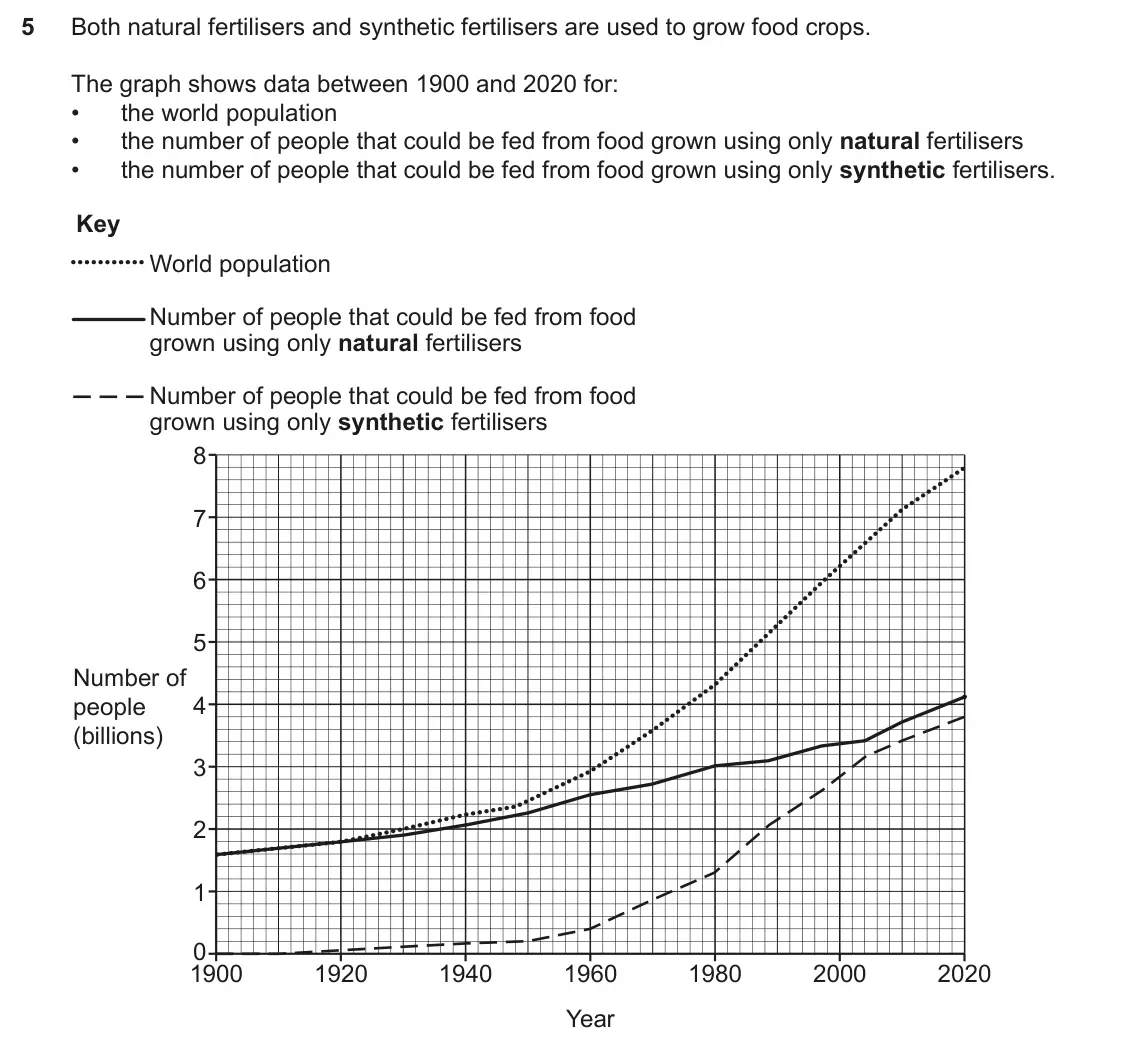
Q5(b)(i)
The whole paper ↗Q5(b)(ii)
The whole paper ↗Q5(c)
The whole paper ↗Q5(d)
The whole paper ↗Q5(e)
The whole paper ↗Q6(b)(ii)
The whole paper ↗
Q6(c)(i)
The whole paper ↗Q5(a)
The whole paper ↗
Q5(b)
The whole paper ↗Q6(b)
The whole paper ↗
Q6(c)(ii)
The whole paper ↗Q6(d)
The whole paper ↗Q6(e)(ii)
The whole paper ↗Q10(a)
The whole paper ↗
Q10(b)(i)
The whole paper ↗Q10(b)(ii)
The whole paper ↗Q5(a)(i)
The whole paper ↗Q5(a)(ii)
The whole paper ↗Q5(c)(i)
The whole paper ↗
All 69 questions on How are chemicals made on an industrial scale?, as a list
- June 2025, Paper 2 Foundation, Q5(a) (1 mark): Predict when the first synthetic fertiliser became available. Use the graph. [1]
- June 2025, Paper 2 Foundation, Q5(b)(i) (2 marks): How many people could be fed with food grown using only natural fertilisers in 1900 and 2020. Use the graph. Number of people that could be fed using only natur
- June 2025, Paper 2 Foundation, Q5(b)(ii) (3 marks): Calculate the percentage increase in the number of people that can be fed using only natural fertilisers between 1900 and 2020. Give your answer to 1 decimal pl
- June 2025, Paper 2 Foundation, Q5(c) (2 marks): A student looks at the graph and has this idea: ‘The total amount of food that can be grown using both natural and synthetic fertilisers in 2020 is enough to fe
- June 2025, Paper 2 Foundation, Q5(d) (2 marks): Making and using synthetic fertilisers has both costs and benefits. Which statements about making and using synthetic fertilisers are a benefit and which are a
- June 2025, Paper 2 Foundation, Q5(e) (2 marks): Most synthetic fertilisers contain three essential elements. One essential element is nitrogen. Which two other essential elements do fertilisers contain? Tick
- June 2025, Paper 2 Foundation, Q6(b)(ii) (2 marks): Calculate the atom economy of the reaction. Use: • data from the table above the formula: atom economy = total mass of hydrogen in equation • total mass of all
- June 2025, Paper 2 Foundation, Q6(c)(i) (2 marks): Which two statements give benefits of using the carbon dioxide in another process? Tick (✓) two boxes. Hydrogen and carbon dioxide are easy to separate. Less en
- June 2025, Paper 4 Higher, Q5(a) (2 marks): Which statements about fertilisers are true and which are false? Tick (✓) one box in each row. True False Ammonia is added to fertilisers to provide potassium a
- June 2025, Paper 4 Higher, Q5(b) (6 marks): Nitrogen and hydrogen react together to make ammonia in the Haber process. Ammonia is used in fertilisers. (b)* The diagram shows a flow chart for the substance
- June 2025, Paper 4 Higher, Q6(b) (2 marks): Equation 1 shows the reaction of methane with steam which is used in industry to manufacture hydrogen. Equation 1 CH4 + 2H2O 4H2 + CO2 The carbon dioxide produc
- June 2025, Paper 4 Higher, Q6(c)(ii) (4 marks): Calculate the atom economy of the reaction of methane with steam to make hydrogen. Use: • Equation 1: CH4 + 2H2O 4H2 + CO2 • the data from Table 6.1. Give your
- June 2025, Paper 4 Higher, Q6(d) (2 marks): Scientists did some experiments and collected data about the yield of the products made when 1000 kg of methane reacts with steam. Table 6.2 shows the data they
- June 2025, Paper 4 Higher, Q6(e)(ii) (1 mark): Explain how Equation 2 shows that the atom economy of the reaction to make methanol is not 100%. [1]
- June 2024, Paper 1 Foundation, Q10(a) (2 marks): Nitrogen is one essential plant nutrient element. Name two other essential plant nutrient elements. 1 2 [2]
- June 2024, Paper 1 Foundation, Q10(b)(i) (1 mark): State one disadvantage of the over-use of synthetic fertilisers. [1]
- June 2024, Paper 1 Foundation, Q10(b)(ii) (1 mark): Suggest why farmers still use synthetic fertilisers despite their disadvantages. [1]
- June 2024, Paper 2 Foundation, Q5(a)(i) (1 mark): Which method can be used to separate aqueous ammonium sulfate from the mixture left at the end of the reaction. Put a ring around the correct option. Distillati
- June 2024, Paper 2 Foundation, Q5(a)(ii) (2 marks): Explain the difference between what happens to by-products and waste products from industrial processes. [2]
- June 2024, Paper 2 Foundation, Q5(c)(i) (1 mark): State one advantage of using continuous processes in industry. [1]
- June 2024, Paper 2 Foundation, Q5(c)(ii) (1 mark): State one advantage of making chemicals in the laboratory in batches. [1]
- June 2024, Paper 3 Higher, Q1(a) (2 marks): Nitrogen is one essential plant nutrient element. Name two other essential plant nutrient elements. 1 2 [2]
- June 2024, Paper 3 Higher, Q1(b)(i) (1 mark): State one disadvantage of the over-use of synthetic fertilisers. [1]
- June 2024, Paper 3 Higher, Q1(b)(ii) (1 mark): Suggest why farmers still use synthetic fertilisers despite their disadvantages. [1]
- June 2024, Paper 3 Higher, Q1(c) (4 marks): An example of a synthetic fertiliser is ammonium nitrate, NH4NO3. Ammonium nitrate is produced when ammonium hydroxide, NH4OH, reacts with nitric acid, HNO3. NH
- June 2024, Paper 4 Higher, Q11(a) (2 marks): Ammonium sulfate, (NH4)2SO4, is made in an industrial process for use as a fertiliser. Aqueous ammonium carbonate reacts with excess solid calcium sulfate. (NH4
- June 2024, Paper 4 Higher, Q11(c) (2 marks): Which statements about industrial processes and laboratory reactions are true and which are false? Tick (3) one box in each row. True False Industrial processes
- June 2023, Paper 2 Foundation, Q8(a) (2 marks): Which two statements explain why the atom economy of this reaction is 100%? Tick (3) two boxes. All of the atoms in nitrogen and hydrogen are used to make ammon
- June 2023, Paper 2 Foundation, Q8(b)(i) (1 mark): Fertiliser from fields can get into rivers. How does this cause a risk to the environment? [1]
- June 2023, Paper 2 Foundation, Q8(b)(ii) (1 mark): Give one benefit of using fertilisers. [1]
- June 2023, Paper 3 Higher, Q9(c) (2 marks): The industrial company use a pressure of only 200 kPa. Explain why a higher pressure is not used. [2]
- June 2023, Paper 4 Higher, Q8(a) (2 marks): What is the atom economy of this reaction? Explain your answer. Atom economy = % Explanation [2]
- June 2023, Paper 4 Higher, Q8(c) (2 marks): The reaction used to make ammonia takes place in a reactor. Unreacted nitrogen and hydrogen left at the end of the reaction are recycled back into the reactor.
- June 2023, Paper 4 Higher, Q8(d) (6 marks): Ammonia is made on an industrial scale in a reaction between nitrogen and hydrogen. The equation to make ammonia is shown. N2(g) + 3H2(g) 2NH3(g) (d)* The graph
- June 2022, Paper 2 Foundation, Q9(b) (2 marks): An ammonia factory tests a new reactor. The table shows the theoretical yield and actual yield for a process in the new reactor. Theoretical yield (tonnes) 150
- June 2022, Paper 4 Higher, Q2(c)(i) (1 mark): Bubbles of ammonia gas enter the water but no gas collects in the test-tube. What happens to the ammonia gas when it enters the water? [1]
- June 2022, Paper 4 Higher, Q2(c)(ii) (1 mark): Which apparatus should Kofi use to collect ammonia? Tick (3) one box. burette gas syringe measuring cylinder volumetric flask [1]
- November 2020, Paper 1 Foundation, Q7(a)(ii) (1 mark): Potassium is an element. It is an essential nutrient for plants. Name one other element that is an essential nutrient for plants. [1]
- November 2020, Paper 1 Foundation, Q8(e)(i) (3 marks): Some relative formula masses are given in the table. Formula Ti O2 TiO2 Relative formula mass 47.9 32.0 79.9 Calculate the atom economy for Method 2. Use the da
- November 2020, Paper 1 Foundation, Q8(e)(ii) (2 marks): Look at the equations again for Method 1 and Method 2. Method 1: 2Mg + TiO2 Ti + 2MgO Method 2: TiO2 Ti + O2 Explain why Method 2 has a higher atom economy than
- November 2020, Paper 1 Foundation, Q9(a) (3 marks): Ammonia is manufactured in the Haber process. N2 + 3H2 2NH3 Which statements about this reaction are true and which are false? Tick (3) one box in each row. Tru
- November 2020, Paper 3 Higher, Q9(b)(ii) (1 mark): Suggest one disadvantage of using a temperature of 350 °C rather than 450 °C in the Haber process. [1]
- November 2020, Paper 3 Higher, Q9(d) (1 mark): Ammonium sulfate can be mixed with other substances to make compound fertilisers. Suggest why compound fertilisers are better for farmers than pure ammonium sul
- November 2020, Paper 3 Higher, Q11(c)(i) (1 mark): What does atom economy tell us about a reaction? [1]
- November 2020, Paper 3 Higher, Q11(c)(ii) (3 marks): Calculate the atom economy of Method 2. Give your answer to 2 significant figures. Atom economy = % [3]
- November 2020, Paper 3 Higher, Q11(c)(iii) (1 mark): Explain, without further calculation, which method has the higher atom economy. [1]
- November 2020, Paper 3 Higher, Q11(c)(iv) (3 marks): Jamal and Mia discuss atom economy. The method with the higher atom economy is more environmentally friendly. It’s not possible to say. Jamal Mia Evaluate Jamal
- November 2020, Paper 4 Higher, Q7(c) (1 mark): Some fertilisers contain more than one compound mixed together. Which two compounds, when mixed together, contain the three elements nitrogen, phosphorus and po
- June 2019, Paper 1 Foundation, Q10(b) (1 mark): The NO then reacts with air and water to form nitric acid. Nitric acid is an ingredient used to make fertilisers. Why is nitric acid not used as a fertiliser on
- June 2019, Paper 2 Foundation, Q6(a) (2 marks): In process 1, the reactor reaches 60 °C without being heated. Explain why the reactor keeps hot without being heated. [2]
- June 2019, Paper 2 Foundation, Q6(b) (2 marks): Suggest one advantage of using process 2 to make ammonium sulfate, rather than the other two processes. [2]
- June 2019, Paper 2 Foundation, Q6(c) (2 marks): Use the equations in the table to explain why the atom economies of the processes are different. [2]
- June 2019, Paper 2 Foundation, Q6(d)(ii) (2 marks): Ammonium sulfate is made in the laboratory in a batch process. The processes that make ammonium sulfate in industry are continuous processes. Describe the diffe
- June 2019, Paper 3 Higher, Q10(b) (2 marks): Which two statements about the Haber Process are correct? Tick (3) two boxes. Nitrogen is the most expensive raw material. Hydrogen is made from natural gas and
- June 2019, Paper 3 Higher, Q10(c) (3 marks): In the Haber process a temperature of 450 °C is often used. Nina says, ‘The Haber process should be run at a lower temperature. More ammonia is produced per day
- June 2019, Paper 3 Higher, Q10(d) (2 marks): Jamal, another student, says, ‘Fertilisers that contain ammonium compounds should be banned.’ Give one argument for and one argument against these types of fert
- June 2019, Paper 4 Higher, Q6(a) (3 marks): Both process 1 and process 2 are exothermic. Explain why an exothermic reaction has a positive effect on how each process works. [3]
- June 2019, Paper 4 Higher, Q6(b) (2 marks): Process 1 and process 3 both need to go through further separation after the main reactions. How can pure, solid ammonium sulfate be separated from the reaction
- June 2019, Paper 4 Higher, Q6(c) (3 marks): Use relative formula masses to calculate the atom economy of process 3. Give your answer to 1 decimal place. Atom economy = % [3]
- June 2019, Paper 4 Higher, Q6(d)(i) (1 mark): Explain what sustainability means. [1]
- June 2019, Paper 4 Higher, Q6(d)(ii) (2 marks): Give two examples from Table 6.1 to explain why some processes are more sustainable than others. [2]
- June 2019, Paper 4 Higher, Q6(e) (2 marks): Process 3 can be carried out as a batch process in the laboratory. In industry, process 3 is carried out as a continuous process. Explain why batch processes ar
- June 2018, Paper 1 Foundation, Q3(a)(ii) (1 mark): Plants need one of the elements in ammonium sulfate to grow faster. Write down the name of this element. [1]
- June 2018, Paper 1 Foundation, Q3(b)(i) (1 mark): Suggest one reason, other than cost, why some farmers use manure rather than ammonium sulfate as a fertiliser. [1]
- June 2018, Paper 1 Foundation, Q3(b)(ii) (1 mark): Suggest one reason, other than cost, why some farmers use ammonium sulfate rather than manure as a fertiliser. [1]
- June 2018, Paper 1 Foundation, Q13(b) (4 marks): Calculate the atom economy for the production of carbon dioxide in this reaction. Use the formula: atom economy = mass of atoms in desired product total mass of
- June 2018, Paper 3 Higher, Q2(b) (4 marks): Calculate the atom economy for the production of carbon dioxide in this reaction. Use the formula: atom economy = mass of atoms in desired product total mass of
- June 2018, Paper 3 Higher, Q7(b)(i) (1 mark): Suggest a use for these compounds. [1]
- June 2018, Paper 3 Higher, Q7(c) (3 marks): There are several ways of making nitrogen compounds from nitrogen gas in industry. Give two reasons why scientists may choose this reaction and one against. Rea
Questions, mark schemes and examiner’s reports are © OCR, from their published past papers. Plumi isn’t affiliated with any exam board. Want whole papers? Every OCR GCSE Chemistry B paper.
Rather write your answers by hand on iPad? Plumi marks them against the same mark schemes.