 plumi
How are metals with different reactivities extracted?: OCR GCSE Chemistry B questions
Every OCR GCSE Chemistry B exam question on C3.2 How are metals with different reactivities extracted?, 2018–2025, with its mark scheme and examiner’s report.
Paper
All papers
Exam
All years
Calculations
Q2(b)(i)
The whole paper ↗
Q2(b)(ii)
The whole paper ↗Q2(b)(iii)
The whole paper ↗Q3(b)(iii)
The whole paper ↗Q2(b)
The whole paper ↗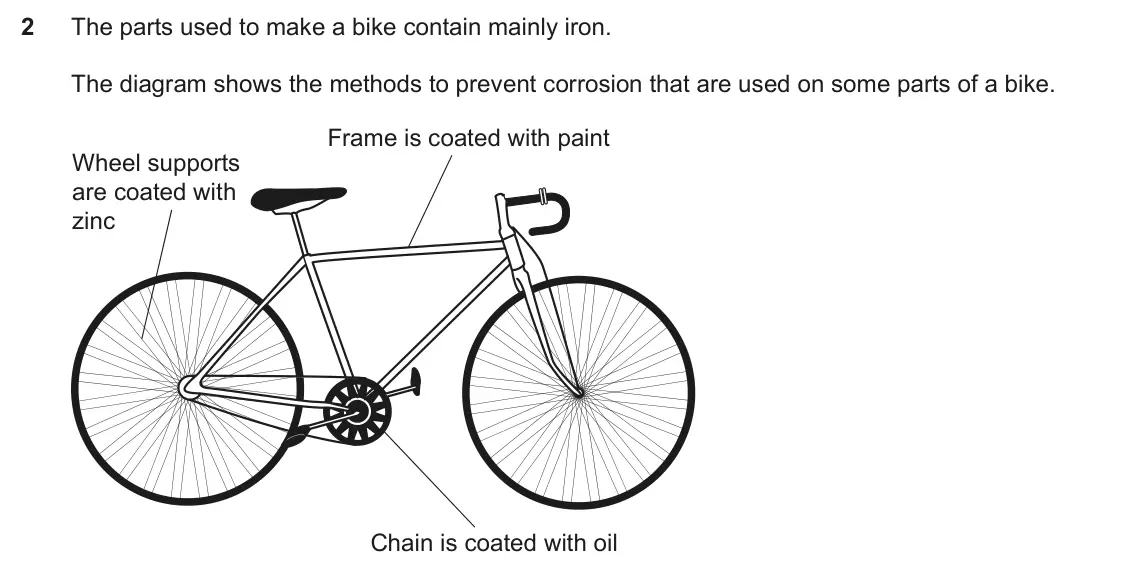
Q4(a)
The whole paper ↗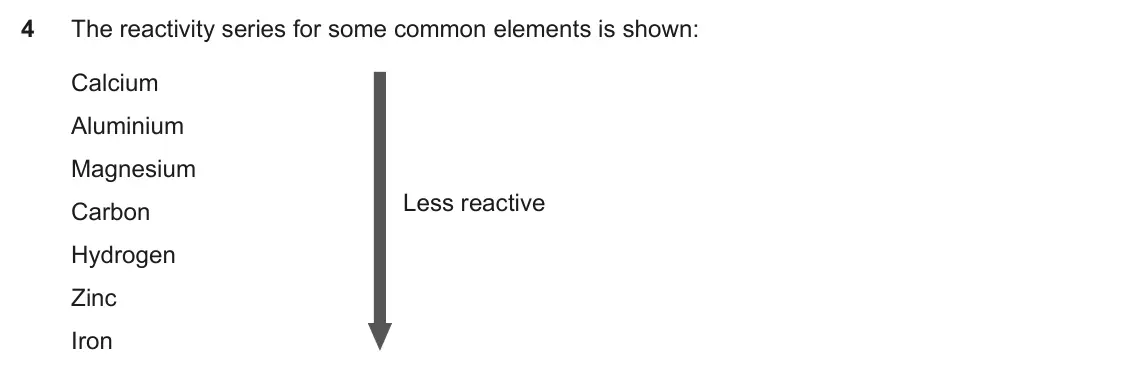
Q7(b)(ii)
The whole paper ↗
Q7(b)(iii)
The whole paper ↗Q6(f)
The whole paper ↗
Q5(a)(i)
The whole paper ↗
Q5(a)(ii)
The whole paper ↗Q5(b)
The whole paper ↗Q6(a)
The whole paper ↗Q5(a)
The whole paper ↗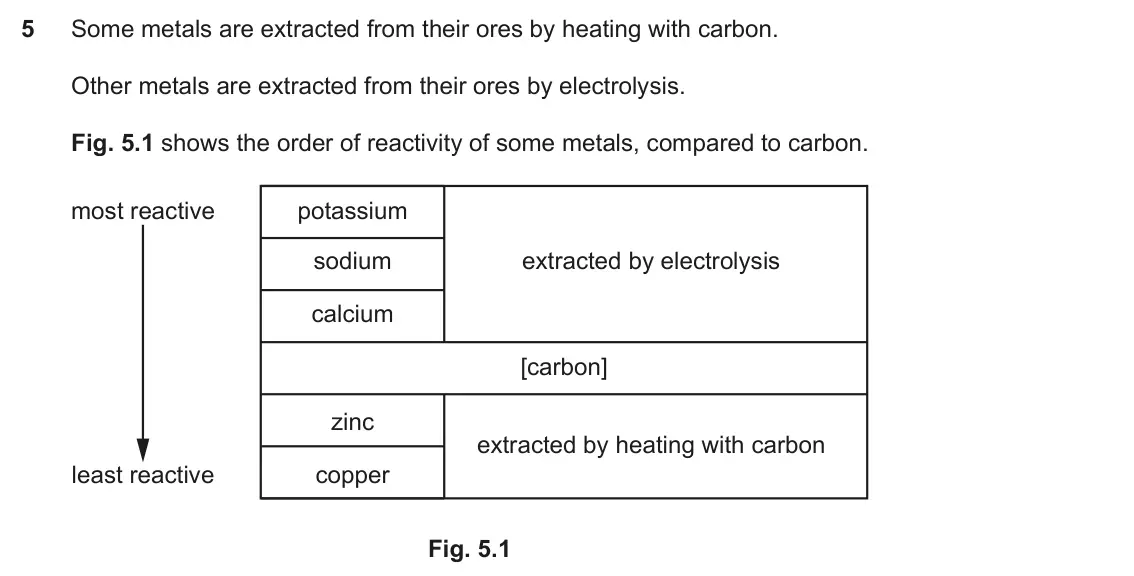
Q5(b)(i)
The whole paper ↗Q5(b)(ii)
The whole paper ↗Q5(c)(i)
The whole paper ↗Q5(d)(i)
The whole paper ↗
All 47 questions on How are metals with different reactivities extracted?, as a list
- June 2025, Paper 1 Foundation, Q2(b)(i) (2 marks): Which of the metals in the table is the least reactive? Explain your answer. Least reactive metal Explanation [2]
- June 2025, Paper 1 Foundation, Q2(b)(ii) (1 mark): What happens to metal atoms when they lose electrons? Tick (✓) one box. They form double bonds. They form negative ions. They form positive ions. They form prot
- June 2025, Paper 1 Foundation, Q2(b)(iii) (1 mark): Complete the word equation for the reaction of potassium with dilute hydrochloric acid. potassium + hydrochloric acid hydrogen + [1]
- June 2025, Paper 3 Higher, Q3(b)(iii) (1 mark): What is meant by the term reduction? [1]
- June 2024, Paper 2 Foundation, Q2(b) (3 marks): Iron to make bikes is extracted from iron oxide. During the extraction, iron oxide reacts with carbon monoxide to make iron. When iron corrodes it reacts with o
- June 2024, Paper 2 Foundation, Q8 (6 marks): 8* A student does some experiments to find out the order of reactivity of some metals. They add the same size pieces of five different metals to separate sample
- June 2024, Paper 4 Higher, Q8 (6 marks): 8* Metals react with other metal ions in displacement reactions. The greater the difference in reactivity between the metal and the metal ion, the greater the e
- June 2023, Paper 1 Foundation, Q4(a) (2 marks): Zinc can be extracted by reacting zinc oxide with carbon. Aluminium cannot be extracted by reacting aluminium oxide with carbon. Explain why these statements ar
- June 2023, Paper 2 Foundation, Q7(b)(ii) (1 mark): Suggest why no gas is collected when copper is used in the experiment. [1]
- June 2023, Paper 2 Foundation, Q7(b)(iii) (2 marks): Suggest the name of metal X. Explain your answer. Name Explanation [2]
- June 2023, Paper 3 Higher, Q6(f) (1 mark): Explain why aluminium is not made by heating its oxide with carbon. [1]
- June 2022, Paper 1 Foundation, Q5(a)(i) (1 mark): The formula for iron sulfide is FeS. The formula for magnesium sulfide is MgS. Write a balanced symbol equation for this reaction. [1]
- June 2022, Paper 1 Foundation, Q5(a)(ii) (1 mark): How does this reaction show that magnesium is above iron in the reactivity series? [1]
- June 2022, Paper 1 Foundation, Q5(b) (2 marks): Complete the sentences about the reactivity of metals with acids. Use words from the list. electrons protons quickly slowly Metals higher in the reactivity seri
- June 2022, Paper 1 Foundation, Q6(a) (1 mark): Iron ore contains iron oxide. Iron ore reacts with carbon to make iron. This is a word equation for the reaction: iron oxide + carbon iron + carbon monoxide Whi
- June 2022, Paper 2 Foundation, Q5(a) (1 mark): Which statement explains why calcium must be extracted from its ore by electrolysis? Tick (3) one box. Calcium does not conduct electricity. Calcium is a non-me
- June 2022, Paper 2 Foundation, Q5(b)(i) (1 mark): Which metal, not listed in Fig. 5.1, is less reactive than carbon? Put a ring around the correct answer. lithium magnesium potassium silver [1]
- June 2022, Paper 2 Foundation, Q5(b)(ii) (2 marks): Mia makes this statement: ‘The information in Fig. 5.1 shows that all metals which are more reactive than carbon are in Group 1.’ Use information from Fig. 5.1
- June 2022, Paper 2 Foundation, Q5(c)(i) (1 mark): How are iron and aluminium extracted from their ores? Tick (3) one box in each row. Extracted by heating Extracted by Metal with carbon electrolysis iron alumin
- June 2022, Paper 2 Foundation, Q5(d)(i) (2 marks): Write the word equation for the reaction between copper oxide and carbon. [2]
- June 2022, Paper 2 Foundation, Q5(d)(ii) (2 marks): What is oxidised and what is reduced during the reaction between copper oxide and carbon? Explain your reasons. oxidised reduced reasons [2]
- June 2022, Paper 2 Foundation, Q5(d)(iii) (1 mark): What would you expect to happen to the total mass of solids during the reaction between copper oxide and carbon? Tick (3) one box. mass of solids becomes zero m
- June 2022, Paper 2 Foundation, Q5(d)(iv) (1 mark): Explain how you decided your answer to (d)(iii). [1]
- June 2022, Paper 3 Higher, Q8(a) (1 mark): What information does this reaction give about the reactivity of magnesium? [1]
- June 2022, Paper 4 Higher, Q5(a) (2 marks): Explain why calcium and copper must be extracted by different methods. [2]
- June 2022, Paper 4 Higher, Q5(b) (2 marks): What are the most common methods of extraction for iron, potassium, aluminium and lead from their ores? Use ideas about the order of reactivity of the metals to
- November 2021, Paper 2 Foundation, Q1(b)(i) (1 mark): Amir says that nitrogen oxides are reduced during the reaction. Give one reason why Amir is correct. [1]
- November 2021, Paper 2 Foundation, Q1(b)(ii) (1 mark): Jamal says that the reaction also involves oxidation. Give one reason why Jamal is right. [1]
- November 2021, Paper 2 Foundation, Q7 (6 marks): 7* Kareem finds this table of information about the reactivity of some metals with dilute acids. Metal Reactivity with dilute acids Copper Does not react Zinc M
- November 2021, Paper 3 Higher, Q2(e) (2 marks): Fig. 2.3 shows Alex’s results for zinc, magnesium and iron: Volume of gas (cm3) A B C Time (minutes) Fig. 2.3 Which metal makes each curve in Fig. 2.3? Curve A
- November 2021, Paper 4 Higher, Q7(a) (6 marks): Kareem investigates the order of reactivity of five metals, aluminium, magnesium, calcium, copper and zinc. He does two experiments, as shown. Water Dilute acid
- November 2021, Paper 4 Higher, Q7(b) (2 marks): Which two statements explain why some metals are more reactive than others? Tick (✓) two boxes. Some metals form positive ions more easily. Some metals have low
- November 2020, Paper 1 Foundation, Q8(b) (3 marks): Titanium, Ti, can be made from titanium oxide by two methods. Method 1 uses magnesium which reacts with titanium oxide: 2Mg + TiO2 Ti + 2MgO Complete the senten
- June 2019, Paper 1 Foundation, Q6(a)(i) (1 mark): Put the metals in order of reactivity, with the most reactive first. > > [1]
- June 2019, Paper 1 Foundation, Q6(a)(ii) (1 mark): Which metal forms positive ions most easily? [1]
- June 2019, Paper 1 Foundation, Q6(b) (1 mark): Metal A is placed in copper sulfate solution. A brown metal is made. Name the brown metal. [1]
- June 2019, Paper 2 Foundation, Q3(a) (1 mark): Gas X forms when copper carbonate is heated. What is the name of gas X? Put a ring around the correct answer. carbon dioxide chlorine hydrogen nitrogen [1]
- June 2019, Paper 2 Foundation, Q3(b) (2 marks): Which substances in Fig. 3.1 are raw materials, which are products and which are waste? Tick (✓) one box in each row. Substance Raw Material Product Waste coppe
- June 2019, Paper 3 Higher, Q11(a)(i) (1 mark): Which metal forms positive ions most easily? Give one reason for your answer. [1]
- June 2019, Paper 3 Higher, Q11(b) (2 marks): Metal C goes brown when put in copper sulfate solution, CuSO4. Metal C forms a compound that contains C2+ ions. Write a balanced symbol equation for this reacti
- June 2019, Paper 4 Higher, Q5(a) (2 marks): Write a symbol equation for the reaction that happens when copper carbonate is heated. [2]
- June 2019, Paper 4 Higher, Q5(b) (2 marks): Copper made by the method in Fig. 5.1 contains solid impurities. Name two solid impurities that the copper may contain. and [2]
- June 2019, Paper 4 Higher, Q5(d) (3 marks): New methods of copper extraction have been developed. One of these methods uses bacteria to extract copper from the ground around old mines. Evaluate the effect
- June 2018, Paper 1 Foundation, Q7(a)(i) (1 mark): Write a word equation for this reaction. [1]
- June 2018, Paper 1 Foundation, Q7(a)(ii) (4 marks): Aluminium cannot be made by heating aluminium oxide with carbon. Which of the statements below are true and which are false? Put a tick (3) in one box in each r
- June 2018, Paper 3 Higher, Q8(a)(i) (2 marks): Write a balanced chemical equation for this reaction. Include state symbols in your equation. [2]
- June 2018, Paper 3 Higher, Q8(a)(ii) (2 marks): Explain why carbon can be used to extract manganese from its compounds. Use ideas about reactivity and reduction in your answer. [2]
Questions, mark schemes and examiner’s reports are © OCR, from their published past papers. Plumi isn’t affiliated with any exam board. Want whole papers? Every OCR GCSE Chemistry B paper.
Rather write your answers by hand on iPad? Plumi marks them against the same mark schemes.