 plumi
What factors affect the yield of chemical reactions?: OCR GCSE Chemistry B questions
Every OCR GCSE Chemistry B exam question on C6.3 What factors affect the yield of chemical reactions?, 2018–2025, with its mark scheme and examiner’s report.
Paper
All papers
Exam
All years
Calculations
Q6(a)
The whole paper ↗
Q6(e)(i)
The whole paper ↗
Q5(a)(i)
The whole paper ↗
Q5(a)(ii)
The whole paper ↗Q10(b)
The whole paper ↗
Q8(a)
The whole paper ↗
Q8(b)
The whole paper ↗Q8(c)(i)
The whole paper ↗Q8(c)(ii)
The whole paper ↗Q8(c)(iii)
The whole paper ↗Q8(c)(iv)
The whole paper ↗Q10(e)(ii)
The whole paper ↗
Q2(e)(ii)
The whole paper ↗
Q9(a)
The whole paper ↗
Q9(b)
The whole paper ↗Q9(d)
The whole paper ↗Q8(b)
The whole paper ↗
Q8(d)
The whole paper ↗Q7(e)
The whole paper ↗
Q9(a)(i)
The whole paper ↗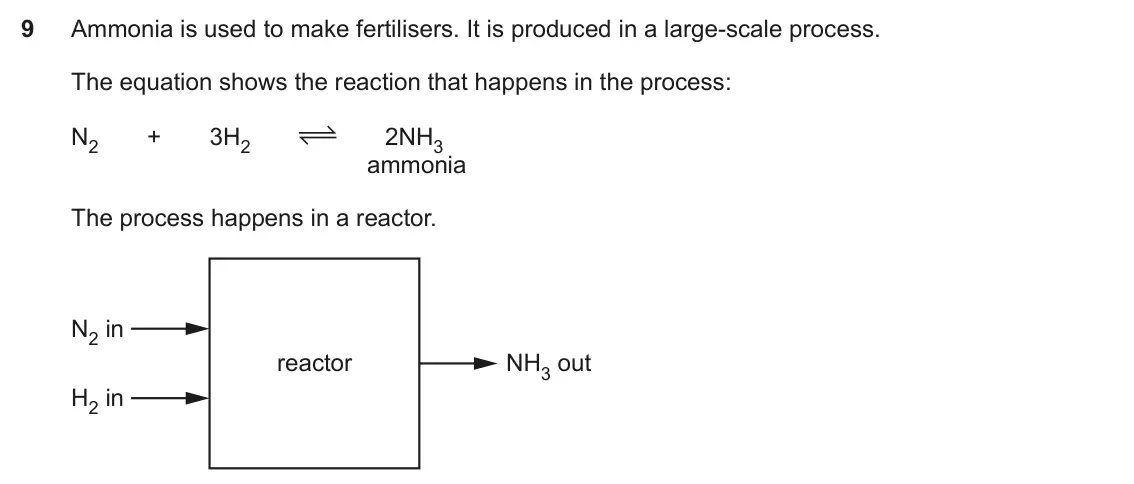
All 45 questions on What factors affect the yield of chemical reactions?, as a list
- June 2025, Paper 2 Foundation, Q6(a) (2 marks): Which two statements explain why this reaction does not give a 100% yield? Tick (✓) two boxes. At the end of the reaction there will be some unreacted methane.
- June 2025, Paper 4 Higher, Q6(e)(i) (2 marks): Explain how Equation 2 shows that the percentage yield of methanol is not 100%. [2]
- June 2024, Paper 1 Foundation, Q5(a)(i) (1 mark): How does the equation show that the reaction is reversible? [1]
- June 2024, Paper 1 Foundation, Q5(a)(ii) (1 mark): The reaction reaches a dynamic equilibrium. Complete the sentence about a dynamic equilibrium. Put a ring around the correct option. In a dynamic equilibrium, t
- June 2024, Paper 3 Higher, Q10(b) (2 marks): The actual yield of silver in an experiment is 215 g. Some black silver oxide powder remains visible after the experiment. Suggest two ways the experiment could
- June 2023, Paper 1 Foundation, Q8(a) (2 marks): Complete the balanced symbol equation for this reaction. [2]
- June 2023, Paper 1 Foundation, Q8(b) (2 marks): The symbol indicates that the reaction is reversible and can reach equilibrium. Which two statements are correct when the reaction reaches equilibrium? Tick (3)
- June 2023, Paper 1 Foundation, Q8(c)(i) (1 mark): Describe the general trend of the graph. [1]
- June 2023, Paper 1 Foundation, Q8(c)(ii) (1 mark): Use the graph to estimate the percentage of SO2 converted to SO3 at 400 °C. Percentage of SO2 converted to SO3 = % [1]
- June 2023, Paper 1 Foundation, Q8(c)(iii) (2 marks): Use the graph to estimate the percentage of SO2 remaining at 800 °C. Percentage of SO2 remaining = % [2]
- June 2023, Paper 1 Foundation, Q8(c)(iv) (3 marks): Calculate the percentage of SO2 converted to SO3 when 20 g of SO3 is made from 32 g of SO2. Use the equation: mass of SO2 × percentage of SO2 converted to SO3 =
- June 2023, Paper 1 Foundation, Q10(e)(ii) (3 marks): They use 20.0 g of calcium carbonate and get 7.8 g of pure calcium formate. Chemists calculate that 10.0 g of calcium carbonate should make 13.0 g of calcium fo
- June 2023, Paper 3 Higher, Q2(e)(ii) (3 marks): They use 20.0 g of calcium carbonate and get 7.8 g of pure calcium formate. Chemists calculate that 10.0 g of calcium carbonate should make 13.0 g of calcium fo
- June 2023, Paper 3 Higher, Q9(a) (2 marks): An industrial company reacts 2 moles of SO2 with oxygen and makes 1.99 moles of SO3. Calculate the percentage yield of SO3. actual yield Use the formula: percen
- June 2023, Paper 3 Higher, Q9(b) (2 marks): Explain why a high pressure is needed to get the best yield of SO3. Use the symbol equation. [2]
- June 2023, Paper 3 Higher, Q9(d) (2 marks): The graph shows the percentage of SO2 converted to SO3, at different temperatures. 100 80 60 Percentage of SO2 converted to SO3 40 20 0 200 400 600 800 1000 Tem
- June 2023, Paper 4 Higher, Q8(b) (1 mark): Why does this reaction not give a 100% yield? [1]
- June 2023, Paper 4 Higher, Q8(d) (6 marks): Ammonia is made on an industrial scale in a reaction between nitrogen and hydrogen. The equation to make ammonia is shown. N2(g) + 3H2(g) 2NH3(g) (d)* The graph
- June 2022, Paper 1 Foundation, Q7(e) (3 marks): Jack makes 6.6 g of zinc sulfate. He calculates that he should have made 9.8 g. Calculate the percentage yield. Give your answer to 2 significant figures. actua
- June 2022, Paper 2 Foundation, Q9(a)(i) (1 mark): Use the equation to explain why it is not possible to get 100% yield of ammonia. [1]
- June 2022, Paper 2 Foundation, Q9(a)(ii) (1 mark): The gas that leaves the reactor contains ammonia mixed with two other gases. Use the equation to help you to give the names of the other two gases. and [1]
- June 2022, Paper 4 Higher, Q2(a)(i) (1 mark): Use the equation to explain why it is not possible to get 100% yield of ammonia. [1]
- June 2022, Paper 4 Higher, Q2(a)(ii) (1 mark): The gas that leaves the reactor contains ammonia mixed with two other gases. Use the equation to help you to give the names of the other two gases. and [1]
- June 2022, Paper 4 Higher, Q2(b) (2 marks): An ammonia factory tests a new reactor. The table shows the theoretical yield and actual yield for a process in the new reactor. Theoretical yield (tonnes) 150
- November 2021, Paper 1 Foundation, Q6(a)(i) (1 mark): Put a ring around the result that does not fit the pattern in Fig. 6.1. [1]
- November 2021, Paper 1 Foundation, Q6(a)(ii) (1 mark): Kai thinks he made a mistake when he was heating the ‘blue copper sulfate’ for this result. Suggest the mistake Kai made. [1]
- November 2021, Paper 1 Foundation, Q6(e)(i) (1 mark): Does her observation show that the reaction is reversible? Yes No Explain your answer. [1]
- November 2020, Paper 1 Foundation, Q9(c) (2 marks): Sundip makes 9.9 g of ammonium sulfate. The maximum mass of ammonium sulfate she could have made is 13.2 g. Calculate the percentage yield. mass made Use the fo
- November 2020, Paper 2 Foundation, Q6(b)(ii) (3 marks): Eve works out her percentage yield, using the equation: mass of magnesium oxide formed percentage yield = theoretical yield of magnesium oxide × 100 % Calculate
- November 2020, Paper 3 Higher, Q9(a) (1 mark): The reaction in the Haber process reaches equilibrium. Describe the rates of the forward and reverse reactions at equilibrium. [1]
- November 2020, Paper 3 Higher, Q9(b)(i) (1 mark): State the lowest temperature and pressure necessary to get a yield of ammonia of 15%. Temperature = °C Pressure = MPa [1]
- June 2019, Paper 1 Foundation, Q10(a) (2 marks): The sign shows that the reaction is ‘in equilibrium’. Which two statements are correct at equilibrium? Tick (3) two boxes. The reaction N2(g) + O2(g) 2NO(g) has
- June 2019, Paper 1 Foundation, Q10(c) (2 marks): In theory, 28 g of nitrogen makes a maximum of 60 g of NO. However, in a reaction, 28 g of nitrogen makes 9.0 g of NO. Calculate the percentage yield of the rea
- June 2019, Paper 2 Foundation, Q3(c)(iv) (2 marks): Jane does the experiment. She measures the mass of copper she makes (her actual yield). The mass of copper she makes is higher than she predicts. She knows that
- June 2019, Paper 2 Foundation, Q3(d) (2 marks): Nina and Kai also follow the flowchart in Fig. 3.1 to make some copper. They compare the mass of copper they make at the end (their actual yield) with each othe
- June 2019, Paper 3 Higher, Q10(a) (2 marks): The sign shows that the reaction is ‘in equilibrium’. Which two statements are correct for this reaction at equilibrium? Tick (3) two boxes. The reaction N2(g)
- June 2019, Paper 4 Higher, Q5(c)(ii) (2 marks): When Jane follows her method, she only makes 2.4 g of copper. Calculate Jane’s percentage yield. Percentage yield = % [2]
- June 2019, Paper 4 Higher, Q5(c)(iii) (2 marks): Jane comments on her method. Jane I followed the flowchart (Fig 5.1), but I think some of my method could be improved to make sure I get the highest possible pe
- June 2018, Paper 1 Foundation, Q13(c)(ii) (1 mark): In Ali’s experiment, the mass of carbon dioxide lost is 1.8 g. Calculate the percentage yield of carbon dioxide in Ali’s experiment. Percentage yield = % [1]
- June 2018, Paper 3 Higher, Q2(c)(ii) (1 mark): In Ali’s experiment, the mass of carbon dioxide lost is 1.8 g. Calculate the percentage yield of carbon dioxide in Ali’s experiment. Percentage yield = % [1]
- June 2018, Paper 3 Higher, Q7(a)(i) (1 mark): Explain how you can tell that this equation refers to an equilibrium. [1]
- June 2018, Paper 3 Higher, Q7(a)(ii) (2 marks): Use ideas about rates to explain what is happening when the reaction reaches dynamic equilibrium. [2]
- June 2018, Paper 3 Higher, Q7(b)(ii) (2 marks): The scientists discuss increasing the pressure on the reaction. Describe and explain the effect on the equilibrium position. [2]
- June 2018, Paper 4 Higher, Q8(c)(i) (1 mark): How will this problem affect his actual yield? [1]
- June 2018, Paper 4 Higher, Q8(c)(ii) (1 mark): How could Alex change his experiment to solve this problem? [1]
Questions, mark schemes and examiner’s reports are © OCR, from their published past papers. Plumi isn’t affiliated with any exam board. Want whole papers? Every OCR GCSE Chemistry B paper.
Rather write your answers by hand on iPad? Plumi marks them against the same mark schemes.