 plumi
How do chemists find the composition of unknown samples?: OCR GCSE Chemistry B questions
Every OCR GCSE Chemistry B exam question on C5.2 How do chemists find the composition of unknown samples?, 2018–2025, with its mark scheme and examiner’s report.
Paper
All papers
Exam
All years
Calculations
Q6(b)(i)
The whole paper ↗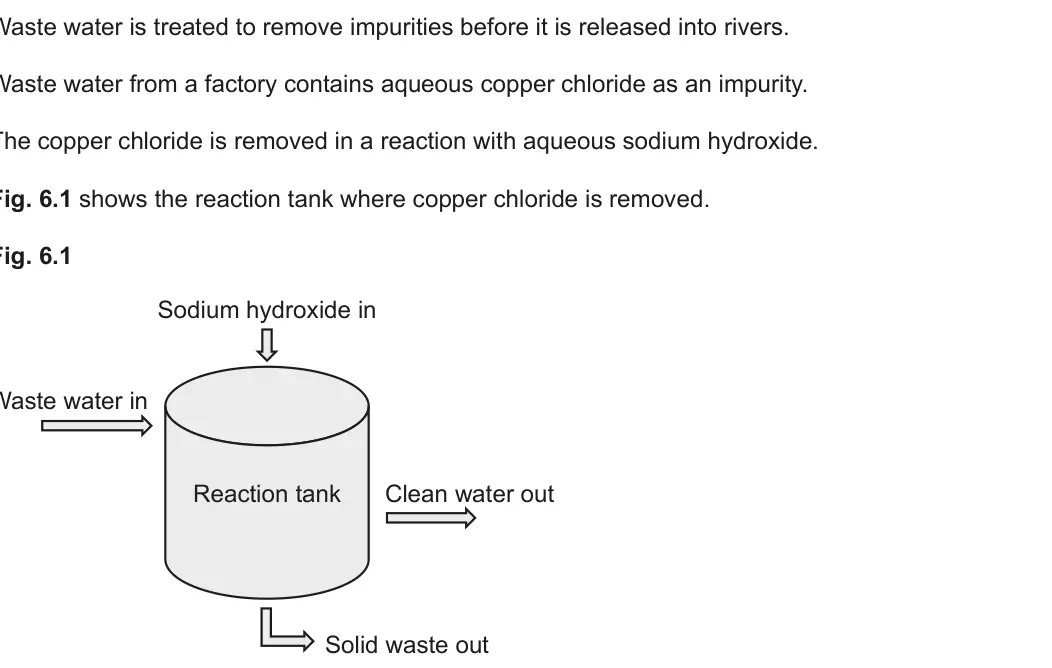
Q6(b)(ii)
The whole paper ↗Q1(a)(v)
The whole paper ↗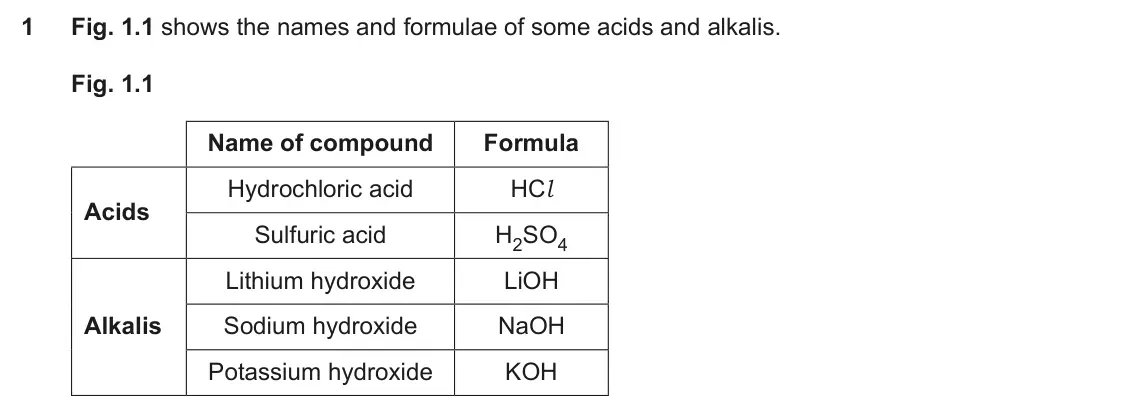
Q2(b)
The whole paper ↗
Q9(a)(i)
The whole paper ↗
Q9(a)(ii)
The whole paper ↗Q9(a)(iii)
The whole paper ↗Q9(b)
The whole paper ↗Q9(c)(i)
The whole paper ↗Q9(c)(ii)
The whole paper ↗Q3(a)(ii)
The whole paper ↗
Q6(a)
The whole paper ↗Q6(b)(i)
The whole paper ↗Q6(b)(ii)
The whole paper ↗Q4(a)
The whole paper ↗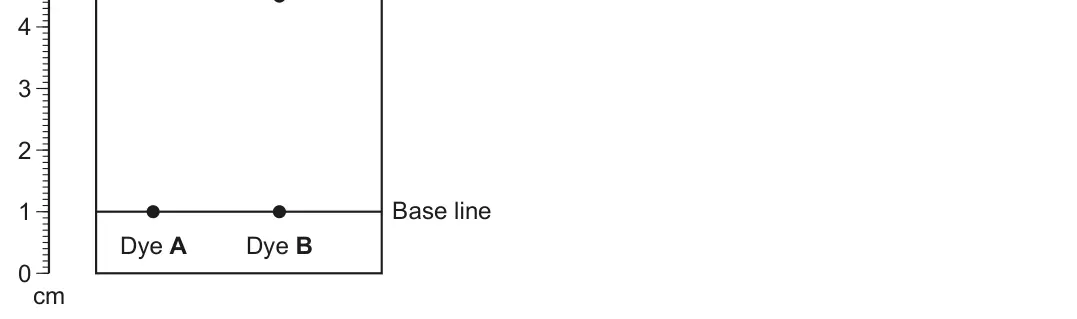
Q4(b)
The whole paper ↗Q4(c)
The whole paper ↗Q2(c)
The whole paper ↗
Q2(d)
The whole paper ↗Q2(e)
The whole paper ↗
All 72 questions on How do chemists find the composition of unknown samples?, as a list
- June 2025, Paper 1 Foundation, Q6(b)(i) (2 marks): Complete the method for the tests. 1. Place four test tubes in a test tube holder. 2. 3. 4. Record results. [2]
- June 2025, Paper 1 Foundation, Q6(b)(ii) (1 mark): Which water sample, A, B, C or D contains copper ions? [1]
- June 2025, Paper 2 Foundation, Q1(a)(v) (1 mark): Which compound gives a white precipitate when a few drops are added to dilute barium nitrate? [1]
- June 2025, Paper 2 Foundation, Q2(b) (2 marks): Water for drinking is treated with chlorine. What is the test and expected result for chlorine gas? Tick (✓) one box in each column. Test Expected result Aqueou
- June 2025, Paper 3 Higher, Q9(a)(i) (3 marks): Describe the method for using a flame test to identify metal ions. [3]
- June 2025, Paper 3 Higher, Q9(a)(ii) (1 mark): The student says: “Sample D contains sodium metal ions.” They are not correct. Explain why. [1]
- June 2025, Paper 3 Higher, Q9(a)(iii) (1 mark): Name the metal ion in Sample D. [1]
- June 2025, Paper 3 Higher, Q9(b) (1 mark): In qualitative analysis, chemists make sure that a sample is representative. Describe the purpose of representative sampling in qualitative analysis. [1]
- June 2025, Paper 3 Higher, Q9(c)(i) (3 marks): What conclusions can be made about the ions in the unknown sample? Explain your reasoning. Use Fig. 9.1. [3]
- June 2025, Paper 3 Higher, Q9(c)(ii) (2 marks): State two advantages of instrumental methods of analysis rather than flame tests to identify the ions in unknown samples. 1 2 [2]
- June 2025, Paper 4 Higher, Q3(a)(ii) (3 marks): Sea water contains dissolved sodium chloride. A student adds dilute acidified silver nitrate to the sea water before distillation and to the water collected aft
- June 2024, Paper 2 Foundation, Q6(a) (6 marks): (a)* A student has samples of two solid compounds. They think that one compound contains copper and that the other compound contains calcium. They decide to do
- June 2024, Paper 2 Foundation, Q6(b)(i) (2 marks): Which statements about the unknown mixture are true and which are false? Tick (3) one box in each row. True False The unknown mixture contains both lithium ions
- June 2024, Paper 2 Foundation, Q6(b)(ii) (1 mark): Which statement about using tests to identify ions is true? Tick (3) one box. Emission spectroscopy relies on human judgement of colours. Emission spectroscopy
- June 2024, Paper 3 Higher, Q4(a) (3 marks): What conclusions can the student make about the ions present in each solution? Solution A Solution B Solution C [3]
- June 2024, Paper 3 Higher, Q4(b) (3 marks): Complete the word equation and ionic equation for the reaction between solutions of silver ions and bromide ions. You need to: • add the name and the formula fo
- June 2024, Paper 3 Higher, Q4(c) (1 mark): Before the tests, silver nitrate solution is acidified by adding a dilute acid. Explain why dilute hydrochloric acid is not a suitable acid to use to acidify th
- June 2023, Paper 1 Foundation, Q2(c) (1 mark): Alex tests for calcium ions by adding sodium hydroxide solution to the more concentrated mineral water. Complete the word equation for the reaction. CaCl 2(aq)
- June 2023, Paper 1 Foundation, Q2(d) (2 marks): Alex tests the more concentrated mineral water for chloride ions. A white precipitate is seen. Complete the word equation for the test. calcium chloride + nitra
- June 2023, Paper 1 Foundation, Q2(e) (3 marks): An industrial laboratory tests for calcium using emission spectroscopy. Describe the advantages of emission spectroscopy compared with a flame test. [3]
- June 2023, Paper 2 Foundation, Q10(a)(i) (1 mark): Describe how Ali should choose sweets to test to make sure that his sample is representative. [1]
- June 2023, Paper 2 Foundation, Q10(a)(ii) (1 mark): Explain why it is important that the sample Ali tests is representative. [1]
- June 2023, Paper 3 Higher, Q5(a)(ii) (2 marks): Alex adds sodium hydroxide solution to some of the concentrated mineral water. The calcium ions form a white precipitate. Complete the balanced symbol equation
- June 2023, Paper 3 Higher, Q5(b) (1 mark): Alex tests the concentrated mineral water for calcium by doing a flame test. Suggest why the flame they see is yellow and not red. [1]
- June 2023, Paper 3 Higher, Q5(c)(i) (1 mark): What instrumental method of analysis is the laboratory using? [1]
- June 2023, Paper 3 Higher, Q5(c)(ii) (2 marks): Give two conclusions that you can make about the presence of minerals in this mineral water. 1 2 [2]
- June 2023, Paper 4 Higher, Q2(a)(i) (1 mark): Describe how Ali should choose sweets to test to make sure that his sample is representative. [1]
- June 2023, Paper 4 Higher, Q2(a)(ii) (1 mark): Explain why it is important that the sample Ali tests is representative. [1]
- June 2022, Paper 1 Foundation, Q10(b) (2 marks): Table 10.2 shows two tests Jamal does on the copper sulfate solution: Test Result Add sodium hydroxide solution Add acidified barium chloride solution Table 10.
- June 2022, Paper 2 Foundation, Q3(a) (2 marks): Before she sets up the cell, Beth tests each gas to check its identity. Draw lines to connect each gas to its correct test and result. Gas Test Result lime wate
- June 2022, Paper 3 Higher, Q12(b)(i) (1 mark): In test 1 she adds sodium hydroxide solution to the solution of copper sulfate. She sees a blue precipitate of copper hydroxide. Write a word equation for the f
- June 2022, Paper 3 Higher, Q12(b)(ii) (2 marks): In test 2 she adds acidified barium chloride solution to the solution of copper sulfate. She sees a white precipitate of barium sulfate. Write an ionic equation
- November 2021, Paper 2 Foundation, Q4(a) (2 marks): Jane wants to make sure that the tablets she tests are representative of all the tablets in each brand. What should Jane do to make sure her choice of tablets i
- November 2021, Paper 4 Higher, Q1(d)(ii) (1 mark): Kai makes his lithium model red to match the flame test colour of lithium. What colour should he make his sodium model? [1]
- November 2021, Paper 4 Higher, Q3(a)(i) (1 mark): Why is it important to make sure that the samples are representative? [1]
- November 2021, Paper 4 Higher, Q3(a)(ii) (2 marks): What should Jane do to make sure her choice of tablets is representative? Tick (✓) two boxes. Choose tablets at random from each box. Choose tablets from more t
- November 2021, Paper 4 Higher, Q4(c) (3 marks): Layla tests some of the salts formed in the reactions. She collects samples of solid sodium chloride and solid sodium bromide. She uses silver nitrate solution
- November 2020, Paper 1 Foundation, Q6(b) (1 mark): Mia collects the rust. She dissolves the rust in hydrochloric acid and adds some sodium hydroxide solution. She sees a brown precipitate. What is the name of th
- November 2020, Paper 1 Foundation, Q7(a)(i) (1 mark): Amir finds that Salt A contains positive potassium ions. Which colour flame does Amir see when he does a flame test? Put a ring around the correct answer. green
- November 2020, Paper 1 Foundation, Q7(c)(i) (1 mark): Describe the colour and state of the barium sulfate formed. [1]
- November 2020, Paper 1 Foundation, Q7(d)(i) (1 mark): Using Fig. 7.1, name the metal ion in Salt B. [1]
- November 2020, Paper 1 Foundation, Q7(d)(ii) (1 mark): Convert 400 nm to metres. Give your answer in standard form. 1 nm = 1 × 10⁻⁹ m 400 nm = m [1]
- November 2020, Paper 1 Foundation, Q7(e) (2 marks): Elements can be identified using flame tests or by comparing emission spectra. Amir uses the internet to compare each method: Flame test Emission spectra Equipm
- November 2020, Paper 2 Foundation, Q10(a)(ii) (2 marks): Sundip uses tests to identify the gases formed in her experiments. Draw lines to connect each gas to its correct test and result. Gas Test and result relights a
- November 2020, Paper 3 Higher, Q5(a)(i) (3 marks): Describe how Amir does the flame test. [3]
- November 2020, Paper 3 Higher, Q5(a)(ii) (1 mark): What colour does Amir see when he carries out the flame test on potassium sulfate? [1]
- November 2020, Paper 3 Higher, Q5(b) (3 marks): Write a balanced symbol equation for the reaction of potassium sulfate (K2SO4) solution with barium chloride (BaCl2) solution. Show state symbols. [3]
- November 2020, Paper 3 Higher, Q5(c)(i) (1 mark): What can Amir conclude about Fertiliser E from these emission spectra? [1]
- November 2020, Paper 3 Higher, Q5(c)(ii) (1 mark): Compounds can be analysed using a flame test or an emission spectrum. State one advantage of using an emission spectrum to analyse compounds. [1]
- November 2020, Paper 3 Higher, Q6(c) (1 mark): Jane collects the rust. She dissolves the rust in hydrochloric acid and adds some sodium hydroxide solution. She sees a brown precipitate. What is the name of t
- June 2019, Paper 2 Foundation, Q10(a) (3 marks): He carries out flame tests on each sample and compares his results (Table 10.1) to a reference book of flame colours for some metal ions (Table 10.2). Alex’s re
- June 2019, Paper 2 Foundation, Q10(b)(i) (1 mark): Alex thinks that mineral A contains two negative ions. How can you tell from the results that Alex is right? [1]
- June 2019, Paper 2 Foundation, Q10(b)(ii) (3 marks): Identify the ions in mineral A and mineral B. Choose words from this list. copper calcium iron zinc carbonate chloride sulfate Ions in mineral A Ions in mineral
- June 2019, Paper 2 Foundation, Q10(c) (1 mark): Alex also has an emission spectroscopy machine to analyse samples of minerals. Give one advantage of using an emission spectroscopy machine, rather than flame t
- June 2019, Paper 4 Higher, Q1(a) (3 marks): He carries out flame tests on each sample and compares his results (Table 1.1) to a reference book of flame colours for some metal ions (Table 1.2). Alex’s resu
- June 2019, Paper 4 Higher, Q1(b)(i) (1 mark): Alex thinks that mineral A contains two negative ions. How can you tell from the results that Alex is right? [1]
- June 2019, Paper 4 Higher, Q1(b)(ii) (3 marks): Identify the ions in mineral A and mineral B. Choose words from this list. copper calcium iron zinc carbonate chloride sulfate Ions in mineral A Ions in mineral
- June 2019, Paper 4 Higher, Q1(c) (1 mark): Alex also has an emission spectroscopy machine to analyse samples of minerals. Give one advantage of using an emission spectroscopy machine, rather than flame t
- June 2018, Paper 1 Foundation, Q3(c)(i) (3 marks): Alex uses barium chloride solution to show that the solution contains sulfate ions. Describe what Alex sees and name the substance formed. Alex sees Name of sub
- June 2018, Paper 2 Foundation, Q3(b)(ii) (3 marks): Complete Table 3.2 below to show the tests and results used to identify oxygen and chlorine gas. Gas Test Result oxygen chlorine damp blue litmus paper Table 3.
- June 2018, Paper 2 Foundation, Q8(a) (6 marks): Salt that is used for food contains compounds of Group 1 elements. One type of food salt is called ‘Healthy salt’. Ben wants to find out what the difference is
- June 2018, Paper 2 Foundation, Q8(b) (3 marks): Elements in salts can also be identified using chemical tests. Each test involves adding chemicals to the salts and looking for colour changes or reactions. Ben
- June 2018, Paper 2 Foundation, Q8(c) (2 marks): Ben says that spectroscopy is a qualitative technique. He says that he wants to try a quantitative technique to find out more about the salts. Draw lines to con
- June 2018, Paper 2 Foundation, Q10(a) (3 marks): Kai has three unlabelled samples of different compounds. All are colourless liquids. Kai thinks that one of the compounds might be an alkene. He thinks that ano
- June 2018, Paper 3 Higher, Q9(a) (1 mark): Jane carries out a flame test on compound A and sees a lilac flame. What can Jane conclude about compound A? [1]
- June 2018, Paper 3 Higher, Q9(b)(i) (2 marks): Describe what an emission spectrum looks like. [2]
- June 2018, Paper 3 Higher, Q9(b)(ii) (1 mark): Describe how Jane could use the spectrum to confirm her answer to (a). [1]
- June 2018, Paper 3 Higher, Q9(c)(i) (1 mark): What does she see when she does this? [1]
- June 2018, Paper 3 Higher, Q9(c)(ii) (2 marks): Write a balanced chemical equation for the reaction that occurs. [2]
- June 2018, Paper 4 Higher, Q1(a) (3 marks): Kai has three unlabelled samples of different compounds. All are colourless liquids. Kai thinks that one of the compounds might be an alkene. He thinks that ano
- June 2018, Paper 4 Higher, Q7(a) (6 marks): A new type of salt for using on food is called ‘Lo-So salt’. Nina wants to find out what elements ‘Lo-So salt’ contains. She does some experiments to find the e
- June 2018, Paper 4 Higher, Q7(b) (2 marks): The label for ‘Lo-So salt’ claims that it is ‘low in sodium’. Nina says that she cannot use spectroscopy to check this claim because spectroscopy is a qualitati
Questions, mark schemes and examiner’s reports are © OCR, from their published past papers. Plumi isn’t affiliated with any exam board. Want whole papers? Every OCR GCSE Chemistry B paper.
Rather write your answers by hand on iPad? Plumi marks them against the same mark schemes.