 plumi
How are the amounts of substances in reactions calculated?: OCR GCSE Chemistry B questions
Every OCR GCSE Chemistry B exam question on C5.3 How are the amounts of substances in reactions calculated?, 2018–2025, with its mark scheme and examiner’s report.
Paper
All papers
Exam
All years
Calculations
Q1(a)(iii)
The whole paper ↗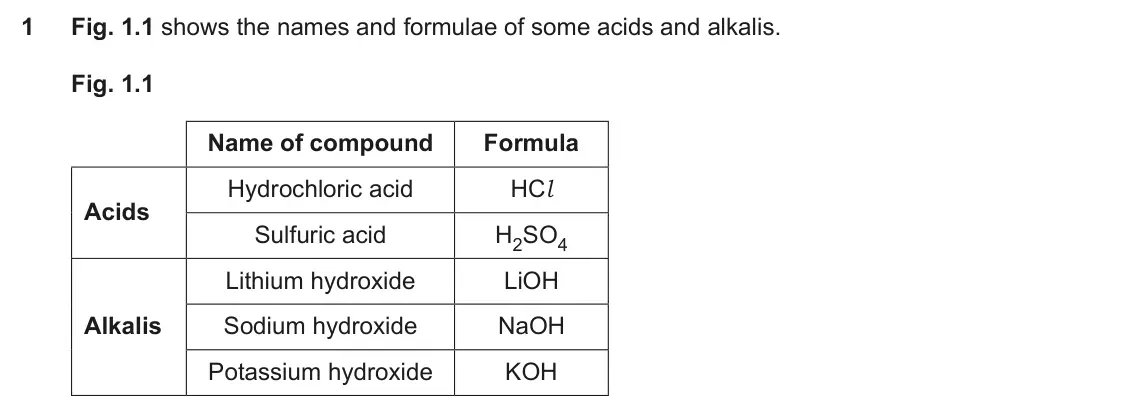
Q6(b)(i)
The whole paper ↗
Q6(b)(iii)
The whole paper ↗Q8(a)(i)
The whole paper ↗
Q8(a)(ii)
The whole paper ↗Q8(b)(i)
The whole paper ↗Q8(b)(ii)
The whole paper ↗Q6(c)(i)
The whole paper ↗
Q9(a)
The whole paper ↗
Q8(c)
The whole paper ↗
Q10(c)
The whole paper ↗
Q7(b)(ii)
The whole paper ↗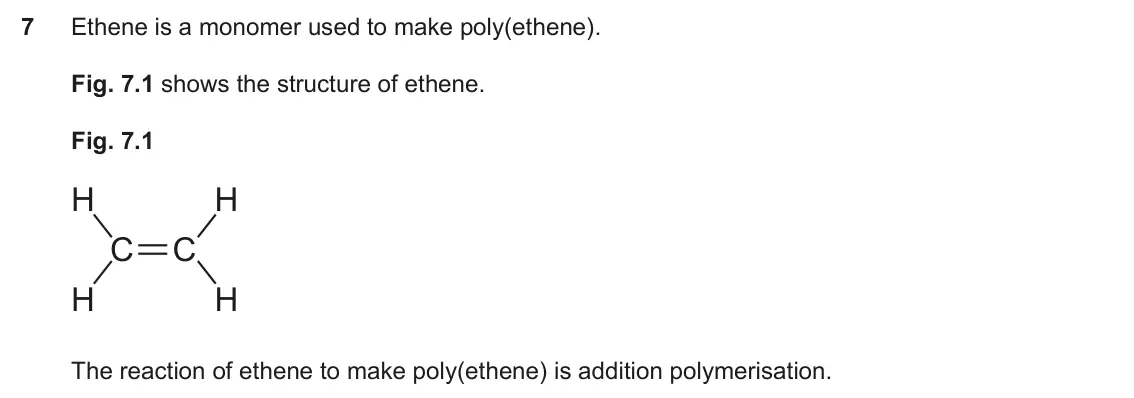
Q6(a)(ii)
The whole paper ↗
Q6(b)(i)
The whole paper ↗Q6(b)(ii)
The whole paper ↗Q7(c)
The whole paper ↗
Q10(a)
The whole paper ↗
Q5(b)(ii)
The whole paper ↗
Q10(a)
The whole paper ↗
Q10(b)
The whole paper ↗
All 102 questions on How are the amounts of substances in reactions calculated?, as a list
- June 2025, Paper 2 Foundation, Q1(a)(iii) (1 mark): Which alkali has the highest relative formula mass? Use the Periodic Table to help you. [1]
- June 2025, Paper 2 Foundation, Q6(b)(i) (2 marks): Explain why the total mass of hydrogen in the equation is given by 4 × 2 = 8. [2]
- June 2025, Paper 2 Foundation, Q6(b)(iii) (2 marks): Calculate the relative formula mass of carbon dioxide, CO2. Use the Periodic Table. Relative formula mass = [2]
- June 2025, Paper 3 Higher, Q8(a)(i) (4 marks): The student uses 40.0 g of dilute hydrochloric acid. The empty conical flask weighs 150.0 g. Calculate the number of moles of sodium bicarbonate the student add
- June 2025, Paper 3 Higher, Q8(a)(ii) (3 marks): The student also measures the mass of the flask and contents at the end of the reaction. The table shows their results. Mass of flask and contents at start of r
- June 2025, Paper 3 Higher, Q8(b)(i) (2 marks): Predict the mass of the flask and contents at the end of the reaction. Explain your reasoning. Mass = g Explanation [2]
- June 2025, Paper 3 Higher, Q8(b)(ii) (2 marks): Complete the sentences to describe the reactants at the end of a reaction. A reaction ends when one of the reactants is used up. The reactant that is used up is
- June 2025, Paper 4 Higher, Q6(c)(i) (1 mark): Complete Table 6.1 by calculating the relative formula mass for carbon dioxide. Use the Periodic Table. [1]
- June 2025, Paper 4 Higher, Q9(a) (2 marks): Table 9.1 shows the relative formula masses for the compounds in the equation. Table 9.1 Compound Relative formula mass NaOH 40 HNO3 63 NaNO3 85 H2O 18 Explain
- June 2024, Paper 1 Foundation, Q8(c) (3 marks): The equation shows the reaction between iron and chlorine to form iron chloride. 2Fe(s) + 3Cl 2(g) 2FeCl 3(s) A scientist reacts 2.0 g of iron with excess chlor
- June 2024, Paper 1 Foundation, Q10(c) (4 marks): An example of a synthetic fertiliser is ammonium nitrate, NH4NO3. Ammonium nitrate is produced when ammonium hydroxide, NH4OH, reacts with nitric acid, HNO3. NH
- June 2024, Paper 2 Foundation, Q7(b)(ii) (2 marks): Another poly(ethene) molecule forms when 10 000 ethene monomers join together. Calculate the relative formula mass of this poly(ethene) molecule. Use the Period
- June 2024, Paper 3 Higher, Q6(a)(ii) (2 marks): The mass decreases during the reaction. Explain why. [2]
- June 2024, Paper 3 Higher, Q6(b)(i) (3 marks): Relative atomic masses (Ar): H = 1.0 Cl = 35.5 Use the equation: number of moles = mass of substance relative formula mass Number of moles = [3]
- June 2024, Paper 3 Higher, Q6(b)(ii) (1 mark): There are 6.0 × 10²³ atoms in one mole of atoms. How many atoms are in 4 moles of HCl ? Put a ring around the correct option. 1.2 × 1024 2.4 × 1024 4.8 × 1024 8
- June 2024, Paper 3 Higher, Q7(c) (3 marks): In one experiment, 0.1 moles of oxygen is collected when hydrogen peroxide decomposes. Calculate the volume of 0.1 moles of oxygen at room temperature and press
- June 2024, Paper 3 Higher, Q10(a) (4 marks): Calculate the theoretical yield of silver made when 250 g of silver oxide completely decomposes. Relative atomic mass (Ar): O = 16 Ag = 108 Give your answer to
- June 2024, Paper 4 Higher, Q5(b)(ii) (2 marks): The ratio by number of moles of iron : carbon in this steel is approximately 175 : 1. Explain why the ratio by mass is different to the ratio by number of moles
- June 2024, Paper 4 Higher, Q10(a) (2 marks): The student concludes that the graph shows this relationship: number of moles of element ∝ number of moles of oxygen The student is correct. Explain why. [2]
- June 2024, Paper 4 Higher, Q10(b) (3 marks): Calculate the mass of oxygen gas that reacts with 1.5 moles of the element. Use: • data from the graph • the Periodic Table. Mass of oxygen gas = g [3]
- June 2024, Paper 4 Higher, Q10(c)(i) (1 mark): Which equation for the reaction is correct? Use information from the graph. Tick (3) one box. X + O2 XO2 2X + O2 2XO 4X + O2 2X2O 4X + 3O2 X2O3 [1]
- June 2024, Paper 4 Higher, Q10(c)(ii) (1 mark): Explain how you worked out your answer to (c)(i). [1]
- June 2023, Paper 1 Foundation, Q3(b) (3 marks): One type of iron ore contains an oxide of iron, Fe3O4. 232 g of Fe3O4 contain 168 g of iron. Calculate the percentage of iron, by mass, in Fe3O4. Give your answ
- June 2023, Paper 3 Higher, Q6(d)(i) (1 mark): The relative formula mass of Al 2O3 is 102. Show how this is calculated. Relative atomic mass (Ar): O = 16 Al = 27 [1]
- June 2023, Paper 3 Higher, Q6(d)(ii) (4 marks): Calculate the mass of aluminium, Al, that is made from 1.0 g of aluminium oxide, Al 2O3. Use the overall equation and the formula: mass of substance (g) number
- June 2022, Paper 1 Foundation, Q6(b) (2 marks): 160 g of iron oxide makes 112 g of iron. Calculate the mass of iron in 100 g of iron oxide. Mass of iron = g [2]
- June 2022, Paper 1 Foundation, Q11(b)(ii) (1 mark): Explain why the mass of the flask and its contents decreases during the reaction. [1]
- June 2022, Paper 2 Foundation, Q2(c)(i) (2 marks): Describe the pattern shown by the results in Table 2.1. [2]
- June 2022, Paper 2 Foundation, Q2(c)(ii) (2 marks): Jane wants to change her experiment to make more than 1.00 g of dry copper hydroxide. Jane and Alex talk about the results. Jane says, ‘To make more copper hydr
- June 2022, Paper 2 Foundation, Q3(c)(i) (2 marks): Complete Table 3.1 by predicting the missing amounts for experiments 3 and 4. [2]
- June 2022, Paper 3 Higher, Q1(b)(ii) (1 mark): Explain why the mass of the flask and its contents decreases during the reaction. [1]
- June 2022, Paper 3 Higher, Q5(b) (3 marks): 1.00 cm3 of iodine has a mass of 4.93 g. Calculate the volume of 1.00 mol of I2. mass of substance (g) Use the equation: number of moles = relative formula mass
- June 2022, Paper 3 Higher, Q5(e) (3 marks): Phosphorus reacts with iodine to form a compound. The compound contains 7.5% by mass of phosphorus. The rest of the compound is iodine. Determine the formula of
- June 2022, Paper 3 Higher, Q7(b) (3 marks): Calculate the percentage by mass of iron present in iron oxide, Fe2O3. Give your answer to 3 significant figures. Percentage of Fe = % [3]
- June 2022, Paper 4 Higher, Q5(c)(i) (3 marks): Look at the equation for Stage 1. Predict whether the mass of the solid increases, decreases or stays the same during Stage 1. Use the Periodic Table and calcul
- June 2022, Paper 4 Higher, Q5(c)(ii) (2 marks): During Stage 2, the total mass of the solids decreases. Explain why Stage 2 obeys the law of conservation of mass even though the total mass of the solids decre
- June 2022, Paper 4 Higher, Q7(c)(i) (3 marks): Plot Jane’s results on the graph. Draw lines of best fit to show the pattern in the results. [3] 1.00 0.80 0.60 Mass of dry copper hydroxide formed (g) 0.40 0.2
- June 2022, Paper 4 Higher, Q7(c)(ii) (1 mark): Suggest why the mass of the dry precipitate does not continue to increase when more than 20 cm3 of sodium hydroxide solution is added. [1]
- June 2022, Paper 4 Higher, Q7(c)(iii) (2 marks): Jane and Alex look at the table and the equation for the reaction: CuSO4 + 2NaOH Cu(OH)2 + Na2SO4 They disagree about the results. Jane says, ‘I think the conce
- November 2021, Paper 1 Foundation, Q6(b) (3 marks): Calculate the mass of ‘white copper sulfate’ that is made when 2.0 g of ‘blue copper sulfate’ is heated. Use the equation: mass of ‘white copper sulfate’ × 1.56
- November 2021, Paper 1 Foundation, Q6(c) (2 marks): Jane and Kai discuss the results: The test tube and its contents loses mass when it’s heated. I think the total mass Jane stays the same. Kai Explain why Jane a
- November 2021, Paper 1 Foundation, Q6(d) (1 mark): 100 g of ‘blue copper sulfate’ gives 64 g of ‘white copper sulfate’. ‘blue copper sulfate’ ‘white copper sulfate’ + water Calculate the mass of water that is fo
- November 2021, Paper 1 Foundation, Q7(c) (1 mark): Calculate the relative formula mass of methane. Use the Data Sheet. Relative formula mass = [1]
- November 2021, Paper 1 Foundation, Q9(c) (2 marks): 2.0 g of zinc makes a total of 800 cm3 of gas. Calculate the mass of zinc Alex used in his experiment. Use the total volume of gas produced in Fig. 9.2. Mass of
- November 2021, Paper 2 Foundation, Q4(c)(iv) (2 marks): Calculate the relative formula mass of calcium carbonate, CaCO3. Use the Data Sheet. Relative formula mass = [2]
- November 2021, Paper 3 Higher, Q2(c) (2 marks): 2.0 g of zinc makes a total of 800 cm3 of gas. Calculate the mass of zinc Alex used in his experiment. Use the total volume of gas produced in Fig. 2.2. Mass of
- November 2021, Paper 3 Higher, Q5(f)(iii) (3 marks): The formula of carbon monoxide is CO. One mole of carbon monoxide contains 6.02 × 10²³ molecules. Calculate the mass of one carbon monoxide molecule. Use the Da
- November 2021, Paper 3 Higher, Q9(a)(i) (1 mark): Result A does not fit the pattern. Sarah says the test tube was not heated for long enough. Is Sarah correct? Explain your answer. [1]
- November 2021, Paper 3 Higher, Q9(a)(ii) (3 marks): The equation for the line in Fig. 9.1 is given by y = mx + c. Calculate values for m and c, using Fig. 9.1. m = c = g [3]
- November 2021, Paper 3 Higher, Q9(b)(i) (3 marks): 25 g of ‘blue copper sulfate’ gives 16 g of ‘white copper sulfate’ when heated. Calculate the number of moles of water that are made. Use the equation: number o
- November 2021, Paper 3 Higher, Q9(b)(ii) (2 marks): ‘Blue copper sulfate’ has the formula CuSO4•nH2O, where n is a whole number. In one experiment, Sarah makes 2.0 mol of water and 0.4 mol of ‘white copper sulfat
- November 2021, Paper 4 Higher, Q3(c)(i) (3 marks): Calculate the mean mass of calcium carbonate in one FeelRight tablet. mean mass of Use the mean volume of relative formula calcium carbonate = × hydrochloric ac
- November 2021, Paper 4 Higher, Q3(c)(ii) (3 marks): Jane thinks her results are inaccurate because the tablets contain other ingredients. The labels show the other ingredient in each brand of tablet. EasyCalm Tab
- November 2020, Paper 1 Foundation, Q5(a)(ii) (2 marks): 14 g of lithium reacts with 71 g of chlorine. What mass of chlorine reacts with 5.6 g of lithium? Mass of chlorine = g [2]
- November 2020, Paper 1 Foundation, Q8(c) (1 mark): Calculate the relative formula mass of magnesium oxide (MgO). Use the Periodic Table. Relative formula mass = [1]
- November 2020, Paper 1 Foundation, Q8(d) (2 marks): Calculate the percentage of magnesium in magnesium oxide (MgO). Use relative formula mass of magnesium = 24. Percentage of magnesium = % [2]
- November 2020, Paper 2 Foundation, Q6(b)(i) (1 mark): Complete Table 6.1 by calculating the mass of magnesium oxide formed in Eve’s experiment. [1]
- November 2020, Paper 2 Foundation, Q6(c)(i) (4 marks): Plot a graph of magnesium oxide formed against mass of magnesium heated. Use the data in Table 6.2. You should include on your graph: • an appropriate scale for
- November 2020, Paper 2 Foundation, Q6(c)(ii) (2 marks): Eve thinks that she wrote down the results for one of her experiments before the reaction had fully finished. Suggest which reaction had not fully finished. Use
- November 2020, Paper 3 Higher, Q3(b) (1 mark): 1 mole of ethene contains 6.0 × 10²³ molecules. How many hydrogen atoms are there in one mole of ethene? Put a ring around the correct answer. 1 4 6 6.0 × 10²³
- November 2020, Paper 3 Higher, Q7(a)(i) (1 mark): What is the empirical formula of propene? [1]
- November 2020, Paper 3 Higher, Q9(b)(iii) (3 marks): A reactor starts with 12.0 tonnes of hydrogen and excess nitrogen. N2 + 3H2 2NH3 How many tonnes of ammonia would be produced from 6 × 10⁶ moles of hydrogen, H2
- November 2020, Paper 3 Higher, Q10(a) (3 marks): Lithium reacts with chlorine to form lithium chloride. 2Li + Cl 2 2LiCl What mass of chlorine reacts with 1 g of lithium? mass of substance (g) Use the equation
- November 2020, Paper 4 Higher, Q6(a) (1 mark): Eve weighs the crucible after heating. She heats it again and reweighs it. She does this until the mass does not change. Why does she do this? [1]
- November 2020, Paper 4 Higher, Q6(b) (1 mark): Eve writes a word equation for the reaction. magnesium + oxygen magnesium oxide Which reactant limits the amount of magnesium oxide that can be formed? Explain
- November 2020, Paper 4 Higher, Q6(c) (3 marks): Use Eve’s results in Table 6.1 to calculate the mass of magnesium and oxygen used and the mass of magnesium oxide formed in the experiment. Write your answers i
- November 2020, Paper 4 Higher, Q6(d) (3 marks): Eve thinks about her results. When I look at my results (Table 6.1), the law of conservation of mass does not seem to work for this experiment. Do you agree wit
- November 2020, Paper 4 Higher, Q6(e)(i) (2 marks): Complete Table 6.3 by calculating the missing values. [2]
- November 2020, Paper 4 Higher, Q6(e)(ii) (2 marks): Eve writes a balanced symbol equation for the reaction. 2Mg + O2 2MgO Explain how the results in Table 6.3 show that the balanced symbol equation is correct. Us
- June 2019, Paper 1 Foundation, Q2(c) (3 marks): 58 g of butane contain 48 g of carbon. What is the percentage of carbon in butane? Give your answer to 2 significant figures. Percentage of carbon = % [3]
- June 2019, Paper 1 Foundation, Q4(d)(i) (1 mark): Calculate the relative formula mass of H2O. Relative formula mass of H2O = [1]
- June 2019, Paper 1 Foundation, Q8(b)(iii) (1 mark): The law of conservation of mass says: ‘The mass at the start and end of a reaction must be the same.’ Explain why the law is true for the reaction between NaHCO
- June 2019, Paper 1 Foundation, Q11(c)(i) (2 marks): Calculate the mass of CO2 produced when 1.0 # 10−3 g of diamond is burned completely. Give your answer to 2 significant figures. Mass of CO2 = g [2]
- June 2019, Paper 1 Foundation, Q11(c)(ii) (2 marks): Jane makes some statements about graphite and diamond: 1 ‘Complete combustion of 12 g of graphite produces less than 44 g of CO2.’ 2 ‘This is because atoms in g
- June 2019, Paper 2 Foundation, Q2(c)(i) (2 marks): Calculate the relative formula mass of the poly(propene) monomer. Use the Periodic Table to help you. Relative formula mass = [2]
- June 2019, Paper 2 Foundation, Q2(c)(ii) (1 mark): The relative formula mass of an ethene monomer is 28. A poly(ethene) polymer has an average relative formula mass of 11200. How many ethene monomers have been j
- June 2019, Paper 2 Foundation, Q3(c)(i) (2 marks): Jane looks at Fig. 3.2 and thinks that the theoretical yield of copper is directly proportional to the mass of copper carbonate at the start. Use values from th
- June 2019, Paper 2 Foundation, Q3(c)(ii) (1 mark): Explain why the line on the graph in Fig. 3.2 starts at 0 on both axes. [1]
- June 2019, Paper 2 Foundation, Q3(c)(iii) (1 mark): Jane wants to make a theoretical yield of 15.0 g of copper. What starting mass of copper carbonate should she use? Use the graph in Fig. 3.2 to help you. Mass o
- June 2019, Paper 3 Higher, Q1(c)(i) (2 marks): Calculate the mass of CO2 produced when 1.0 × 10⁻³ g of diamond is burned completely. Give your answer to 2 significant figures. Mass of CO2 = g [2]
- June 2019, Paper 3 Higher, Q1(c)(ii) (2 marks): Jane makes some statements about graphite and diamond: 1 ‘Complete combustion of 12 g of graphite produces less than 44 g of CO2.’ 2 ‘This is because atoms in g
- June 2019, Paper 3 Higher, Q3(b) (3 marks): The molecular formula of butane is C4H10. Calculate the percentage of carbon by mass in butane. Give your answer to 2 significant figures. Percentage of carbon
- June 2019, Paper 3 Higher, Q6(c) (2 marks): Burning 10 g of hydrogen gives out 1200 kJ of energy. How much energy is given out when 1.0 mole of H2 burns? mass of substance Use the formula: number of moles
- June 2019, Paper 3 Higher, Q8(c)(i) (2 marks): Sundip uses 6.5 g of zinc and excess acid. All the zinc reacts. Calculate the volume of hydrogen is made at room temperature and pressure. volume of gas in samp
- June 2019, Paper 3 Higher, Q12(b)(i) (2 marks): Calculate the number of moles of CO2 given off. mass of substance Use the formula: number of moles = relative formula mass Give your answer to 2 significant fig
- June 2019, Paper 3 Higher, Q12(b)(ii) (2 marks): This is an equation for the reaction: NaHCO3(aq) + HCl (aq) CO2(g) + NaCl (aq) + H2O(l) Calculate the mass of NaHCO3 that reacts. mass of substance Use the form
- June 2019, Paper 4 Higher, Q5(c)(i) (3 marks): Jane uses the equation to work out what mass of copper carbonate she should use to make a theoretical yield of 5.0 g of copper. Calculate the starting mass of c
- June 2018, Paper 1 Foundation, Q3(d) (3 marks): 132 g of ammonium sulfate contain 28 g of nitrogen. Calculate the mass of nitrogen in 1.0 kg of ammonium sulfate. Give your answer in kg and to 2 decimal places
- June 2018, Paper 1 Foundation, Q11(d)(ii) (3 marks): 160 g of CeO2 contains 30 g of oxygen. Calculate the percentage of cerium in CeO2. Percentage of cerium = % [3]
- June 2018, Paper 1 Foundation, Q12(d) (3 marks): 0.10 g of calcium carbonate makes 24 cm3 of carbon dioxide. Jack uses 0.070 g of calcium carbonate. What volume of carbon dioxide does he make? Give your answer
- June 2018, Paper 1 Foundation, Q13(a) (2 marks): Ali weighs the test tube before and after heating. The mass of the test tube after heating is less. Ali says that this means the law of conservation of mass is
- June 2018, Paper 1 Foundation, Q13(c)(i) (1 mark): Calculate the mass of carbon dioxide lost when 4.2 g of MgCO3 completely decomposes. Mass = g [1]
- June 2018, Paper 2 Foundation, Q6(a)(i) (2 marks): He starts by working out the relative formula masses of the compounds in the equation. Complete Table 6.1 by working out the missing relative formula masses. Us
- June 2018, Paper 2 Foundation, Q6(a)(ii) (1 mark): Amir uses 8 g of copper oxide in his experiment. What is the theoretical yield of copper chloride from 7.95 g of copper oxide? Use Table 6.1 and the equation to
- June 2018, Paper 2 Foundation, Q6(b)(ii) (1 mark): Amir’s percentage yield for this experiment is very low. Suggest a reason why. [1]
- June 2018, Paper 3 Higher, Q1(d) (3 marks): 0.10 g of calcium carbonate makes 24 cm3 of carbon dioxide. Jack uses 0.070 g of calcium carbonate. What volume of carbon dioxide does he make? Give your answer
- June 2018, Paper 3 Higher, Q2(a) (2 marks): Ali weighs the test tube before and after heating. The mass of the test tube after heating is less. Ali says that this means the law of conservation of mass is
- June 2018, Paper 3 Higher, Q2(c)(i) (1 mark): Calculate the mass of carbon dioxide lost when 4.2 g of MgCO3 completely decomposes. Mass = g [1]
- June 2018, Paper 3 Higher, Q6(d) (3 marks): A nanoparticle has a volume of 8 × 10–27 m. A molecule has a volume of 4 × 10–30 m. Estimate how many moles of this molecule there are in the nanoparticle. Numb
- June 2018, Paper 3 Higher, Q11(c) (4 marks): This is an equation for the overall reaction in the electrolysis cell. 2Al2O3 4Al + 3O2 1.0 kg of aluminium is made in the cell. Calculate the volume of oxygen
- June 2018, Paper 4 Higher, Q8(a) (3 marks): In his first experiment, he uses 0.2 moles of magnesium oxide. He works out the mass of magnesium oxide in 0.2 moles. He uses this equation: number of moles = m
- June 2018, Paper 4 Higher, Q8(b) (4 marks): In another experiment, Alex reacts 4.0 g copper oxide with hydrochloric acid to make copper chloride. This is an equation for the reaction. copper oxide + hydro
Questions, mark schemes and examiner’s reports are © OCR, from their published past papers. Plumi isn’t affiliated with any exam board. Want whole papers? Every OCR GCSE Chemistry B paper.
Rather write your answers by hand on iPad? Plumi marks them against the same mark schemes.