 plumi
How can scientists help improve the supply of potable water?: OCR GCSE Chemistry B questions
Every OCR GCSE Chemistry B exam question on C1.4 How can scientists help improve the supply of potable water?, 2018–2025, with its mark scheme and examiner’s report.
Paper
All papers
Exam
All years
Calculations
Q6(a)(ii)
The whole paper ↗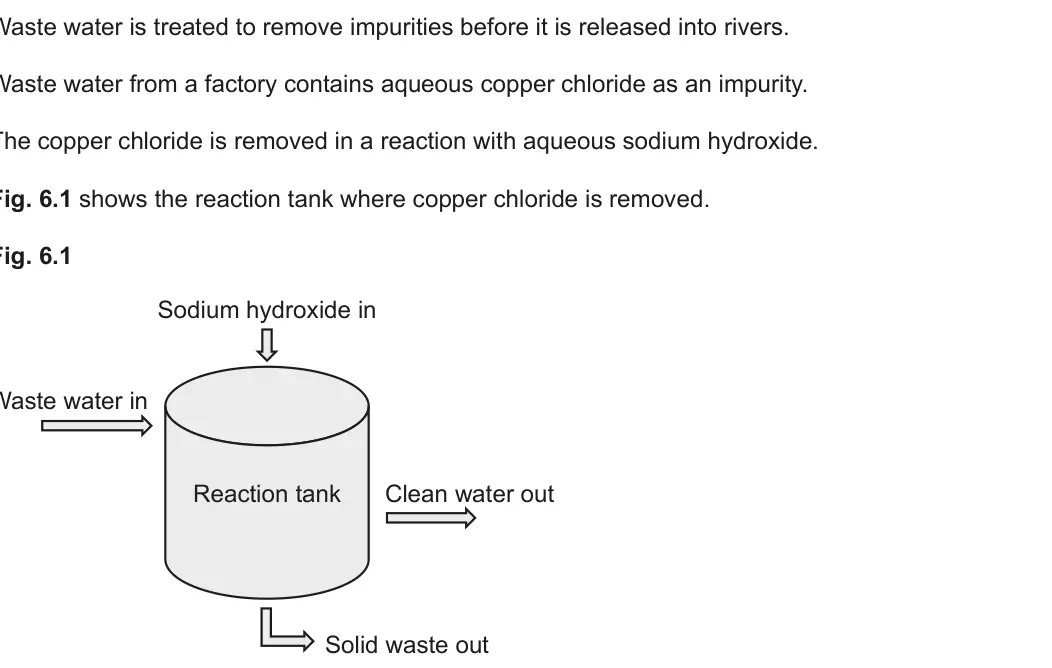
Q2(a)
The whole paper ↗
Q2(c)(i)
The whole paper ↗Q2(c)(ii)
The whole paper ↗Q2(d)
The whole paper ↗Q3(a)(i)
The whole paper ↗
Q3(a)(ii)
The whole paper ↗Q3(b)(i)
The whole paper ↗Q3(b)(ii)
The whole paper ↗Q3(c)
The whole paper ↗Q3(a)(i)
The whole paper ↗
Q3(a)(ii)
The whole paper ↗Q3(b)(i)
The whole paper ↗Q3(b)(ii)
The whole paper ↗Q3(c)
The whole paper ↗
Q1(a)
The whole paper ↗
Q1(b)
The whole paper ↗Q1(c)(i)
The whole paper ↗Q1(c)(ii)
The whole paper ↗Q1(c)(iii)
The whole paper ↗
All 38 questions on How can scientists help improve the supply of potable water?, as a list
- June 2025, Paper 1 Foundation, Q6(a)(ii) (1 mark): The copper hydroxide produced in the reaction is insoluble in water. Name the process used to remove the copper hydroxide from the water. [1]
- June 2025, Paper 2 Foundation, Q2(a) (2 marks): Draw lines to connect each water treatment process with its correct purpose. Water treatment process Purpose Aeration Separates pure water from salt water. Dist
- June 2025, Paper 2 Foundation, Q2(c)(i) (2 marks): Describe what the graph shows about the death rate from typhoid fever in the United States before and after chlorine was first added to drinking water. [2]
- June 2025, Paper 2 Foundation, Q2(c)(ii) (2 marks): A student looks at the graph and has this idea: ‘The graph shows that everyone in the world has had water that is safe to drink since about 1948.’ Suggest two r
- June 2025, Paper 2 Foundation, Q2(d) (2 marks): The effect of adding chlorine to drinking water was an important scientific discovery. Today, information about important scientific discoveries is published fo
- June 2025, Paper 4 Higher, Q3(a)(i) (2 marks): Complete the labels on the diagram. Use all of the words from the list. Heat Pure water Sea water Water in Water out [2]
- June 2025, Paper 4 Higher, Q3(a)(ii) (3 marks): Sea water contains dissolved sodium chloride. A student adds dilute acidified silver nitrate to the sea water before distillation and to the water collected aft
- June 2025, Paper 4 Higher, Q3(b)(i) (2 marks): Chlorine was not added to water in all areas of the United States at the same time. A student says that the time taken for all areas to have chlorine added to t
- June 2025, Paper 4 Higher, Q3(b)(ii) (3 marks): Some people think that chlorine should not be added to drinking water because it causes other health issues such as allergies in some people. Suggest why chlori
- June 2025, Paper 4 Higher, Q3(c) (3 marks): The effect of adding chlorine to drinking water was an important scientific discovery. Today, information about important scientific discoveries is published fo
- June 2024, Paper 1 Foundation, Q3(a)(i) (1 mark): In Process 1 large solid items such as leaves or plastic are removed from the groundwater. Name Process 1. [1]
- June 2024, Paper 1 Foundation, Q3(a)(ii) (3 marks): In Process 4, chlorine is used to kill microorganisms. Describe a test and the result to identify chlorine. Test Result [3]
- June 2024, Paper 1 Foundation, Q3(b)(i) (1 mark): Complete the labels on the diagram. [1]
- June 2024, Paper 1 Foundation, Q3(b)(ii) (2 marks): Describe how the student uses the apparatus to remove some impurities from the groundwater. [2]
- June 2024, Paper 2 Foundation, Q3(c) (1 mark): Another worker says that tap water is already pure because it has been treated to kill bacteria. Explain why tap water is not a pure substance. [1]
- June 2023, Paper 1 Foundation, Q1(a) (1 mark): What is the correct term for drinking water? Tick (3) one box. Ground water Potable water Sea water Waste water [1]
- June 2023, Paper 1 Foundation, Q1(b) (2 marks): One source of drinking water is salt water. Describe a process that separates water from salt water. [2]
- June 2023, Paper 1 Foundation, Q1(c)(i) (1 mark): Why is chlorine added? [1]
- June 2023, Paper 1 Foundation, Q1(c)(ii) (1 mark): Suggest one disadvantage of adding chlorine to drinking water. [1]
- June 2023, Paper 1 Foundation, Q1(c)(iii) (3 marks): Chlorine and other gases can be identified by simple tests. Draw lines to connect each gas with its correct test. It gives a ‘pop’ with a lighted splint. Chlori
- June 2022, Paper 4 Higher, Q8(a) (2 marks): Before she sets up the cell, Beth tests each gas to check its identity. Describe the tests and the results for hydrogen and oxygen gas. hydrogen test result oxy
- November 2021, Paper 1 Foundation, Q8(a) (1 mark): How does chlorine make water safe to drink? [1]
- November 2021, Paper 1 Foundation, Q8(b) (2 marks): James has a solution of chlorine in water. He tests the solution with blue litmus paper. State two colour changes that James will see. 1 2 [2]
- November 2021, Paper 3 Higher, Q1(a) (1 mark): How does chlorine make water safe to drink? [1]
- November 2020, Paper 2 Foundation, Q9(b)(i) (1 mark): If glass bottles are used instead of PET bottles, the bacteria are not killed. Suggest why bacteria in water in a glass bottle are not killed. [1]
- November 2020, Paper 2 Foundation, Q9(b)(ii) (1 mark): In the UK, bacteria in drinking water are killed by adding a substance to the water. Name this substance. [1]
- November 2020, Paper 4 Higher, Q1(b)(i) (1 mark): If glass bottles are used instead of PET bottles, the bacteria are not killed. Suggest why bacteria in water in a glass bottle are not killed. [1]
- November 2020, Paper 4 Higher, Q1(b)(ii) (1 mark): In the UK, bacteria in drinking water are killed by adding a substance to the water. Name this substance. [1]
- June 2019, Paper 1 Foundation, Q1(a) (1 mark): Choose the test for chlorine. Tick (3) one box. Makes a ‘pop’ with a lighted splint. Relights a glowing splint. Turns blue litmus red and then white. Turns lime
- June 2019, Paper 1 Foundation, Q1(b) (3 marks): Choose words from the list below to complete the sentences. You may use each word once, more than once, or not at all. animals diseases microorganisms smelly to
- June 2019, Paper 3 Higher, Q9(a) (2 marks): Chlorine is added to water to make it fit to drink. The test for chlorine gas relies on two properties of chlorine. Put a ring around the two correct answers. a
- June 2019, Paper 3 Higher, Q9(b)(i) (2 marks): Explain why chlorine is added to drinking water. [2]
- June 2019, Paper 3 Higher, Q9(b)(ii) (1 mark): Give one risk of adding chlorine to drinking water. [1]
- June 2018, Paper 2 Foundation, Q3(a) (2 marks): A distillation process is used to produce fresh water. Statements A–G describe some correct and some incorrect stages in the distillation process. A Cold water
- June 2018, Paper 2 Foundation, Q3(b)(i) (2 marks): Chlorine is used to treat drinking water before it is sent to homes. The waste water from homes is treated with oxygen. The table shows some information about o
- June 2018, Paper 4 Higher, Q3(a)(i) (3 marks): Which stage removes the salt from the seawater? Explain your answer. Stage Explanation [3]
- June 2018, Paper 4 Higher, Q3(a)(ii) (2 marks): Explain why there are no harmful bacteria in the water after stage 2. [2]
- June 2018, Paper 4 Higher, Q3(a)(iii) (1 mark): Explain why stage 3 is needed. [1]
Questions, mark schemes and examiner’s reports are © OCR, from their published past papers. Plumi isn’t affiliated with any exam board. Want whole papers? Every OCR GCSE Chemistry B paper.
Rather write your answers by hand on iPad? Plumi marks them against the same mark schemes.