 plumi
How are the amounts of chemicals in solution measured?: OCR GCSE Chemistry B questions
Every OCR GCSE Chemistry B exam question on C5.4 How are the amounts of chemicals in solution measured?, 2018–2025, with its mark scheme and examiner’s report.
Paper
All papers
Exam
All years
Calculations
Q6(a)(iii)
The whole paper ↗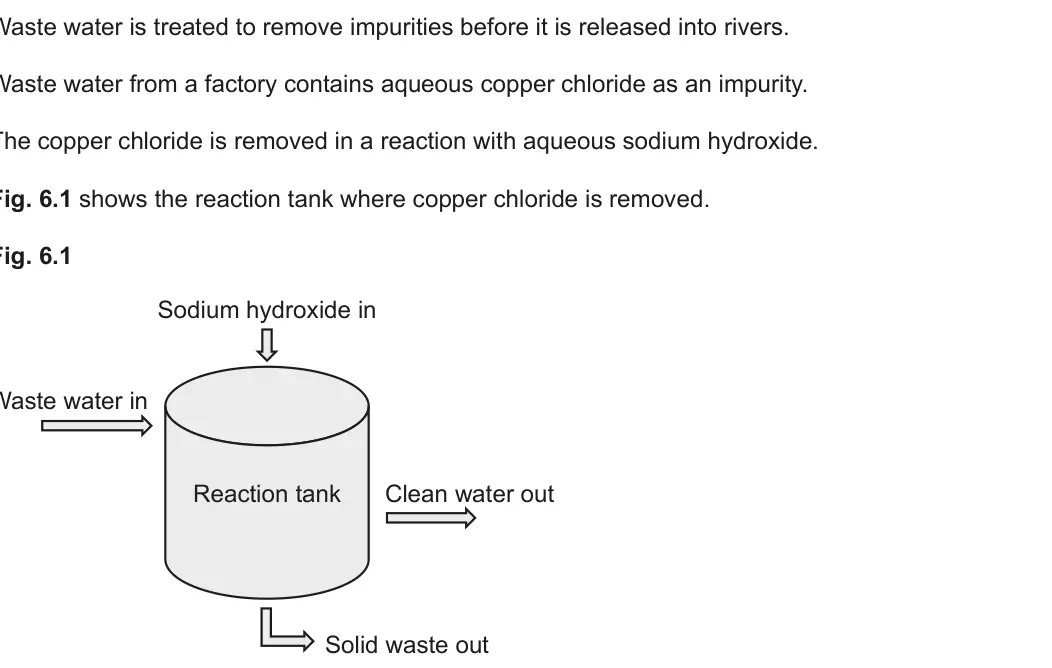
Q1(c)(i)
The whole paper ↗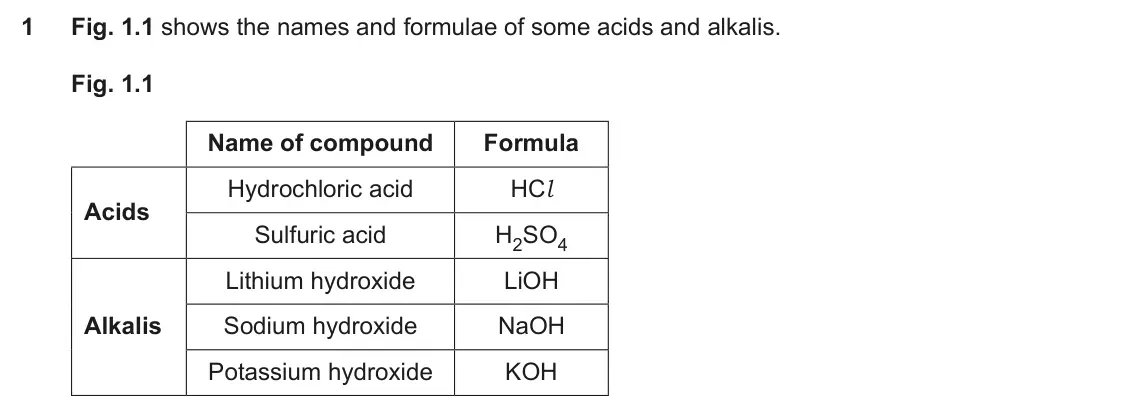
Q1(c)(ii)
The whole paper ↗Q1(c)(iii)
The whole paper ↗Q10(a)(ii)
The whole paper ↗
Q9(b)
The whole paper ↗
Q9(c)(i)
The whole paper ↗Q9(c)(ii)
The whole paper ↗Q6(b)(i)
The whole paper ↗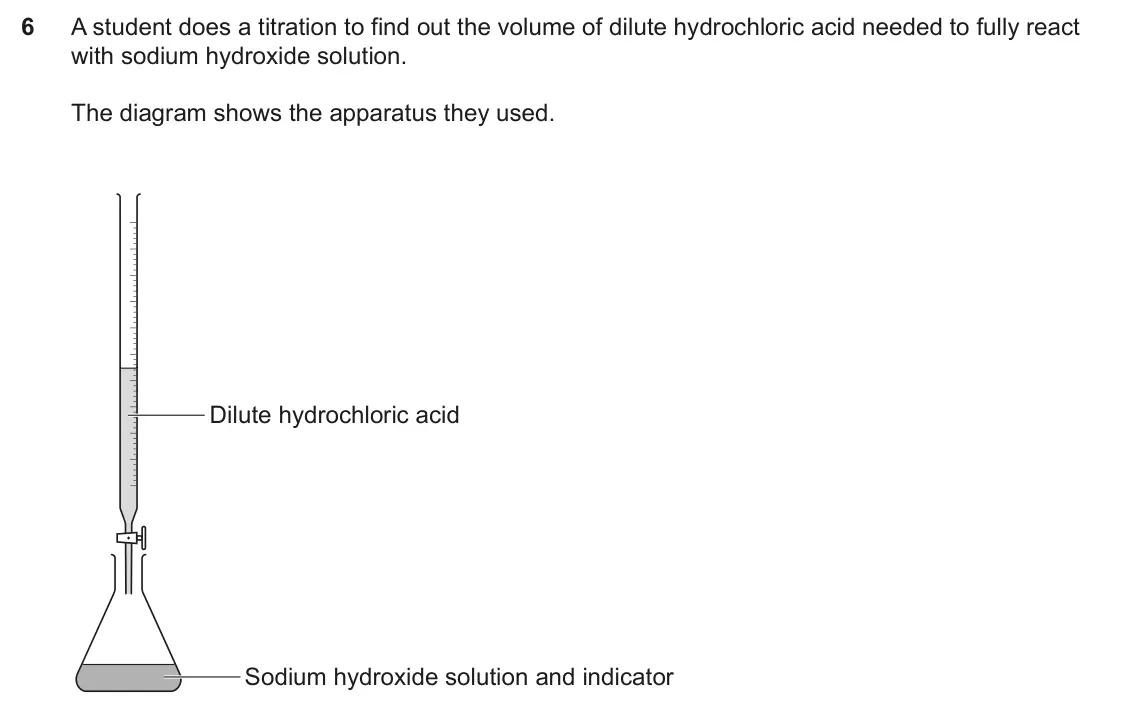
Q6(b)(ii)
The whole paper ↗Q6(b)(iii)
The whole paper ↗Q6(b)(iv)
The whole paper ↗Q2(a)
The whole paper ↗
Q10(a)
The whole paper ↗
Q10(b)
The whole paper ↗Q10(c)(i)
The whole paper ↗Q10(c)(ii)
The whole paper ↗Q8(b)
The whole paper ↗
Q8(c)(i)
The whole paper ↗Q8(c)(ii)
The whole paper ↗
All 52 questions on How are the amounts of chemicals in solution measured?, as a list
- June 2025, Paper 1 Foundation, Q6(a)(iii) (1 mark): Scientists use analysis to calculate the mass of copper chloride in the waste water. What is the name for this type of analysis? Tick (✓) one box. Experimental
- June 2025, Paper 2 Foundation, Q1(c)(i) (2 marks): The student adds another substance to the conical flask so that they know when the aqueous sodium hydroxide is neutralised. Name this substance. Describe how th
- June 2025, Paper 2 Foundation, Q1(c)(ii) (1 mark): Which other piece of apparatus does the student need to do the titration? Tick (✓) one box. Bunsen burner Burette Stop clock Test-tube Thermometer [1]
- June 2025, Paper 2 Foundation, Q1(c)(iii) (1 mark): The student does the titration and then looks at the results of another student. Explain why the student looks at the results of another student. [1]
- June 2025, Paper 3 Higher, Q10(a)(ii) (1 mark): The student uses phenolphthalein indicator. They complete the titration four times. The table shows their results. Titration number 1 2 3 4 Volume of acid used
- June 2025, Paper 4 Higher, Q9(b) (2 marks): In the reaction, hydrogen ions from the acid react with hydroxide ions from the sodium hydroxide. Write the ionic equation for this reaction. [2]
- June 2025, Paper 4 Higher, Q9(c)(i) (3 marks): Complete Table 9.2 by working out the missing information. [3]
- June 2025, Paper 4 Higher, Q9(c)(ii) (2 marks): 25.0 cm3 samples of each dilute acid are used in a titration with aqueous sodium hydroxide. The concentration of the aqueous sodium hydroxide was the same for e
- June 2024, Paper 1 Foundation, Q6(b)(i) (1 mark): Calculate the burette reading at the start of titration 1. Burette reading at the start of titration 1 = cm3 [1]
- June 2024, Paper 1 Foundation, Q6(b)(ii) (2 marks): Calculate the mean volume added for the three titrations. Mean volume added = cm3 [2]
- June 2024, Paper 1 Foundation, Q6(b)(iii) (2 marks): Explain why an indicator must be used in the titration. [2]
- June 2024, Paper 1 Foundation, Q6(b)(iv) (1 mark): Describe one way the student can make sure that the burette readings are as accurate as possible. [1]
- June 2023, Paper 1 Foundation, Q2(a) (3 marks): The label on a bottle of mineral water states that 1000 cm3 of the mineral water contains 40.5 mg of calcium. Calculate the mass of calcium in 500 cm3 of the mi
- June 2023, Paper 4 Higher, Q10(a) (4 marks): Nina uses this method: • Fill the burette with dilute hydrochloric acid. Use a beaker to measure 25 cm3 of dilute sodium hydroxide. • • Add universal indicator
- June 2023, Paper 4 Higher, Q10(b) (2 marks): Nina uses an improved method to do more titrations. She uses the same concentration of dilute sodium hydroxide each time. She uses different concentrations of d
- June 2023, Paper 4 Higher, Q10(c)(i) (1 mark): Which concentration of sodium hydroxide is most likely to be correct? Use the table. Put a ring around the correct option. 0.05 mol / dm3 0.1 mol / dm3 0.2 mol
- June 2023, Paper 4 Higher, Q10(c)(ii) (2 marks): Explain your answer to (c)(i). [2]
- June 2022, Paper 1 Foundation, Q8(b) (2 marks): This is a diagram of Sara’s apparatus: Burette Flask This is Sara’s method: Put 25.0 cm3 of drain cleaner into the flask. • • Add an indicator to the drain clea
- June 2022, Paper 1 Foundation, Q8(c)(i) (1 mark): Calculate the missing titration result for Noblock. Answer = cm3 [1]
- June 2022, Paper 1 Foundation, Q8(c)(ii) (2 marks): Look at the mean volume of hydrochloric acid used for each drain cleaner. What can you conclude about the amount of sodium hydroxide in Drainclear and Noblock?
- June 2022, Paper 3 Higher, Q10(a) (1 mark): Nina uses a burette to measure out the dilute hydrochloric acid in the titration. Nina wants to minimise errors in her method. Describe one thing she should do
- June 2022, Paper 3 Higher, Q10(b) (2 marks): The table shows Nina’s results: Rough Titration 1 Titration 2 Titration 3 2nd reading (cm3) 14.05 20.55 10.60 22.05 1st reading (cm3) 3.00 10.05 0.05 11.60 Volu
- June 2022, Paper 3 Higher, Q10(c) (3 marks): In her titration, Nina used 25.0 cm3 of diluted ‘Drainclear’ with 0.20 mol / dm3 hydrochloric acid. A symbol equation for the reaction is: NaOH(aq) + HCl (aq) N
- June 2022, Paper 3 Higher, Q10(d) (2 marks): Nina says: ‘I would have preferred my titration result to be larger than 10.50 cm3. This would reduce the percentage uncertainty in my titration result.’ Explai
- June 2022, Paper 4 Higher, Q9(a)(i) (2 marks): Use data from the graph to calculate the solubility of sodium chloride at 50 °C. Use the information: 100 g of water = 100 cm3 of water. Give your answer in g /
- June 2022, Paper 4 Higher, Q9(a)(ii) (3 marks): Calculate the concentration of sodium chloride at 50 °C in mol / dm3. Use the equations: number of moles = mass of substance (g) relative formula mass (g) and c
- June 2022, Paper 4 Higher, Q9(b)(i) (2 marks): Kai writes: solubility of potassium chloride α temperature Use the graph to explain in words why this relationship is incorrect. [2]
- June 2022, Paper 4 Higher, Q9(b)(ii) (3 marks): Use data from the graph to do a calculation to predict the solubility of potassium chloride at 100 °C. Solubility g in 100 g of water [3]
- November 2021, Paper 2 Foundation, Q4(c)(i) (1 mark): What else does Jane need to add to the flask before she starts her titration? [1]
- November 2021, Paper 2 Foundation, Q4(c)(ii) (1 mark): Give one reason for your answer to (c)(i). [1]
- November 2021, Paper 2 Foundation, Q4(c)(iii) (1 mark): Which brand of tablet contains the most calcium carbonate? Put a ring around the correct answer. EasyCalm FeelRight RumbleTum [1]
- November 2021, Paper 2 Foundation, Q4(c)(v) (2 marks): Calculate the mean mass of calcium carbonate in one RumbleTum tablet. mean mass of Use the mean volume of relative formula calcium carbonate = × hydrochloric ac
- November 2021, Paper 4 Higher, Q3(b) (2 marks): Jane reacts dilute hydrochloric acid with a tablet. The equation shows the reaction that happens: CaCO3(s) + 2HCl (aq) CaCl 2(aq) + H2O(l) + CO2(g) Which two st
- November 2020, Paper 1 Foundation, Q10(a) (1 mark): Layla says, ‘The titration uses a neutralisation reaction.’ Define a neutralisation reaction. [1]
- November 2020, Paper 1 Foundation, Q10(b)(i) (2 marks): Layla needs to add another substance to the flask so that she knows when to stop adding the hydrochloric acid. Which substance does Layla need to add, and what
- November 2020, Paper 1 Foundation, Q10(b)(ii) (1 mark): Layla titrates the hydrochloric acid into a flask from a burette. She wants to make sure her final burette reading is as accurate as possible. Describe one thin
- November 2020, Paper 1 Foundation, Q10(c)(i) (1 mark): Layla’s results for her rough titration are shown in Table 10.1. Complete Table 10.1 by calculating the volume for the rough titration. Rough titration Initial
- November 2020, Paper 1 Foundation, Q10(c)(ii) (2 marks): Layla's repeat readings for her careful titrations are shown in Table 10.2. First Second Third Fourth titration titration titration titration Volume (cm3) 24.55
- November 2020, Paper 1 Foundation, Q10(c)(iii) (4 marks): Calculate the mass of acid in 1 cm3 of hydrochloric acid. 0.0908 Use the formula: mean titration volume = mass of acid in 1 cm3 of hydrochloric acid Give your a
- November 2020, Paper 3 Higher, Q1(b)(i) (2 marks): Layla needs to add another substance to the flask so that she knows when to stop adding the hydrochloric acid. Which substance does Layla need to add, and what
- November 2020, Paper 3 Higher, Q1(b)(ii) (1 mark): Layla titrates the hydrochloric acid into a flask from a burette. She wants to make sure her final burette reading is as accurate as possible. Describe one thin
- November 2020, Paper 3 Higher, Q1(c)(i) (1 mark): Layla’s results for her rough titration are shown in Table 1.1. Complete Table 1.1 by calculating the volume for the rough titration. Rough titration Initial bu
- November 2020, Paper 3 Higher, Q1(c)(ii) (2 marks): Layla’s repeat readings for her careful titrations are shown in Table 1.2. First Second Third Fourth titration titration titration titration Volume (cm3) 24.55
- November 2020, Paper 3 Higher, Q1(c)(iii) (4 marks): Calculate the mass of acid in 1 cm3 of hydrochloric acid. 0.0908 Use the formula: mean titration volume = mass of acid in 1 cm3 of hydrochloric acid Give your a
- June 2019, Paper 1 Foundation, Q8(c) (2 marks): Layla now does a titration because she wants to measure the concentration of NaHCO3 in Tumsoothe. Put a ring around the two pieces of apparatus that she needs t
- June 2019, Paper 1 Foundation, Q8(d)(i) (1 mark): Layla says, ‘This is good quality data.’ Do you agree? Explain your answer. [1]
- June 2019, Paper 1 Foundation, Q8(d)(ii) (1 mark): Calculate the mean value for the volume of acid added in the titration. Mean value = cm3 [1]
- June 2019, Paper 3 Higher, Q12(c)(i) (1 mark): Layla measures out 25.0 cm3 of Tumsoothe. What piece of apparatus should Layla use to measure out this volume? [1]
- June 2019, Paper 3 Higher, Q12(c)(ii) (1 mark): Layla repeats her titration three times. Her results are shown. Repeat 1 2 3 Volume of acid added to 20.10 20.20 20.60 neutralise NaHCO3 (cm3) What can Layla do
- June 2018, Paper 3 Higher, Q12(b)(i) (1 mark): She wants to measure the 25.0 cm3 of NaOH as accurately as possible. Which piece of apparatus should Mia use? Put a ring around the correct answer. conical flas
- June 2018, Paper 3 Higher, Q12(b)(ii) (3 marks): Calculate the number of moles in 25.0 cm3 of 0.100 mol / dm3 NaOH. Use the equation: concentration (mol / dm3) = number of moles of solute ÷ volume (dm3) Number
- June 2018, Paper 3 Higher, Q12(b)(iii) (3 marks): This is an equation for sulfuric acid reacting with NaOH. 2NaOH + H2SO4 Na2SO4 + 2H2O Mia finds that 24.5 cm3 of H2SO4 reacts exactly with the NaOH. Calculate t
Questions, mark schemes and examiner’s reports are © OCR, from their published past papers. Plumi isn’t affiliated with any exam board. Want whole papers? Every OCR GCSE Chemistry B paper.
Rather write your answers by hand on iPad? Plumi marks them against the same mark schemes.