 plumi
Ionising radiation and risk: OCR A‑Level Physics B questions
Every OCR A-Level Physics B exam question on 6.2.2 Ionising radiation and risk, 2016–2025, with its mark scheme and examiner’s report.
Find questions1,881
Calculations


Q2(a)(i)
The whole paper ↗

Q39(a)
The whole paper ↗
Q39(b)
The whole paper ↗
Q6(a)(ii)
The whole paper ↗
Q6(c)(i)
The whole paper ↗
Q6(c)(ii)
The whole paper ↗
Q7(b)
The whole paper ↗

Q37(b)(i)
The whole paper ↗
Q37(b)(ii)
The whole paper ↗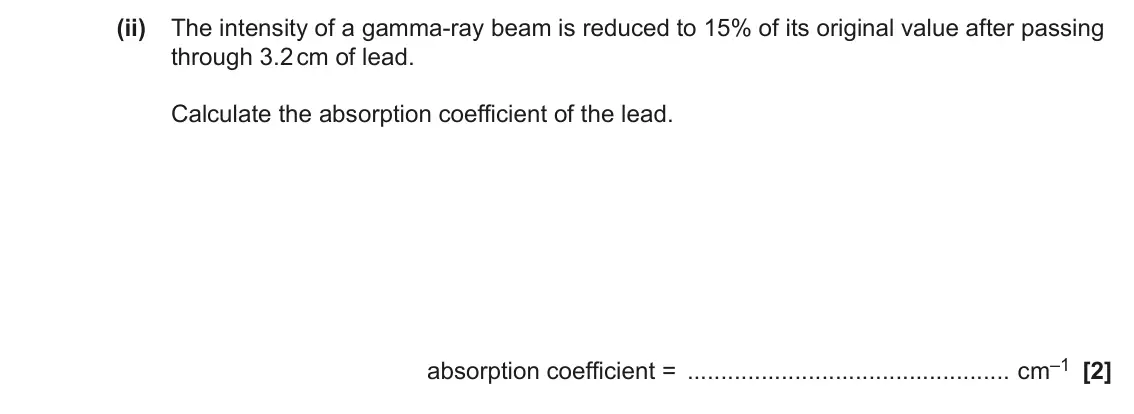
Q39(c)(i)
The whole paper ↗
Q39(c)(ii)
The whole paper ↗
Q39(c)(iii)
The whole paper ↗
Q39(c)(iv)
The whole paper ↗
Q5(a)(i)
The whole paper ↗
All 76 questions on Ionising radiation and risk, as a list
- June 2025, Paper 1, Q26 (1 mark): Which statement about the binding energy per nucleon in a nucleus is correct? A It becomes less negative when hydrogen nuclei undergo fusion to produce a helium
- June 2025, Paper 1, Q28 (1 mark): An isotope emits alpha particles of energy 9.0 × 10⁻¹³ J. All of the alpha particles are absorbed by 0.25 kg tissue. The isotope gives a dose equivalent to 2.0
- June 2025, Paper 1, Q30 (1 mark): What is the difference between the masses of the strontium-90 nucleus and the yttrium-90 nucleus? Assume that particle X has negligible mass. 9.707 × 10⁻³¹ kg A
- June 2025, Paper 2, Q2(a)(i) (2 marks): Show that the average energy to remove an electron from a molecule (ionisation energy) in air is less than 6 × 10–18 J. [2]
- June 2024, Paper 1, Q16 (1 mark): What is the best estimate of the absorbed dose of UVA per second for a typical human? A 0.4 mGy B 0.9 mGy C 4 mGy D 9 mGy Your answer [1]
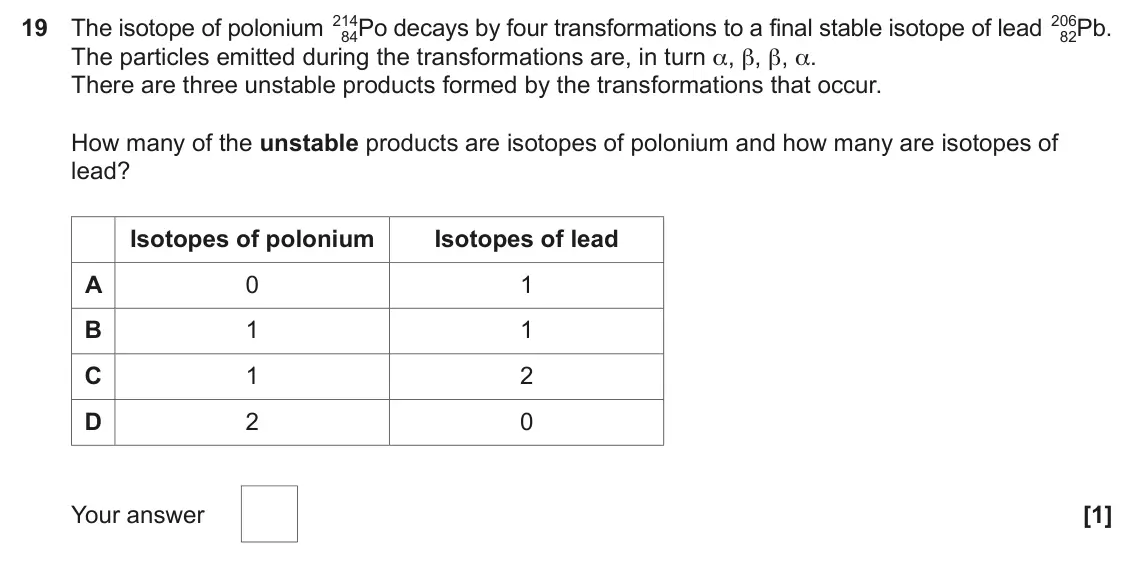
- June 2024, Paper 1, Q19 (1 mark): The isotope of polonium 214 84Po decays by four transformations to a final stable isotope of lead 206 82Pb. The particles emitted during the transformations are
- June 2024, Paper 1, Q39(a) (2 marks): Radioactive decay happens when an unstable nucleus emits a particle or electromagnetic radiation to become more stable. This is a random process. Explain the me
- June 2024, Paper 1, Q39(b) (4 marks): Thorium-232 is a radioactive metal that can be added to welding rods to improve their performance. These welding rods are said to be thoriated. Thorium-232 deca
- June 2024, Paper 2, Q6(a)(ii) (2 marks): The masses of the two nuclei in part (i) and the beta-minus particle are given below. Calculate the energy released in the decay. mass of thorium-234 nucleus: 2
- June 2024, Paper 2, Q6(c)(i) (2 marks): Explain how the reaction below can lead to a chain reaction. 1 0n + 23 5 9 0 7Rb + 14 3 5Cs + 31 2U 0n 9 3 5 [2]
- June 2024, Paper 2, Q6(c)(ii) (4 marks): In a reactor, uranium-238 can capture a neutron to become unstable uranium-239. This decays through two beta decays to plutonium-239 which will fission. β decay
- June 2024, Paper 2, Q7(b) (2 marks): Fig. 1 in the article shows that half the gamma rays incident at the top of the atmosphere are absorbed as they pass through the first 120 km of the atmosphere.
- June 2023, Paper 1, Q9 (1 mark): A nucleus decays by alpha emission. The nucleus formed then decays by beta emission. Which graph of nucleon number N plotted against proton number Z shows the t
- June 2023, Paper 1, Q37(b)(i) (3 marks): Describe how this apparatus can be used to gather data to determine the absorption coefficient of the absorbing material. [3]
- June 2023, Paper 1, Q37(b)(ii) (2 marks): The intensity of a gamma-ray beam is reduced to 15% of its original value after passing through 3.2 cm of lead. Calculate the absorption coefficient of the lead
- June 2023, Paper 1, Q39(c)(i) (2 marks): Use data from Fig. 39.1 to show that the total energy released in the three-stage process is about 5 × 10–12 J. [2]
- June 2023, Paper 1, Q39(c)(ii) (2 marks): Use the value for the average energy output, L, of the Sun to calculate the number of fusion reactions per second. L = 3.9 × 1026 J s–1 number = [2]
- June 2023, Paper 1, Q39(c)(iii) (2 marks): Calculate the rate at which mass is being converted to energy in the Sun. rate = kg s–1 [2]
- June 2023, Paper 1, Q39(c)(iv) (3 marks): The age of the Earth is about 4.5 billion years. Use your answer to (c)(iii) to calculate the percentage of the solar mass converted to energy in 4.5 billion ye
- June 2023, Paper 2, Q5(a)(i) (1 mark): State how the graph shows that an alpha particle produces about 240 000 ion pairs along its track. [1]
- June 2023, Paper 2, Q5(a)(ii) (2 marks): It takes about 30 eV to produce an ion-pair. Estimate the kinetic energy of the alpha particle when it is ejected from a nucleus. Explain your reasoning. Reason
- June 2023, Paper 2, Q5(a)(iii) (2 marks): Explain why beta particles have a longer range in air than alpha particles of the same initial energy. [2]
- June 2023, Paper 2, Q5(b)(ii) (1 mark): Alpha emitters can be implanted into body tissue. The range of alpha particles in the tissue is typically about 0.1 mm. State why the range is smaller in tissue
- June 2023, Paper 2, Q5(b)(iii) (6 marks): This question is about using alpha particles in radiotherapy. Fig. 5.1 shows a graph of the number of ion-pairs formed by an alpha particle travelling through a
- June 2022, Paper 1, Q21 (1 mark): An alpha particle source of activity 1.8 × 10³ Bq is implanted into 25 g of tissue. What is the effective dose transferred to the tissue in a 48 hour period? As
- June 2022, Paper 1, Q25 (1 mark): The decay equation of strontium-90 is: 90 90 –1e + 0 0 0v–. 38Sr 39Y + Which of the following quantities is not conserved in the decay? A charge B lepton number
- June 2022, Paper 1, Q39(a) (2 marks): Explain what is meant by the ‘binding energy’ of a nucleus and describe how its value can be calculated from the mass of the nucleus and the values for the mass
- June 2022, Paper 1, Q39(b)(i) (2 marks): The fission reaction is 234 137 54Xe + 94 38Sr + 3 1 92U 0n The binding energy of the U-234 nucleus is –1778 MeV. Use the graph to show that the energy released
- June 2022, Paper 1, Q39(b)(ii) (2 marks): Calculate the mass of 234 92U that must undergo fission to produce a constant output of 1400 MW for one year. mass of 234 92U atom = 3.89 × 10⁻²⁵ kg. 1 year = 3
- June 2022, Paper 1, Q39(c) (4 marks): In a ‘thorium’ reactor, 234 92U is produced when a neutron is captured by a 233 92U nucleus. The 233 92U is produced from an isotope of thorium (Th) in the foll
- November 2021, Paper 1, Q28 (1 mark): The graph shows the binding energy per nucleon for different nuclides. nucleon number, A 0 25 50 75 100 125 150 175 200 225 250 0 –1 –2 –3 binding energy –4 per
- November 2021, Paper 1, Q34(b) (2 marks): The 125I nucleus emits a γ-ray of energy 35 keV which will be absorbed by about 50 grams of surrounding tissue. Show that in the first 60 days of irradiation by
- November 2021, Paper 1, Q34(c) (1 mark): Seeds are implanted into cancer masses and remain there for many half-lives. Suggest why implanting many seeds throughout a 50 gram cancer may be better than im
- November 2021, Paper 1, Q41(a)(i) (2 marks): Calculate the maximum energy available when a free neutron decays into a proton and a β-particle. 1 u = 931 MeV energy = MeV [2]
- November 2021, Paper 1, Q41(b) (1 mark): Neutrons bound in nuclei can be either stable or unstable, see Fig. 41.2 showing the neutron number N against proton number Z for the light nuclei. All known β-
- November 2021, Paper 2, Q3(b) (2 marks): The power per m2 of solar radiation of all wavelengths striking the top of the Earth’s atmosphere is 1.4 kW m–2. The distance from the Earth to the Sun is 1.5 ×
- November 2021, Paper 2, Q3(c)(ii) (4 marks): Use the data below to calculate an estimate of the number of fusion three-stage reactions occurring in the Sun each second. 98% of the energy released in the pr
- November 2021, Paper 3, Q4(a)(i) (1 mark): Complete the tracks by drawing on Fig. 4.1 continuing the lines through each material unless a material absorbs 100% of the incident radiation. [1] Table 4.1 sh
- November 2021, Paper 3, Q4(a)(ii) (2 marks): Using the information in Table 4.1 suggest and explain which isotope of xenon should be used as a medical imaging tracer. Consider the effect on the patient of
- November 2021, Paper 3, Q4(a)(iii) (2 marks): The parent isotope of krypton-81m is rubidium-81. Complete the following decay equation for the production of krypton-81m. [2] Rb Kr + 1 + 81 81m 0 0 ν 36 0
- November 2021, Paper 3, Q4(b)(i) (2 marks): Suggest and explain one safety precaution required when handling a source of ionising radiation. [2]
- November 2021, Paper 3, Q4(b)(ii) (2 marks): Before taking any measurements with the absorber and source in place, the student takes several readings of the count rate. Explain why they do this. [2]
- November 2021, Paper 3, Q4(c)(i) (6 marks): The student gathers the following data. Shielding Corrected count rate Count rate / s–1 thickness, / s–1 x / cm 0 1250 1240 1 915 905 2 636 626 3 475 465 4 353
- November 2020, Paper 1, Q31(a) (1 mark): Complete the equation. [1]
- November 2020, Paper 1, Q31(b) (3 marks): The masses of the nuclides (in atomic mass units) are: Nuclide Mass / u 239Pu 239.00055 134Xe 133.87575 103Zr 102.90345 1 n 1.00867 Calculate the binding energy
- November 2020, Paper 1, Q41(a)(i) (2 marks): Suggest why a γ-ray source is chosen for this purpose rather than α or β. [2]
- November 2020, Paper 1, Q41(a)(ii) (2 marks): The food is irradiated for 5 minutes to give a dose of 500 Gy. Calculate the dose in Gy that would be received by a worker exposed to the gamma source for one s
- November 2020, Paper 1, Q41(b)(i) (2 marks): Explain why this equation: • has an exponential term • has an inverse square law. [2]
- November 2020, Paper 1, Q41(b)(ii) (3 marks): The γ-ray photons from 60Co have mean energy 1.3 MeV. A worker near the surface of the water storage pool will absorb about three-quarters of the photons enteri
- June 2019, Paper 1, Q20 (1 mark): A radioactive nucleus is formed by β-decay. This nucleus then decays by α-emission. Which graph of nucleon number N plotted against proton number Z shows the β-
- June 2019, Paper 1, Q26 (1 mark): What is the best estimate of the energy of one of the α-particles? A 2.2 MeV B 3.5 MeV C 4.4 MeV D 5.6 MeV Your answer [1] 18 This diagram is for use in questio
- June 2019, Paper 1, Q29 (1 mark): The graph shows neutron number N plotted against proton number Z for stable nuclei. N 120 110 100 90 80 70 60 50 40 30 20 10 0 10 20 30 40 50 60 70 80 Z Which s
- June 2019, Paper 1, Q37(a)(i) (1 mark): Complete the equation for this fusion reaction: 2 3 4 .... 1H + 1H → ....He + ....n + released binding energy. [1]
- June 2019, Paper 1, Q37(a)(ii) (2 marks): Use data from Fig. 37.1 to show that the binding energy released in this reaction is more than 15 MeV. You should calculate the binding energy of the reactants
- June 2019, Paper 1, Q37(c)(ii) (2 marks): Compare this to the possible fusion energy released by the bead. Use your answer to (a)(ii). You can assume 100% conversion to 4He. [2]
- June 2019, Paper 1, Q37(c)(iii) (1 mark): Suggest one practical difficulty in obtaining energy by this method. [1]
- June 2019, Paper 2, Q5(b)(i) (2 marks): Show that a total of eight alpha decays and six beta decays will produce 206 82Pb from 238 92U. [2]
- June 2019, Paper 2, Q10(a) (3 marks): The risk of contracting cancer due to radiation exposure is 5% per Sievert. The percentage risk of contracting cancer for an astronaut on a three-year mission t
- June 2019, Paper 2, Q10(b) (2 marks): Explain why exposure to radiation increases the risk of contracting cancer and how the high level of radiation on the surface of Mars may affect the design of t
- June 2018, Paper 1, Q12 (1 mark): The diagram shows the beta energy spectrum for emissions from a radioactive isotope. 1.0 relative frequency of beta emission 0.8 0.6 0.4 0.2 0 0.0 0.2 0.4 0.6 0
- June 2018, Paper 1, Q23 (1 mark): The graph shows neutron number N plotted against proton number Z for stable nuclei. N = neutron number 120 110 100 90 80 70 60 50 40 30 20 10 0 10 20 30 40 50 6
- June 2018, Paper 1, Q33(a) (2 marks): Complete the decay equation. 210 210 0 0 83 Bi Po + −1 e + y [2]
- June 2018, Paper 2, Q2(a) (2 marks): Explain how this reaction can become a chain reaction and suggest how the rate of the reaction can be controlled. [2]
- June 2018, Paper 2, Q2(b) (2 marks): The graph in Fig. 2.1 shows the binding energies per nucleon of the nuclei involved in the reaction. nucleon number A 0 235U 146La 87Br –9 Fig. 2.1 Use the grap
- June 2018, Paper 2, Q2(c) (3 marks): Each fission reaction releases about 16 MeV. Calculate the mass change in a single reaction. mass change = kg [3]
- June 2018, Paper 2, Q2(d) (4 marks): Each year, fission reactors around the world produce about 1.4 × 10¹⁸ J of useful energy. Use the data below to calculate an estimate of the time uranium reserv
- June 2018, Paper 2, Q3(b) (5 marks): The average energy of the beta particles emitted by potassium-40 is 8.3 × 10⁻¹⁴ J. Show that the equivalent dose received over 20 years by a 70 kg person who ea
- June 2018, Paper 2, Q3(c) (1 mark): The risk of contracting cancer is about 5% per sievert. Calculate an estimate of the number of cancers produced in a population of 60 million over a period of t
- June 2018, Paper 2, Q3(d) (2 marks): The amount of potassium-40 in the body is maintained at a steady level of about 2.0 × 10⁻⁵ kg for a 70 kg adult. The excess is excreted. Suggest and explain one
- June 2018, Paper 3, Q2(a) (2 marks): Describe two safety precautions necessary for handling such a material in the laboratory. [2]
- June 2017, Paper 1, Q26 (1 mark): Which one of the following statements is correct? A All unstable nuclei have less binding energy than stable nuclei. 56Fe requires less energy per nucleon than
- June 2017, Paper 1, Q27 (1 mark): 27 Which is the best estimate for the total binding energy for a nucleus of 8O (Oxygen)? A – 10 pJ B – 20 pJ C – 64 pJ D – 128 pJ Your answer [1]
- June 2017, Paper 1, Q28 (1 mark): Isotopes of a given element all have the same A proton number. B charge / mass ratio. C neutron number. D nucleon number. Your answer [1]
- June 2017, Paper 1, Q30 (1 mark): 214 30 Pb decays by a series of transformations to a final stable product. 82 The particles emitted are: β, β, α, β, β, α. Which one of the isotopes below is th
- June 2017, Paper 1, Q39(a) (3 marks): One of the sources emits α, β and γ radiation, one source emits β and γ and one source emits pure β. For each source below state which radiations are emitted. J
- June 2017, Paper 1, Q39(b)(ii) (4 marks): State whether the graph shows that the count rate C varies as C ∝ 2 R and explain which radiation(s) α, β or γ might be responsible for such a variation. [4]
Questions, mark schemes and examiner’s reports are © OCR, from their published past papers. Plumi isn’t affiliated with any exam board. Want whole papers? Every OCR A-Level Physics B paper.
Rather write your answers by hand on iPad? Plumi marks them against the same mark schemes.