 plumi
Creating models: OCR A‑Level Physics B questions
Every OCR A-Level Physics B exam question on 5.1.1 Creating models, 2016–2025, with its mark scheme and examiner’s report.
Find questions1,881
Calculations

Q32(a)
The whole paper ↗
Q32(b)
The whole paper ↗
Q34(a)(i)
The whole paper ↗
Q34(a)(ii)
The whole paper ↗
Q34(a)(iii)
The whole paper ↗
Q34(b)(i)
The whole paper ↗
Q34(b)(ii)
The whole paper ↗
Q34(b)(iii)
The whole paper ↗
Q3(a)(i)
The whole paper ↗
Q3(a)(ii)
The whole paper ↗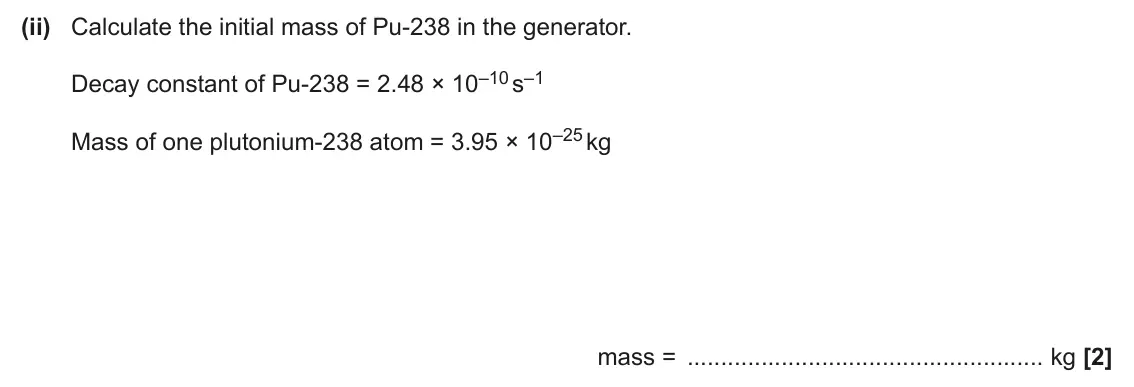
Q3(b)(i)
The whole paper ↗
Q3(b)(iii)
The whole paper ↗
Q8(a)
The whole paper ↗
Q9(a)
The whole paper ↗
Q9(b)
The whole paper ↗
Q9(c)
The whole paper ↗

Q11(a)
The whole paper ↗
All 164 questions on Creating models, as a list
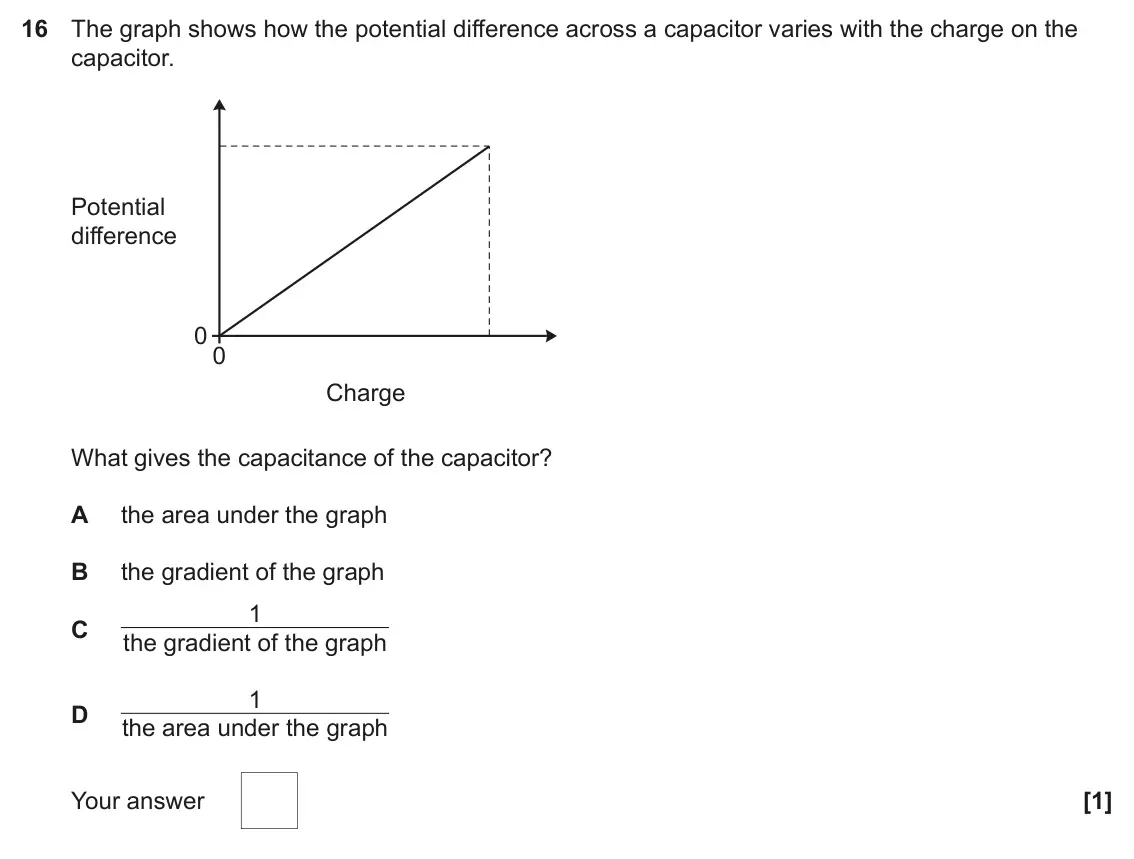
- June 2025, Paper 1, Q16 (1 mark): The graph shows how the potential difference across a capacitor varies with the charge on the capacitor. Potential difference 0 0 Charge What gives the capacita
- June 2025, Paper 1, Q17 (1 mark): An object is oscillating with simple harmonic motion. The graph shows how its displacement x varies with time t. 2.0 1.5 Displacement 1.0 x / cm 0.5 Time t / s
- June 2025, Paper 1, Q32(a) (1 mark): Show that the energy stored in the capacitor is given by E = 1 2CV 2. [1]
- June 2025, Paper 1, Q32(b) (4 marks): A 680 μF capacitor is charged until it stores 12 mJ energy. It is then discharged through a 1.2 kΩ resistor. Calculate the time taken for the capacitor to trans
- June 2025, Paper 1, Q34(a)(i) (1 mark): [1]
- June 2025, Paper 1, Q34(a)(ii) (2 marks): Show that the change of displacement over the initial 0.02 s is approximately 0.0008 m. [2]
- June 2025, Paper 1, Q34(a)(iii) (1 mark): Hence calculate the displacement of the car from its equilibrium position after the first 0.02 s. displacement = m [1]
- June 2025, Paper 1, Q34(b)(i) (2 marks): Use data from the graph to estimate the period of the oscillation. period = s [2]
- June 2025, Paper 1, Q34(b)(ii) (2 marks): Calculate a value for the time period of the oscillation. Use the equation a = 4π 2f 2x where f = frequency of oscillation. Use data from (a)(i) period calculat
- June 2025, Paper 1, Q34(b)(iii) (1 mark): Explain how the iterative model can be improved. [1]
- June 2025, Paper 2, Q3(a)(i) (1 mark): Energy released in one decay of Pu‑238 = 8.96 × 10⁻¹³ J [1]
- June 2025, Paper 2, Q3(a)(ii) (2 marks): Calculate the initial mass of Pu‑238 in the generator. Decay constant of Pu‑238 = 2.48 × 10⁻¹⁰ s–1 Mass of one plutonium‑238 atom = 3.95 × 10⁻²⁵ kg mass = kg [2
- June 2025, Paper 2, Q3(b)(i) (2 marks): Show that the power output of a stationary RTG will have fallen to about 72% of its original value after 42 years. Initial power of RTG = 3.50 × 10⁴ W [2] 7 Whe
- June 2025, Paper 2, Q3(b)(iii) (4 marks): Explain by using relevant calculations, why the power output of the RTG when the spaceship lands on WST‑A is approximately 79% of its value at launch. Assume th
- June 2025, Paper 2, Q8(a) (3 marks): Explain why the sensitivity of dynamic microphones falls at high frequencies and how this can affect the accuracy of recordings (lines 66–69). [3]
- June 2025, Paper 2, Q9(a) (2 marks): Use the equation given (line 76) in the article to show that the maximum value of capacitance during the oscillation is about 2.4 pF. [2]
- June 2025, Paper 2, Q9(b) (1 mark): Calculate the energy stored on the capacitor at this maximum value. energy stored = [1]
- June 2025, Paper 2, Q9(c) (3 marks): The capacitance at equilibrium position is 2.35 pF. Use this value and your value from (a) to calculate the mean current from the capacitor as the diaphragm mov
- June 2025, Paper 2, Q10 (6 marks): 10* Using appropriate equations, explain and compare how the phase of the output signal from dynamic and condenser microphones relates to the phase of the incid
- June 2025, Paper 2, Q11(a) (2 marks): Using equations for the capacitance of the membrane and air‑gap capacitors in an electret microphone (lines 100–105) to show that the total capacitance of the t
- June 2025, Paper 2, Q11(b) (2 marks): The total charge on the capacitors is 9.7 × 10⁻¹¹ C. Calculate the potential difference across the two capacitors. potential difference = V [2]
- June 2025, Paper 3, Q4(c)(iv) (2 marks): A different student calculates their gradient to be 2.05 s2kg–1. Show that the spring constant of the oscillating system is approximately 19 Nm–1. [2]
- June 2025, Paper 3, Q4(d)(i) (6 marks): The student develops their experiment to investigate resonance. In the modified experiment, the oscillations are driven by a signal generator and vibrator as sh
- June 2025, Paper 3, Q4(d)(ii) (3 marks): Measurements of mass in space can be challenging. Suggest briefly how to adapt the method shown in Fig. 4.3 to measure mass in zero g environments. Estimate a r
- June 2024, Paper 1, Q21 (1 mark): The graph shows how a quantity y changes when a quantity x changes. y 0 x 0 Which row of the table shows two examples of quantities x and y that have the relati
- June 2024, Paper 1, Q22 (1 mark): A simple pendulum P has length L and mass M. Its period is T. A simple pendulum Q has length 2L and mass M. What is the period of simple pendulum Q? A 0.5T B 0.
- June 2024, Paper 1, Q29 (1 mark): The diagram shows a circuit used to find the capacitance of a capacitor. The capacitor is initially uncharged. A V The switch is closed and the variable resisto
- June 2024, Paper 1, Q30 (1 mark): The capacitor in this circuit is initially uncharged. A V The graphs all show the variation of different quantities associated with the circuit after the switch
- June 2024, Paper 1, Q36(a)(ii) (2 marks): The mass suspended from the wire oscillates vertically with simple harmonic motion. Calculate the period of oscillation for the wire when it carries a 10 N load
- June 2024, Paper 1, Q36(a)(iii) (2 marks): Explain why the oscillations of the wire are simple harmonic but those of the rubber strip are not. [2]
- June 2024, Paper 1, Q39(a) (2 marks): Radioactive decay happens when an unstable nucleus emits a particle or electromagnetic radiation to become more stable. This is a random process. Explain the me
- June 2024, Paper 1, Q39(c)(i) (1 mark): Explain why the ionisation current is proportional to the number of radon-220 atoms remaining in the chamber. [1] 44 The reading on the pico-ammeter is noted ev
- June 2024, Paper 1, Q39(c)(ii) (6 marks): (ii)* Another student starts to plot a graph of ln (I) against time. time / s 40 0 20 60 80 100 120 140 160 –27.8 –28.0 –28.2 –28.4 –28.6 –28.8 ln (I/A) –29.0 –
- June 2024, Paper 2, Q3(b)(i) (2 marks): Refer to Fig. 3.1 to explain why the mass will oscillate with simple harmonic motion for oscillations of amplitude less than about 0.11 m. [2]
- June 2024, Paper 2, Q3(b)(ii) (2 marks): Explain why the oscillation will not be simple harmonic for oscillations with a greater amplitude than 0.11 m. [2]
- June 2024, Paper 2, Q3(c) (3 marks): The spring and mass are attached to a vibration generator as shown in Fig. 3.2. The vibration generator oscillates the spring through a range of frequencies fro
- June 2024, Paper 2, Q3(d) (3 marks): The hydrogen chloride molecule (HCl ) can be modelled as a light mass (the hydrogen atom) attached to a much heavier mass (the chlorine atom) by an elastic spri
- June 2024, Paper 2, Q6(b)(i) (2 marks): Calculate the number of uranium nuclei in the sample when the spacecraft was launched. half-life of uranium-238 = 4.51 × 10⁹ years number of nuclei = [2]
- June 2024, Paper 2, Q6(b)(ii) (3 marks): Calculate how many years it will take for one third of the original nuclei in the sample to become stable lead-206. Assume that the half-life of uranium is the
- June 2024, Paper 2, Q6(c)(ii) (4 marks): In a reactor, uranium-238 can capture a neutron to become unstable uranium-239. This decays through two beta decays to plutonium-239 which will fission. β decay
- June 2023, Paper 1, Q10 (1 mark): The unit of capacitance is the farad F. 1 F is the same as: 1 A s Ω–1 A 1 V A–1 B 1 V C–1 C 1 Ω–1 s D Your answer [1]
- June 2023, Paper 1, Q23 (1 mark): A 220 μF capacitor discharges through a resistor R. The p.d. across the capacitor falls to 20% of its original value after 5 seconds. What is the value of resis
- June 2023, Paper 1, Q24 (1 mark): A 4700 μF capacitor is connected across a 6.0 V supply as shown. It is discharged through a 6.0 kΩ resistor. 6.0 V 4700 μF 6.0 kΩ How long does it take, after t
- June 2023, Paper 1, Q25 (1 mark): Io is a natural satellite of Jupiter. A pendulum is calculated to have a period of 3.50 s on the Moon and 3.30 s on Io. gravitational field strength on the surf
- June 2023, Paper 1, Q27 (1 mark): The 222Ra sample has 1.0 × 10⁻¹⁴ mol of nuclei. How many mol of nuclei are in the 222Ac sample? 3.3 × 10⁻¹⁵ mol A 5.0 × 10⁻¹⁵ mol B 6.7 × 10⁻¹⁵ mol C 1.5 × 10⁻¹
- June 2023, Paper 1, Q28 (1 mark): After t seconds, the activity of the 222Ac is 40% of its original value. What is the activity of the 222Ra at t seconds, compared to its original value? A 46% B
- June 2023, Paper 1, Q37(a)(iii) (3 marks): The student places transparent sheets between the light source and the lux meter. The graph in Fig. 37.3 shows how the illuminance detected varies with the numb
- June 2023, Paper 1, Q40(a) (1 mark): Draw a curve on Fig. 40.1 showing the kinetic energy of the oscillator. Label this curve ‘kinetic energy’. [1]
- June 2023, Paper 1, Q40(b) (3 marks): A mass oscillates between two springs as shown in Fig. 40.2. Fig. 40.2 It is released from its maximum displacement of 0.050 m at t = 0.0 s. The frequency of th
- June 2023, Paper 1, Q40(c)(i) (2 marks): Calculate the frequency of the oscillation of the molecule. f = Hz [2]
- June 2023, Paper 3, Q3(a) (4 marks): You are provided with the following apparatus: variable power supply (0 – 12 V) capacitor of unknown capacitance resistor of value 4.7 kΩ multimeter leads and s
- June 2023, Paper 3, Q3(b)(i) (3 marks): Capacitor discharge is an example of exponential decay and follows the equation –t V = V0e RC. Complete the ln V column in Table 3 and then perform a mathematic
- June 2023, Paper 3, Q3(b)(ii) (1 mark): Show that the value of the time constant, τ is approximately 25 s. [1]
- June 2023, Paper 3, Q3(b)(iii) (1 mark): Calculate the value of the capacitance. Capacitance = F [1]
- June 2023, Paper 3, Q3(c)(i) (3 marks): Starting from the equation given in (b)(i) and repeated below show that when t = 5τ, the energy stored in the capacitor, E = 4.5 × 10⁻⁵ E0, where E0 is the ener
- June 2023, Paper 3, Q3(c)(ii) (1 mark): Justify why this rule of thumb is useful to engineers. [1]
- June 2023, Paper 3, Q4(b)(iii) (6 marks): This question is about inducing an emf in a coil of wire. Fig. 4.1 shows a coil of wire perpendicular to a uniform magnetic field. Fig. 4.1 0.020 m 0.020 m (iii
- June 2022, Paper 1, Q12 (1 mark): A sample of a radioisotope has initial activity = A0. What is its activity after 0.5 half-lives? A 0.250 A0 B 0.293 A0 C 0.707 A0 D 0.750 A0 Your answer [1]
- June 2022, Paper 1, Q14 (1 mark): A mass is hung from a spring and oscillates at the same frequency as a simple pendulum of length 1.0 m. What mass is hung from the spring? The spring has a spri
- June 2022, Paper 1, Q22 (1 mark): A radioactive source has a half-life of 27 days. The initial activity of the source is determined to be 2.5 × 10⁴ Bq. How long will it take for the activity to
- June 2022, Paper 1, Q23 (1 mark): What is the magnitude of the maximum acceleration of the end of the strip? 1.8 m s–2 A 4.5 m s–2 B 28 m s–2 C 180 m s–2 D Your answer [1]
- June 2022, Paper 1, Q24 (1 mark): When the strip oscillates at an amplitude of 0.020 m the maximum velocity at the end of the strip is v. What is its maximum velocity when the amplitude is incre
- June 2022, Paper 1, Q27 (1 mark): The capacitor in the circuit shown is initially uncharged. At time t = 0 s, the switch is moved to position X. What is the potential difference across the capac
- June 2022, Paper 1, Q28 (1 mark): When the capacitor is fully charged, the switch is moved to position Y. What is the energy stored on the capacitor after 10 s of discharge? A 0.013 J B 0.023 J
- June 2022, Paper 1, Q34(a) (3 marks): Explain the significance of the shaded area of the graph and the significance of the gradient of the graph. Link your explanations to the relevant equations. Sh
- June 2022, Paper 1, Q34(b) (3 marks): A simplified circuit is shown in Fig. 34.2. C R Fig. 34.2 Explain how the equation ∆Q ∆t = – Q RC can be used to find the charge remaining on the capacitor afte
- June 2022, Paper 2, Q4(b)(ii) (6 marks): This question is about the force on a current-carrying wire in a magnetic field. A student sets up an experiment to measure the field strength between a pair of
- June 2022, Paper 2, Q6(a)(i) (1 mark): State how the graph shows that the oscillator is undamped. [1]
- June 2022, Paper 2, Q6(a)(ii) (1 mark): Draw a curve on Fig. 6.1 showing how the velocity of the oscillator varies with time. Label this line ‘v’. [1]
- June 2022, Paper 2, Q6(a)(iii) (1 mark): Draw a curve on Fig. 6.1 showing how the acceleration of the oscillator varies with time. Label this line ‘a’. [1] 17 The oscillation of a mass held between spr
- June 2022, Paper 2, Q6(b)(i) (1 mark): State why the change in displacement during an iteration is given by vnew + vold Δx = Δt 2 [1]
- June 2022, Paper 2, Q6(b)(ii) (3 marks): The model starts at t = 0 s with x = 0.1200 m at a velocity vnew = 0.000 m s–1. The table below has the first two rows filled in. Use the flow chart to complete
- June 2022, Paper 2, Q6(b)(iii) (4 marks): Use the graph to estimate the frequency of the oscillation and compare this to the result found using the equation for the time period of a mass-spring oscillat
- June 2022, Paper 2, Q6(c) (4 marks): When the model is run over many more iterations, the graph in Fig. 6.5 is produced. 5 4 3 2 1 time / s 0 0 1 2 3 4 5 6 7 8 9 10 – 1 – 2 – 3 – 4 – 5 Fig. 6.5 The
- June 2022, Paper 3, Q3(a) (2 marks): The decay equation is ΔN Δt = –λN where λ is the decay constant and N is the number of nuclei present. Explain what the decay constant represents for a particul
- June 2022, Paper 3, Q3(b)(i) (2 marks): Complete the remaining rows of Table 3.1. [2]
- June 2022, Paper 3, Q3(b)(iii) (1 mark): How is the activity of the sample represented in this model? [1]
- June 2022, Paper 3, Q3(b)(iv) (2 marks): Explain why a better model is created if Δt = 0.5 s. [2]
- June 2022, Paper 3, Q3(c)(i) (2 marks): Explain why 10‑second intervals over a period of a few minutes are suitable for this experiment. [2]
- June 2022, Paper 3, Q3(c)(ii) (4 marks): Fig. 3.2 shows a graph of ln(count rate) against t from this experiment. Use the graph to find a value for the decay constant for protactinium‑234 and hence the
- November 2021, Paper 1, Q11 (1 mark): The maximum speed of the oscillating object is 0.08 m s–1 A 0.24 m s–1 B 0.39 m s–1 C 39 m s–1 D Your answer [1]
- November 2021, Paper 1, Q12 (1 mark): The mass of the oscillating object is 600 g. The spring constant k of the spring is 14 N m–1 A 18 N m–1 B 56 N m–1 C 14 000 N m–1 D Your answer [1]
- November 2021, Paper 1, Q16 (1 mark): A charged capacitor discharges through a resistor with the time constant τ = RC. What is the best explanation of the time constant τ? A τ is the time for the ch
- November 2021, Paper 1, Q21 (1 mark): The graph shows the variation of the charge on a capacitor with the potential difference across that capacitor. 10.0 8.0 6.0 charge on capacitor / mC 4.0 2.0 0
- November 2021, Paper 1, Q34(a) (2 marks): Show that the number of atoms of 125I atoms initially present in one seed is about 6 × 10¹³. [2]
- November 2021, Paper 1, Q41(a)(iii) (2 marks): Estimate the number of neutrons that would decay in one second from a sample of 104 free neutrons. number per second = [2]
- November 2021, Paper 2, Q2(a)(i) (2 marks): The operating range of the component is 5.2 V to 9.0 V. Show that 3.5 s after the switch is opened the p.d. across the component will be about 5.3 V. [2]
- November 2021, Paper 2, Q2(a)(ii) (3 marks): Estimate the average power delivered to the component during this time. Explain why the value is an average. average power = W Explanation: [3] 5 In recent year
- November 2021, Paper 2, Q2(b) (4 marks): A 120 F supercapacitor has an internal resistance of 30 mΩ. At time t = 0.0 s it stores 300 J. Calculate the minimum time taken for the capacitor to transfer 25
- November 2021, Paper 2, Q5(a) (2 marks): The mass oscillates between the springs with a time period of 1.3 s. Calculate the spring constant k of the system. spring constant = N m–1 [2]
- November 2021, Paper 2, Q5(b) (3 marks): Calculate the maximum velocity of the mass. maximum velocity = m s–1 [3]
- November 2021, Paper 2, Q5(c) (2 marks): Explain why the kinetic energy of the oscillator will equal the elastic potential in the system when its displacement = maximum displacement . 2 [2]
- November 2021, Paper 2, Q5(d) (2 marks): Calculate the time interval between releasing the mass from its position of maximum displacement and the first time the kinetic energy of the mass is equal to t
- November 2021, Paper 2, Q5(f) (3 marks): At a height of 632 m, the Shanghai Tower is the world’s second tallest building. A huge pendulum which oscillates at the natural frequency of the building reduc
- November 2021, Paper 2, Q9(b)(i) (2 marks): Ignoring the effects of spreading, the power of a sound wave of frequency 100 kHz falls to 93% of its original value after travelling 0.1 m. Show that the atten
- November 2021, Paper 2, Q9(b)(ii) (4 marks): By considering only the effects of spreading and attenuation calculate the difference in power in decibels between the transmitted pulse and detected echo when
- November 2021, Paper 3, Q3(a)(i) (2 marks): Apply a test to the data to show that length is proportional to period. Explain the method. [2]
- November 2021, Paper 3, Q3(a)(ii) (1 mark): Calculate the natural frequency for a blade with a length of 24.0 cm. frequency = Hz [1]
- November 2021, Paper 3, Q3(b)(i) (2 marks): What is resonance? [2] hacksaw blade ruler vibration signal generator generator 24.0 cm string Hz Fig. 3.1
- November 2021, Paper 3, Q3(b)(ii) (3 marks): On the axes in Fig. 3.2 sketch the frequency-amplitude graph you would expect to achieve. Label the significant features of your graph. amplitude 0 0 frequency
- November 2021, Paper 3, Q3(b)(iii) (6 marks): This question is about the oscillations of hacksaw blades. (iii)* To investigate how damping affects resonance, two different sized pieces of card can be stuck
- November 2021, Paper 3, Q4(a)(iv) (1 mark): Krypton-81m has a half-life of only 13 seconds, whilst rubidium-81 has a half-life of 4 hours. Suggest why hospital stocks do not lose their activity before pat
- November 2021, Paper 3, Q4(c)(i) (6 marks): The student gathers the following data. Shielding Corrected count rate Count rate / s–1 thickness, / s–1 x / cm 0 1250 1240 1 915 905 2 636 626 3 475 465 4 353
- November 2021, Paper 3, Q4(c)(ii) (4 marks): Using the equation I = I0 e–μx, and the information in Fig. 4.4, determine the value of the attenuation coefficient, μ. attenuation coefficient = unit [4] 17 8
- November 2020, Paper 1, Q12 (1 mark): Which graph shows the variation of kinetic energy with displacement? Your answer [1]
- November 2020, Paper 1, Q13 (1 mark): Which graph shows the variation of total energy with displacement? Your answer [1]
- November 2020, Paper 1, Q39 (6 marks): 39* The age of atoms in terrestrial rocks can be estimated by considering the ratio of numbers of atoms of radioactive isotopes. Today the number ratio for the
- November 2020, Paper 2, Q1(a)(i) (1 mark): Suggest why the student chooses to use a data logger rather than a digital meter. [1]
- November 2020, Paper 2, Q1(a)(ii) (3 marks): Use data from the graph to show that the capacitance of C is about 500 μF. [3]
- November 2020, Paper 2, Q1(a)(iii) (2 marks): Calculate the energy stored in the capacitor when the p.d. across it is 4.2 V (at t = 7.0 s). energy = J [2]
- November 2020, Paper 2, Q1(b)(i) (3 marks): When the capacitor is charged to 4.2 V, the student resets the data logger to t = 0.0 s and moves the switch from position A to position B. Draw a line on Fig.
- November 2020, Paper 2, Q1(b)(ii) (3 marks): Calculate the time from the beginning of the discharge for the energy stored on the capacitor to fall to half its value. time = s [3]
- November 2020, Paper 2, Q8(b) (2 marks): Radiocarbon dating uses a value for the half-life of 14C = 5.70 × 10³ years. The 14C/12C ratio in living material is about 1.4 × 10⁻¹². Calculate the 14C/12C ra
- November 2020, Paper 2, Q8(c) (6 marks): This question is about radiocarbon dating (lines 44–61). (c)* Explain why living plants growing near active volcanoes may have radiocarbon ages that suggest the
- June 2019, Paper 1, Q21 (1 mark): number of 225Ra atoms remaining 21 After 30 days which ratio gives number of 225Ac atoms remaining ? 1 A 2 3 B 4 4 C 3 D 2 Your answer [1]
- June 2019, Paper 1, Q22 (1 mark): activity of the 225Ra source 22 After 30 days which ratio gives activity of the 225Ac source ? 1 A 2 3 B 4 4 C 3 D 2 Your answer [1]
- June 2019, Paper 1, Q27 (1 mark): Which of the arrangements will give the simple harmonic oscillator of lowest frequency? Your answer [1]
- June 2019, Paper 1, Q28 (1 mark): Which of the arrangements will give a simple harmonic oscillator whose frequency f is given by the following equation? f = 1 2k m 2π Your answer [1]
- June 2019, Paper 1, Q39(a)(i) (2 marks): Use the graph to find the initial current when the capacitor starts to charge. Make your method clear. initial current = A [2]
- June 2019, Paper 1, Q39(a)(ii) (2 marks): Calculate the size of the electrical resistance in the charging circuit. resistance = Ω [2]
- June 2019, Paper 1, Q39(b) (1 mark): Explain why the charging current decreases as the capacitor charges. [1]
- June 2019, Paper 1, Q39(c)(i) (2 marks): A student makes an iterative model for the charging of the capacitor in (a), using time intervals ∆t = 2.0 s. The start conditions and the situation at times t
- June 2019, Paper 1, Q39(c)(ii) (2 marks): Compare the model values for the charge Q on the capacitor at time t = 4.0 s with the experimental values from Fig. 39.1. Explain any differences and state how
- June 2019, Paper 1, Q41(a)(i) (2 marks): Fig. 41.2 shows the f = c v proportionality and Fig. 41.3 shows how the sound level in the car varies with speed v. frequency of eddies f / Hz sound intensity i
- June 2019, Paper 1, Q41(a)(ii) (2 marks): State the evidence that shows there is a resonant oscillation happening in this example. [2]
- June 2019, Paper 1, Q41(b) (2 marks): The resonant frequency f of an enclosed volume of air V, with an aperture area A, is given by: f = u A V L. 2π Calculate the resonant frequency f of oscillation
- June 2019, Paper 2, Q3(c)(i) (4 marks): Explain what the student means by ‘decreases exponentially’ and, using ideas from part (b), explain whether you would expect the speed of the disk to decrease i
- June 2019, Paper 2, Q3(c)(ii) (3 marks): Use data from the graph to test whether there is an exponential decrease in speed over time. Make your conclusion clear. [3]
- June 2019, Paper 2, Q5(a) (1 mark): For a stable product, the number of daughter nuclei D at time t is given by the equation D = N0 – N where N0 is the original number of parent nuclei and N is th
- June 2019, Paper 2, Q5(b)(ii) (1 mark): The half-life of the series is 4.47 × 10 9 years. This means that it will take about 4.5 billion years before half the uranium-238 (238U) has decayed into lead-
- June 2019, Paper 2, Q5(b)(iii) (3 marks): A rock is assumed to have contained no lead-206 when it was formed. In a sample of the rock, the ratio number of lead-206 atoms present in rock sample original
- June 2019, Paper 2, Q5(c)(i) (1 mark): Use the relationship N = N0 e–mt to show that the number of daughter nuclei after time t is given by D = N ( 1 e–mt – 1) where N is the number of parent nuclei
- June 2019, Paper 2, Q5(c)(ii) (3 marks): Use the equation for D given in (c)(i) and the data given to calculate the value for the age of the rock based on the uranium-235 decay series. age of rock = ye
- June 2019, Paper 3, Q2(a)(i) (2 marks): Explain why, for small angle θ of deflection, F can be given by the expression F ≈ – Tsx L . [2]
- June 2019, Paper 3, Q2(a)(ii) (2 marks): For small angle θ, Ts ≈ mg. Therefore, the acceleration a of the bob can be given by the expression a ≈ – gx L . Use the equation for simple harmonic motion, a
- June 2019, Paper 3, Q2(b)(ii) (1 mark): Complete the table by calculating the three missing values of T 2 / s2. [1]
- June 2019, Paper 3, Q2(b)(iv) (2 marks): Use the graph to determine a value for the acceleration due to gravity g. Show your working. g = m s–2 [2] 9 Fig. 2.2
- June 2018, Paper 1, Q9 (1 mark): The graph shows the displacement of a body which is oscillating periodically with time period T. displacement 0 time X T Which statement is correct? A The accel
- June 2018, Paper 1, Q10 (1 mark): The spring in this diagram has a spring constant of 20 N m−1. The mass is pulled away from the fixed point. The spring stretches by 2.5 cm. The mass is then rel
- June 2018, Paper 1, Q13 (1 mark): Which set of values A to D above, most closely represents the situation immediately after the switch is closed? Your answer [1]
- June 2018, Paper 1, Q14 (1 mark): Which set of values A to D above, most closely represents the situation 3 seconds after the switch is closed? Your answer [1]
- June 2018, Paper 1, Q22 (1 mark): This table shows the half-lives of three radioactive isotopes. Isotope 60 cobalt 192 iridium 210 thallium Half-life 5.3 years 74 days 1.8 minutes Which statemen
- June 2018, Paper 2, Q3(a) (4 marks): An average banana contains about 5 × 10⁻⁴ kg of potassium. About 0.012% of this potassium is the beta-emitting isotope, potassium-40. Show that a single banana
- June 2018, Paper 3, Q2(b)(i) (2 marks): Explain what is meant by “Corrected count rate” and complete this column in the table. [2]
- June 2018, Paper 3, Q2(b)(ii) (1 mark): Complete the fourth column of the table by calculating the missing values for ln (A / Bq). [1]
- June 2018, Paper 3, Q2(b)(iv) (6 marks): An experiment is carried out to find the half-life of a solid radioactive isotope X which emits beta radiation. (iv)* Use your graph to find the value of half-l
- June 2017, Paper 1, Q7 (1 mark): What is the capacitance? 2 # 10–3 F A 144 # 10–3 F B 288 # 10–3 F C D 500 F Your answer [1]
- June 2017, Paper 1, Q8 (1 mark): Which of the following is the energy stored? 2 # 10–3 J A 144 # 10–3 J B 288 # 10–3 J C D 500 J Your answer [1]
- June 2017, Paper 1, Q14 (1 mark): Suppose that a particular radioactive nucleus is observed for a period of time to find when it decays. The isotope’s half-life is 1 hour, and after 1 hour the p
- June 2017, Paper 1, Q34(a) (2 marks): Complete the numerical values in the two blank cells in the table. [2]
- June 2017, Paper 1, Q34(b)(i) (2 marks): Explain the physics behind the approximation in the third column of the table Q . T . RC [2]
- June 2017, Paper 1, Q34(b)(ii) (2 marks): State the assumption made in using this approximation and explain how its effect can be made insignificant. [2]
- June 2017, Paper 1, Q38(a) (2 marks): Use Fig. 38.1 to find the magnitude of the maximum velocity of the swing. Make your method clear. velocity = m s–1 [2]
- June 2017, Paper 1, Q38(b) (2 marks): On Fig. 38.2 scale the y-axis suitably and draw the velocity v against time t graph for this motion. v / m s–1 0 0.5 1 1.5 2 2.5 3 3.5 4 4.5 5 t / s Fig. 38.2 [
- June 2017, Paper 1, Q38(c) (2 marks): Show that the length of the simple pendulum having the same time period as the swing in Fig. 38.1 is less than 4.0 m. [2]
- June 2017, Paper 2, Q2(b) (2 marks): A student changes the circuit as shown in Fig. 2.2 6.0 V 2.0 kΩ 4.7 kΩ 2200 μF Fig. 2.2 Show that the time constant of the circuit is about 15 s. [2]
- June 2017, Paper 2, Q2(c) (2 marks): The graph in Fig. 2.3 shows how the p.d. across the capacitor varies with time up to 5 RC. Add a line to the graph that shows how the p.d. across the 4.7 kΩ res
- June 2017, Paper 2, Q2(d) (4 marks): Calculate the time it takes from the start of the charging for the p.d across the capacitor to reach 5.0 V. time = s [4]
- June 2017, Paper 2, Q4(c) (6 marks): This question is about the New Horizons spacecraft mission to the dwarf planet Pluto. In July 2015, the Long Range Reconnaissance Imager (LORRI) sent the image
- June 2017, Paper 2, Q6(c) (3 marks): Muons travel through the atmosphere at 98% of the speed of light. The half-life of a muon at rest is about 1.5 × 10⁻⁶ s. Show that about 0.0005% of the original
- June 2017, Paper 3, Q2(b)(i) (1 mark): Mark two points on the curve shown in Fig. 2.3, to indicate where the speed of the oscillating mass is at its maximum. Label each point with a letter V. [1]
- June 2017, Paper 3, Q2(b)(ii) (2 marks): Use data from the trace shown in Fig. 2.3 to calculate the natural frequency f of the mass and spring system. f = Hz [2]
- June 2017, Paper 3, Q2(b)(iii) (2 marks): Show that the mass m supported by the spring is about 500 g. [2]
- June 2017, Paper 3, Q2(c) (6 marks): This question is about the behaviour of a mass on a spring. (c)* By connecting the vibration generator to a signal generator it is possible to use this apparatu
Questions, mark schemes and examiner’s reports are © OCR, from their published past papers. Plumi isn’t affiliated with any exam board. Want whole papers? Every OCR A-Level Physics B paper.
Rather write your answers by hand on iPad? Plumi marks them against the same mark schemes.