 plumi
Probing deep into matter: OCR A‑Level Physics B questions
Every OCR A-Level Physics B exam question on 6.2.1 Probing deep into matter, 2016–2025, with its mark scheme and examiner’s report.
Find questions1,881
Calculations


Q5(c)(ii)
The whole paper ↗


Q5(a)
The whole paper ↗
Q5(b)(i)
The whole paper ↗
Q5(b)(ii)
The whole paper ↗
Q5(c)
The whole paper ↗
Q5(d)(i)
The whole paper ↗
Q5(d)(ii)
The whole paper ↗
Q6(a)(i)
The whole paper ↗
Q6(a)(iii)
The whole paper ↗


All 68 questions on Probing deep into matter, as a list
- June 2025, Paper 1, Q14 (1 mark): The diagram shows some of the energy levels in a hydrogen atom. n = 4 E4 = –0.85eV n = 3 E3 = –1.51eV n = 2 E2 = –3.40eV n = 1 E1 = –13.6eV Which electron trans
- June 2025, Paper 1, Q24 (1 mark): The energy levels in an atom can be modelled as electron standing waves. An electron jumps from a lower energy level to a higher energy level. What are the chan
- June 2025, Paper 1, Q25 (1 mark): An alpha particle approaches a large nucleus head-on. It comes to a halt before reaching the nucleus, and it is then deflected backwards. Which row shows the fa
- June 2025, Paper 1, Q27 (1 mark): What is the total energy of a proton travelling at 50% the speed of light? 1.88 × 10⁻¹¹ J A 1.51 × 10⁻¹⁰ J B 1.74 × 10⁻¹⁰ J C 2.01 × 10⁻¹⁰ J D Your answer [1]
- June 2025, Paper 1, Q29 (1 mark): What is the particle X? A A gamma photon B An antineutrino C A neutrino D A positron Your answer [1]
- June 2025, Paper 2, Q5(c)(ii) (2 marks): Accelerating charges emit electromagnetic radiation. Suggest and explain why this shows that the planetary model of the hydrogen atom is incorrect. [2]
- June 2024, Paper 1, Q7 (1 mark): This incorrect equation has been written to represent positron decay. p n e + v " + + What is the reason for the equation being incorrect? A It shows that charg
- June 2024, Paper 1, Q8 (1 mark): Which list contains only leptons? A electron, neutrino, neutron B electron, neutrino, positron C neutrino, positron, proton D neutrino, neutron, proton [1] Your
- June 2024, Paper 1, Q9 (1 mark): The diagram shows the first six energy levels in a hydrogen atom. n = 6 n = 5 n = 4 n = 3 n = 2 ground n = 1 How many wavelengths of electromagnetic radiation c
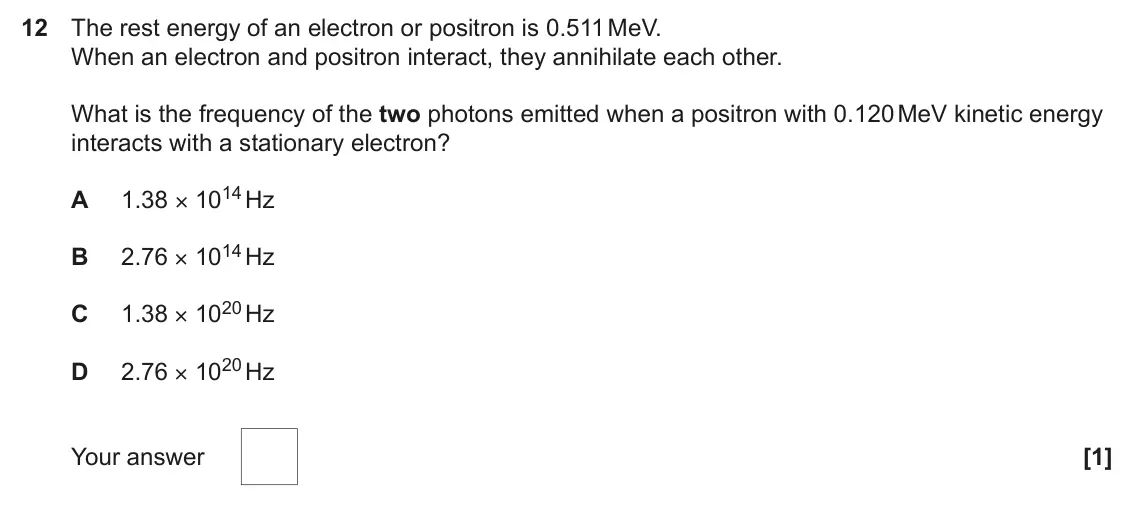
- June 2024, Paper 1, Q12 (1 mark): The rest energy of an electron or positron is 0.511 MeV. When an electron and positron interact, they annihilate each other. What is the frequency of the two ph
- June 2024, Paper 2, Q5(a) (3 marks): Describe and explain how the deflection angle of an alpha particle of the same energy with a smaller aiming error compares to the angle θ shown in Fig. 5.1. [3]
- June 2024, Paper 2, Q5(b)(i) (2 marks): Calculate the distance of nearest approach of the alpha particle to the silver nucleus. distance = m [2]
- June 2024, Paper 2, Q5(b)(ii) (1 mark): State why this value gives a maximum radius for the silver nucleus. [1]
- June 2024, Paper 2, Q5(c) (6 marks): Fig. 5.1 represents the path of an alpha particle that passes near a positively charged nucleus. θ is the deflection angle. Fig. 5.1 alpha particle θ x nucleus
- June 2024, Paper 2, Q5(d)(i) (1 mark): State the nucleon that is shown in Fig. 5.3. [1]
- June 2024, Paper 2, Q5(d)(ii) (2 marks): Suggest and explain why the kinetic energy of the electron is lower after it has scattered from the nucleon. [2]
- June 2024, Paper 2, Q6(a)(i) (1 mark): Thorium-234 decays into protactinium-234. Identify the particle X in the equation below. 234 234 91Pa + 0 90Th –1e + X [1]
- June 2024, Paper 2, Q6(a)(iii) (1 mark): State why your answer to (a)(ii) is the maximum energy of the beta-minus particle. [1]
- June 2023, Paper 1, Q8 (1 mark): Which value is the best estimate of the ratio nuclear diameter 8 atomic diameter 10–2 A 10–5 B 10–8 C 10–11 D Your answer [1]
- June 2023, Paper 1, Q19 (1 mark): The diagram shows some of the energy levels of a hydrogen atom. n = 4 E4 = –0.85 eV n = 3 E3 = –1.51 eV n = 2 E2 = –3.40 eV n = 1 E1 = –13.6 eV An electron with
- June 2023, Paper 1, Q33(a) (2 marks): Calculate the velocity of the accelerated electron, ignoring relativistic effects. electron mass = 9.1 × 10⁻³¹ kg velocity = m s–1 [2]
- June 2023, Paper 1, Q33(b) (2 marks): A much greater potential difference is used to accelerate electrons which reach a relativistic factor γ of 1.7. Calculate the accelerating potential difference.
- June 2023, Paper 1, Q33(c) (1 mark): Suggest why particles are accelerated to very high energies in nuclear scattering experiments. [1]
- June 2023, Paper 1, Q35(a) (2 marks): The kinetic energy of the particle when it is far from the nucleus is 8.0 × 10⁻¹³ J. At point A, the point of closest approach to the nucleus, the kinetic energ
- June 2023, Paper 1, Q39(b)(i) (1 mark): Complete the table below: Before reaction After reaction Total number of up quarks Total number of down quarks [1]
- June 2023, Paper 1, Q39(b)(ii) (1 mark): Explain how the equation shows that lepton number is conserved in the reaction. [1]
- June 2023, Paper 1, Q40(c)(ii) (3 marks): The hydrogen chloride molecule only absorbs and emits photons of specific frequencies. Suggest and explain what this shows about the possible amplitudes of osci
- June 2023, Paper 2, Q4(c)(i) (1 mark): Show that the momentum of an electron in a box of length 2.4 × 10⁻¹⁰ m is about 1.4 × 10⁻²⁴ kg m s–1. [1]
- June 2023, Paper 2, Q4(c)(ii) (2 marks): Calculate the kinetic energy of the electron. kinetic energy = J [2]
- June 2023, Paper 2, Q4(c)(iv) (3 marks): Use your answers to (ii) and (iii) to explain whether or not the electron would escape from the proton at this distance and explain how an estimate for the mini
- June 2022, Paper 1, Q17 (1 mark): The diagram shows the path of an alpha particle of energy E deflecting near a nucleus. alpha particle θ x nucleus Which change will reduce the deflection angle
- June 2022, Paper 1, Q18 (1 mark): A proton is accelerated through 12.4 kV and makes a direct collision with a silver (107 47Ag) nucleus. What is the closest distance the proton can approach the
- June 2022, Paper 1, Q30 (1 mark): The diagram shows some of the energy levels of a hydrogen atom. n = 4 E4 = –0.85 eV n = 3 E3 = –1.51 eV n = 2 E2 = –3.40 eV n = 1 E1 = –13.6 eV A photon of freq
- June 2022, Paper 1, Q40(c)(ii) (4 marks): Show that the velocity of an electron accelerated through 50 kV is about 1.2 × 10⁸ m s–1. [4]
- June 2022, Paper 2, Q1(c)(iii) (2 marks): When Millikan and Fletcher performed this experiment with many oil drops, they found that the charge on the drop was always a multiple of about 1.6 × 10⁻¹⁹ C (t
- June 2022, Paper 2, Q8(a) (3 marks): Explain the mechanism that produces light from aurorae and calculate the energy associated with photons of the green light of wavelength 558 nm that is often se
- November 2021, Paper 1, Q19 (1 mark): A muon of rest energy = 106 MeV is travelling at a speed of 0.99 c. The total energy of the muon is A 133 MeV B 249 MeV C 751 MeV D 5330 MeV [1] Your answer
- November 2021, Paper 1, Q20 (1 mark): The hydrogen atom can be modelled as an electron standing wave. One simple version has one ‘loop’ of the standing wave fitting in the diameter of the atom, as s
- November 2021, Paper 1, Q29 (1 mark): The diagram shows the path of two alpha particles, each of initial kinetic energy 4.0 MeV, as they are scattered by a gold nucleus. X 2d 2 1 gold nucleus d Alph
- November 2021, Paper 1, Q38(b)(iii) (1 mark): Accelerating electrons emit electromagnetic radiation. Suggest why Bohr had to introduce the quantisation principle of allowed energy levels into his model atom
- November 2021, Paper 1, Q41(a)(ii) (1 mark): The β-particles from neutron decay have a spectrum of energies up to this maximum value as shown in Fig. 41.1. relative frequency of beta emission maximum beta
- November 2021, Paper 1, Q41(a)(iv) (1 mark): A down quark has electric charge of – 1 3e. 3 State what is happening in terms of quarks during β-decay. [1]
- November 2021, Paper 2, Q3(c)(i) (2 marks): Explain how the equation shows that lepton number is conserved in the fusion reactions. [2]
- November 2020, Paper 1, Q33(a) (1 mark): State one effect of the repulsive force F on the motion of the alpha particle at position α1. [1]
- November 2020, Paper 1, Q33(b) (1 mark): At the position α2 the alpha particle is as close as it can get to the nucleus. State what has happened to the original kinetic energy of the alpha particle. [1
- November 2020, Paper 1, Q33(c)(i) (1 mark): What combination of alpha particle kinetic energy and proton number Z of the target nucleus will result in the closest possible approach? Place a tick in the co
- November 2020, Paper 1, Q33(c)(ii) (2 marks): A 7.7 MeV alpha particle makes a head-on collision with an aluminium nucleus 2 7 3 Al . 1 Calculate the distance of closest approach between the centres of the
- November 2020, Paper 1, Q42(b)(ii) (1 mark): When an electron of mass m collides elastically with a mercury atom of much greater mass M, the fraction of kinetic energy it transfers is given by the equation
- November 2020, Paper 1, Q42(b)(iii) (2 marks): Even after hundreds of collisions the electron will have lost negligible energy by elastic collisions. Explain how the dips in the graph Fig. 42.4 suggest that
- November 2020, Paper 2, Q3(a) (2 marks): Calculate the wavelength of the light released by the electron. wavelength = m [2]
- November 2020, Paper 2, Q8(a) (3 marks): Carbon-14 decays by beta emission. Identify the particle X in the equation below and state how it ensures that lepton number and mass-energy is conserved in the
- June 2019, Paper 1, Q19 (1 mark): Protons consist of quarks. 3 and the ‘down’ anti-quark has a charge of + 1e The ‘up’ anti-quark has a charge of – 2e 3 , where e is the charge on an electron. W
- June 2019, Paper 1, Q34(a)(i) (2 marks): Show that the relativistic time dilation factor γ for these particles is less than 2. γ = [2]
- June 2019, Paper 2, Q4(a)(ii) (3 marks): Explain whether it is reasonable to ignore relativistic effects in the calculation in (a)(i). Include a calculation in your explanation. [3]
- June 2018, Paper 1, Q11 (1 mark): An electron is travelling at a speed of 3.1 # 105 m s−1. What is its kinetic energy in electronvolts? 4.4 # 10−20 eV A 8.8 # 10−7 eV B C 0.27 eV D 500 eV Your a
- June 2018, Paper 1, Q19 (1 mark): An α particle approaches an atomic nucleus and is scattered through angle θ. The path of the particle is offset as shown. θ offset distance from head-on nuclear
- June 2018, Paper 1, Q33(b) (1 mark): State why an antineutrino is emitted during beta decay. [1]
- June 2018, Paper 1, Q35(a) (2 marks): Explain how this model gives rise to discrete quantised energy levels for the atom. [2]
- June 2018, Paper 1, Q35(b) (1 mark): How many different frequencies of photon can be emitted from an atom with 3 energy levels? [1]
- June 2018, Paper 1, Q35(c) (3 marks): The distance d between the walls of the box is about atomic size ≈ 0.10 nm. Calculate the frequency of the most energetic photon that this model atom could emit
- June 2018, Paper 2, Q5(a)(i) (3 marks): Explain why such scattering experiments are carried out in a vacuum. [3]
- June 2018, Paper 2, Q5(a)(ii) (3 marks): We can assume that the alpha particles come to rest for an instant at the point where the electrical potential energy of the particle is equal to the kinetic en
- June 2018, Paper 2, Q5(b)(i) (4 marks): Show that the velocity of an electron accelerated through 1.5 × 10⁸ V is very close to the velocity of light. rest energy of electron = 0.51 MeV [4]
- June 2018, Paper 2, Q5(b)(ii) (4 marks): Calculate the angle of the diffraction minimum for a beam of electrons accelerated through 1.5 × 10⁸ V scattered from a nucleus of diameter 3.0 × 10⁻¹⁴ m. For r
- June 2018, Paper 2, Q5(c) (4 marks): Electron scattering experiments show that the radius r of a nucleus of nucleon number A is 3 proportional to A . This relationship suggests that the radius of a
- June 2017, Paper 2, Q6(a) (3 marks): Explain how the decay equation shows that charge and lepton number are both conserved and name one other property that is conserved in the decay. [3]
- June 2017, Paper 2, Q6(b) (3 marks): The maximum total energy of the particles formed from the muon is about 106 MeV. Show that this suggests that the mass of the muon is about 200 times that of an
- June 2017, Paper 2, Q12 (6 marks): 12* This question is about spectroscopic measurements of stellar distances. Describe how absorption spectra are formed and how they are useful in establishing t
Questions, mark schemes and examiner’s reports are © OCR, from their published past papers. Plumi isn’t affiliated with any exam board. Want whole papers? Every OCR A-Level Physics B paper.
Rather write your answers by hand on iPad? Plumi marks them against the same mark schemes.