 plumi
Charge and field: OCR A‑Level Physics B questions
Every OCR A-Level Physics B exam question on 6.1.2 Charge and field, 2016–2025, with its mark scheme and examiner’s report.
Find questions1,881
Calculations

Q40(a)(i)
The whole paper ↗
Q40(a)(ii)
The whole paper ↗
Q40(b)(i)
The whole paper ↗
Q40(b)(ii)
The whole paper ↗
Q2(a)(ii)
The whole paper ↗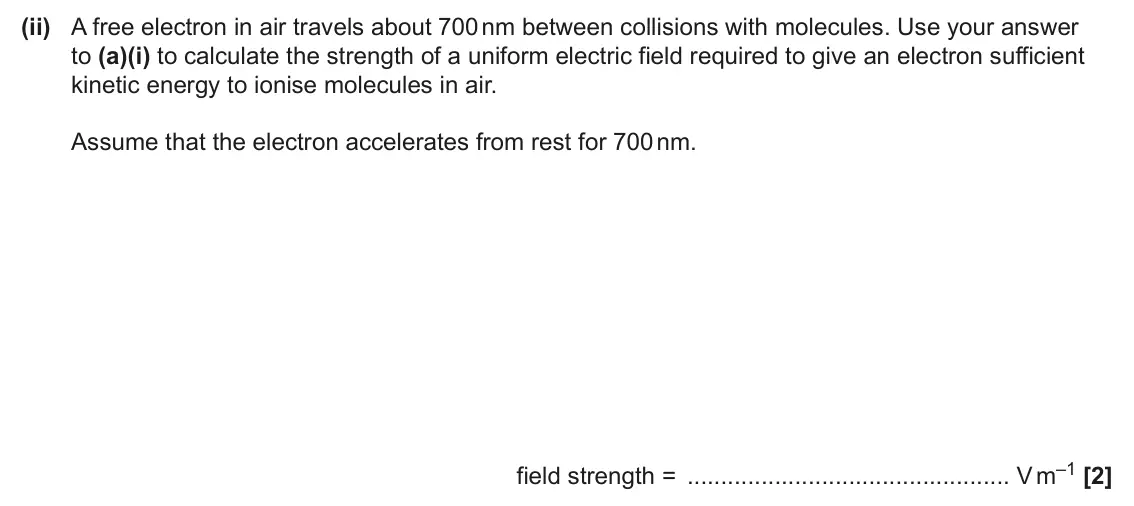
Q2(a)(iii)
The whole paper ↗
Q2(b)(i)
The whole paper ↗
Q2(b)(ii)
The whole paper ↗
Q5(b)(i)
The whole paper ↗
Q5(b)(ii)
The whole paper ↗
Q5(c)(i)
The whole paper ↗
Q2(d)
The whole paper ↗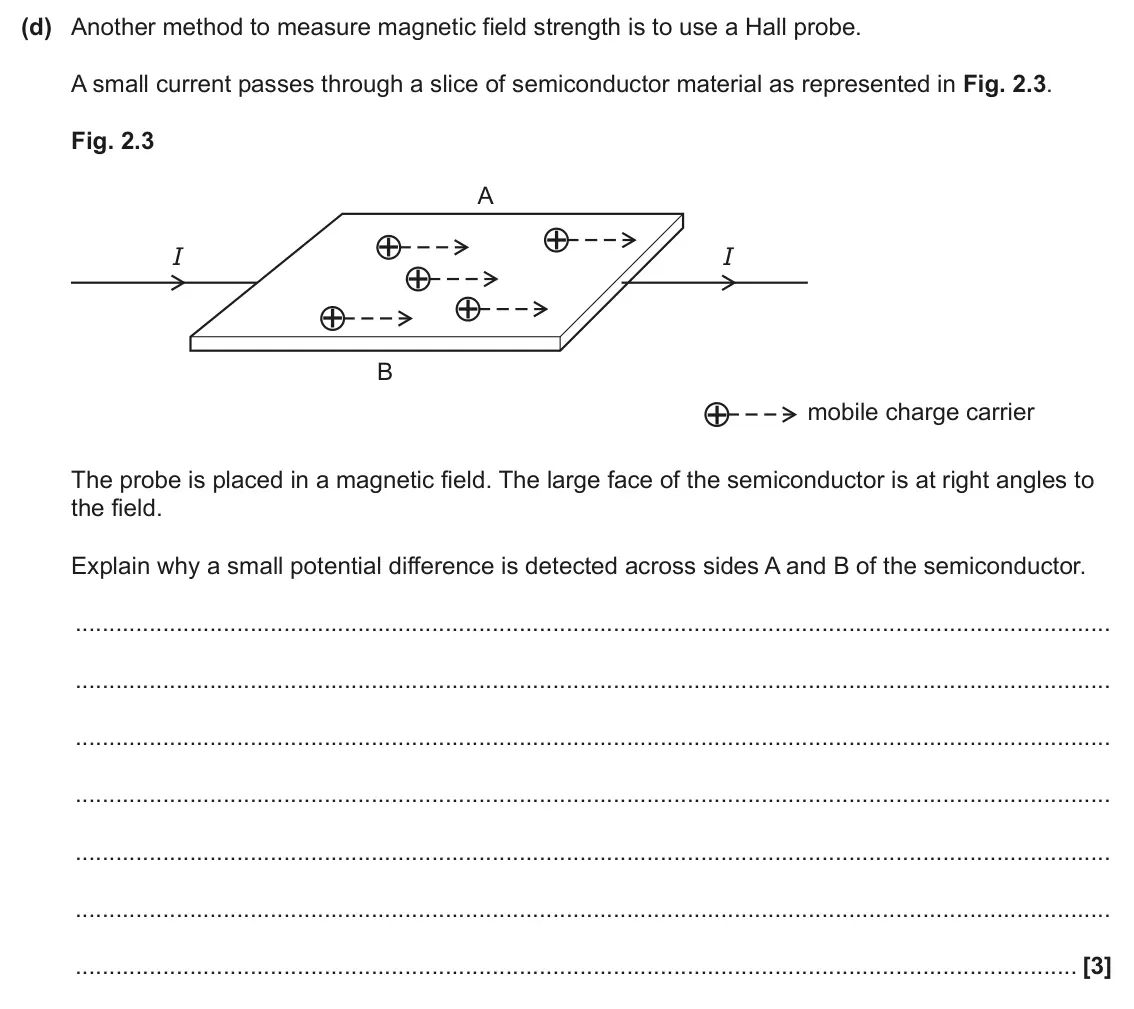
Q40(a)(i)
The whole paper ↗
Q40(a)(ii)
The whole paper ↗
Q40(b)
The whole paper ↗
Q40(c)
The whole paper ↗


All 79 questions on Charge and field, as a list
- June 2025, Paper 1, Q23 (1 mark): Which quantity gives the strength of an electric field around an isolated charge? A The area under a graph of electric field versus distance B The area under a
- June 2025, Paper 1, Q40(a)(i) (2 marks): The electrons in the beam are accelerated through a potential difference V. When they enter the magnetic field of flux density B they follow a circular path of
- June 2025, Paper 1, Q40(a)(ii) (3 marks): Fig. 40.2 shows the path of the electron beam on the fluorescent screen when the magnetic field is produced by the coils. Fig. 40.2 y x The radius of the circul
- June 2025, Paper 1, Q40(b)(i) (3 marks): Use data for the oil drop when it is falling. [3]
- June 2025, Paper 1, Q40(b)(ii) (3 marks): Calculate the charge on the oil drop. Use data for the oil drop when it is stationary. charge = C [3]
- June 2025, Paper 2, Q2(a)(ii) (2 marks): A free electron in air travels about 700 nm between collisions with molecules. Use your answer to (a)(i) to calculate the strength of a uniform electric field r
- June 2025, Paper 2, Q2(a)(iii) (2 marks): Explain why the number of ions formed per second will initially rise at increasing rate after the first ionisation event. [2]
- June 2025, Paper 2, Q2(b)(i) (2 marks): Draw field lines linking the points on the bottom of the cloud marked A to E to points of zero potential. [2]
- June 2025, Paper 2, Q2(b)(ii) (2 marks): State and explain where the force on free electrons will be the greatest in the region between the zero potential surface and the lower edge of the cloud. [2]
- June 2025, Paper 2, Q5(b)(i) (3 marks): Calculate the ratio of the force due to the electric field (electrostatic force) between a proton and an electron and the gravitational force between the same p
- June 2025, Paper 2, Q5(b)(ii) (2 marks): State why gravity is the dominant force in the large‑scale structure of the Universe even though it is weaker than the electrostatic force on an atomic level. [
- June 2025, Paper 2, Q5(c)(i) (2 marks): Calculate the centripetal acceleration of an electron orbiting a proton at a separation of 0.5 × 10⁻¹⁰ m. centripetal acceleration = m s–2 [2]
- June 2025, Paper 3, Q2(d) (3 marks): Another method to measure magnetic field strength is to use a Hall probe. A small current passes through a slice of semiconductor material as represented in Fig
- June 2024, Paper 1, Q40(a)(i) (2 marks): Show that the speed of the electrons when they enter the magnetic field is about 1.9 × 10⁷ m s–1. Ignore relativistic effects. [2]
- June 2024, Paper 1, Q40(a)(ii) (4 marks): Describe the path followed by the electron beam when it is passing through the region of magnetic field. You may add to Fig. 40.1 in your description. Include c
- June 2024, Paper 1, Q40(b) (2 marks): Fig. 40.2 shows the same experiment when two vertical metal plates are positioned parallel to the initial velocity of the electron. A potential difference is ap
- June 2024, Paper 1, Q40(c) (4 marks): The same equipment is used to accelerate negative ions through a potential difference of 1.0 kV. With the same magnetic field, a potential difference of 120 V i
- June 2023, Paper 1, Q6 (1 mark): Two parallel conducting plates P and Q have a p.d. V between them. They are separated by distance d. + V 0 V d P Q Which graph shows the variation of electric f
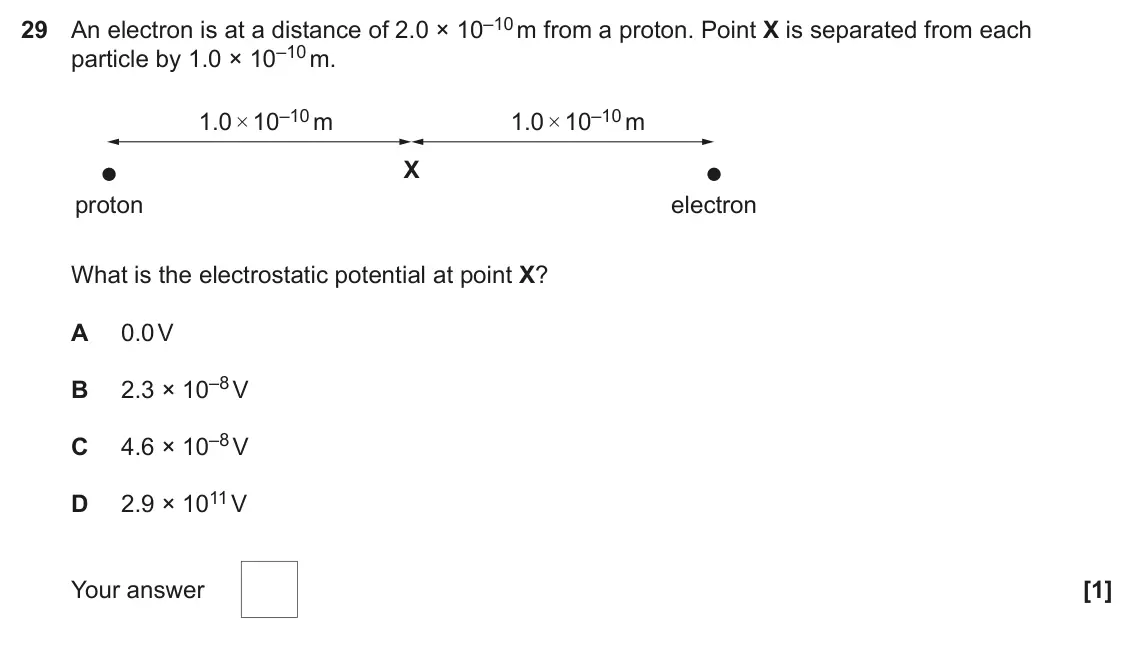
- June 2023, Paper 1, Q29 (1 mark): An electron is at a distance of 2.0 × 10⁻¹⁰ m from a proton. Point X is separated from each particle by 1.0 × 10⁻¹⁰ m. 1.0 × 10⁻¹⁰ m 1.0 × 10⁻¹⁰ m X proton elec
- June 2023, Paper 1, Q30 (1 mark): An electron travelling at 8.5 × 10⁶ m s–1 enters a uniform magnetic field of flux density 0.57 mT. r What is the radius r of the circular path of the electron i
- June 2023, Paper 1, Q35(b) (2 marks): Explain why the acceleration of the alpha particle is greatest at position A. [2]
- June 2023, Paper 2, Q4(c)(iii) (2 marks): Calculate the potential energy of an electron at a distance of 1.2 × 10⁻¹⁰ m from a proton. potential energy = J [2]
- June 2022, Paper 1, Q19 (1 mark): Which feature represents the magnitude of electrical field strength at a point? Your answer [1]
- June 2022, Paper 1, Q20 (1 mark): Which feature represents a change in electrical potential between two points? Your answer [1]
- June 2022, Paper 1, Q26 (1 mark): The diagram shows a point X at displacement r from a single point charge +q. The electric field strength at X is E. +q X r A charge of –2q is brought to the sam
- June 2022, Paper 1, Q35(a) (2 marks): Use the data in the table to show that 1 electric field strength ∝ (distance from centre of charge)2 Explain your method. Explanation: [2]
- June 2022, Paper 1, Q35(b) (2 marks): Explain why the electric potential due to the charged sphere decreases more gradually with distance from the sphere than the decrease of electric field strength
- June 2022, Paper 2, Q1(c)(i) (2 marks): Draw six lines on Fig. 1.2 to represent the uniform field between the plates. Assume that the oil drop does not distort the field. [2]
- June 2022, Paper 2, Q1(c)(ii) (2 marks): The drop of mass 1.8 × 10⁻¹⁵ kg is held stationary between the plates when the p.d.V between the plates is 200 V. The plate separation is 5.4 mm. Calculate the
- June 2022, Paper 2, Q1(c)(iii) (2 marks): When Millikan and Fletcher performed this experiment with many oil drops, they found that the charge on the drop was always a multiple of about 1.6 × 10⁻¹⁹ C (t
- June 2022, Paper 2, Q8(b)(i) (2 marks): The article states that the charged particles in the solar wind ‘spiral down the magnetic field near the poles’. Consider an electron in the solar wind moving w
- June 2022, Paper 2, Q8(b)(ii) (4 marks): Consider the situation represented in Fig. 8.2. An electron is travelling at 5.0 × 10⁵ m s–1 at an angle of 25° to the direction of the magnetic field of streng
- June 2022, Paper 2, Q8(b)(iii) (2 marks): Suggest and explain how the spiral might change as the electron moves nearer to the pole, considering the strengthening field and the energy transferred to part
- June 2022, Paper 2, Q9 (6 marks): 9* This question is about the slow rate of fusion in the Sun (lines 33 – 47). The temperature of the core of the Sun is 1.5 × 10⁷ K. Assuming that two protons n
- November 2021, Paper 1, Q38(a)(i) (2 marks): Show by calculation that E is about 1 × 10¹² V m–1 at distance 40 × 10–12 m from the centre of the proton. [2]
- November 2021, Paper 1, Q38(a)(ii) (2 marks): Fig. 38.1 shows the electric field strength E near to a proton. 1.0 E / ×1012 V m–1 0.8 0.6 0.4 0.2 0.0 0 20 40 60 80 100 120 140 160 r / pm Fig. 38.1 Use any t
- November 2021, Paper 1, Q38(a)(iii) (2 marks): State what the area under the graph between two r values represents and make an estimate of its value between the marked r values 52 and 160 pm. Area represents
- November 2021, Paper 1, Q38(b)(i) (1 mark): Show that the kinetic energy of the electron in orbit is k e2 2r where k is the electric force constant = 1 / 4πεo. [1]
- November 2021, Paper 1, Q38(b)(ii) (2 marks): Fig. 38.3 shows the variation of kinetic energy and potential energy of the electron with the radius of its orbit r. 20 energy / eV 10 kinetic energy 0 potentia
- November 2021, Paper 1, Q38(b)(iv) (2 marks): In Bohr’s quantised model the radius of orbit for the ground state of the electron (lowest total energy) is given by the equation: ε 0h 2 r = π m e 2 where m an
- November 2021, Paper 2, Q1(a)(iii) (1 mark): Explain why electrical potential can be positive or negative. [1]
- November 2020, Paper 1, Q19 (1 mark): There are similarities and differences between electric charges, fields and potentials and gravitational masses, fields and potentials. Which one of the followi
- November 2020, Paper 1, Q22 (1 mark): The speed of an alpha particle is 8 times the speed of a beta particle. They both travel through a 0.3 T uniform magnetic field perpendicular to their path. for
- November 2020, Paper 1, Q42(a)(i) (1 mark): Draw on Fig. 42.1 above the equipotential line at + 8.0 V. [1] potential / V 12 0 A B displacement Fig. 42.2
- November 2020, Paper 1, Q42(a)(ii) (1 mark): Draw on Fig. 42.2 a line which shows how the potential varies along the field line AB. [1]
- November 2020, Paper 1, Q42(a)(iii) (1 mark): The distance AB is 5.0 mm. Calculate the electric field between the plates. electric field = V m−1 [1]
- November 2020, Paper 1, Q42(b)(i) (2 marks): Use data from Fig. 42.4 to show that the value of the velocity of the electron when accelerated through the potential difference Va is greater than 1 × 10⁶ m s−
- November 2020, Paper 2, Q9(a) (3 marks): A doubly-charged carbon-14 atom is accelerated through a potential difference of 4.2 MV and enters a uniform magnetic field of strength 0.72 T. Use the equation
- November 2020, Paper 2, Q9(b) (2 marks): Explain why it is important to ensure that no 12CH2 2+ and 13CH+ ions reach the second deflecting magnet (See Fig. 6 in the Advance Notice Article). [2]
- June 2019, Paper 1, Q12 (1 mark): A positive and a negative charge of equal magnitude are placed near each other. Which diagram best represents the electric field of the two charges? A B – – + +
- June 2019, Paper 1, Q13 (1 mark): Two horizontal metal plates are 5.0 mm apart. The plates are at potentials of + 120 V and + 40 V. + 120 V 5.0 mm + 40 V What is the force experienced by an elec
- June 2019, Paper 1, Q37(b)(i) (2 marks): To estimate the temperature at which 2H and 3H nuclei will fuse, a student writes down the formula: e2 4πε0R ≈ k T Explain what the two sides of the approximati
- June 2019, Paper 1, Q37(b)(ii) (1 mark): Use the equation in (b)(i) to estimate this temperature when R ≈ 2 × 10⁻¹⁴ m. temperature = K [1]
- June 2019, Paper 2, Q4(a)(i) (2 marks): An electron is accelerated through a p.d. of 4.3 kV. Calculate the velocity of the accelerated electron. Ignore relativistic effects. velocity = m s–1 [2]
- June 2019, Paper 2, Q6(a) (1 mark): State how Fig. 6.2 shows that the electric field is uniform within the selector. [1]
- June 2019, Paper 2, Q6(b)(i) (2 marks): By considering the forces on the charge, explain why the charge will not be deflected when v = Es . Bs [2]
- June 2019, Paper 2, Q6(b)(ii) (2 marks): Show that the units of magnetic field strength are equivalent to the unit of velocity. [2]
- June 2019, Paper 2, Q6(b)(iii) (3 marks): Describe and explain the motion of charges moving through the region if their velocities are not equal to Es . Bs [3]
- June 2019, Paper 2, Q6(c)(i) (1 mark): Show that the force on a proton moving at a velocity of 5.2 × 10⁶ m s–1 at right angles to a field of strength 0.64 T is about 5.3 × 10⁻¹³ N. [1]
- June 2019, Paper 2, Q6(c)(ii) (2 marks): Calculate the radius r of the path the proton will follow. radius = m [2]
- June 2019, Paper 2, Q6(c)(iii) (3 marks): A beam of 12 6C and 14 6C singly charged positive ions with equal velocities enters a deflection region, travelling at right angles to a uniform magnetic field
- June 2018, Paper 1, Q20 (1 mark): Which expression gives the time for the particle to complete one circle of its motion? 2r m A Bqr 2r mr B Bq 2r m C Bq Bq D 2r m Your answer [1]
- June 2018, Paper 1, Q21 (1 mark): A proton and an α particle, with the same velocity, enter the region of constant magnetic flux density. r What is the ratio of the radii of their paths, ? a rpr
- June 2018, Paper 1, Q29 (1 mark): The electric potential at a distance r from a positive point charge Q is 450 V. The potential increases to 500 V when the distance from the point charge decreas
- June 2018, Paper 1, Q37(b)(i) (2 marks): A positive ion of charge Q and mass m is accelerated through a p.d. V. Show that the p it gains is given by the expression momentum per unit mass m p c m. Q 2 V
- June 2018, Paper 1, Q37(b)(ii) (2 marks): Discuss an advantage of using ions of hydrogen 1H+ as propellant instead of xenon 130Xe+. [2]
- June 2018, Paper 1, Q41(a)(i) (1 mark): Explain why the electric field strength at X is zero. [1]
- June 2018, Paper 1, Q41(a)(ii) (2 marks): Calculate the electric potential at X. potential = V [2] Question 41 continues on page 35
- June 2018, Paper 1, Q41(b)(i) (4 marks): Show that the resultant force F on the third proton is about 4 # 10−10 N in the direction shown. Explain your reasoning. You may include a diagram in your answe
- June 2018, Paper 1, Q41(b)(ii) (2 marks): The separation of protons in a lithium the magnitude of the resultant electric force on a proton in the nucleus if the protons are arranged symmetrically as in
- June 2018, Paper 3, Q3(b)(i) (2 marks): Calculate the electric field strength E between the two parallel plates. Include a suitable unit. E = …………………. unit ………… [2]
- June 2018, Paper 3, Q3(b)(ii) (3 marks): Calculate the charge q carried by each oil drop. q = C [3]
- June 2018, Paper 3, Q3(b)(iii) (2 marks): This calculation does not take into account the effect of buoyancy from the displaced air. This effect produces an additional upwards force on the oil drop. Exp
- June 2018, Paper 3, Q3(c) (2 marks): The charge on the parallel metal plates is reversed. Explain the effect this has on the motion of the oil drop. [2]
- June 2017, Paper 1, Q25 (1 mark): An oil drop of mass m charged by one electron is balanced between two parallel horizontal metal plates. A potential difference V is applied between the plates a
- June 2017, Paper 1, Q41(a) (2 marks): On the appropriate figure(s) mark a point • N where the electric field is zero and a point • V [2] where the electric potential is zero.
- June 2017, Paper 1, Q41(b) (2 marks): On each of Fig. 41.1 and 41.2 draw three complete equipotential lines. [2]
- June 2017, Paper 1, Q41(c) (2 marks): Fig. 41.2 can also represent two spherical charge distributions of +1 C and –1 C situated 1 km apart. Calculate the electric field midway between the charge cen
- June 2017, Paper 1, Q41(d) (6 marks): Fig. 41.1 shows the electric field pattern near two protons and Fig. 41.2 the electric field pattern near a proton and an electron. Fig. 41.1 Fig. 41.2 (d)* Fig
Questions, mark schemes and examiner’s reports are © OCR, from their published past papers. Plumi isn’t affiliated with any exam board. Want whole papers? Every OCR A-Level Physics B paper.
Rather write your answers by hand on iPad? Plumi marks them against the same mark schemes.