 plumi
Projectiles and step-by-step modelling: OCR A‑Level Physics B questions
OCR A-Level Physics B past-paper questions on 4.2.2 Projectiles and step-by-step modelling, 2016–2025, with mark schemes and examiner’s reports where available.
Paper
All papers
Exam
All years
Calculations
Q31(a)(i)
The whole paper ↗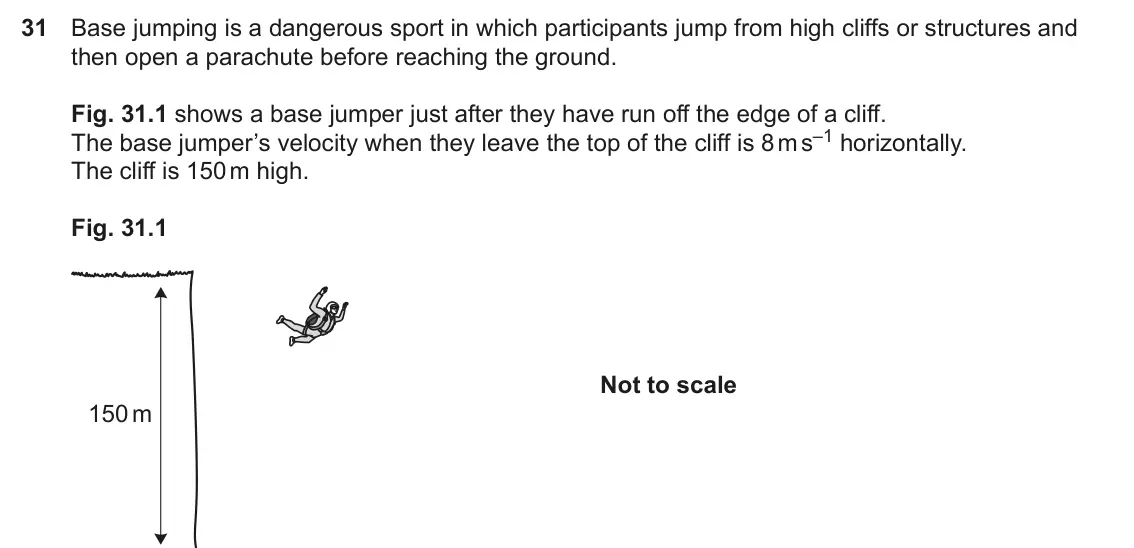
Q31(b)
The whole paper ↗- Your answer
Q7(b)(i)
The whole paper ↗
Q7(b)(ii)
The whole paper ↗Q7(b)(iii)
The whole paper ↗Q3(a)
The whole paper ↗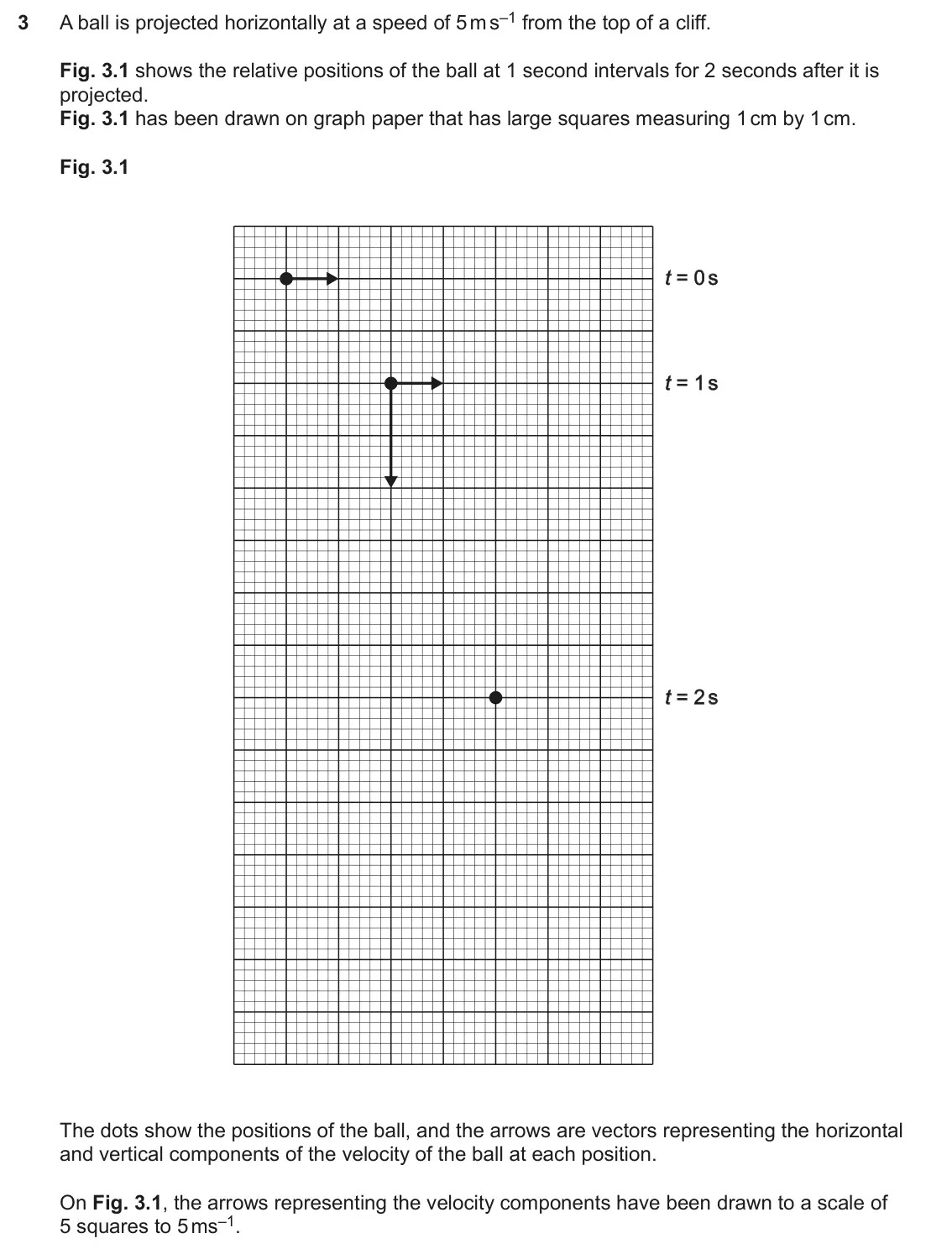
Q3(b)
The whole paper ↗Q7(b)(iii)
The whole paper ↗
Q7(b)(iv)
The whole paper ↗Q2(a)(i)
The whole paper ↗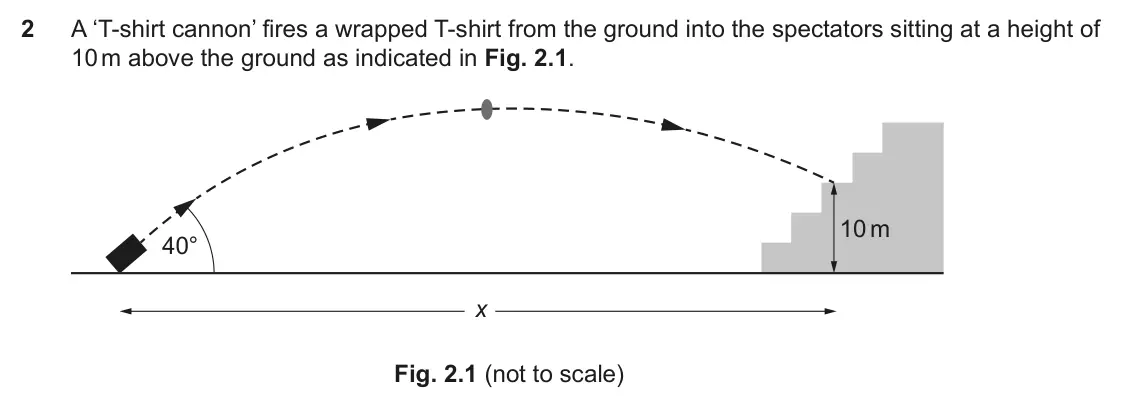
Q2(a)(ii)
The whole paper ↗Q1(b)
The whole paper ↗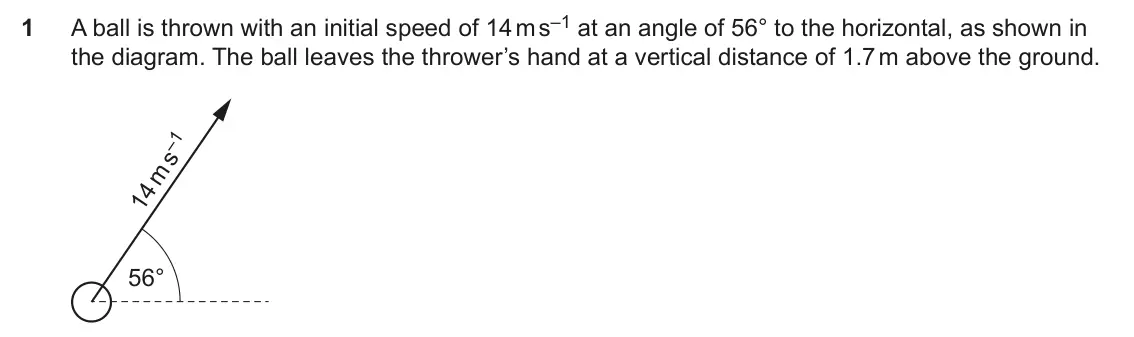
Q1(c)
The whole paper ↗Q1(b)
The whole paper ↗
Q1(c)
The whole paper ↗- Your answer
Q6(c)(i)
The whole paper ↗
Q6(c)(ii)
The whole paper ↗Q6(c)(iii)
The whole paper ↗
All 40 questions on Projectiles and step-by-step modelling, as a list
- June 2025, Paper 1, Q31(a)(i) (2 marks): Calculate the vertical component of the velocity 1.5 s after the base jumper leaves the edge of the cliff. vertical component = m s–1 [2]
- June 2025, Paper 1, Q31(b) (3 marks): To avoid injury, the base jumper must open the parachute when: • they are at least 20 m from the cliff • at least 80 m above the ground. Deduce whether or not t
- June 2025, AS Paper 1, Q19 (1 mark): A projectile is fired at 10 m s–1 horizontally from a 50 m high cliff. 10 m s–1 50 m How long does it take for the projectile to hit the ground? A 1.69 s B 2.32
- June 2025, AS Paper 2, Q7(b)(i) (1 mark): Use the m and F values to calculate the missing values of a and write them in the table. [1]
- June 2025, AS Paper 2, Q7(b)(ii) (2 marks): Calculate the missing values of v using the time and previous value of a and write them in the table. [2]
- June 2025, AS Paper 2, Q7(b)(iii) (2 marks): State and explain the effect of making the time intervals between iterations shorter on the calculated velocity at 3.00 s. [2]
- June 2024, AS Paper 2, Q3(a) (2 marks): Explain how Fig. 3.1 shows that air resistance acting on the ball is negligible. [2]
- June 2024, AS Paper 2, Q3(b) (3 marks): On Fig. 3.1 draw arrows to represent the horizontal and vertical components of the ball’s velocity at time 2 s and use the diagram to calculate the magnitude of
- June 2024, AS Paper 2, Q7(b)(iii) (3 marks): (1) Write down the equation in terms of aprevious, Δ t, vnew and vprevious to calculate the velocity of the ball at a given time. [1] (2) Write down the formula
- June 2024, AS Paper 2, Q7(b)(iv) (2 marks): Describe an advantage of using this computational method to model the motion of a falling ball experiencing a changing resultant force. Suggest how the model ca
- June 2023, Paper 2, Q2(a)(i) (2 marks): The velocity of the shirt when it leaves the cannon is 30 m s–1 at an angle of 40° to the horizontal. Ignoring the effects of air resistance, show that the high
- June 2023, Paper 2, Q2(a)(ii) (3 marks): Calculate the horizontal distance x between the cannon and the place where the T-shirt landed in the spectators. horizontal distance = m [3] 5 T-shirt barrel co
- June 2023, AS Paper 2, Q1(b) (2 marks): Calculate the maximum height above the ground reached by the ball. You can assume that air resistance is negligible. height = m [2]
- June 2023, AS Paper 2, Q1(c) (2 marks): Calculate the horizontal distance between the point where the ball is thrown and the point where it reaches its maximum height. distance = m [2]
- June 2022, AS Paper 2, Q1(b) (2 marks): The glowing fragments travel initially horizontally at a speed of 15 m s–1. Calculate the distance of one fragment from its launch site when it reaches the grou
- June 2022, AS Paper 2, Q1(c) (2 marks): Calculate the angle θ with the horizontal at which the fragment hits the ground. angle = ° [2]
- November 2021, AS Paper 1, Q15 (1 mark): A projectile at height 5 m above the ground is launched horizontally at speed 10 m s–1. Ignore the effect of air resistance. Which statement is correct? A The h
- November 2021, AS Paper 2, Q6(c)(i) (1 mark): The process used is to calculate each value of v from the one before. The mass m and resultant force F are constant throughout giving constant acceleration a =
- November 2021, AS Paper 2, Q6(c)(ii) (1 mark): If 50 kg of fuel is burnt each second, Table 6.1 becomes as follows. a / m s–2 v / m s–1 t / s m / kg F / N 0 1000 2000 2.0 0.0 2 900 2000 4.0 4 800 2000 6 700
- November 2021, AS Paper 2, Q6(c)(iii) (2 marks): Calculate the values of v as in (i), using each time the previous value of a, and insert them in Table 6.2. The value for t = 2 s has been done as an example. [
- November 2021, AS Paper 2, Q6(c)(iv) (2 marks): Explain the effect of including the loss of mass in the calculations of velocity shown in Table 6.1 and Table 6.2 above. [2]
- November 2020, Paper 1, Q37(a)(i) (1 mark): Complete Fig. 37.1 to show the complete trajectory back to ground level. [1]
- November 2020, Paper 1, Q37(a)(iii) (2 marks): The time intervals of the steps in the approximation are Δt = 2.0 s. The change in vertical velocity over each time interval of 2.0 s is 20 m s−1 downwards. 1 C
- November 2020, Paper 1, Q37(a)(iv) (1 mark): The horizontal range R of a projectile launched at initial velocity v at angle θ to the horizontal is given by R = v2 sin 2θ . g Use the equation to calculate t
- November 2020, Paper 1, Q37(b) (3 marks): In a demonstration, a projectile is fired from a gun as shown in Fig. 37.2. Fig. 37.2 (not to scale) The projectile leaves the gun at a velocity of 140 m s−1 at
- November 2020, Paper 1, Q37(c) (6 marks): Fig. 37.1 shows how an approximation to a parabolic trajectory (x - y graph) can be built in steps for a projectile launched at 45°, undergoing constant downwar
- November 2020, AS Paper 1, Q17 (1 mark): An aircraft travelling horizontally at 50 ms−1 releases a food parcel of mass 500 kg from a height of 500 m. ground x Calculate the angle, x, at which the parce
- June 2019, Paper 1, Q32(a) (3 marks): The first throw path F has initial horizontal velocity of 8.0 m s−1. Calculate the horizontal range R for this path. You may ignore the effects of air resistanc
- June 2019, Paper 1, Q32(b) (2 marks): The second path S is also from a horizontal projection and achieves a range that is three times larger (3 R) than the first path F. State the initial horizontal
- June 2019, AS Paper 1, Q4 (1 mark): A paintball is fired from a gun 1.8 m above the ground at a velocity of 75 m s–1 horizontally. 4 Ignore the effect of air resistance. How long will the paintbal
- June 2018, Paper 1, Q24 (1 mark): A ball is kicked from horizontal ground at a velocity of 15 m s−1 at an angle of 20° to the horizontal. How long will the ball remain in the air before hitting
- June 2018, Paper 2, Q4(b)(i) (3 marks): The motion of a falling object, taking account of drag forces, can be modelled iteratively as shown below: acceleration a0 = 9.81 m s–2 at t0 = 0.000 s Δv = a0Δ
- June 2018, Paper 2, Q4(b)(ii) (6 marks): This question is about objects falling in a gravitational field. (ii)* Further iterations of the calculation produce the graph in Fig. 4.3. 60 s / m 50 40 30 20
- June 2017, AS Paper 2, Q6(a)(i) (2 marks): Show that the time t is given by the equation 2 sin v i . = t g [2]
- June 2017, AS Paper 2, Q6(a)(ii) (3 marks): Use the equation from part (a)(i) above to complete this table for a projectile of initial speed v = 24 m s−1 by adding the value of R for an angle of 76°. 15 2
- June 2017, AS Paper 2, Q6(b) (3 marks): A real projectile such as a tennis ball is greatly affected by air resistance. State and explain how you would expect the R–i graph for such a projectile, also
- June 2017, AS Paper 2, Q6(c) (6 marks): This question is about projectile motion. Fig. 6.1 shows the path taken by an object thrown with an initial velocity v at a direction i to the horizontal. v i R
- June 2016, AS Paper 1, Q11 (1 mark): A ball is thrown at an angle of 30° to the horizontal. The initial kinetic energy of the ball is K. Air resistance has negligible effect on the motion of the ba
- June 2016, AS Paper 2, Q5(b)(i) (3 marks): Show that the arrow takes about 5 s to reach the target. Ignore any effect of the air. [3]
- June 2016, AS Paper 2, Q5(b)(ii) (2 marks): Calculate the distance from the archer to the target. distance = m [2]
Questions, mark schemes and examiner’s reports are © OCR, from their published past papers. Plumi isn’t affiliated with any exam board. Want whole papers? OCR A-Level Physics B past papers.
The Plumi iPad app also offers exam-style questions with AI feedback on your handwritten working.