 plumi
Superposition: OCR A‑Level Physics A questions
Every OCR A-Level Physics A exam question on 4.4.3 Superposition, 2016–2025, with its mark scheme and examiner’s report.
Find questions1,877
Calculations

Q20(a)
The whole paper ↗
Q20(b)(i)
The whole paper ↗
Q20(b)(ii)
The whole paper ↗
Q7(b)(i)
The whole paper ↗
Q7(b)(ii)
The whole paper ↗
Q7(b)(iii)
The whole paper ↗

Q17(a)
The whole paper ↗
Q17(b)
The whole paper ↗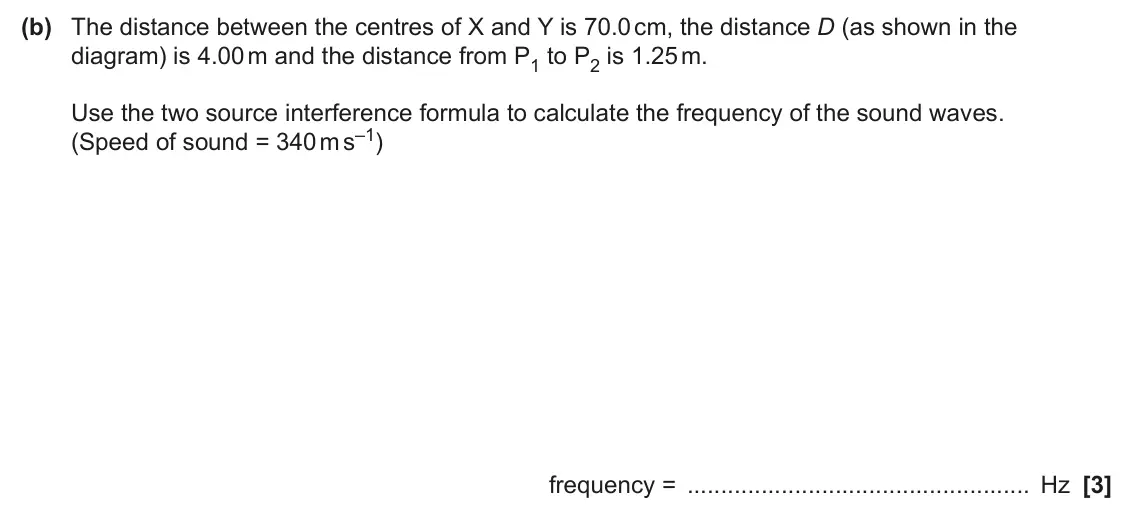
Q17(c)
The whole paper ↗


Q16(a)
The whole paper ↗
Q16(b)
The whole paper ↗
Q16(c)
The whole paper ↗
Q16(d)
The whole paper ↗
Q5(c)(i)
The whole paper ↗
Q5(c)(ii)
The whole paper ↗
All 72 questions on Superposition, as a list
- June 2025, Paper 1, Q11 (1 mark): Monochromatic light of wavelength 600 nm is passed through a diffraction grating. Maxima are formed on a screen 3.0 m from the grating. The distance between the
- June 2025, Paper 2, Q20(a) (2 marks): Draw a diagram in the space below to show how superposition between two waves can cause destructive interference. [2]
- June 2025, Paper 2, Q20(b)(i) (3 marks): Show that the fringe spacing, x, is approximately x ≈ Dλ d State clearly any approximations you make. Approximations [3]
- June 2025, Paper 2, Q20(b)(ii) (4 marks): Explain how the fringe pattern changes if 1 the laser emitting red light is replaced with a green laser [2] 2 the laser emitting red light is replaced with a wh
- June 2025, AS Paper 2, Q7(b)(i) (1 mark): The light from the laser that falls on the double slit is coherent. State the meaning of the term coherent. [1]
- June 2025, AS Paper 2, Q7(b)(ii) (2 marks): Explain how the student determined the fringe width. [2]
- June 2025, AS Paper 2, Q7(b)(iii) (2 marks): Calculate the separation a of the slits. Give your answer to 3 significant figures. a = m [2]
- June 2024, Paper 1, Q19 (6 marks): 19* Describe how to determine the wavelength λ of a monochromatic laser pointer using a diffraction grating. As part of your answer, explain how to • analyse th
- June 2024, Paper 2, Q17(a) (2 marks): Explain these observations. [2]
- June 2024, Paper 2, Q17(b) (3 marks): The distance between the centres of X and Y is 70.0 cm, the distance D (as shown in the diagram) is 4.00 m and the distance from P1 to P2 is 1.25 m. Use the two
- June 2024, Paper 2, Q17(c) (2 marks): Loudspeaker Y is now replaced with a loudspeaker that produces sound waves of twice the original amplitude. Describe how the signal observed on the oscilloscope
- June 2024, AS Paper 1, Q2 (1 mark): Two waves, of wavelength λ, undergo constructive interference. What is a possible path difference between the two waves? λ A 4 λ B 2 3λ C 2 D λ Your answer [1]
- June 2024, AS Paper 1, Q12 (1 mark): In the Young double-slit experiment, light passes through two narrow slits and a pattern of light is observed on a screen. Which property of light is not demons
- June 2024, AS Paper 1, Q13 (1 mark): In a Young double-slit experiment, electromagnetic radiation is incident on a double slit. The following results are obtained. distance from slits to screen = 3
- June 2023, Paper 2, Q16(a) (2 marks): Name the physical processes that cause the features labelled A, D and B, C in Fig. 16.1. A and D B and C [2]
- June 2023, Paper 2, Q16(b) (1 mark): The Young double-slit experiment uses coherent waves. State what coherent means. [1]
- June 2023, Paper 2, Q16(c) (2 marks): Explain how the part of the pattern labelled B is formed. [2]
- June 2023, Paper 2, Q16(d) (3 marks): Calculate the angle θ from the central maximum C to the maximum labelled B as shown in Fig. 16.2. θ = ° [3]
- June 2023, AS Paper 2, Q5(c)(i) (3 marks): The distance between P and D1 is 12.2 cm. The distance between P and D2 is 20.2 cm. Explain whether constructive or destructive interference occurs at P. [3]
- June 2023, AS Paper 2, Q5(c)(ii) (3 marks): The distance between Q and D1 is 12.5 cm. The distance between Q and D2 is 19.7 cm. Calculate the phase difference φ, in rad, between the waves arriving at poin
- June 2022, Paper 1, Q13 (1 mark): Light from a hydrogen source is incident normally at a diffraction grating. The first order maximum of the H-alpha spectral line of wavelength 486 nm is observe
- June 2022, Paper 2, Q16(b) (2 marks): A beam of coherent light of wavelength λ is incident normally at two parallel slits (double-slit). A series of bright and dark fringes are formed on a distant s
- June 2022, Paper 3, Q5(b)(i) (6 marks): The student connects two microwave transmitters X and Y, and places them in front of a microwave detector D, as shown in the diagram below. P A X B Y D Q The tr
- June 2022, Paper 3, Q5(b)(ii) (3 marks): Transmitter X is rotated about the line AB and the experiment is repeated at different orientations until it has been rotated by 180°. Describe and explain the
- June 2022, AS Paper 1, Q4 (1 mark): A student is carrying out the Young double-slit experiment using visible light. The distance between the slits and the screen is kept constant. The wavelength o
- June 2022, AS Paper 1, Q6 (1 mark): Two coherent waves are emitted from the sources X and Y. X b Y P a The diagram is not to scale. The waves at X and Y are in phase. The waves have wavelength 4.0
- June 2022, AS Paper 2, Q8 (6 marks): 8* In an experiment to investigate microwaves, a microwave detector D is placed 100.0 cm from a microwave transmitter T. thin metal sheet R y D T 50.0 cm 50.0 c
- November 2021, Paper 2, Q2 (1 mark): Monochromatic light from a laser is incident normally on a diffraction grating. A series of bright dots are formed on a distant screen. Which two terms can be u
- November 2021, Paper 2, Q8 (1 mark): A double-slit is used in an interference experiment to independently investigate the light from two sources K and L. The light from the sources have different w
- November 2021, Paper 2, Q11 (1 mark): The diagram below shows the graphs of displacement x against time t for two waves S and T. 3.0 T T 2.0 S S x / mm 1.0 0 0 5.0 10.0 t / ms – 1.0 – 2.0 – 3.0 The
- November 2021, AS Paper 1, Q11 (1 mark): Monochromatic light is incident on a double slit. A pattern of dark and bright fringes is formed on a distant screen. Which term, together with diffraction, can
- November 2021, AS Paper 2, Q1(a) (1 mark): State what is meant by the term coherent. [1]
- November 2021, AS Paper 2, Q1(b)(i) (1 mark): Calculate the path difference at point J between the waves from S1 and S2. path difference = m [1]
- November 2021, AS Paper 2, Q1(b)(ii) (1 mark): State the phase difference in radian at point J between the waves from S1 and S2. phase difference = rad [1]
- November 2021, AS Paper 2, Q1(b)(iii) (1 mark): Show that the wavelength of the sound waves is 0.16 m. [1]
- November 2020, Paper 1, Q9 (1 mark): Laser light of wavelength of 640 nm is incident normally at a diffraction grating. The separation between adjacent lines (slits) is 3.3 × 10⁻⁶ m. What is the to
- November 2020, Paper 2, Q20(b) (1 mark): State the principle of superposition. [1]
- November 2020, Paper 2, Q20(c)(i) (2 marks): Explain, in terms of phase difference, the origin of the fringes. [2]
- November 2020, Paper 2, Q20(c)(ii) (3 marks): The speed of the trolley is 0.18 m s−1 and the frequency of the light is 4.75 × 10¹⁴ Hz. Calculate the time interval t between successive bright fringes. Write
- November 2020, AS Paper 1, Q26(a) (1 mark): Explain how the graphs show that the waves are coherent. [1]
- November 2020, AS Paper 1, Q26(d) (1 mark): Determine the resultant displacement at the point P at time t = 2.5 ms. resultant displacement = μm [1]
- November 2020, AS Paper 1, Q27(a) (1 mark): State the principle of superposition of waves. [1]
- November 2020, AS Paper 1, Q27(b) (2 marks): Explain the maxima and minima in the variation of the intensity. [2]
- November 2020, AS Paper 1, Q27(c) (3 marks): The time between adjacent maxima is 200 s. The speed of the car is 18 m s−1. Calculate the wavelength λ of the radio waves. λ = m [3]
- June 2019, Paper 2, Q4 (1 mark): Coherent radio waves from transmitters X and Y are emitted in phase. The waves interfere constructively at point Z. Z X Y The distance XZ is 16.0 m and the dist
- June 2019, Paper 2, Q16(c)(iii) (1 mark): The rays of light are in phase at the dashed line X. Use your two answers above to state the phase difference φ in degrees between the light rays at Y. φ = ° [1
- June 2019, AS Paper 1, Q11 (1 mark): The waves from the sources X and Y are coherent and have wavelength 10.0 cm. The waves are in phase at X and Y. Z X Y Which row gives the correct conditions for
- June 2019, AS Paper 2, Q5(b) (6 marks): (b)* A student wishes to investigate how the fringe spacing x of an interference pattern produced by sound waves varies with the frequency f of the sound waves.
- June 2018, Paper 1, Q24(a) (1 mark): The students decide to plot a graph of y against . x y + Show that the gradient of the graph is equal to sin θ, where θ is the angle between the central maximum
- June 2018, Paper 1, Q24(b)(i) (3 marks): Use Fig. 24.2 to determine an accurate value of the wavelength λ of the light from the laser. λ = m [3]
- June 2018, Paper 1, Q24(b)(ii) (1 mark): Suggest why there are no error bars shown in Fig. 24.2. [1]
- June 2018, Paper 1, Q24(b)(iii) (1 mark): Suggest how the precision of this experiment may be affected by using a protractor to measure the angle θ. [1]
- June 2018, Paper 2, Q19(b) (3 marks): Two transmitters, A and B, emit coherent microwaves in all directions. A receiver is moved at constant speed along the line from P to Q which is parallel to the
- June 2018, AS Paper 1, Q18 (1 mark): The waves emitted from two sources are coherent. Which quantity must be constant for these emitted waves? A amplitude B frequency C intensity D phase difference
- June 2018, AS Paper 1, Q25(b)(i) (1 mark): On Fig. 25.3, draw the variation of x2 with time t at point P. [1]
- June 2018, AS Paper 1, Q25(b)(ii) (2 marks): Explain why the intensity at P due to the sound from both L1 and L2 is not the same as the intensity of the sound at P from only L1. [2]
- June 2018, AS Paper 1, Q25(b)(iii) (2 marks): The wavelength of the sound is 34 cm. The distance L1Q is 200 cm and the distance L2Q is 217 cm. Explain the type of interference occurring at point Q. [2]
- June 2017, Paper 1, Q21(b)(ii) (1 mark): State an adjustment that could be made to the experimental arrangement that would space the emission lines more widely. [1]
- June 2017, Paper 2, Q5 (1 mark): A progressive wave of amplitude a has intensity I. This wave combines with another wave of amplitude 0.6a at a point in space. The phase difference between the
- June 2017, Paper 2, Q16(a) (1 mark): State the principle of superposition of waves. [1]
- June 2017, Paper 2, Q16(b)(i) (3 marks): Use Fig. 16.2 to determine accurately the wavelength of the blue light from the laser. wavelength = m [3]
- June 2017, Paper 2, Q16(b)(ii) (2 marks): The blue light is now replaced by a similar beam of red light. State and explain the effect, if any, on the fringes observed on the screen. [2]
- June 2017, Paper 3, Q5(b) (6 marks): In method (a) the microphone is fixed and one loudspeaker is moved to the left as shown in Fig. 5.3(a). In method (b) the microphone is moved to the left or to
- June 2017, AS Paper 1, Q25(b)(i) (1 mark): Explain what is meant by interference. [1]
- June 2017, AS Paper 1, Q25(b)(ii) (2 marks): State and explain the type of interference occurring at C. [2]
- June 2017, AS Paper 2, Q5(a) (2 marks): Define the terms phase difference and coherence. phase difference coherence [2]
- June 2017, AS Paper 2, Q5(b)(i) (2 marks): Fig. 5.1 shows two points, P and Q, on the screen. Explain in terms of path difference why point P is a bright line and point Q is a dark line. [2]
- June 2017, AS Paper 2, Q5(b)(ii) (5 marks): The screen is at a distance of 4.50 ! 0.02 m from the slits and the slit separation is 0.56 ! 0.02 mm. 1. Use Fig. 5.2 to determine the wavelength λ of the ligh
- June 2016, AS Paper 2, Q2(a)(i) (1 mark): State the principle of superposition of waves. [1]
- June 2016, AS Paper 2, Q2(a)(ii) (1 mark): For interference effects to be observed, the waves from the two slits must be coherent. State what is meant by the term coherent. [1]
- June 2016, AS Paper 2, Q2(b) (2 marks): A student sets up an experiment to demonstrate the interference of microwaves as shown in Fig. 2. A microwave transmitter is placed in front of the two slits. A
- June 2016, AS Paper 2, Q2(c) (2 marks): The separation between the slits is increased. State and explain the effect this has on the separation between adjacent maxima. [2]
Questions, mark schemes and examiner’s reports are © OCR, from their published past papers. Plumi isn’t affiliated with any exam board. Want whole papers? Every OCR A-Level Physics A paper, or our free OCR-style practice pack.
Rather write your answers by hand on iPad? Plumi marks them against the same mark schemes.