 plumi
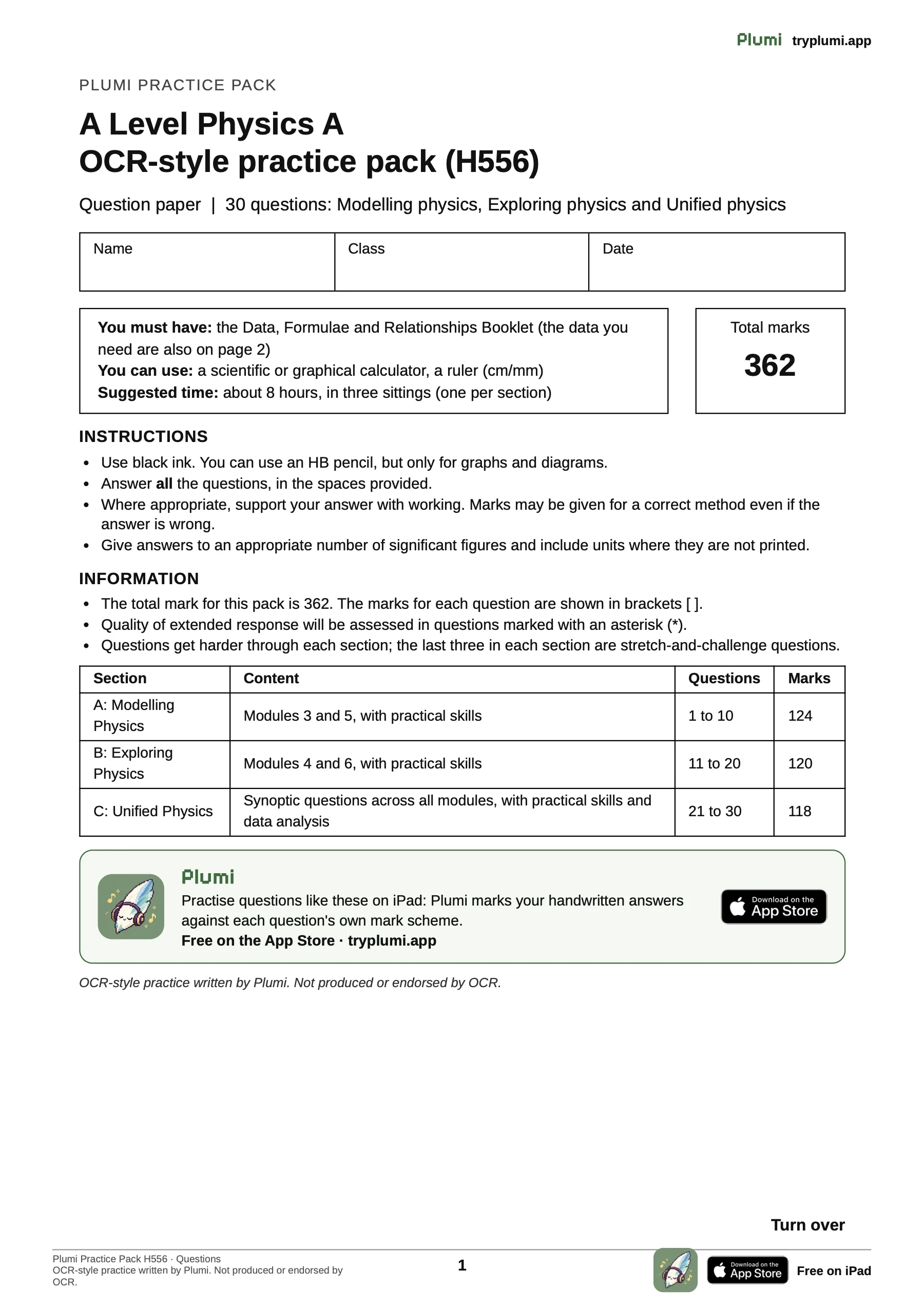
A‑Level Physics A practice pack, OCR-style
30 exam-style questions across Modelling Physics, Exploring Physics and Unified Physics, climbing from easy to super hard, with a full mark scheme. Free to download, no sign-up.
- 30questions
- 362marks
- ~8hin 3 sittings
- H556OCR specification
You need the Data, Formulae and Relationships Booklet (the data are also on page 2), a calculator and a ruler. OCR-style practice written by Plumi. Not produced or endorsed by OCR.
Every question, before you download.
Three sections, ten questions each. Each one starts with a warm-up and ends with three stretch-and-challenge questions.
- Section A · 124 marksModelling Physics
Modules 3 and 5, with practical skills
- Section B · 120 marksExploring Physics
Modules 4 and 6, with practical skills
- Section C · 118 marksUnified Physics
Synoptic questions across all modules, with practical skills and data analysis
All 30 questions
- Easy
- Medium
- Hard
- Super hard
| Q | Level | Topic | Marks |
|---|---|---|---|
| Section A: Modelling Physics | |||
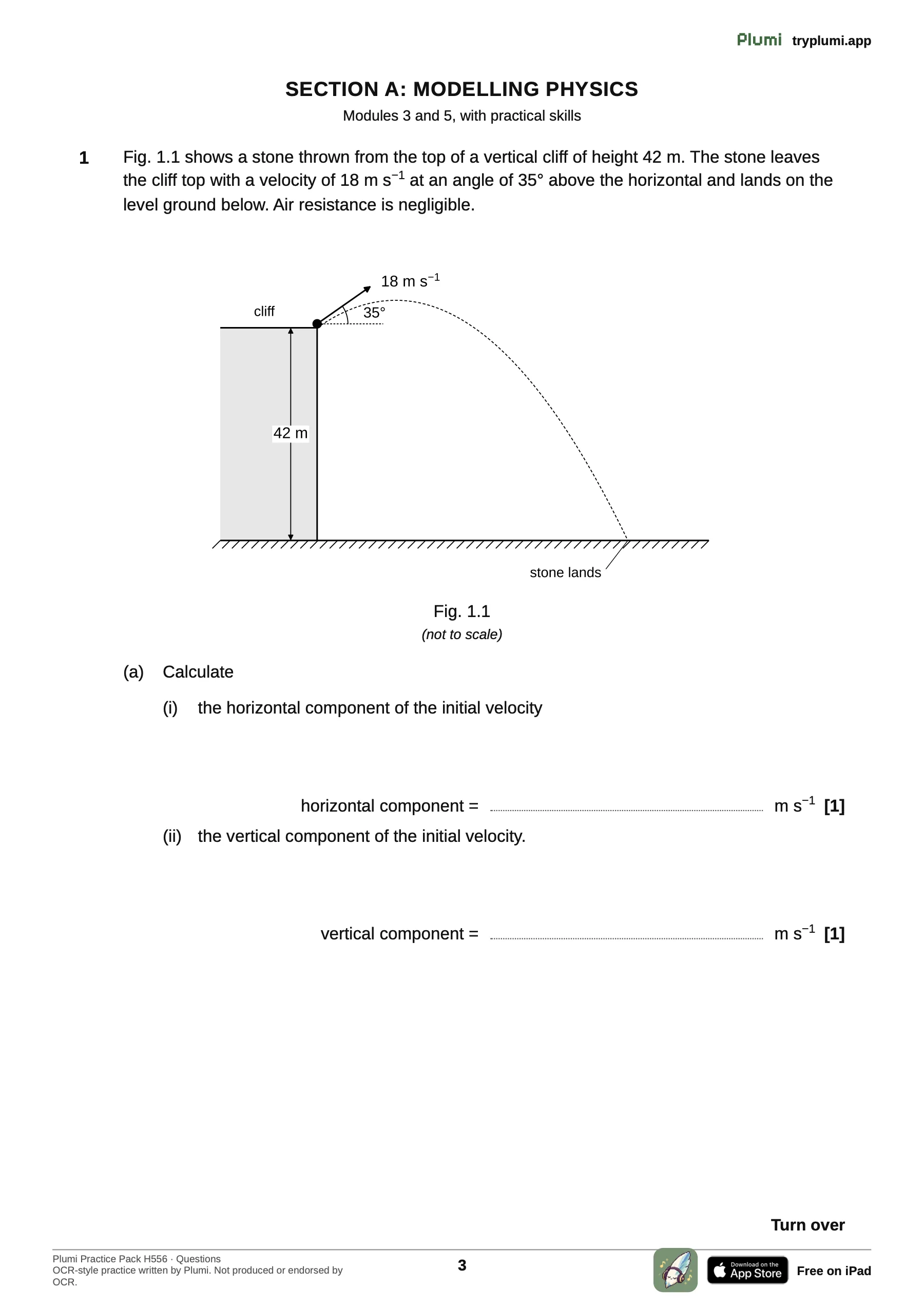
| 1 | Easy | Projectile motion · 3.1.5, 3.3.2 | 11 |
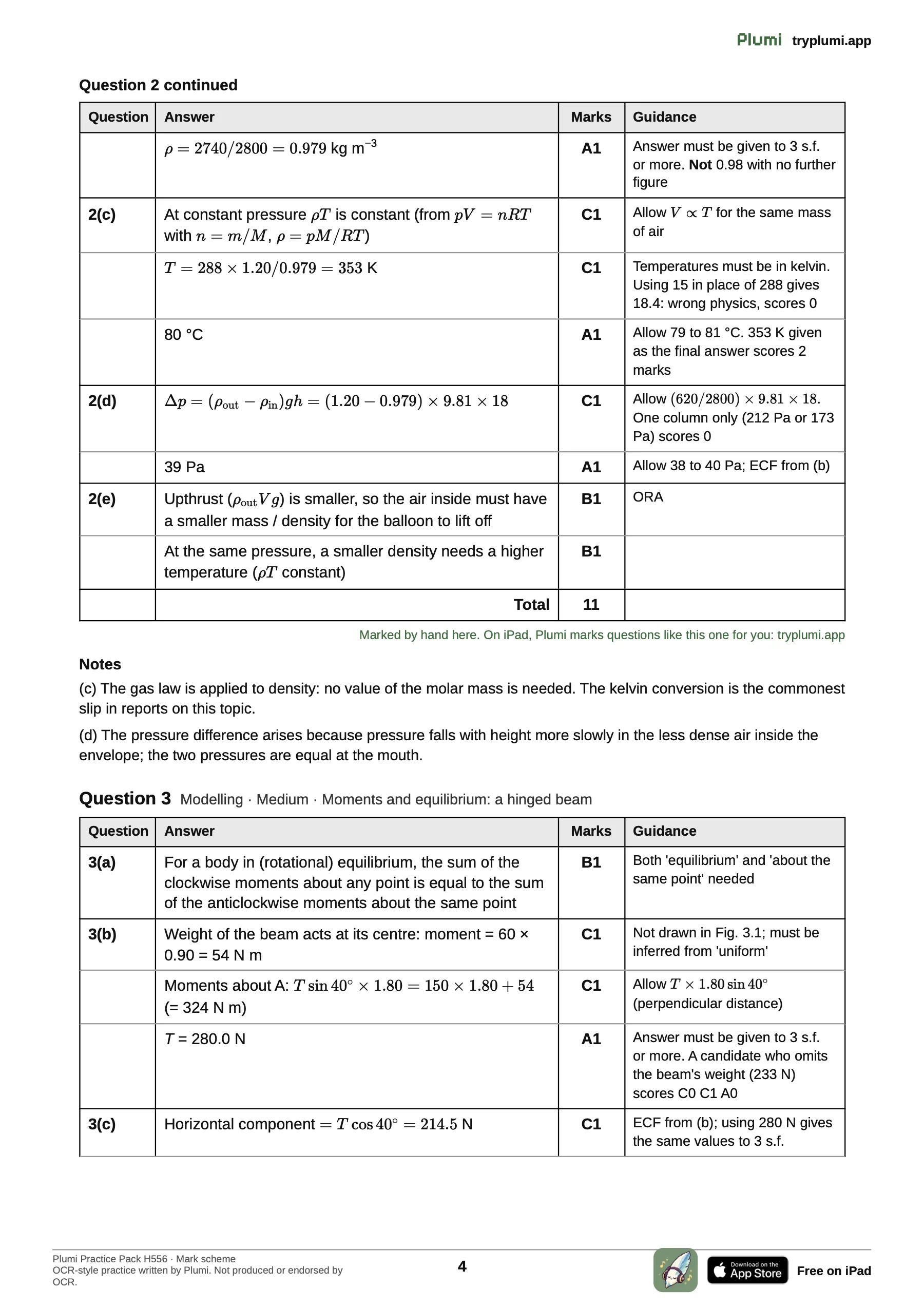
| 2 | Medium | Upthrust and the ideal gas: a hot-air balloon · 3.2.5, 5.1.3 | 11 |
| 3 | Medium | Moments and equilibrium: a hinged beam · 3.2.4, 2.3.2, 3.2.3 | 9 |
| 4 | Medium | Circular orbits: the moons of Saturn · 5.4.3, 5.2.2, 2.1.2 | 11 |
| 5 | Hard | Gravitational orbits and signal timing: a GPS satellite · 5.4.3, 5.4.4, 4.4.1 | 11 |
| 6 | Hard | Oscillations practical: mass on a spring · 5.3.1, 5.3.3, 1.1.4, 2.2.3 | 14 |
| 7 | Hard | Momentum and impulse: an air-track collision · 3.5.1, 3.5.2, 3.5.3, 3.5.4 | 16 |
| 8 | Super hard | Circular motion and energy: a loop-the-loop · 5.2.2, 3.3.2, 3.3.3 | 13 |
| 9 | Super hard | Ideal gases practical: determining absolute zero · 5.1.1, 5.1.3, 1.1.1, 1.1.4, 2.2.2 | 15 |
| 10 | Super hard | Doppler shift and orbits: detecting an exoplanet · 5.5.3, 5.4.3, 5.2.2, 3.5.2 | 13 |
| Section B: Exploring Physics | |||
| 11 | Easy | Potential dividers: a light sensor · 4.3.4, 4.2.2 | 8 |
| 12 | Medium | Capacitor discharge: a clock back-up · 6.1.3, 6.1.4, 6.1.2 | 11 |
| 13 | Medium | Wave-particle duality: electron diffraction · 4.5.3, 4.4.4 | 10 |
| 14 | Medium | Medical imaging: X-ray production and attenuation · 6.5.1, 6.5.2, 4.5.1 | 9 |
| 15 | Hard | Uniform electric fields: separating plastics · 6.2.3, 6.2.1, 3.1.3 | 12 |
| 16 | Hard | Stationary waves: microwaves and a metal plate · 4.4.6, 4.4.4, 2.2.3 | 14 |
| 17 | Hard | The photoelectric effect: stopping potential · 4.5.2, 4.5.1, 4.1.1 | 15 |
| 18 | Super hard | Charged particles in fields: separating isotopes · 6.3.2, 6.2.4, 6.4.1 | 12 |
| 19 | Super hard | Capacitors practical: discharge through a voltmeter · 6.1.3, 6.1.4, 1.1.1, 1.1.4, 2.2.3 | 15 |
| 20 | Super hard | Annihilation and PET scanning · 6.5.4, 6.4.1, 6.4.4, 4.5.1 | 14 |
| Section C: Unified Physics | |||
| 21 | Easy | Practical skills: the resistivity of a wire · 4.2.4, 1.1.3, 1.1.4, 2.2.3, 2.2.4 | 8 |
| 22 | Medium | Energy and electromagnetic induction: a hydroelectric generator · 3.3.3, 3.3.4, 6.3.3, 6.3.4 | 12 |
| 23 | Medium | Gravitational fields and kinematics: a lunar mass driver · 5.4.2, 5.4.4, 3.1.3, 3.3.4 | 12 |
| 24 | Medium | Thermal and electrical energy: an electric shower · 5.1.2, 4.2.5, 4.2.4 | 11 |
| 25 | Hard | Data analysis: a power law for the pendulum · 5.3.1, 1.1.4, 2.2.3 | 13 |
| 26 | Hard | Radioactivity and current: a smoke alarm · 6.4.4, 6.4.2, 4.1.1 | 10 |
| 27 | Hard | Stellar radiation: the radius of a star · 5.5.2, 5.5.3, 4.4.1, 4.5.1 | 12 |
| 28 | Super hard | Practical skills: the Planck constant from LEDs · 4.5.1, 4.2.3, 1.1.1, 1.1.4, 2.2.3 | 14 |
| 29 | Super hard | Stationary waves and materials: a guitar string · 4.4.6, 4.4.1, 3.4.3, 3.4.5 | 13 |
| 30 | Super hard | Momentum, energy and electricity: a hovering drone · 3.5.1, 3.5.3, 3.3.4, 4.2.5, 4.1.1 | 13 |
| Total | 362 | ||
Set out like the real thing.
Every numerical answer, show-that, unit and significant-figure judgement in the mark scheme was checked by computer: exact and numerical calculation, dimensional analysis and simulation.
How a Plumi pack compares
What you get in a Plumi pack, beside what a typical paid practice pack gives you.
- Every answer checked twice
Each numerical answer in the mark schemes was re-checked, not just worked out and trusted. Each pack says how, on its page.
- Mark schemes like the real ones
M1, A1 and B1 marks, what to allow, error carried forward, and a note on the slip most students make.
- Easy to super hard
Each section climbs from a warm-up to three stretch-and-challenge questions, like the end of a real paper.
| What you get | Plumi pack | Typical paid pack |
|---|---|---|
| Price | Free, no sign-up | Usually paid |
| Questions | 30, across every part of the course | Often one paper’s worth |
| Mark scheme | Every mark, with what to allow and error carried forward | Often answers only |
| Common slips | A note on each question saying where marks are lost | Rarely |
| Answers re-checked | Every numerical answer | Rarely |
| Difficulty | Labelled Easy to Super hard, question by question | Rarely labelled |
More practice
Questions
Are these real past papers?
No. Plumi wrote every question in the style of the board’s papers, to its specification, with a mark scheme in the board’s style. They are not produced or endorsed by the exam board. For the board’s own papers, see our past papers pages.
Are they really free?
Yes. Download the questions and the mark scheme, print them or write on them on a tablet. There is nothing to sign up for.
How should I use a pack?
Sit one section at a time, timed and by hand. Mark it with the scheme, read the note on each question you dropped, and come back to those a week later. Each section takes about two to three hours.
Can Plumi mark my answers?
On iPad, yes: Plumi marks handwritten answers to questions like these against each question’s own mark scheme. The packs themselves are for marking by hand, and the scheme tells you everything you need.