 plumi
Stationary waves: OCR A‑Level Physics A questions
Every OCR A-Level Physics A exam question on 4.4.4 Stationary waves, 2016–2025, with its mark scheme and examiner’s report.
Find questions1,877
Calculations

Q2(a)
The whole paper ↗
Q2(b)(i)
The whole paper ↗
Q2(b)(ii)
The whole paper ↗
Q2(c)(i)
The whole paper ↗
Q2(c)(ii)
The whole paper ↗


Q23(c)(i)
The whole paper ↗
Q23(c)(ii)
The whole paper ↗

Q1(a)
The whole paper ↗
Q1(b)(ii)
The whole paper ↗

Q6(b)
The whole paper ↗
Q6(c)
The whole paper ↗

Q18(a)
The whole paper ↗
Q18(b)
The whole paper ↗
All 63 questions on Stationary waves, as a list
- June 2025, Paper 2, Q8 (1 mark): A student uses a tube closed at one end to determine the speed of sound. A stationary wave is formed within the tube. Which of the following quantities can be u
- June 2025, Paper 3, Q2(a) (2 marks): Explain how a stationary wave is formed on the wire. [2]
- June 2025, Paper 3, Q2(b)(i) (1 mark): Suggest why the magnetic flux density, B, of the magnet does not appear in this equation. [1]
- June 2025, Paper 3, Q2(b)(ii) (2 marks): Suggest a method to determine the mass per unit length, μ, of the wire. [2]
- June 2025, Paper 3, Q2(c)(i) (1 mark): Draw a worst acceptable line on the graph. [1]
- June 2025, Paper 3, Q2(c)(ii) (3 marks): Use your worst acceptable line to calculate the percentage uncertainty in the gradient of the best fit line. gradient = 2.81 ± N1/2m–1% [3]
- June 2025, Paper 3, Q2(c)(iii) (3 marks): Calculate a value for the mains frequency, f, including a percentage uncertainty. f = Hz ± % [3]
- June 2025, AS Paper 1, Q5 (1 mark): The diagram shows a sound wave in an open pipe of length 1.4 m. 1.4 m The speed of the wave is 330 m s–1. Calculate the frequency of the wave. A 160 Hz B 240 Hz
- June 2025, AS Paper 1, Q23(c)(i) (2 marks): Explain how stationary waves are formed inside the microwave oven. [2]
- June 2025, AS Paper 1, Q23(c)(ii) (2 marks): Explain why the formation of stationary waves causes the soup to be heated unevenly. [2]
- June 2024, Paper 2, Q9 (1 mark): The diagram shows a string stretched between two posts. The string is plucked and a stationary wave is set up. P Q What is the phase difference between P and Q?
- June 2024, Paper 3, Q1(a) (3 marks): Show that a standard flute has an approximate length of 0.65 m. [3]
- June 2024, Paper 3, Q1(b)(ii) (4 marks): A standard flute is placed inside a sealed chamber. The chamber is filled with helium at a temperature of –10 °C. Calculate the lowest frequency that the flute
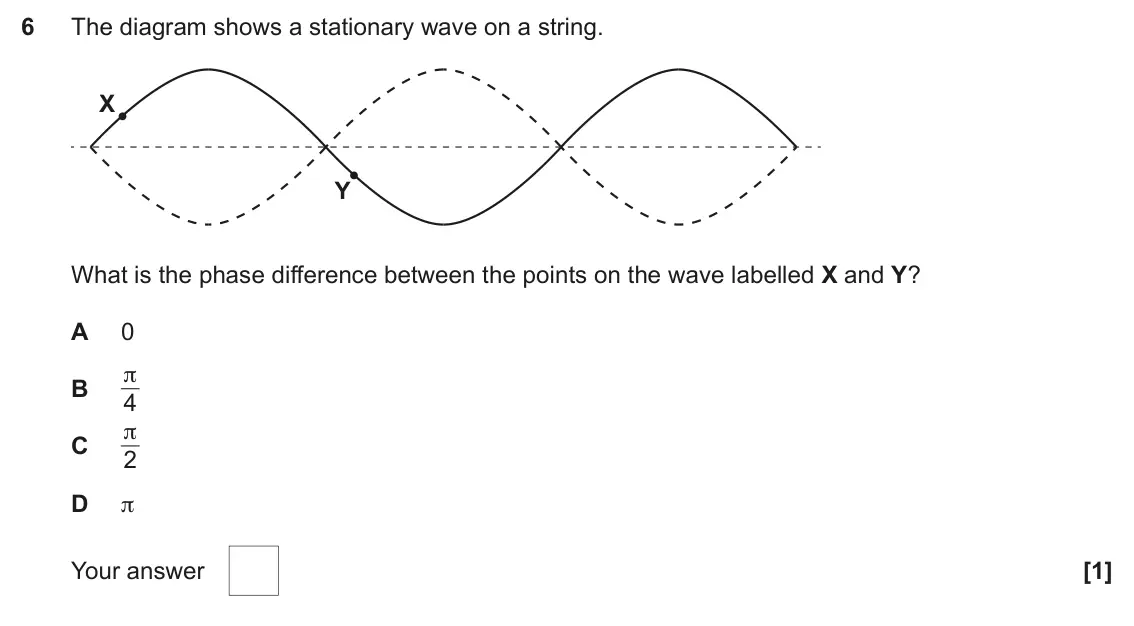
- June 2024, AS Paper 1, Q6 (1 mark): The diagram shows a stationary wave on a string. X Y What is the phase difference between the points on the wave labelled X and Y? A 0 π B 4 π C 2 D π Your answ
- June 2024, AS Paper 1, Q14 (1 mark): A stationary sound wave is created in air. The distance between two adjacent nodes of the stationary wave is 0.7 m. What is the frequency of the sound wave? Spe
- June 2024, AS Paper 2, Q6(b) (2 marks): Draw on Fig. 6.3 the stationary wave pattern for the fundamental mode of vibration. Label on Fig. 6.3 the positions, if any, of any nodes N and any antinodes A.
- June 2024, AS Paper 2, Q6(c) (1 mark): The frequency of the signal generator is increased until the next harmonic is displayed on the oscilloscope. Calculate the frequency fn of the next harmonic. fn
- June 2023, Paper 2, Q10 (1 mark): A column of air in a tube of length L, closed at one end, is forced to vibrate at its fundamental frequency. A standing wave is set up inside the tube. Which ro
- June 2023, Paper 2, Q18(a) (1 mark): On Fig. 18 sketch the standing wave for the fundamental mode of vibration. Fig. 18 _______________________________________________________ _____________________
- June 2023, Paper 2, Q18(b) (1 mark): Calculate the frequency f0 of the speaker that is producing the standing wave inside the tube. f0 = Hz [1]
- June 2023, Paper 2, Q18(c) (2 marks): The frequency of the speaker is increased. Calculate the next frequency f1 that will produce a standing wave in this tube. f1 = Hz [2]
- June 2023, AS Paper 1, Q22(b)(i) (3 marks): Explain how a stationary wave with nodes and antinodes is formed. [3]
- June 2023, AS Paper 1, Q22(b)(ii) (3 marks): The student measures the amplitude of the stationary wave at a range of distances from the reflecting sheet A. Their results are shown below. amplitude 0 0.5 1
- June 2023, AS Paper 1, Q22(b)(iii) (2 marks): The student measures the distance between two adjacent nodes as 0.84 m. The frequency of the sound wave is 200 Hz. Use these measurements to calculate a value f
- June 2023, AS Paper 1, Q22(b)(iv) (1 mark): The student wants to reduce the uncertainty in their calculated value for the speed of sound waves in air. Suggest a suitable improvement to the student’s metho
- June 2023, AS Paper 2, Q7 (6 marks): 7* A student carries out an experiment to determine the speed v of sound in air. The student forms stationary sound waves in a resonance tube with water at the
- June 2022, Paper 2, Q16(c)(i) (1 mark): Suggest why the powder piles up at the nodes within the tube. [1]
- June 2022, Paper 2, Q16(c)(ii) (3 marks): Use Fig. 16.2 to determine the speed of sound v. v = m s–1 [3]
- June 2022, Paper 2, Q16(c)(iii) (2 marks): Determine the fundamental (minimum) frequency f0 of the stationary wave that can be formed within this tube. f0 = Hz [2]
- June 2022, AS Paper 1, Q19 (1 mark): A student is experimenting with sound waves of wavelength 3.0 cm and electromagnetic waves also of wavelength 3.0 cm. Which statement is correct about both of t
- June 2022, AS Paper 1, Q24(a) (1 mark): Stationary waves are formed on the surface of seawater in a harbour as incoming waves are reflected off the harbour wall. An observer is looking at these statio
- June 2022, AS Paper 1, Q24(b)(i) (2 marks): Suggest how the student may have determined the fundamental frequency of the oscillating wire in the laboratory. [2]
- June 2022, AS Paper 1, Q24(b)(ii) (5 marks): Use the data in the table to determine 1 the wavelength of the progressive waves on the stretched wire wavelength = m [1] 2 the speed of the progressive waves o
- November 2021, Paper 2, Q9 (1 mark): A stationary sound wave formed in a tube is shown below. tube 3.5 m The tube is closed at one end. The length of the tube is 3.5 m. The speed of sound is 340 m
- November 2021, Paper 2, Q16(b) (2 marks): State one difference and one similarity between the oscillations of a stationary sound wave and a progressive sound wave. Difference: Similarity: [2]
- November 2021, Paper 3, Q5(a) (4 marks): Explain how a stationary wave of fundamental frequency is produced and state the relationship between l and λ. [4]
- November 2021, Paper 3, Q5(b)(i) (2 marks): Show that the line of best fit has gradient = v 4 and y-intercept = – k. [2]
- November 2021, Paper 3, Q5(b)(ii) (3 marks): Calculate v from the gradient of the line of best fit. v = m s–1 [3]
- November 2021, Paper 3, Q5(c)(i) (2 marks): Use the line of best fit on the graph to estimate F. F = Hz [2]
- November 2021, Paper 3, Q5(c)(ii) (2 marks): The percentage uncertainty in the value of F can be written as 100 ΔF F where ΔF is the absolute uncertainty in F. Use the rules for combining uncertainties to
- November 2021, AS Paper 1, Q13 (1 mark): The stationary wave shown below is formed on a stretched string. The frequency of this stationary wave is 72 Hz. What is the fundamental frequency for a station
- November 2020, Paper 2, Q6 (1 mark): This question is about a progressive wave and a stationary wave. Which statement is correct? A A progressive wave has at least one node. B All progressive waves
- November 2020, Paper 2, Q11 (1 mark): A stationary sound wave, in its fundamental mode of vibration, is formed in a tube open at both ends. tube 0.17 m The length of the tube is 0.17 m. The speed of
- November 2020, Paper 3, Q5(d) (6 marks): A student carries out two investigations with these electromagnetic waves. In investigation 1, the student rotates the receiver aerial about the horizontal axis
- November 2020, AS Paper 1, Q6 (1 mark): This question is about progressive waves and stationary waves. Which statement is not correct? A A progressive wave transports energy through space. B A station
- November 2020, AS Paper 1, Q18 (1 mark): A stationary sound wave, of fundamental mode of vibration, is formed in a tube closed at one end. 0.17 m tube The length of the tube is 0.17 m. The speed of sou
- June 2019, Paper 2, Q17(a)(i) (1 mark): On Fig. 17.1, sketch a graph to show the variation of the displacement at time t = T 2. [1]
- June 2019, Paper 2, Q17(a)(ii) (1 mark): On Fig. 17.1, show the positions of all the nodes. Label each node N. [1]
- June 2019, Paper 2, Q17(b) (3 marks): Stationary sound waves are formed in a tube closed at one end. Fig. 17.2 shows three stationary wave patterns formed in the air column of the tube. 60 Hz 180 Hz
- June 2019, AS Paper 1, Q20 (1 mark): Stationary sound waves are produced in the air inside a tube. The tube is closed at one end. Which pattern of nodes (N) and antinodes (A) is likely to be correc
- June 2019, AS Paper 1, Q24(b)(i) (2 marks): Draw a straight line of best fit and determine the gradient of this line. gradient = Hz m [2]
- June 2019, AS Paper 1, Q24(b)(ii) (2 marks): Explain why the gradient of the line is v 2, where v is the speed of sound. [2] Question 24 continues on the next page.
- June 2019, AS Paper 1, Q24(b)(iii) (1 mark): Use your answer in (i) and the information given in (ii) to determine v. v = m s–1 [1]
- June 2019, AS Paper 1, Q24(b)(iv) (2 marks): The smaller values of L are much more difficult to determine with the microphone in this experiment and this produces large percentage uncertainty in the values
- June 2018, Paper 2, Q4 (1 mark): A vibrating tuning fork is held above the open end of a long vertical tube. The other end of the tube, which is also open, is immersed in a tank of water. The l
- June 2018, AS Paper 1, Q19 (1 mark): The diagram below shows a stationary wave pattern for a sound wave in a tube. The tube has one open end and one closed end. 60 cm The length of the tube is 60 c
- June 2018, AS Paper 2, Q7(a) (6 marks): (a)* In an experiment to investigate microwaves, a microwave detector D is placed between a microwave transmitter T and a flat metal sheet. T D metal sheet dire
- June 2017, Paper 2, Q6 (1 mark): Stationary waves are produced in a tube closed at one end and open at the other end. The fundamental frequency is 120 Hz. What is a possible frequency of a harm
- June 2017, AS Paper 1, Q26(c) (3 marks): The stretched wire of fixed length is used in an experiment to demonstrate stationary waves. The tension in the wire is kept constant. Fig. 26 shows the three s
- June 2017, AS Paper 2, Q6(a) (2 marks): Describe how a stationary wave is different from a progressive wave. [2]
- June 2017, AS Paper 2, Q6(b) (6 marks): (b)* A student is investigating stationary waves in a hollow tube. The tube is open at one end and closed at the other end. The student connects a signal genera
- June 2016, AS Paper 1, Q26(b)(i) (2 marks): Explain how a stationary wave pattern is produced in this arrangement. [2]
- June 2016, AS Paper 1, Q26(b)(ii) (1 mark): The stationary wave pattern shown in Fig. 26.2 is produced in the laboratory. Describe how the wavelength of the transverse wave on the stretched cord can be de
Questions, mark schemes and examiner’s reports are © OCR, from their published past papers. Plumi isn’t affiliated with any exam board. Want whole papers? Every OCR A-Level Physics A paper, or our free OCR-style practice pack.
Rather write your answers by hand on iPad? Plumi marks them against the same mark schemes.