 plumi
Electromagnetic waves: OCR A‑Level Physics A questions
Every OCR A-Level Physics A exam question on 4.4.2 Electromagnetic waves, 2016–2025, with its mark scheme and examiner’s report.
Find questions1,877
Calculations

Q22(a)(i)
The whole paper ↗
Q22(a)(ii)
The whole paper ↗
Q22(c)(i)
The whole paper ↗
Q22(c)(ii)
The whole paper ↗
Q22(c)(iii)
The whole paper ↗
Q25(a)
The whole paper ↗
Q25(b)(i)
The whole paper ↗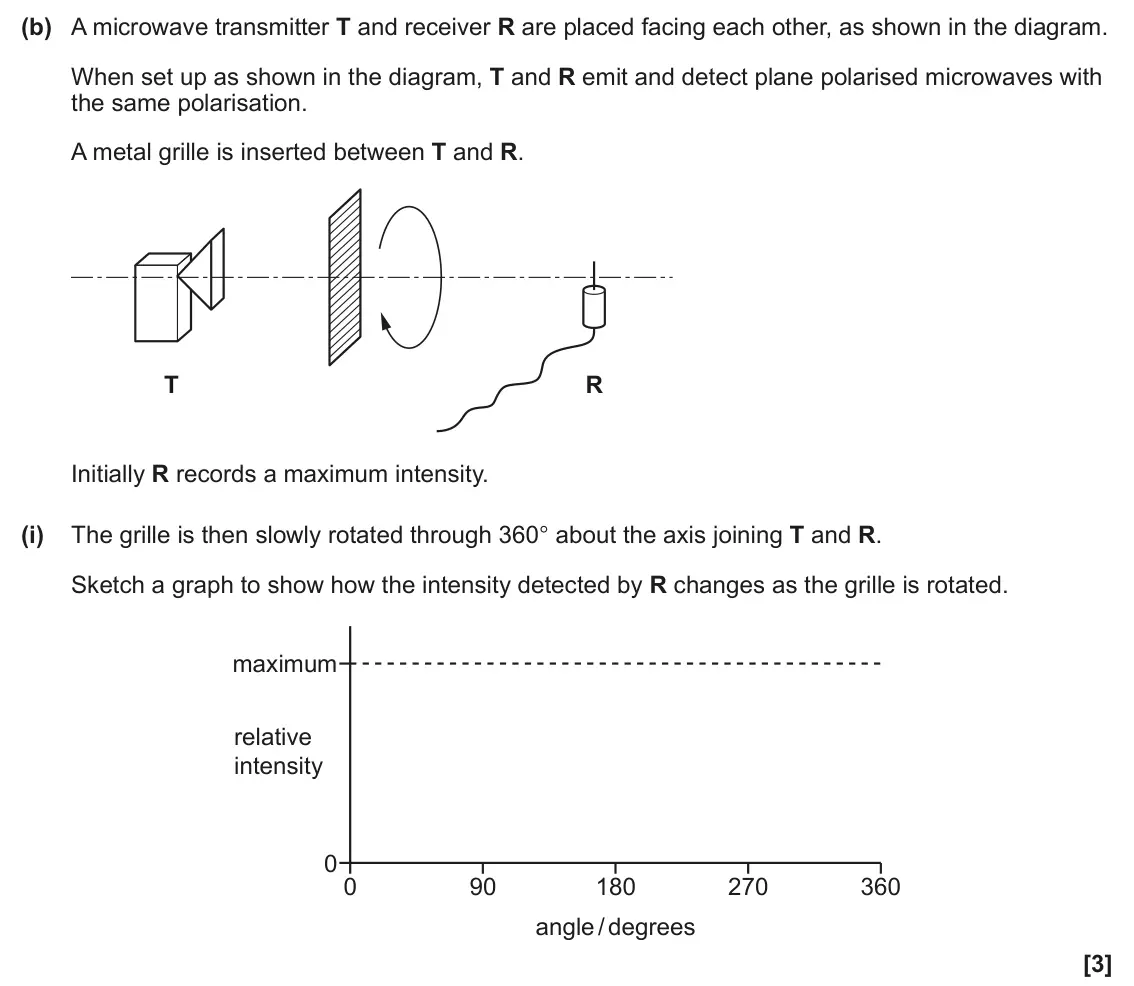
Q25(b)(ii)
The whole paper ↗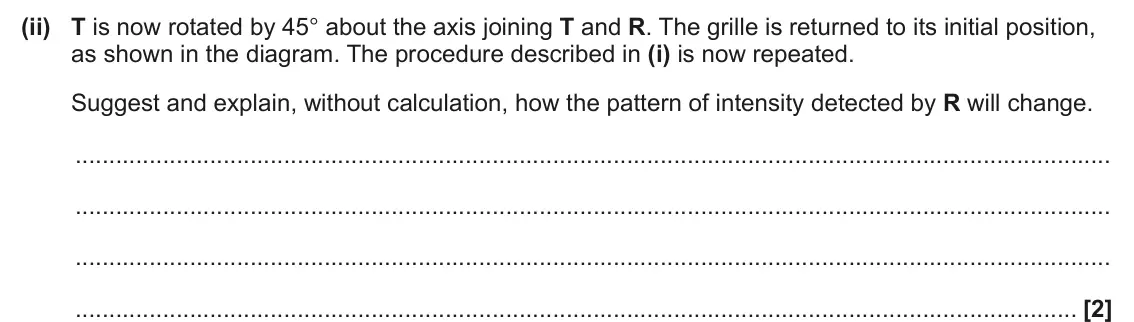
Q7(c)(i)
The whole paper ↗
Q7(c)(ii)
The whole paper ↗

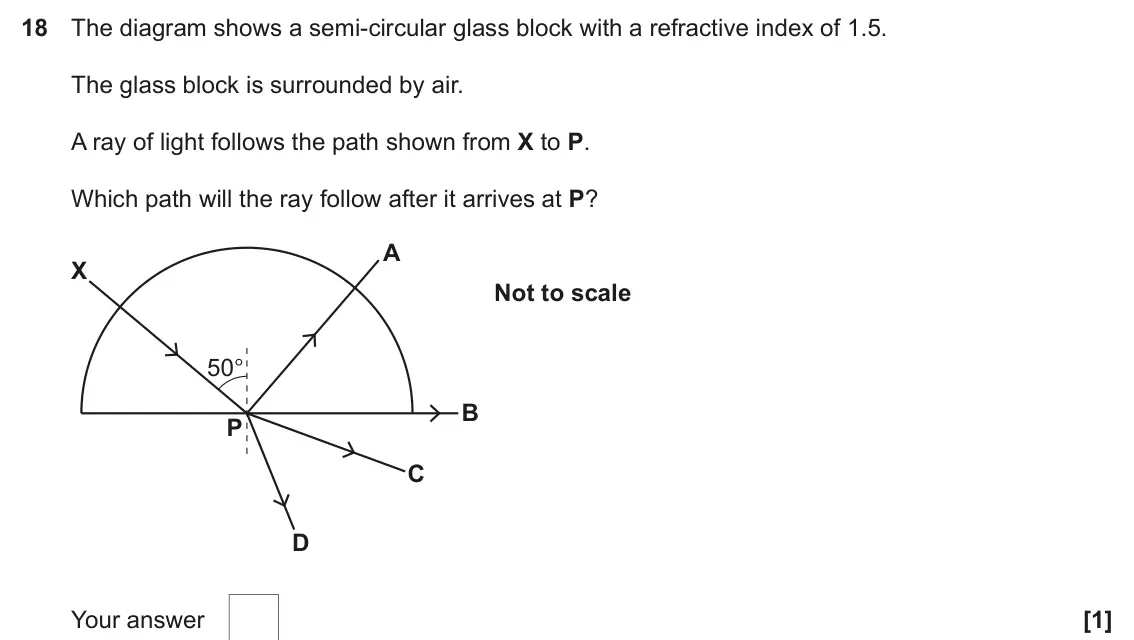
Q5(a)(ii)
The whole paper ↗
Q5(b)(i)
The whole paper ↗
Q5(b)(ii)
The whole paper ↗
Q5(b)(iii)
The whole paper ↗
Q5(b)(iv)
The whole paper ↗
Q5(b)(v)
The whole paper ↗
All 63 questions on Electromagnetic waves, as a list
- June 2025, AS Paper 1, Q4 (1 mark): Which is a possible wavelength of ultraviolet radiation? 10–6 m A 10–8 m B 10–10 m C 10–12 m D Your answer [1]
- June 2025, AS Paper 1, Q22(a)(i) (1 mark): Suggest why the scientist must clean the glass in step 3. [1]
- June 2025, AS Paper 1, Q22(a)(ii) (1 mark): Suggest one other factor that the scientist needs to control. [1]
- June 2025, AS Paper 1, Q22(c)(i) (1 mark): Describe what critical angle means. [1]
- June 2025, AS Paper 1, Q22(c)(ii) (4 marks): The student pours liquid into a shallow, semicircular glass dish. Refraction due to the thin glass walls of the dish can be ignored. liquid dish Describe how th
- June 2025, AS Paper 1, Q22(c)(iii) (2 marks): The student measures the critical angle as 42°. Calculate the refractive index of the liquid. refractive index = [2]
- June 2025, AS Paper 1, Q25(a) (2 marks): Explain what plane polarised wave means. [2]
- June 2025, AS Paper 1, Q25(b)(i) (3 marks): The grille is then slowly rotated through 360° about the axis joining T and R. Sketch a graph to show how the intensity detected by R changes as the grille is r
- June 2025, AS Paper 1, Q25(b)(ii) (2 marks): T is now rotated by 45° about the axis joining T and R. The grille is returned to its initial position, as shown in the diagram. The procedure described in (i)
- June 2025, AS Paper 2, Q7(c)(i) (1 mark): the wavelength λ of the light in the glass λ = m [1]
- June 2025, AS Paper 2, Q7(c)(ii) (2 marks): the angle of incidence i of the incident ray. i = ° [2]
- June 2024, AS Paper 1, Q4 (1 mark): The light emitted by a laptop screen is polarised. The laptop screen is viewed through a polarising filter. Initially the brightness of the screen appears norma
- June 2024, AS Paper 1, Q18 (1 mark): The diagram shows a semi-circular glass block with a refractive index of 1.5. The glass block is surrounded by air. A ray of light follows the path shown from X
- June 2024, AS Paper 2, Q5(a)(ii) (2 marks): Complete the table for yellow light in glass. [2]
- June 2024, AS Paper 2, Q5(b)(i) (1 mark): Draw on Fig. 5.1 the angle of incidence i and the angle of refraction r at point P. Label the angles i and r. [1]
- June 2024, AS Paper 2, Q5(b)(ii) (4 marks): Describe how the student produces Fig. 5.1 experimentally using a ray box. [4]
- June 2024, AS Paper 2, Q5(b)(iii) (1 mark): The angle of incidence i is 49.9°. Show that the angle of refraction r is approximately 30°. [1]
- June 2024, AS Paper 2, Q5(b)(iv) (3 marks): Show that total internal reflection occurs at point Q. [3]
- June 2024, AS Paper 2, Q5(b)(v) (1 mark): Draw on Fig. 5.1 the path of the light as it travels from point Q back into the air. [1]
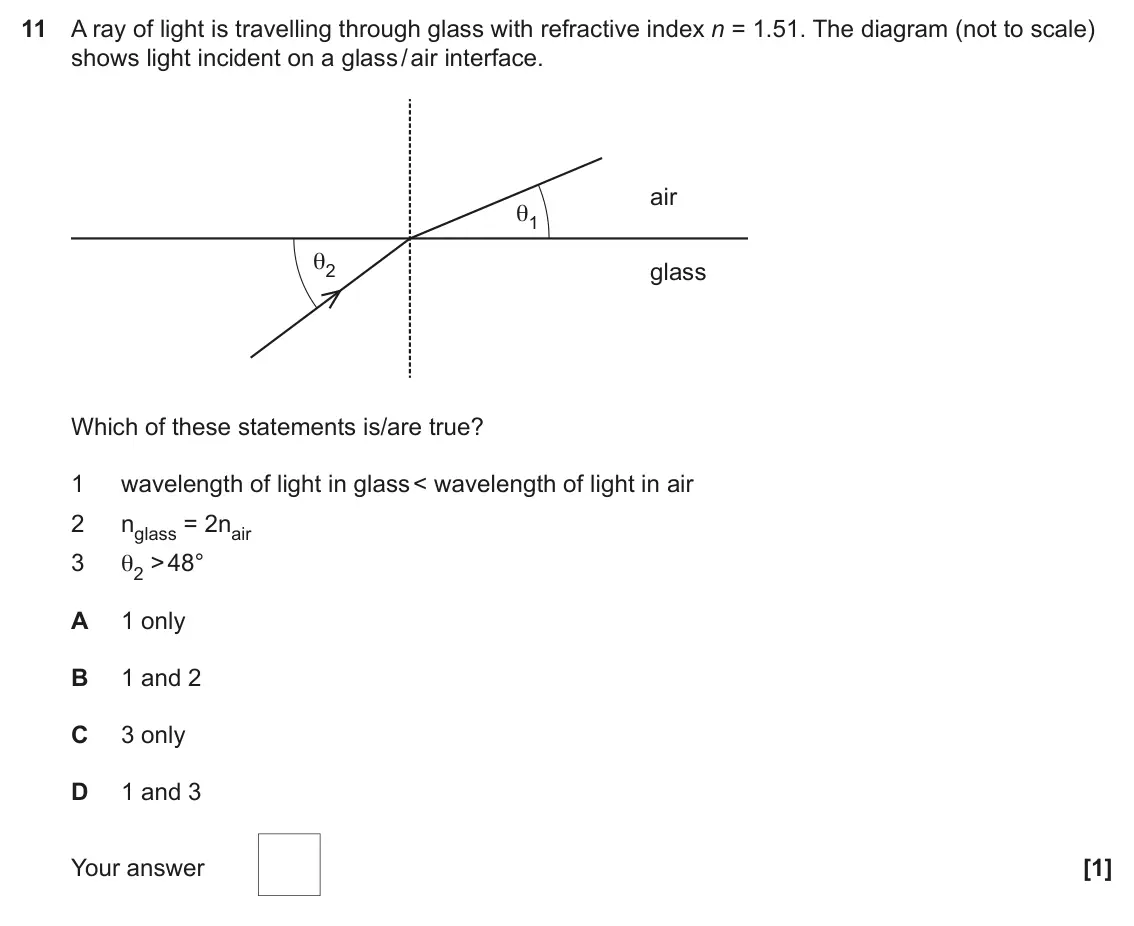
- June 2023, Paper 2, Q11 (1 mark): A ray of light is travelling through glass with refractive index n = 1.51. The diagram (not to scale) shows light incident on a glass / air interface. air θ1 θ2
- June 2023, AS Paper 1, Q1 (1 mark): What is a typical value, in cm, for the wavelength of microwave radiation? A 0.0003 B 0.03 C 3 D 300 Your answer [1]
- June 2023, AS Paper 1, Q5 (1 mark): A ray of monochromatic light is travelling through glass. The refractive index of the glass is 1.5. The ray is incident on a glass-air boundary with angle of in
- June 2023, AS Paper 1, Q13 (1 mark): Unpolarised light is observed through a single polarising filter. The intensity of the light transmitted by the filter is half the intensity of the incident lig
- June 2022, Paper 2, Q9 (1 mark): A student is investigating the refraction of light by a rectangular glass block. The glass block is surrounded by air. The diagram below shows the path of the l
- June 2022, AS Paper 1, Q1 (1 mark): Which of the following could be the wavelength of ultraviolet radiation? 3 × 10⁻⁵ m A 1 × 10⁻¹⁰ m B 4 × 10² m C 2 × 10⁻⁷ m D Your answer [1]
- June 2022, AS Paper 1, Q3 (1 mark): The diagram below shows the refraction of light at the boundary between two transparent materials X and Y. 1.5 X 20° n Y 50° The refractive index of material X
- June 2022, AS Paper 1, Q12 (1 mark): Plane polarised light is incident perpendicular to a vertical polarising filter. The polarising filter is rotated about the horizontal axis. Which property of t
- June 2022, AS Paper 2, Q5(a) (1 mark): Complete the table by determining the missing values for v for glass and oil. Write your answers to 3 significant figures. [1]
- June 2022, AS Paper 2, Q5(b) (2 marks): Show that the critical angle for a ray of red light at the boundary between glass and air is less than 45°. [2]
- June 2022, AS Paper 2, Q5(c) (2 marks): Fig. 5.1 shows a glass block inside a beaker. red light beaker glass block air 45° 45° Fig. 5.1 The path of a ray of red light is shown entering the glass block
- June 2022, AS Paper 2, Q5(d)(i) (2 marks): Calculate the critical angle C for a ray of red light at the boundary between glass and oil. C = ° [2]
- June 2022, AS Paper 2, Q5(d)(ii) (1 mark): Complete Fig. 5.2 to show the path of the ray through the block until it leaves the block. [1]
- November 2021, AS Paper 1, Q24(a) (1 mark): State why the X-rays and ultraviolet radiation from this burst were detected simultaneously. [1]
- November 2021, AS Paper 1, Q25(b)(i) (1 mark): Define refractive index of a material. [1]
- November 2021, AS Paper 1, Q25(b)(ii) (6 marks): The diagram below shows the path of light in two transparent materials A and B. φ boundary A B θ Not to scale The refractive index of B is 1.3 times greater tha
- November 2020, AS Paper 2, Q1(b)(i) (2 marks): The following are possible wavelengths of electromagnetic waves. 0.2 km 2 m 2 cm 0.2 mm 2 µm 200 nm 200 pm Select from the list above a typical wavelength of a
- November 2020, AS Paper 2, Q1(b)(ii) (2 marks): One property of electromagnetic waves is that they are transverse waves. State two other properties. 1. 2. [2]
- November 2020, AS Paper 2, Q2(a)(ii) (2 marks): Complete the table by determining the missing values for v and λ for glass. Write your answers to 3 significant figures. [2]
- November 2020, AS Paper 2, Q2(b)(i) (3 marks): The angle i is 30°. 1. Determine angle p. p = ° [1] 2. Determine angle q, using the information from the table in (a). q = ° [2]
- November 2020, AS Paper 2, Q2(b)(ii) (4 marks): The angle i is increased from 30° to 60°. Describe and explain how angles p and q will change. In your answer, include the term critical angle. [4]
- November 2020, AS Paper 2, Q2(c) (2 marks): Fig. 2.2 shows the same semi-circular glass block with the blue light replaced by red light. red light 30° normal Fig. 2.2 (not to scale) The dashed lines show
- June 2019, Paper 2, Q7 (1 mark): Which of the following statements is/are correct about electromagnetic waves? 1 They can be plane polarised. 2 They can be refracted and diffracted. 3 They have
- June 2019, Paper 2, Q16(c)(i) (3 marks): Show that the difference in time t for the two rays to travel between the dashed lines X and Y is 1.0 × 10⁻¹⁵ s. t = s [3]
- June 2019, AS Paper 1, Q12 (1 mark): The table shows the refractive index n of four transparent materials A, B, C and D. Which material has the smallest critical angle? Material A B C D 2.01 1.87 1
- June 2019, AS Paper 1, Q19 (1 mark): Which of the following waves can be polarised and has a typical wavelength of about a few centimetres? A microwaves B ultraviolet C sound D visible light Your a
- June 2019, AS Paper 1, Q24(a) (3 marks): You are provided with a rectangular block of plastic. Describe how you can use a ray-box (or a laser beam), together with other equipment available in the labor
- June 2018, Paper 2, Q18(a) (3 marks): Show that the angle θ between the refracted ray in the glass and the reflected ray in the air is 90.0°. [3]
- June 2018, Paper 2, Q18(b) (2 marks): Describe how you can demonstrate in the laboratory that the reflected light is plane polarised. [2]
- June 2018, Paper 2, Q18(c) (2 marks): Calculate the time t taken for the refracted light to travel a depth of 6.0 cm of glass. t = s [2]
- June 2018, AS Paper 1, Q26(b) (3 marks): Light travels from air to water. The refractive index of water is greater than the refractive index of air. Compare the speed, frequency and wavelength of light
- June 2018, AS Paper 1, Q26(c) (3 marks): A student is given a semi-circular glass block. Describe with the aid of a ray diagram how an experiment can be conducted to accurately determine the critical a
- June 2018, AS Paper 1, Q27(a) (1 mark): Radio waves and X-rays are both electromagnetic waves. State one difference between radio waves and X-rays. [1]
- June 2018, AS Paper 2, Q7(b) (2 marks): In another experiment using microwaves, a metal grille G consisting of a series of long metal rods is placed between the transmitter T and the detector D as sho
- June 2018, AS Paper 2, Q8(a)(i) (2 marks): Complete the table by calculating the missing values of n and v. [2]
- June 2018, AS Paper 2, Q8(a)(ii) (1 mark): Determine the wavelength λ of the light in glass. λ = m [1]
- June 2018, AS Paper 2, Q8(b)(i) (2 marks): The light is incident on the glass at an angle of 37°. Determine the angle of refraction θ in the glass. θ = ° [2]
- June 2018, AS Paper 2, Q8(b)(ii) (1 mark): Without any further calculation, sketch the ray of light as it passes through the glass into the ethanol. [1]
- June 2017, Paper 2, Q15 (1 mark): A ray of monochromatic light is incident at the boundary between two transparent materials of refractive index n1 and n2. The critical angle θ is equal to 80°.
- June 2017, AS Paper 1, Q1 (1 mark): Which statement is not correct about an electromagnetic wave? A It can be diffracted. B It can be polarised. C It is a longitudinal wave. D It can travel throug
- June 2017, AS Paper 1, Q2 (1 mark): A narrow beam of light in air is directed at the surface of a triangular glass prism. Which is the correct diagram for the light refracted by the prism? A prism
- June 2016, AS Paper 1, Q3 (1 mark): A student views the display of a laptop screen through a polarising filter. The intensity of the light changes when the filter is rotated. Which property of lig
- June 2016, AS Paper 1, Q5 (1 mark): In which region of the electromagnetic spectrum is radiation of wavelength 50 µm? A visible B infra-red C microwave D radio Your answer [1]
- June 2016, AS Paper 1, Q20 (1 mark): The speed of light in air is 3.0 × 10⁸ m s–1 and the speed of light in glass is 2.0 × 10⁸ m s–1. A ray of monochromatic light in glass strikes the glass-air bou
Questions, mark schemes and examiner’s reports are © OCR, from their published past papers. Plumi isn’t affiliated with any exam board. Want whole papers? Every OCR A-Level Physics A paper, or our free OCR-style practice pack.
Rather write your answers by hand on iPad? Plumi marks them against the same mark schemes.