 plumi
Motion with non-uniform acceleration: OCR A‑Level Physics A questions
Every OCR A-Level Physics A exam question on 3.2.2 Motion with non-uniform acceleration, 2016–2025, with its mark scheme and examiner’s report.
Find questions1,877
Calculations
Q16(b)(i)
The whole paper ↗
Q17(a)(iv)
The whole paper ↗
Q16(a)(i)
The whole paper ↗
Q16(a)(ii)
The whole paper ↗
Q16(a)(iii)
The whole paper ↗
Q24(a)
The whole paper ↗
Q20(d)
The whole paper ↗
Q4(a)
The whole paper ↗
Q4(b)(i)
The whole paper ↗
Q4(b)(ii)
The whole paper ↗
Q25(a)
The whole paper ↗
Q25(b)
The whole paper ↗
Q25(c)
The whole paper ↗
Q25(d)
The whole paper ↗

Q1(d)(i)
The whole paper ↗
Q1(e)
The whole paper ↗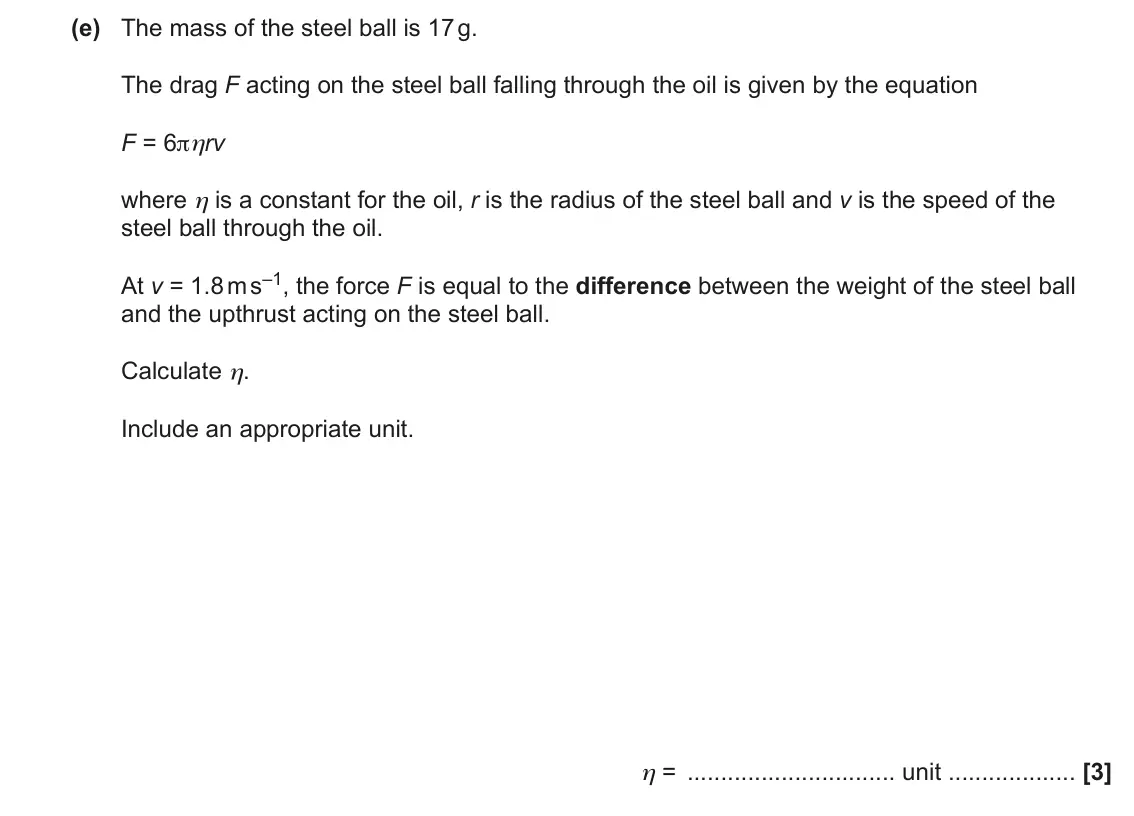


All 29 questions on Motion with non-uniform acceleration, as a list
- June 2025, Paper 1, Q16(b)(i) (2 marks): Explain, in terms of the forces acting on the car, the shape of the graph in Fig. 16.2. [2]
- June 2025, Paper 1, Q17(a)(iv) (2 marks): Explain why the engines of the aircraft must provide thrust during the projectile motion. [2]
- June 2024, Paper 1, Q16(a)(i) (2 marks): Sketch a graph on the axes below to show how the speed of the car changes over time. Add a suitable value to the vertical axis. speed / m s–1 0 0 time [2]
- June 2024, Paper 1, Q16(a)(ii) (2 marks): Explain why the car reaches a maximum speed. [2]
- June 2024, Paper 1, Q16(a)(iii) (3 marks): Show that the value of k in the equation F = kv 2 is about 1. [3]
- June 2024, AS Paper 1, Q24(a) (3 marks): The student releases a feather in air and allows it to fall. The feather reaches a terminal velocity. Explain this observation. [3]
- June 2023, Paper 1, Q20(d) (2 marks): The airship has a higher maximum speed at high altitudes, but also produces less thrust from the engine. Explain these observations. [2]
- June 2023, Paper 3, Q4(a) (3 marks): Describe and explain the motion of an object falling at terminal velocity. [3]
- June 2023, Paper 3, Q4(b)(i) (2 marks): The terminal velocity v of a small sphere of density ρs and radius r falling through a fluid of density ρf is given by the formula: 2gr 2(ρs – ρf) v = 9η where
- June 2023, Paper 3, Q4(b)(ii) (6 marks): A student models water droplets falling through air using small solid spheres in a liquid. The table shows properties of the materials available to the student.
- June 2023, AS Paper 1, Q25(a) (2 marks): Use the information in the table to explain why using a video camera to measure the time is more appropriate than a stopwatch in this investigation. [2]
- June 2023, AS Paper 1, Q25(b) (1 mark): Suggest one other precaution that the scientist should take to ensure that the terminal velocity is determined as accurately as possible. [1]
- June 2023, AS Paper 1, Q25(c) (2 marks): Use the scientist’s results to show that the terminal velocity is about 0.3 m s–1. [2]
- June 2023, AS Paper 1, Q25(d) (3 marks): Soil scientists classify soil samples according to the diameter of the particles, as shown in the table below. Soil sample Range of diameter / mm clay < 0.002 s
- June 2023, AS Paper 2, Q2 (6 marks): 2* A student is investigating the motion of small metal balls falling from rest vertically through a liquid. The student drops a ball of diameter d from rest at
- June 2022, AS Paper 2, Q1(d)(i) (3 marks): The terminal velocity v of the steel ball is 1.8 m s–1. Describe and explain how this can be determined from the graph. [3]
- June 2022, AS Paper 2, Q1(e) (3 marks): The mass of the steel ball is 17 g. The drag F acting on the steel ball falling through the oil is given by the equation F = 6πηrv where η is a constant for the
- November 2021, AS Paper 1, Q4 (1 mark): The air resistance F acting on an object falling vertically through air is given by the expression F = 0.13 v 2 where v is the speed of the object. The mass of
- November 2020, AS Paper 1, Q3 (1 mark): A ball, made from scrunched-up paper, is dropped from rest at time t = 0. It reaches terminal velocity before it hits the ground. Which acceleration a against t
- June 2019, Paper 1, Q2 (1 mark): A paper cone is held above the ground and dropped. It falls vertically and reaches terminal velocity before it hits the ground. Which statement correctly descri
- June 2019, Paper 1, Q17(c) (3 marks): Use your answer in (b) to calculate the drag on the ball at time t = 0.25 s. drag = N [3]
- June 2019, Paper 1, Q17(d)(i) (2 marks): Describe how the forces acting on the sand-filled ball at v = 0.50 m s–1 compare with the forces acting on the hollow ball at this speed. [2]
- June 2019, Paper 1, Q17(d)(ii) (2 marks): Explain why the terminal velocity of the sand-filled ball will be greater than the terminal velocity of the hollow ball. [2]
- June 2019, AS Paper 2, Q1(c) (2 marks): The student repeats the experiment with a different ball that is affected by air resistance. Explain how the graph in Fig. 1 now appears from the time the ball
- June 2018, Paper 1, Q12 (1 mark): An object is dropped from rest at time t = 0. It falls vertically through the air. The variation of the velocity v with time t is shown below. v 0 0 10 20 30 40
- June 2018, AS Paper 1, Q23(c) (1 mark): State why the acceleration of the tube decreases as it travels vertically upwards through the water. [1]
- June 2017, Paper 1, Q18(c)(ii) (3 marks): Describe and explain how the resultant force on the wooden cylinder varies from the moment the cylinder is fully submerged until it reaches its deepest point. [
- June 2017, Paper 1, Q18(d) (2 marks): The graph of Fig. 18.3 shows the depth d reached for different initial drop height h. 0.3 0.2 d / m 0.1 0 0 0.1 0.2 0.3 0.4 0.5 0.6 h / m Fig. 18.3 The designer
- June 2016, AS Paper 2, Q3(c) (2 marks): The hockey ball is replaced with a ball that is affected by air resistance. This ball is hit with the hockey stick so that it leaves the stick with the same ini
Questions, mark schemes and examiner’s reports are © OCR, from their published past papers. Plumi isn’t affiliated with any exam board. Want whole papers? Every OCR A-Level Physics A paper, or our free OCR-style practice pack.
Rather write your answers by hand on iPad? Plumi marks them against the same mark schemes.