 plumi
Newton’s laws of motion: OCR A‑Level Physics A questions
Every OCR A-Level Physics A exam question on 3.5.1 Newton’s laws of motion, 2016–2025, with its mark scheme and examiner’s report.
Find questions1,877
Calculations
Q16(a)(iii)
The whole paper ↗
Q16(b)(ii)
The whole paper ↗
Q16(c)(i)
The whole paper ↗


Q21(a)
The whole paper ↗
Q6(b)(i)
The whole paper ↗
Q6(b)(ii)
The whole paper ↗
Q17(a)
The whole paper ↗
Q17(b)(ii)
The whole paper ↗
Q17(b)(iii)
The whole paper ↗
Q3(a)
The whole paper ↗

Q2(a)
The whole paper ↗
Q2(b)(i)
The whole paper ↗
Q2(b)(ii)
The whole paper ↗

Q20(c)
The whole paper ↗
All 52 questions on Newton’s laws of motion, as a list
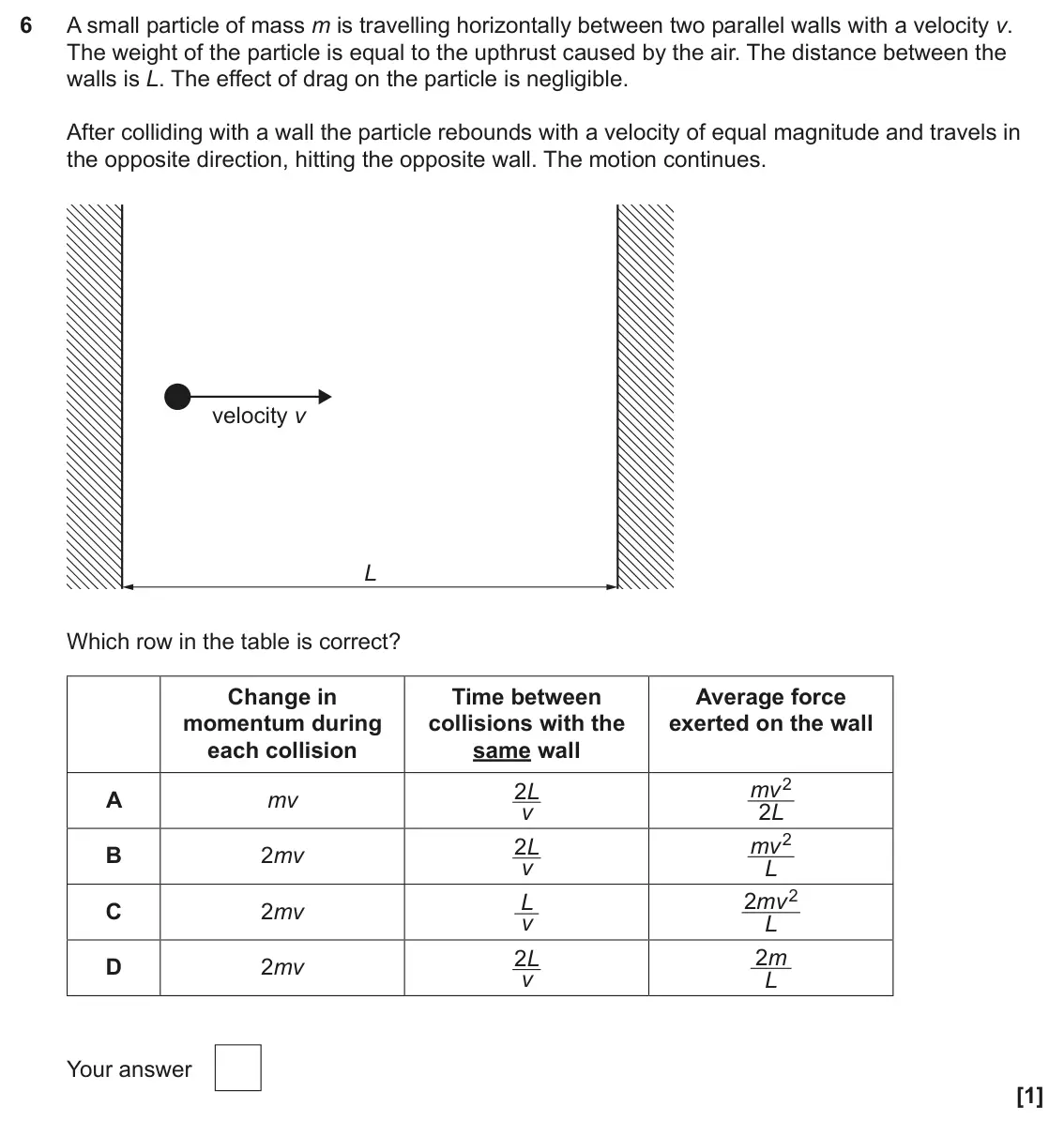
- June 2025, Paper 1, Q6 (1 mark): A small particle of mass m is travelling horizontally between two parallel walls with a velocity v. The weight of the particle is equal to the upthrust caused b
- June 2025, Paper 1, Q16(a)(iii) (2 marks): Use Fig. 16.1 to calculate the change of momentum of the car in 18 s. = kg m s–1 [2]
- June 2025, Paper 1, Q16(b)(ii) (1 mark): Explain why the value you have calculated in (a)(iii) is the area under the graph in Fig. 16.2. [1]
- June 2025, Paper 1, Q16(c)(i) (2 marks): Use Newton’s third law to explain how frictional forces cause the car to accelerate. [2]
- June 2025, AS Paper 1, Q16 (1 mark): A ball is thrown upwards from a height 1 m above the ground. It rises to maximum height, then falls to the ground and bounces once, rises and falls back down to
- June 2025, AS Paper 1, Q17 (1 mark): A ball is hit by a racket. The graph shows how the force on the ball changes whilst the racket is in contact with the ball. 140 120 100 80 force / N 60 40 20 0
- June 2025, AS Paper 1, Q21(a) (3 marks): When the lift is stationary, W = R. Discuss whether these two forces form a force pair according to Newton’s third law. [3]
- June 2025, AS Paper 2, Q6(b)(i) (1 mark): [1]
- June 2025, AS Paper 2, Q6(b)(ii) (2 marks): Determine the impulse of the force acting on R. impulse = N s [2]
- June 2024, Paper 1, Q17(a) (1 mark): State Newton’s second law of motion. [1]
- June 2024, Paper 1, Q17(b)(ii) (2 marks): Explain how the airflow around the model produces a force on the model. [2]
- June 2024, Paper 1, Q17(b)(iii) (3 marks): Calculate the vertical lift force F acting on the model due to the airflow around it. F = N [3]
- June 2024, Paper 3, Q3(a) (3 marks): The rocket engine works by expelling hot gas backwards. Explain, using Newton’s laws of motion, how the engine causes the rocket to accelerate between t = 0 and
- June 2024, AS Paper 1, Q9 (1 mark): According to Newton’s third law, forces always occur in pairs. Which statement is not true for a Newton’s third law force pair? A The forces are acting in oppos
- June 2024, AS Paper 2, Q2(a) (1 mark): State Newton’s second law of motion. [1]
- June 2024, AS Paper 2, Q2(b)(i) (2 marks): the impulse of the force applied to the puck. Include an appropriate unit. impulse = unit [2]
- June 2024, AS Paper 2, Q2(b)(ii) (1 mark): the average force F that the stick exerts on the puck. F = N [1]
- June 2023, Paper 1, Q3 (1 mark): The resultant force acting on a moving object is zero. Which graph shows this? displacement displacement 0 0 time time 0 0 B A velocity velocity 0 0 time time 0
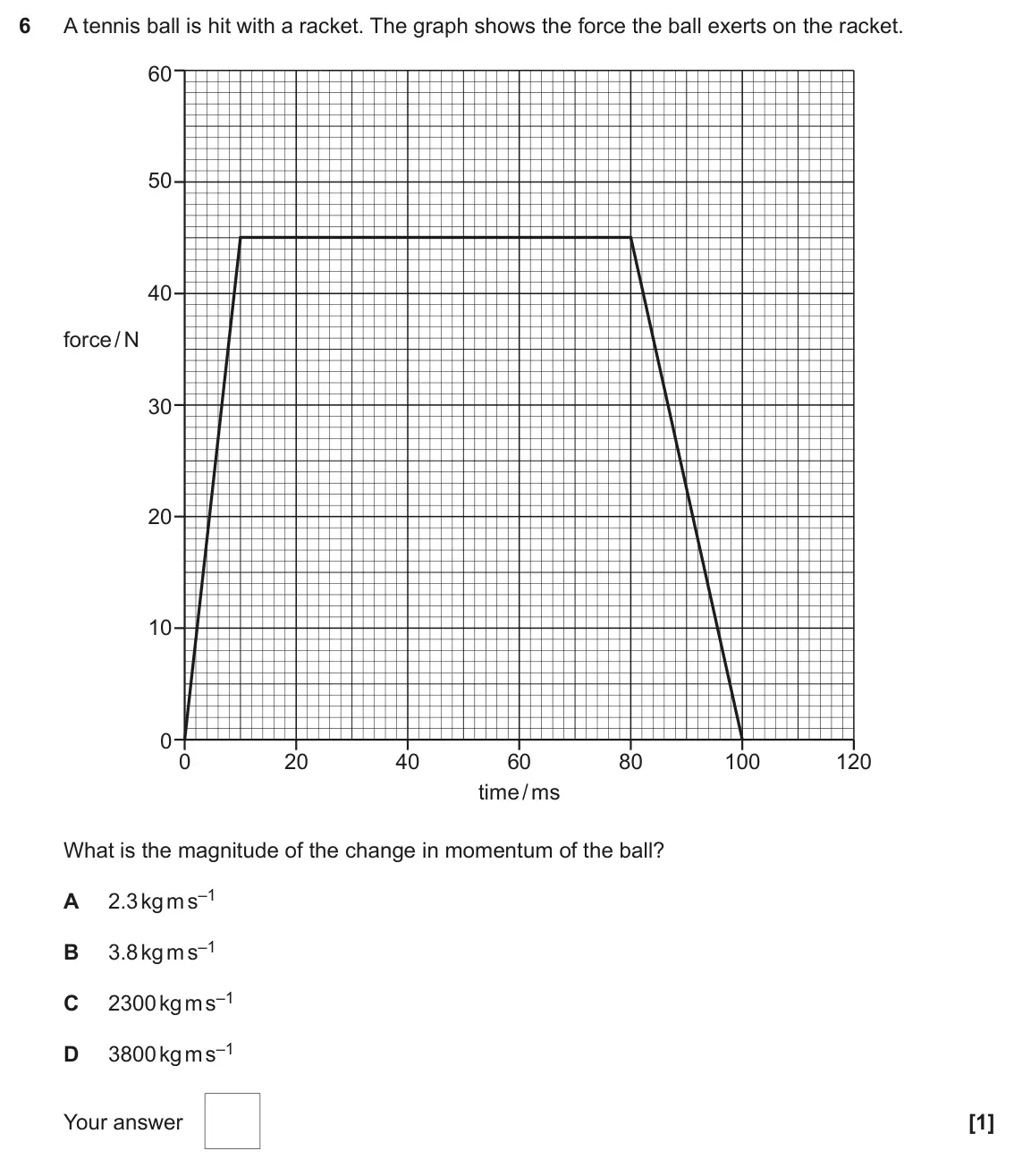
- June 2023, Paper 1, Q6 (1 mark): A tennis ball is hit with a racket. The graph shows the force the ball exerts on the racket. 60 50 40 force / N 30 20 10 0 0 20 40 60 80 100 120 time / ms What
- June 2023, Paper 1, Q20(c) (2 marks): The airship engine drives a fan which moves 7.8 kg of air per second at a relative speed of 45 m s–1, so the airship starts to move. All other conditions given
- June 2023, Paper 1, Q20(d) (2 marks): The airship has a higher maximum speed at high altitudes, but also produces less thrust from the engine. Explain these observations. [2]
- June 2023, AS Paper 1, Q24(a) (3 marks): The ball is incident normally on the wall with a horizontal velocity of 7.2 m s–1. The ball is in contact with the wall for 52 ms before rebounding normally wit
- June 2023, AS Paper 2, Q3(d) (2 marks): Explain why the momentum of the ball changes as the ball travels from the hand to the ground. [2]
- June 2022, Paper 1, Q18(a)(ii) (2 marks): All of the air incident on the shaded side of the tent is deflected at 90° to the original direction as shown in Fig. 18.2. viewed from above tent wind directio
- June 2022, AS Paper 1, Q23(a) (2 marks): Explain how the graphs demonstrate Newton’s third law during the collision. [2]
- November 2021, Paper 1, Q16(b)(i) (1 mark): Calculate the initial momentum p1 of the ball just before it hits the trapdoor. p1 = kg m s–1 [1]
- November 2021, Paper 1, Q16(b)(ii) (3 marks): Use the graph to calculate the magnitude of the final momentum p2 of the ball immediately after the collision. p2 = kg m s–1 [3]
- November 2021, AS Paper 1, Q20 (1 mark): Which one of the graphs below can be used to determine the impulse of a force from the area under the graph? acceleration A 0 0 time momentum B 0 0 time force C
- November 2021, AS Paper 1, Q21(b) (2 marks): The diagram below shows a trolley loaded onto the back of a truck. trolley truck ground The truck suddenly accelerates. The trolley is observed to remain in the
- November 2021, AS Paper 1, Q21(c)(ii) (3 marks): The mass of the car is 1200 kg. Calculate the rate of change of momentum of the car from t = 0 to t = 4.0 s. Include an appropriate unit for your answer. rate o
- November 2021, AS Paper 2, Q3(b) (3 marks): A golf ball initially at rest is hit by a golf club. A data-logger records the variation of force F acting on the ball with time t, as shown in Fig. 3.2. 20 F /
- November 2020, Paper 3, Q6(c) (3 marks): The initial kinetic energy of each α-particle is 5.0 MeV. Show that the magnitude of the initial momentum of each α-particle is about 10–19 kg m s–1. Take the m
- November 2020, Paper 3, Q6(d)(i) (2 marks): Draw two vectors in the spaces below to represent the initial momentum and the final momentum of the α-particle. initial momentum at A final momentum at B [2]
- November 2020, AS Paper 1, Q12 (1 mark): The momentum of an object moving to the left is 28 kg m s−1. A force of magnitude 3.5 N acts on the object to the right for a time of 2.0 s. What is the change
- June 2019, Paper 1, Q20(a) (2 marks): Use Newton’s second law of motion to explain the physical quantity represented by the area under the graph shown in Fig. 20.1. [2]
- June 2019, Paper 1, Q20(b) (2 marks): The total mass of cyclist and bicycle is 71 kg. Use Fig. 20.1 to calculate the initial speed U. U = m s–1 [2]
- June 2019, AS Paper 1, Q4 (1 mark): The variation with time t of the force F acting on a ball is shown below. F/N 300 200 100 0 t / 10–3 s 0 5.0 10.0 Which statement is not correct? A The area und
- June 2019, AS Paper 1, Q21(b)(i) (1 mark): According to Newton’s third law of motion, W is one of the forces in a pair of equal and opposite forces. Name the object that experiences a force of magnitude
- June 2019, AS Paper 1, Q21(b)(ii) (1 mark): According to a student, W = N is a consequence of Newton’s third law of motion. State why this is incorrect. [1]
- June 2019, AS Paper 1, Q22(d) (2 marks): Calculate the average resultant force acting on the ball during the collision. force = N [2]
- June 2018, Paper 1, Q20(a) (2 marks): Use the equations for momentum and kinetic energy to derive an expression for the kinetic energy Ek of a particle in terms of its momentum p and mass m. [2]
- June 2018, Paper 1, Q21(a) (2 marks): When the drum is at rest, the weight of the clothes is equal to the normal contact force on the clothes at point A. Explain why these two forces are not an exam
- June 2018, AS Paper 1, Q11 (1 mark): A javelin thrower exerts a force of 100 N on a javelin for a time of 0.30 s. The javelin has a mass of 0.80 kg. What is the rate of change of the momentum of th
- June 2018, AS Paper 1, Q15 (1 mark): A trolley of mass 1.0 kg is moving on a horizontal surface at a constant velocity of 2.0 m s−1. A force of 3.0 N is applied to the trolley in the opposite direc
- June 2018, AS Paper 2, Q5(a) (1 mark): State Newton’s second law of motion. [1]
- June 2018, AS Paper 2, Q5(b)(i) (1 mark): The tennis ball hits the ground at a speed of 14 m s–1. Calculate the momentum p of the tennis ball as it hits the ground. p = N s [1] The force acting on the b
- June 2018, AS Paper 2, Q5(b)(ii) (3 marks): Determine the speed v of the tennis ball as it leaves the ground. v = m s–1 [3]
- June 2017, Paper 1, Q13 (1 mark): A puck of mass 0.16 kg is sliding on ice with a constant velocity of 11.0 m s−1. A hockey stick exerts a force on the puck, for a short period of time, in the o
- June 2017, AS Paper 1, Q6 (1 mark): A ball, initially at rest, is struck by a hockey stick. It leaves the hockey stick at speed v. Which quantity, together with the mass of the ball, can be used t
- June 2017, AS Paper 1, Q23(b)(i) (2 marks): Use Fig. 23 to calculate the force F acting on ball X during the collision. F = N [2]
- June 2016, AS Paper 1, Q24(a) (1 mark): State Newton’s second law. [1]
- June 2016, AS Paper 1, Q24(b)(ii) (2 marks): Fig. 24.1 shows how the force F acting on the comet varies with time t during the collision. F 0 0 t Fig. 24.1 Describe and explain how the force acting on the
Questions, mark schemes and examiner’s reports are © OCR, from their published past papers. Plumi isn’t affiliated with any exam board. Want whole papers? Every OCR A-Level Physics A paper, or our free OCR-style practice pack.
Rather write your answers by hand on iPad? Plumi marks them against the same mark schemes.