Skip to content
Android waitlistTry on iPad
Get started

Mechanisms and motion: OCR A‑Level Design Engineering questions

OCR A-Level Design Engineering past-paper questions on 6.2 Mechanisms and motion, 2021–2025, with mark schemes and examiner’s reports where available.

Past paper difficulty
Paper
All papers
Exam
All years

Loading the full question list…

193 questions

  1. Q1(c)

    June 2025 · H404/01 · ★★

    The whole paper ↗
    1
    Setup for original question 1(c)

    Loading the question setup…

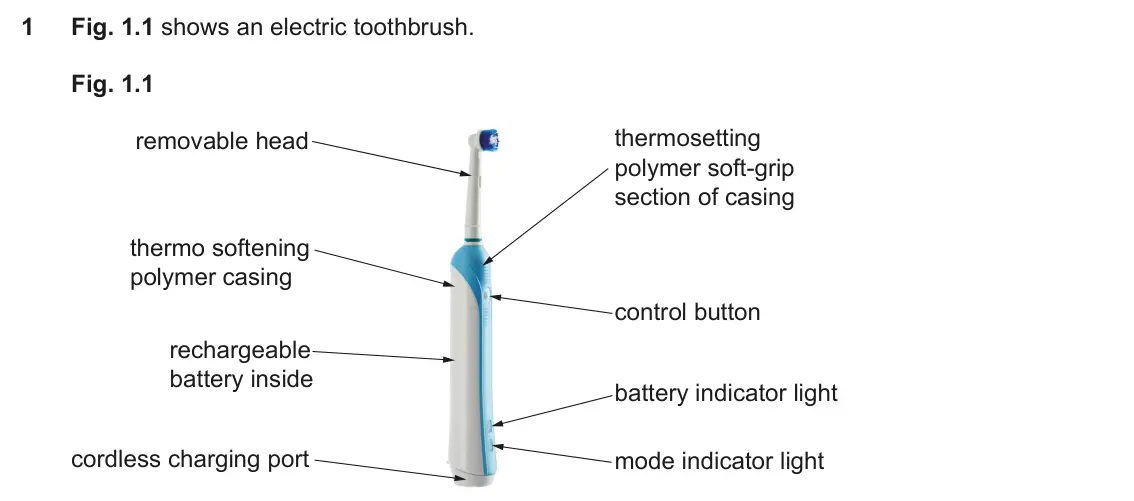
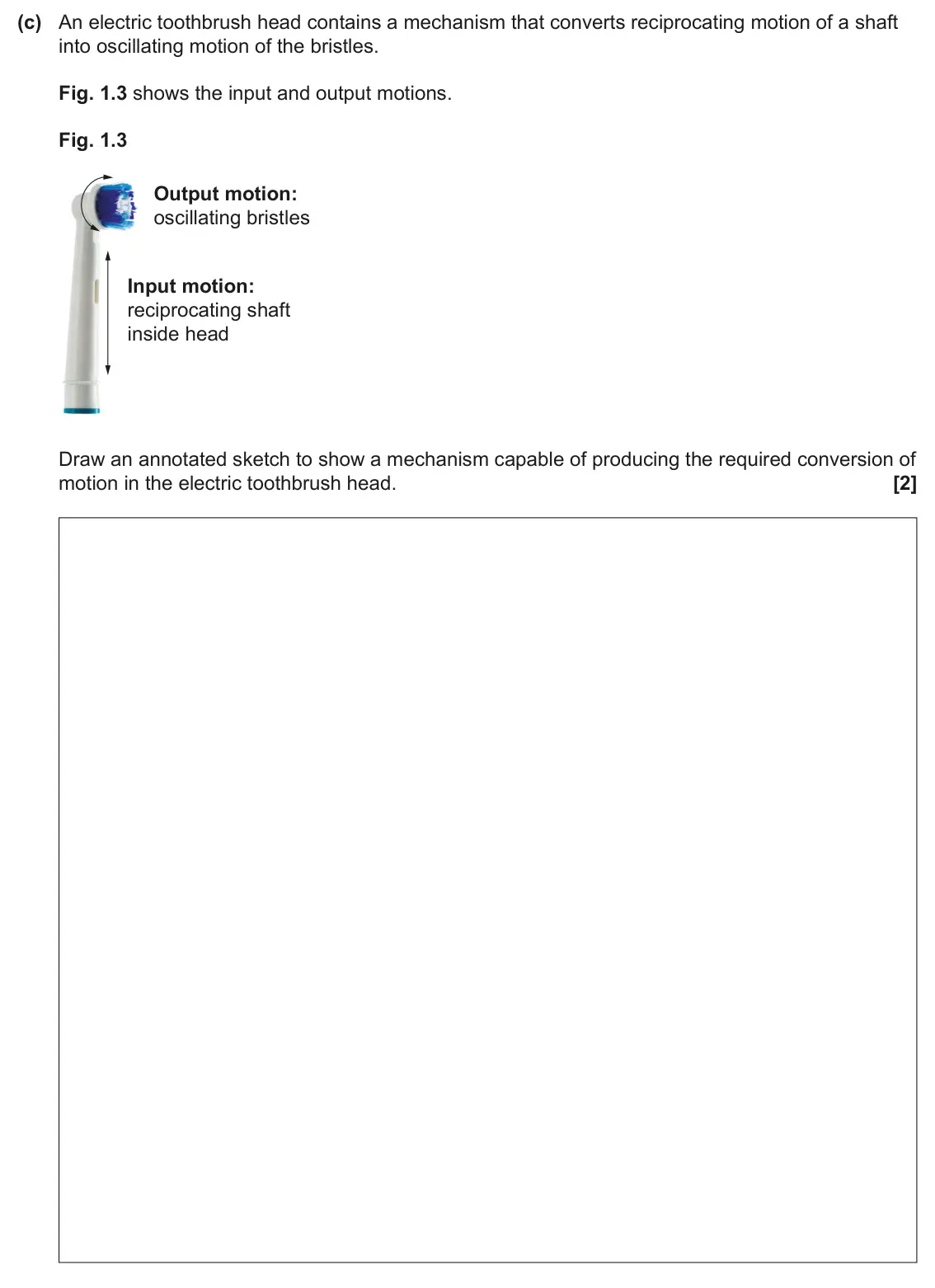
    Original question 1(c): An electric toothbrush head contains a mechanism that converts reciprocating motion of a shaft into oscillating motion of the bristles. Fig. 1.3 shows the input

    Loading the question…

  2. Q3(b)(i)

    June 2025 · H404/02 · ★★

    Sources (insert) ↗
    The whole paper ↗
    2
    Setup for original question 3(b)(i)

    Loading the question setup…

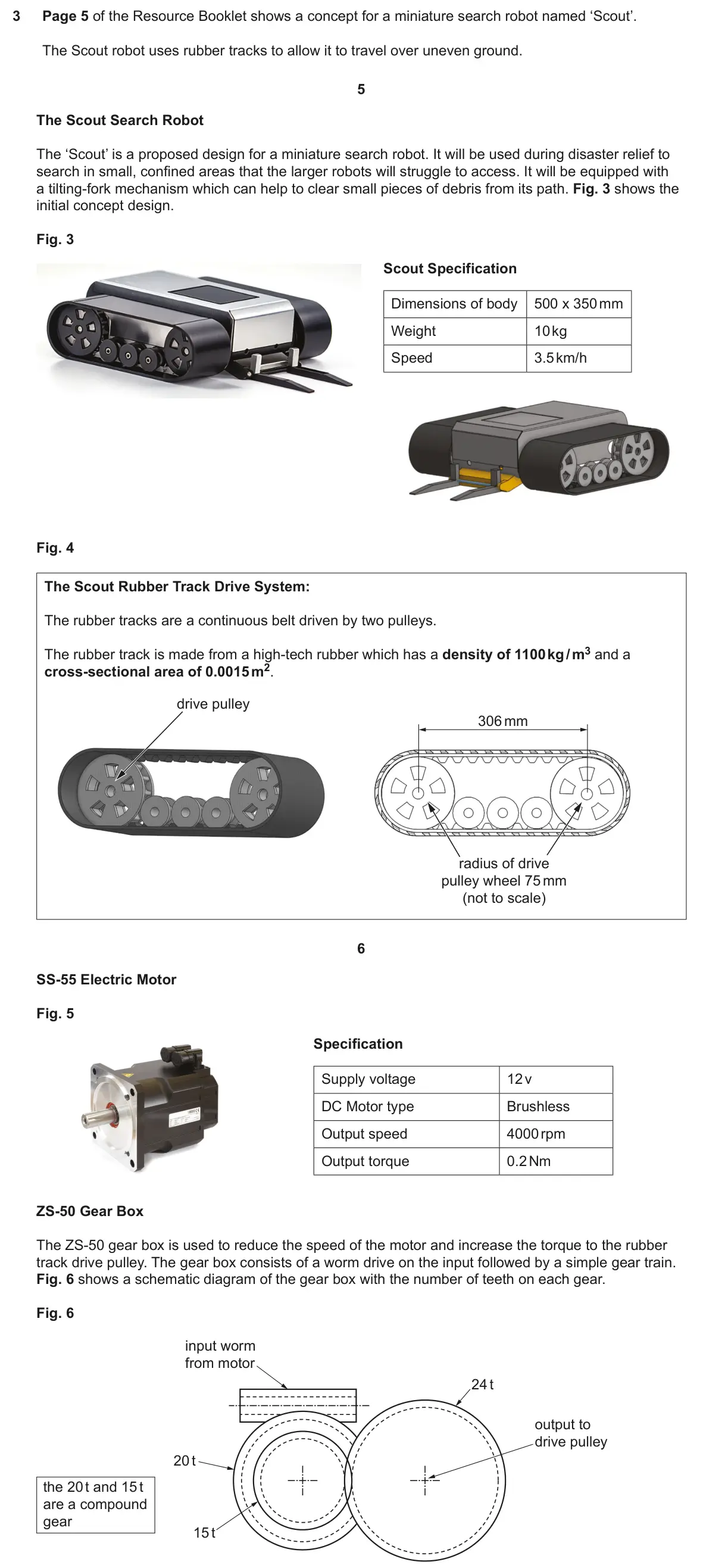
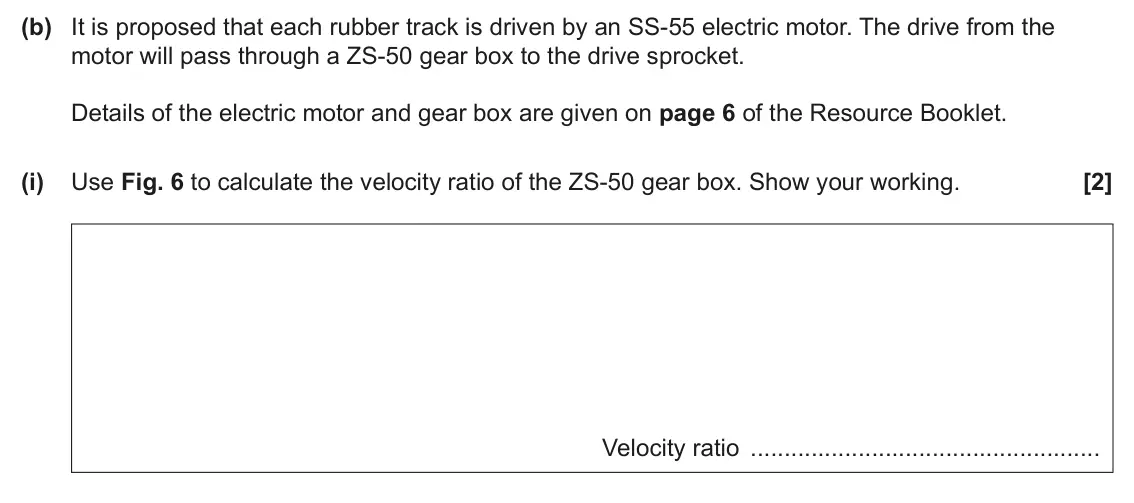
    Original question 3(b)(i): Use Fig. 6 to calculate the velocity ratio of the ZS-50 gear box. Show your working. [2] Velocity ratio

    Loading the question…

  3. Q3(b)(ii)

    June 2025 · H404/02 · ★★★★

    Sources (insert) ↗
    The whole paper ↗
    3
    Setup for original question 3(b)(ii)

    Loading the question setup…

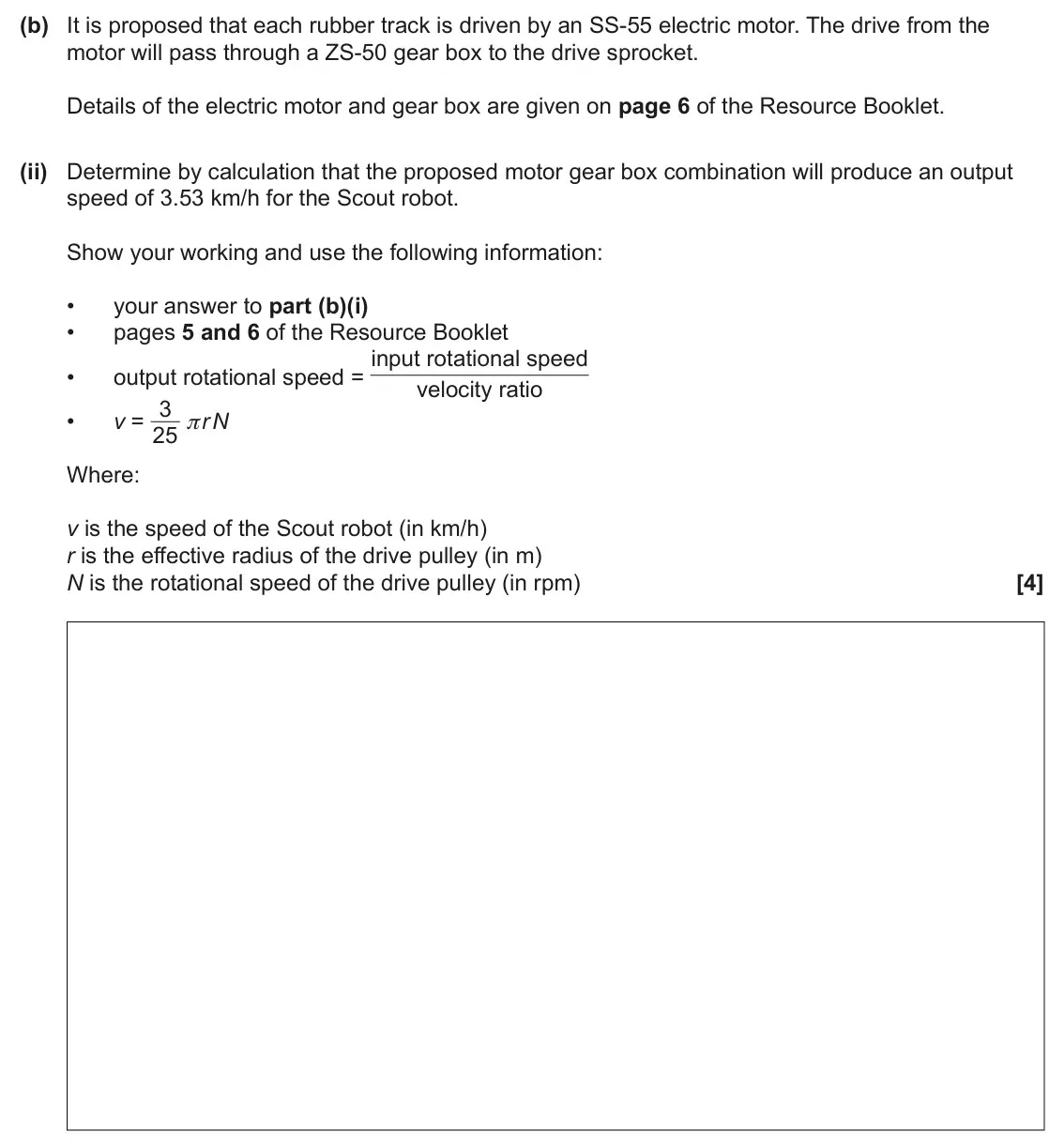
    Original question 3(b)(ii): Determine by calculation that the proposed motor gear box combination will produce an output speed of 3.53 km/h for the Scout robot. Show your working and use t

    Loading the question…

  4. Q4

    June 2025 · H404/02 · ★★★★★

    Sources (insert) ↗
    The whole paper ↗
    4
    Setup for original question 4

    Loading the question setup…

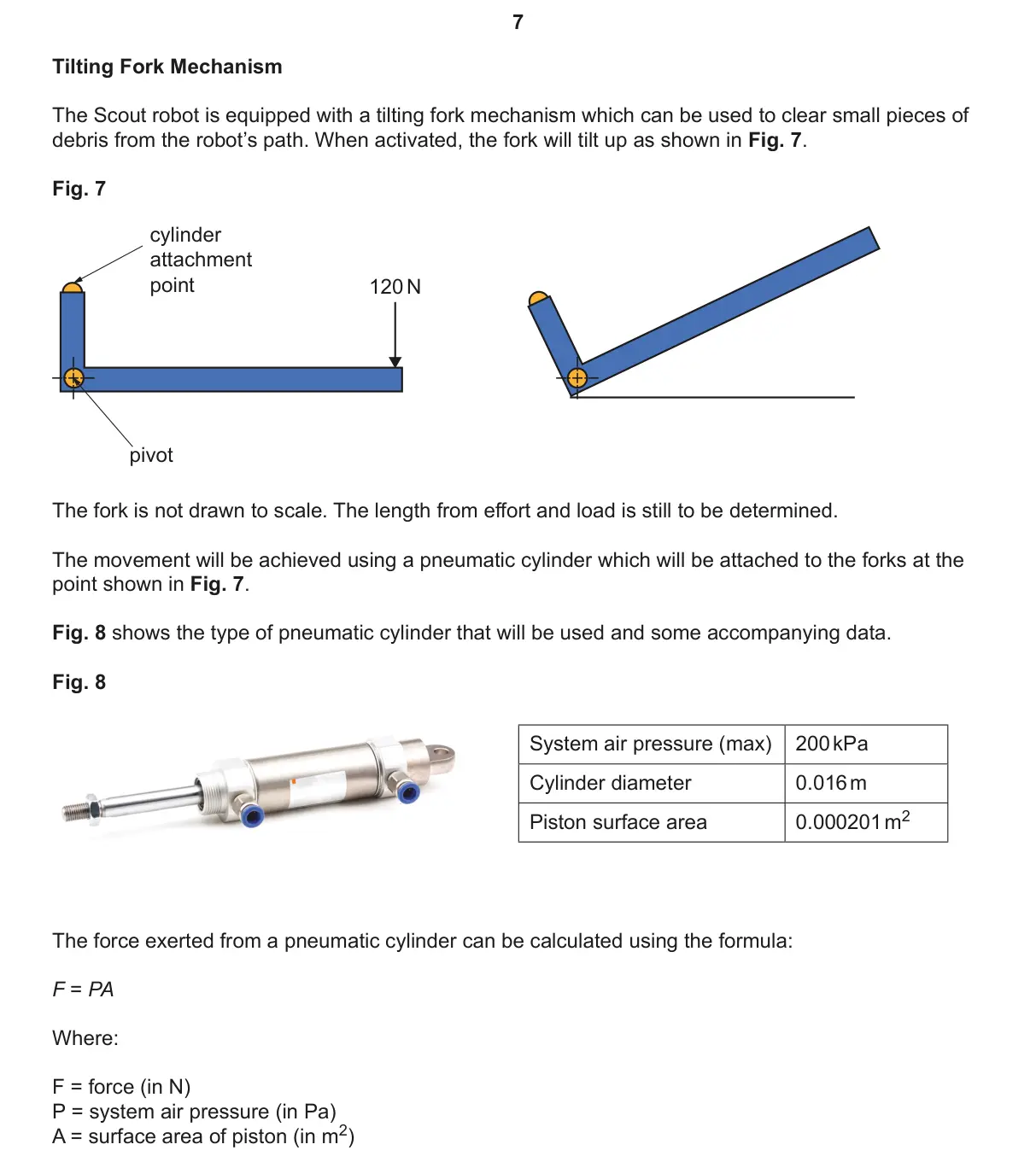
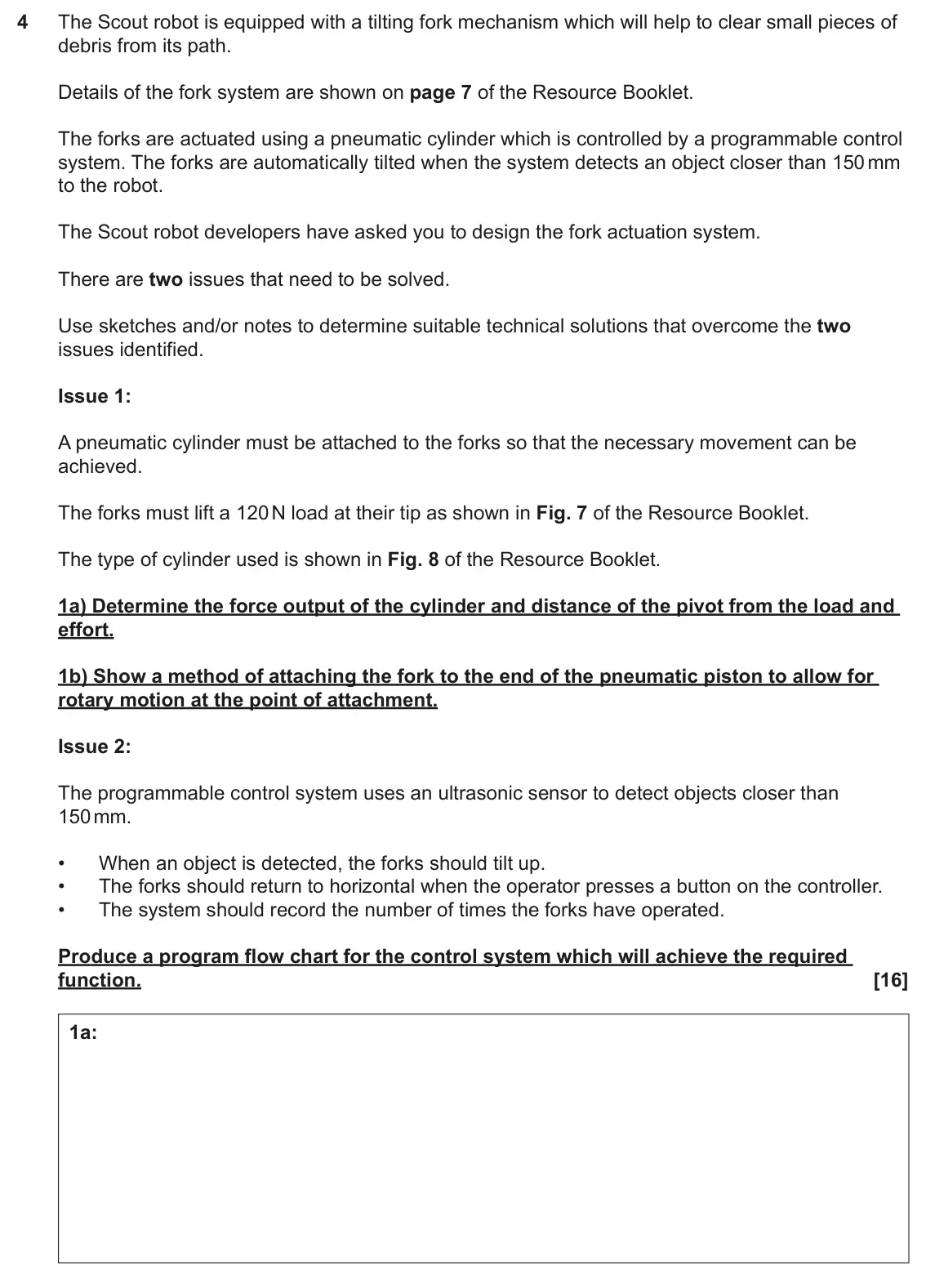
    Original question 4: The Scout robot is equipped with a tilting fork mechanism which will help to clear small pieces of debris from its path. Details of the fork system are shown on

    Loading the question…

  5. Q1(b)(i)

    June 2024 · H404/01 · ★★★

    The whole paper ↗
    5
    Setup for original question 1(b)(i)

    Loading the question setup…

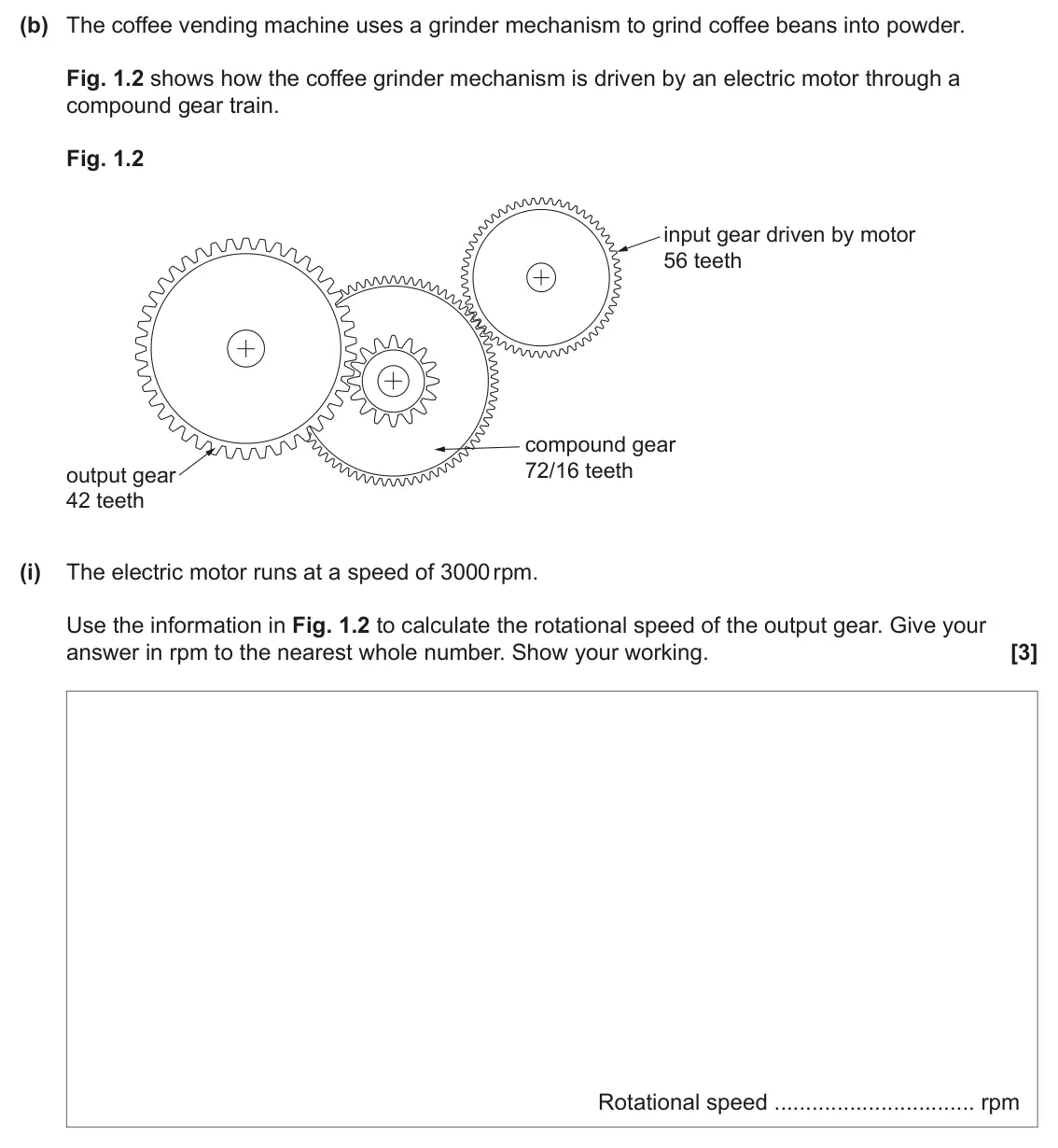
    Original question 1(b)(i): The electric motor runs at a speed of 3000 rpm. Use the information in Fig. 1.2 to calculate the rotational speed of the output gear. Give your answer in rpm to

    Loading the question…

  6. Q1(b)(ii)

    June 2024 · H404/01 · ★★

    The whole paper ↗
    6
    Setup for original question 1(b)(ii)

    Loading the question setup…

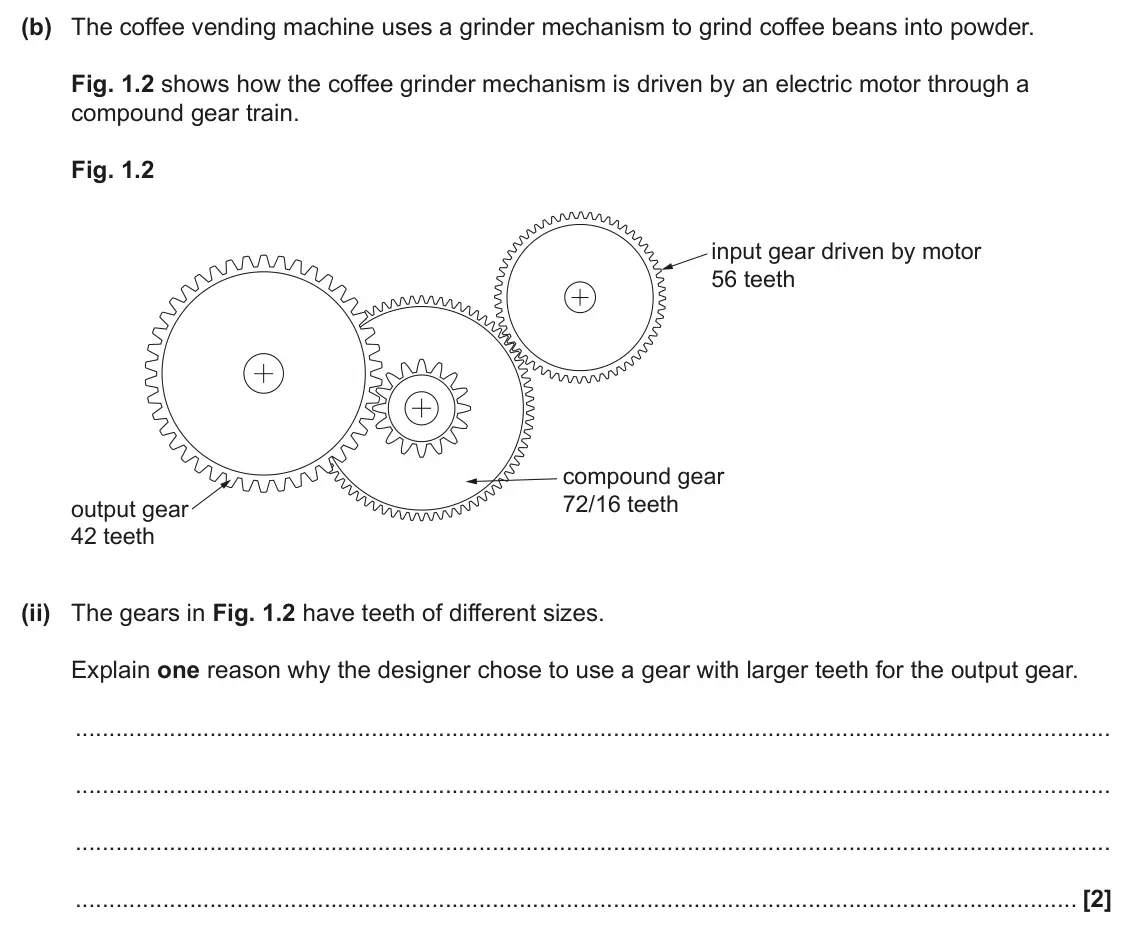
    Original question 1(b)(ii): The gears in Fig. 1.2 have teeth of different sizes. Explain one reason why the designer chose to use a gear with larger teeth for the output gear. [2]

    Loading the question…

  7. Q1(b)

    June 2023 · H404/01 · ★★

    The whole paper ↗
    7
    Setup for original question 1(b)

    Loading the question setup…

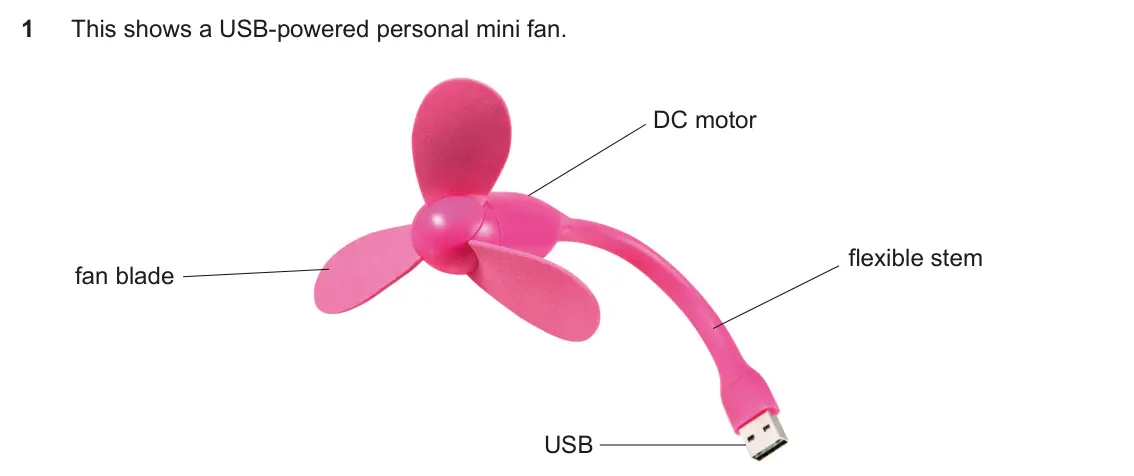
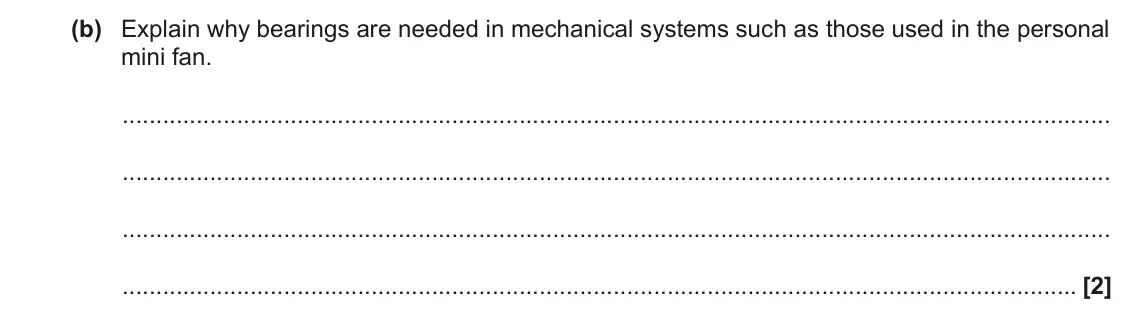
    Original question 1(b): Explain why bearings are needed in mechanical systems such as those used in the personal mini fan. [2]

    Loading the question…

  8. Q4(b)(i)

    June 2023 · H404/01 · ★★★★

    The whole paper ↗
    8
    Setup for original question 4(b)(i)

    Loading the question setup…

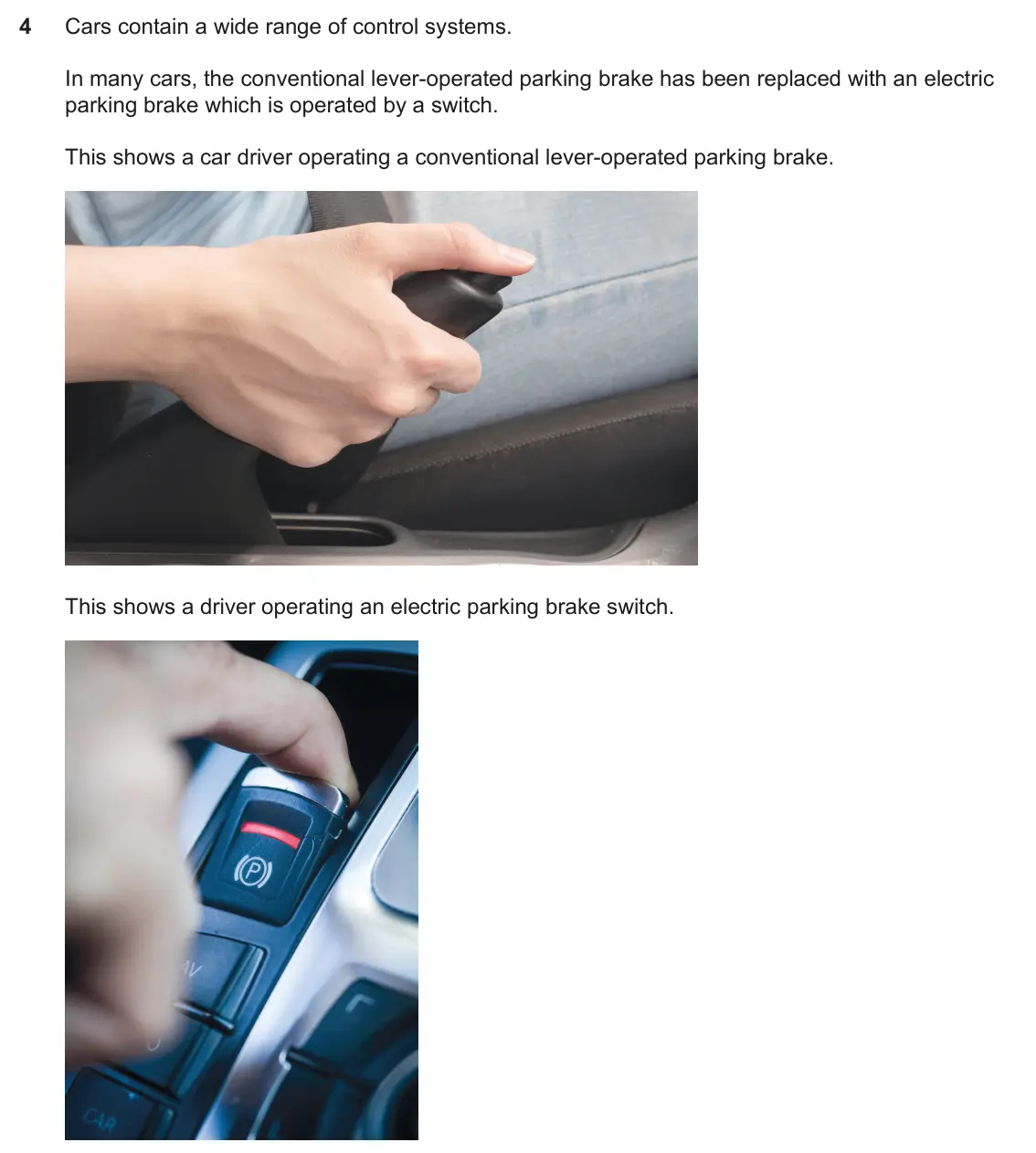
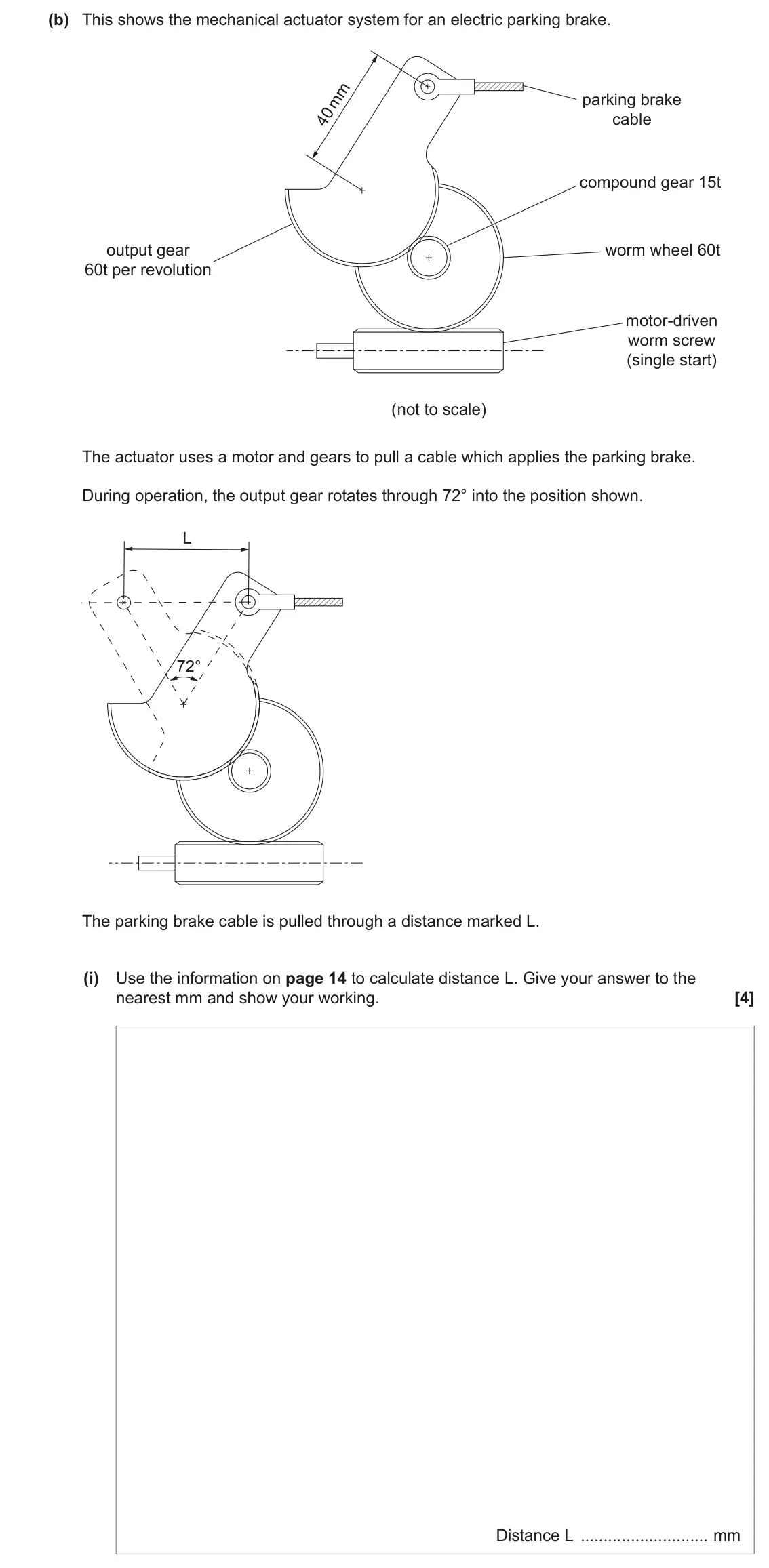
    Original question 4(b)(i): Use the information on page 14 to calculate distance L. Give your answer to the nearest mm and show your working. [4] Distance L mm

    Loading the question…

  9. Q4(b)(ii)

    June 2023 · H404/01 · ★★★

    The whole paper ↗
    9
    Setup for original question 4(b)(ii)

    Loading the question setup…

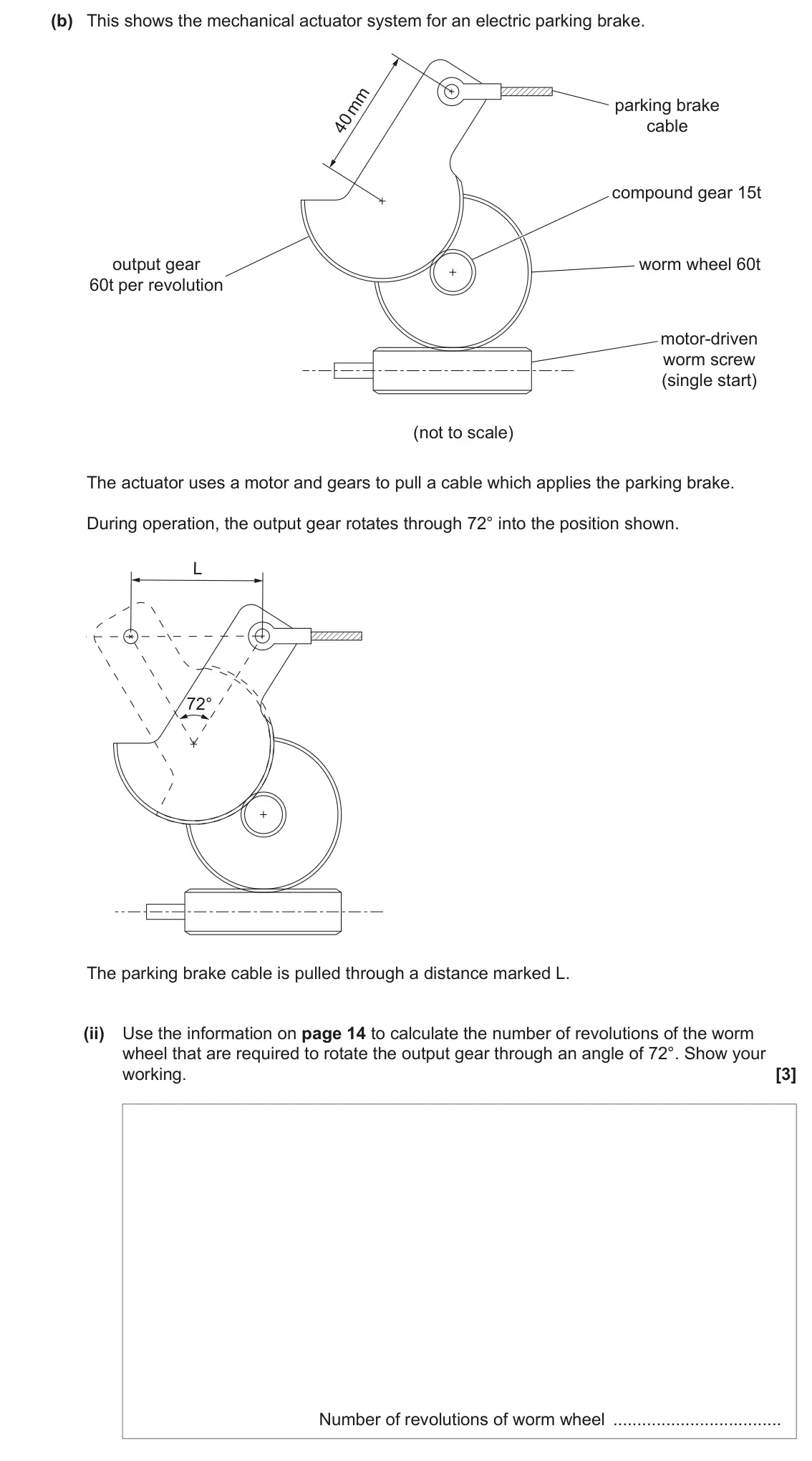
    Original question 4(b)(ii): Use the information on page 14 to calculate the number of revolutions of the worm wheel that are required to rotate the output gear through an angle of 72°. Sho

    Loading the question…

  10. Q4(b)(i)

    June 2022 · H404/01 · ★★★★

    The whole paper ↗
    10
    Setup for original question 4(b)(i)

    Loading the question setup…

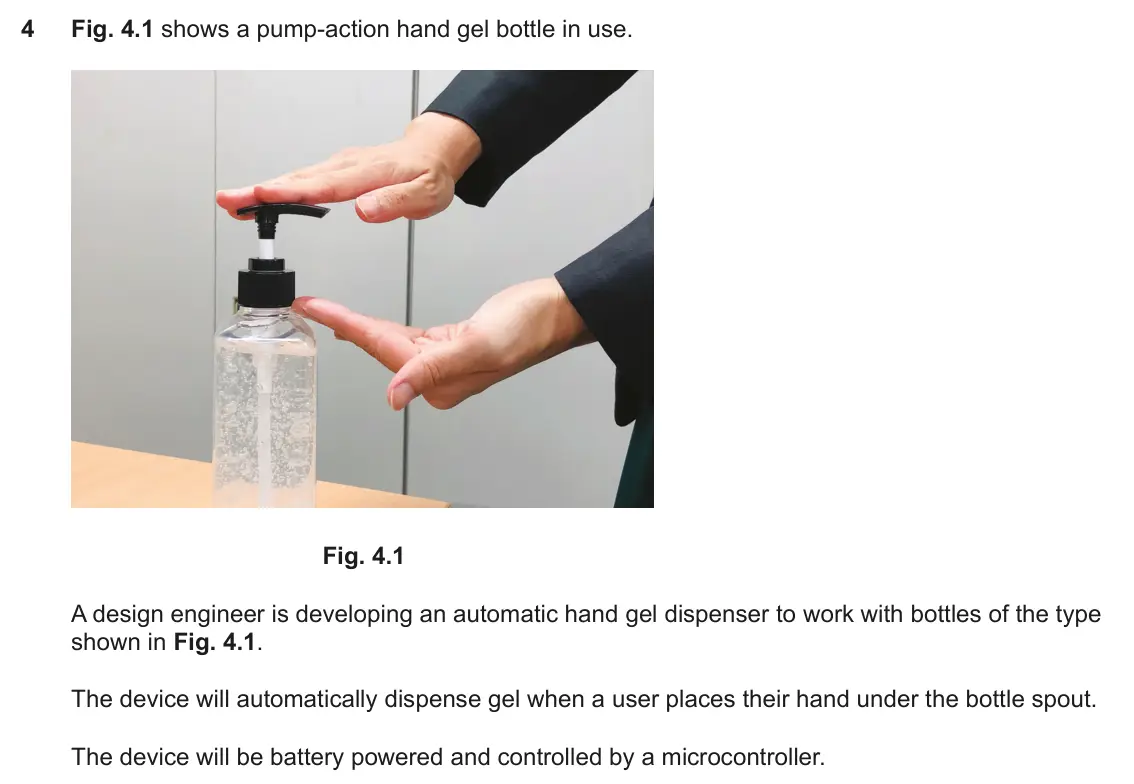
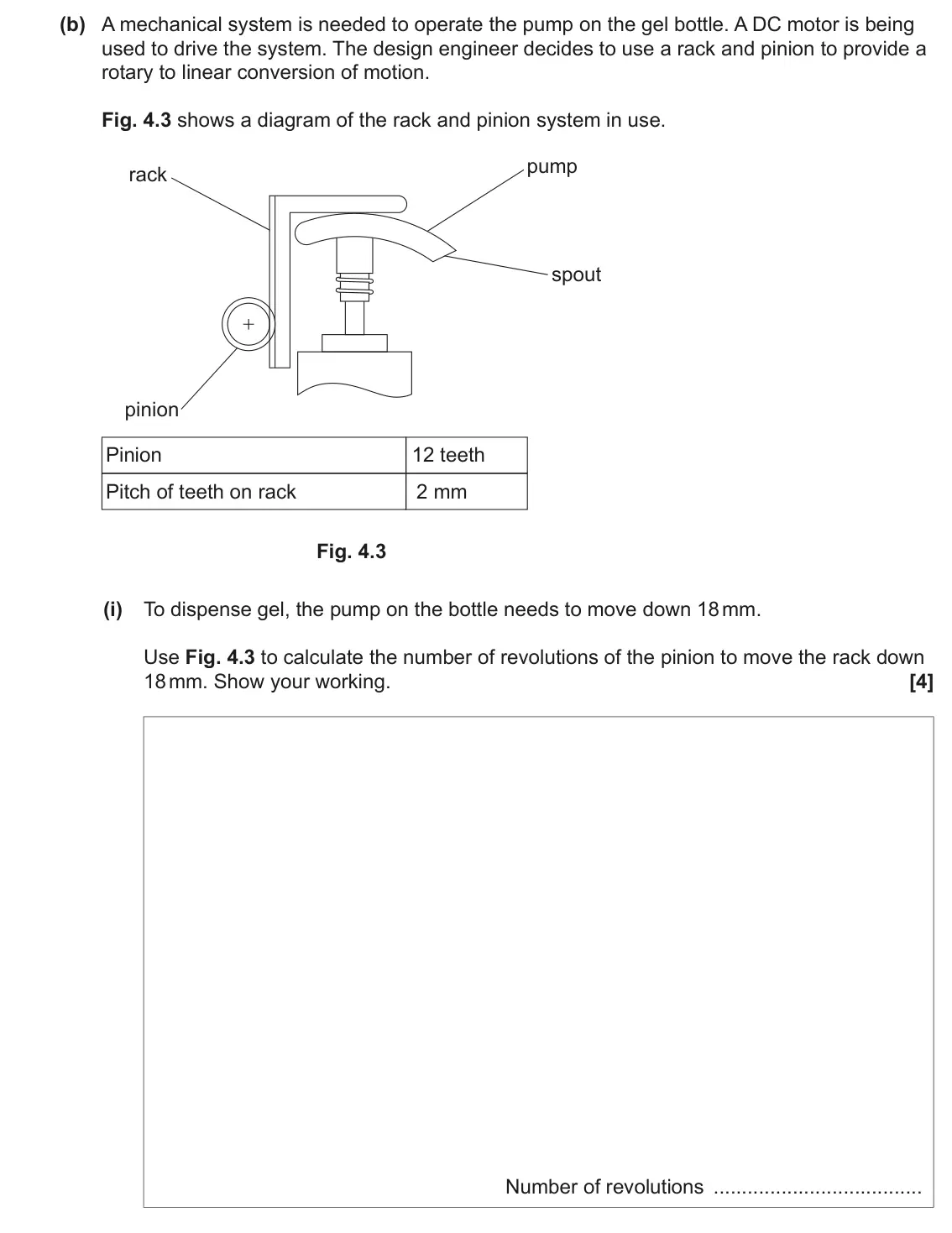
    Original question 4(b)(i): To dispense gel, the pump on the bottle needs to move down 18 mm. Use Fig. 4.3 to calculate the number of revolutions of the pinion to move the rack down 18 mm.

    Loading the question…

  11. Q4(b)(ii)

    June 2022 · H404/01 · ★★★★

    The whole paper ↗
    11
    Setup for original question 4(b)(ii)

    Loading the question setup…

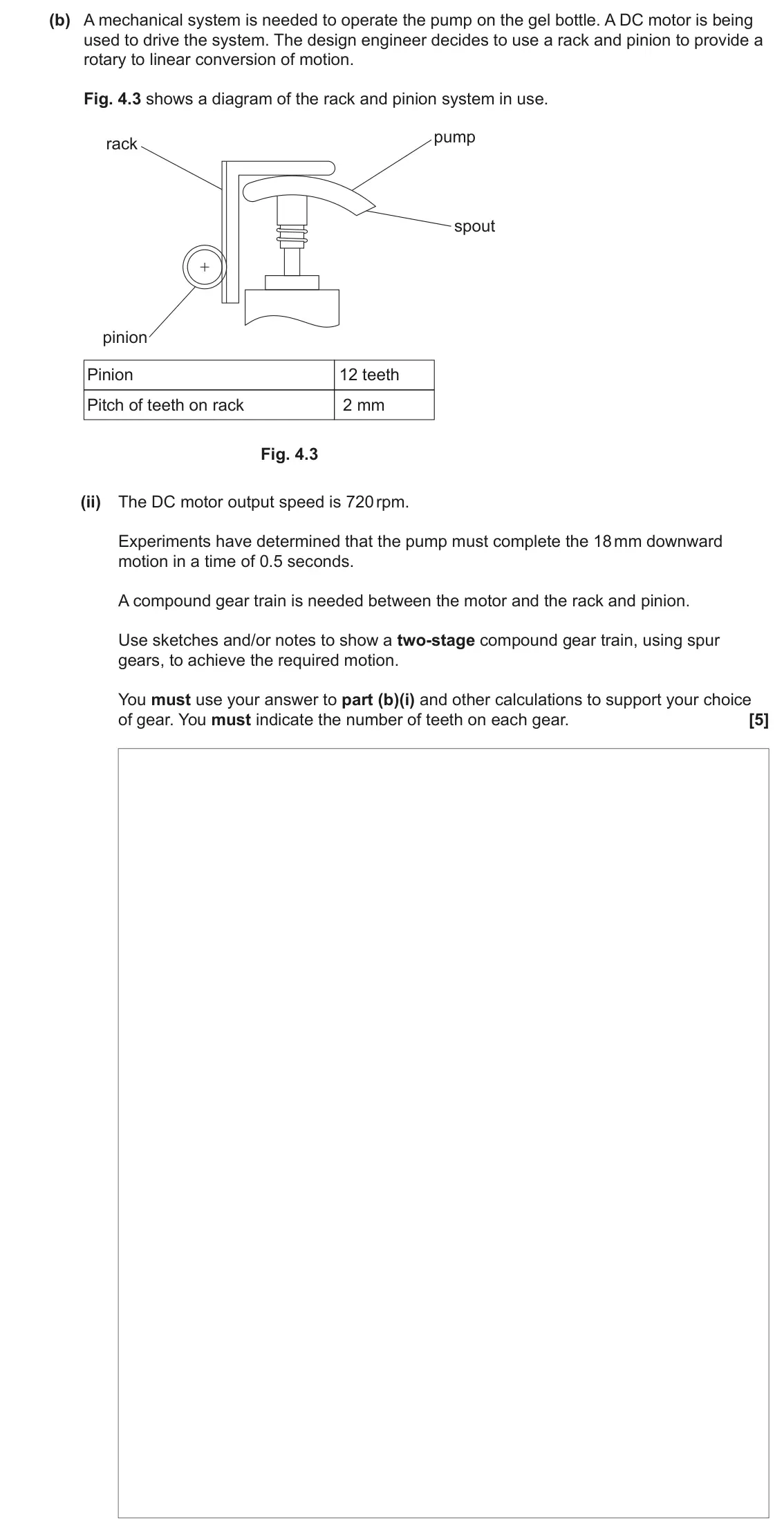
    Original question 4(b)(ii): The DC motor output speed is 720 rpm. Experiments have determined that the pump must complete the 18 mm downward motion in a time of 0.5 seconds. A compound gea

    Loading the question…

  12. Q4(b)(iii)

    June 2022 · H404/01 · ★★

    The whole paper ↗
    12
    Setup for original question 4(b)(iii)

    Loading the question setup…

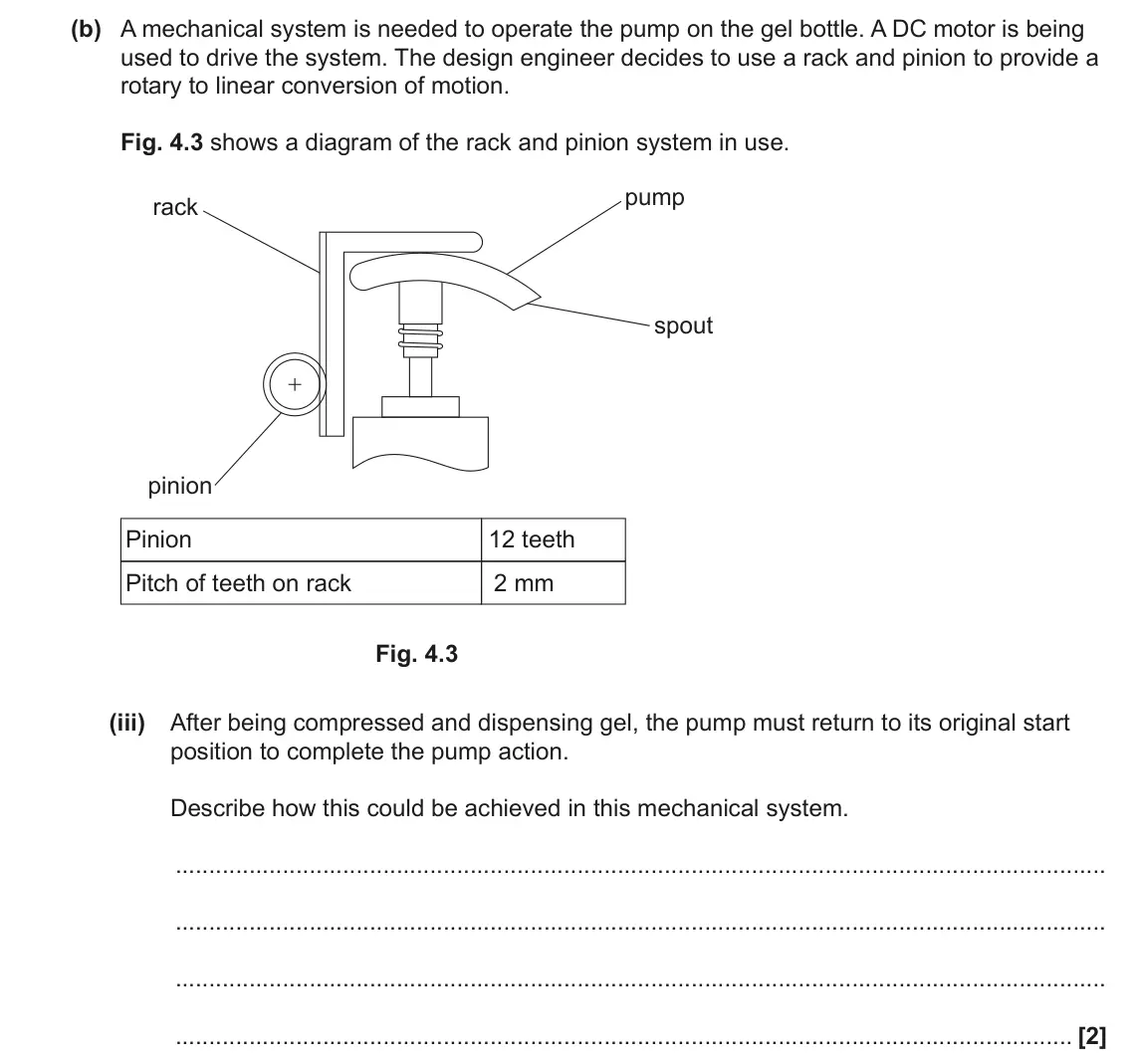
    Original question 4(b)(iii): After being compressed and dispensing gel, the pump must return to its original start position to complete the pump action. Describe how this could be achieved

    Loading the question…

  13. Q1(b)(i)

    November 2021 · H404/01 · ★★★★

    The whole paper ↗
    13
    Setup for original question 1(b)(i)

    Loading the question setup…

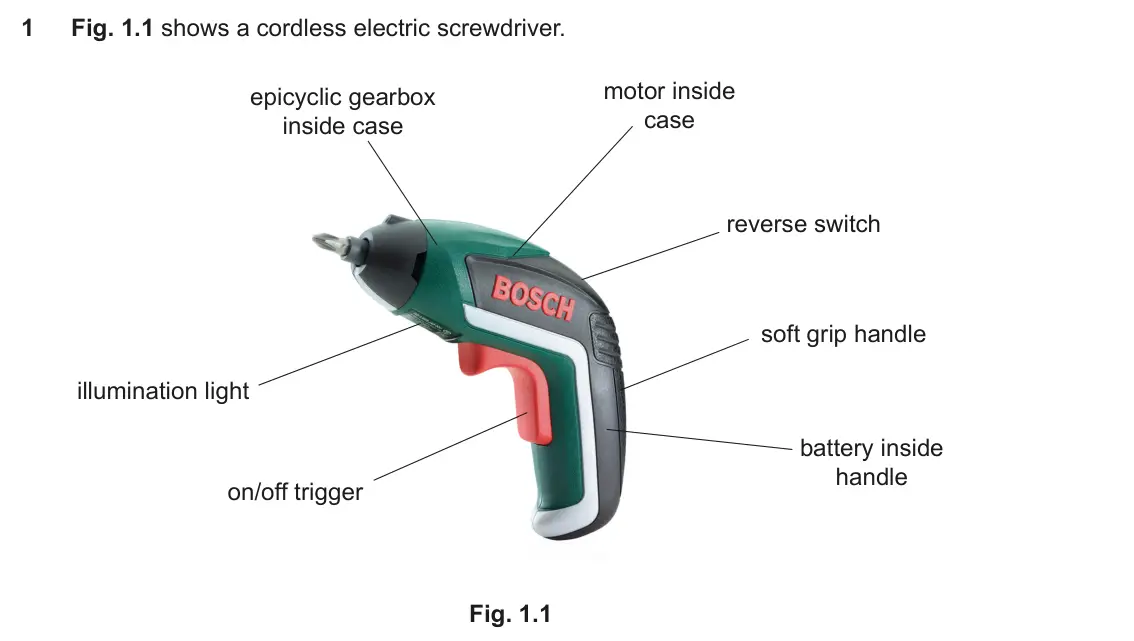
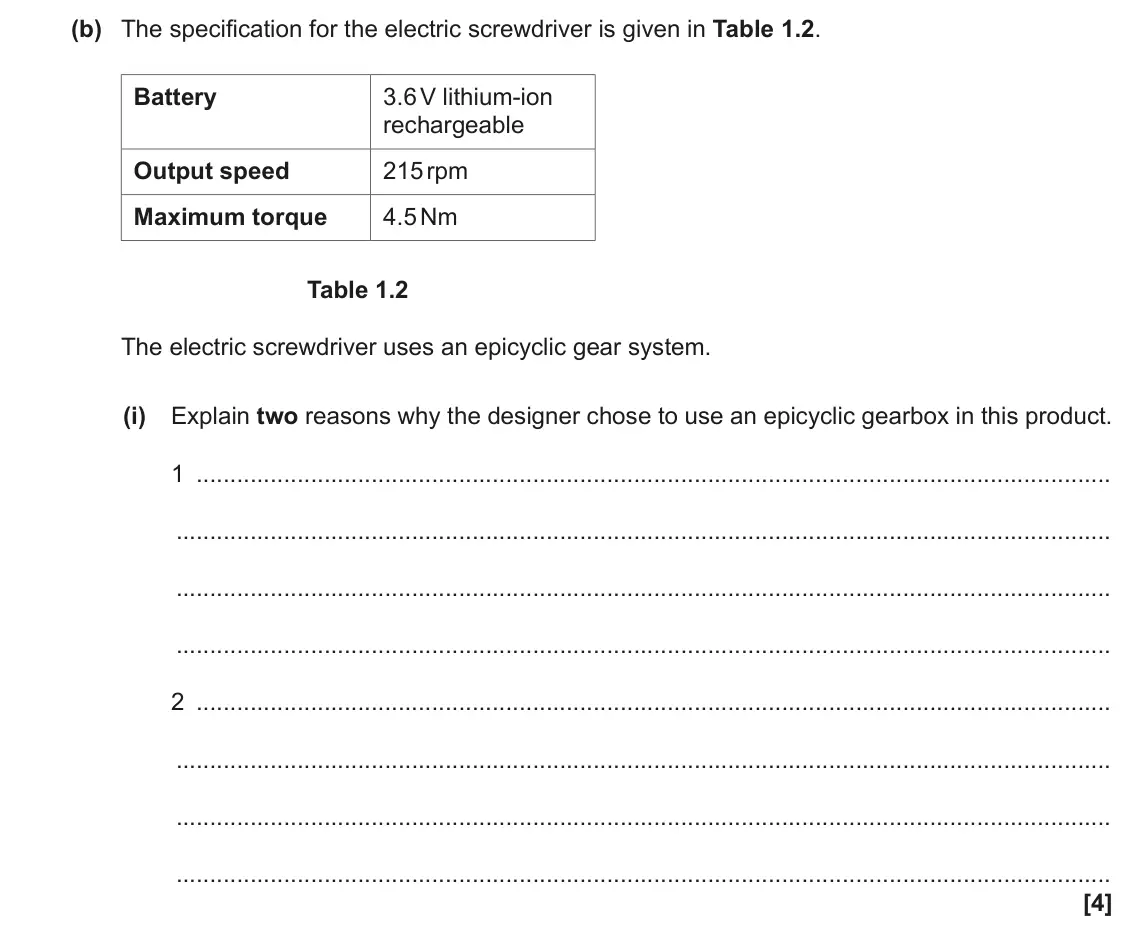
    Original question 1(b)(i): Explain two reasons why the designer chose to use an epicyclic gearbox in this product. 1 2 [4]

    Loading the question…

  14. Q1(b)(ii)

    November 2021 · H404/01 · ★★★

    The whole paper ↗
    14
    Setup for original question 1(b)(ii)

    Loading the question setup…

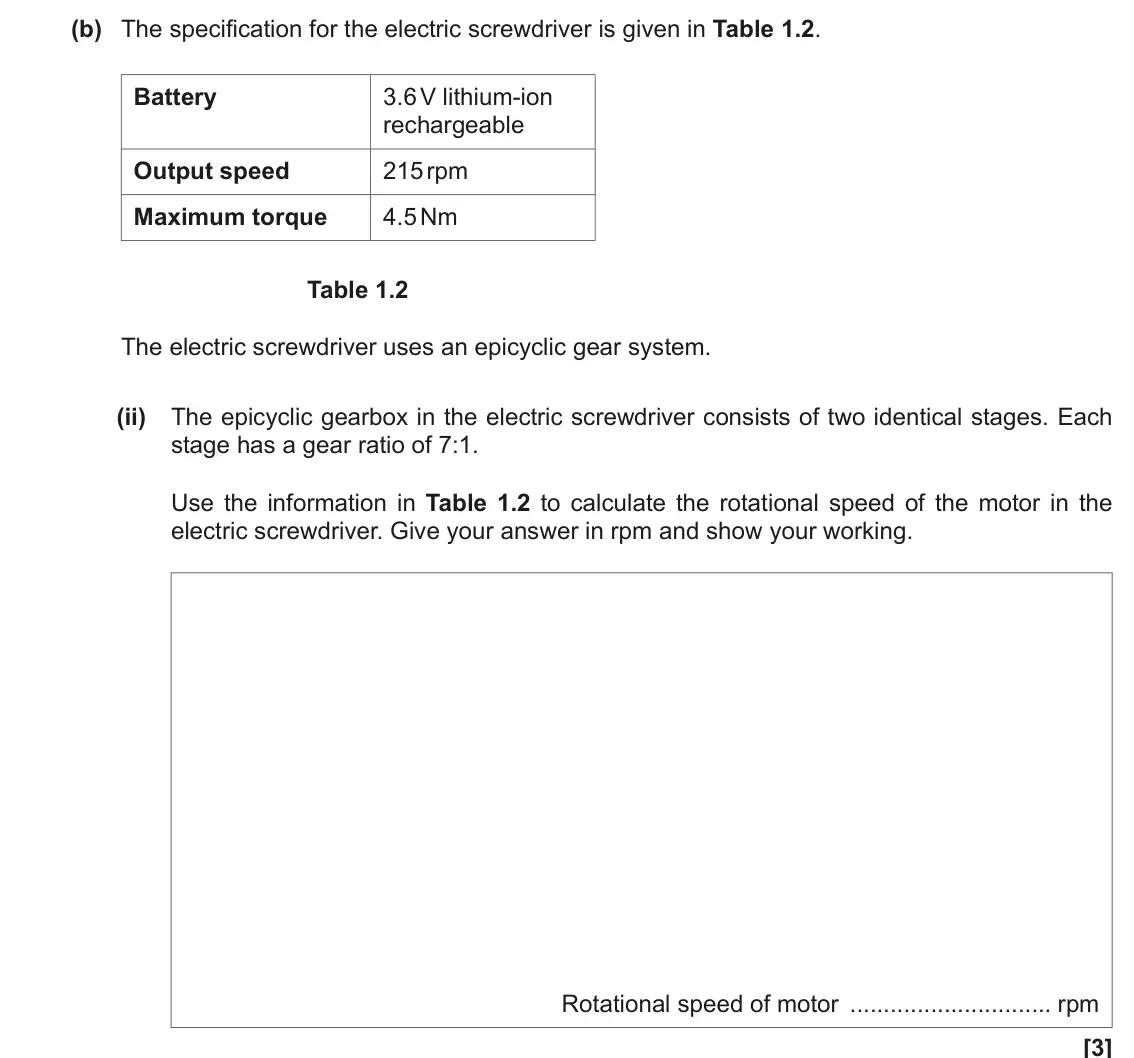
    Original question 1(b)(ii): The epicyclic gearbox in the electric screwdriver consists of two identical stages. Each stage has a gear ratio of 7:1. Use the information in Table 1.2 to calc

    Loading the question…

  15. Q3

    November 2021 · H404/02 · ★★★★★

    Sources (insert) ↗
    The whole paper ↗
    15
    Setup for original question 3

    Loading the question setup…

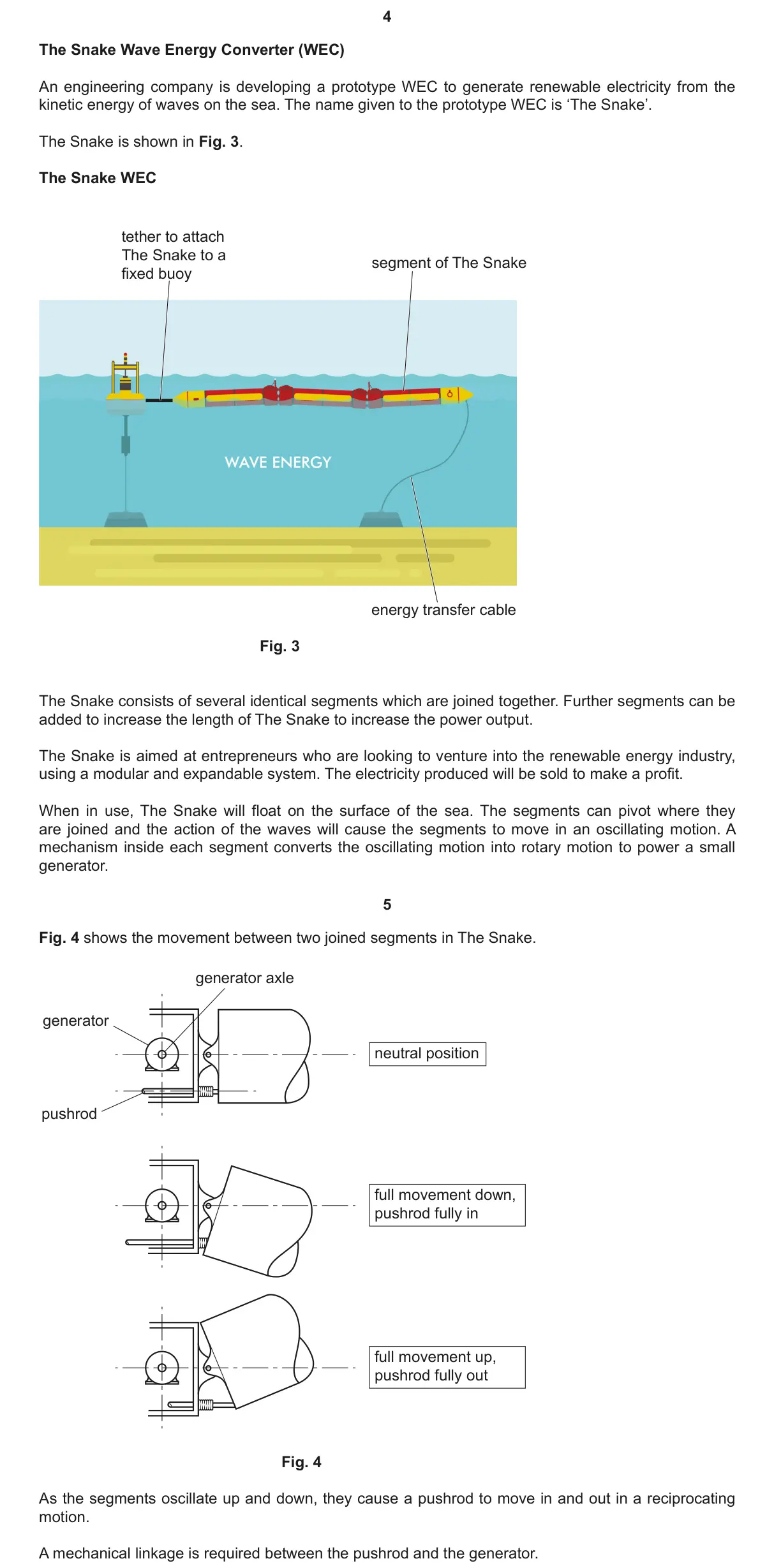
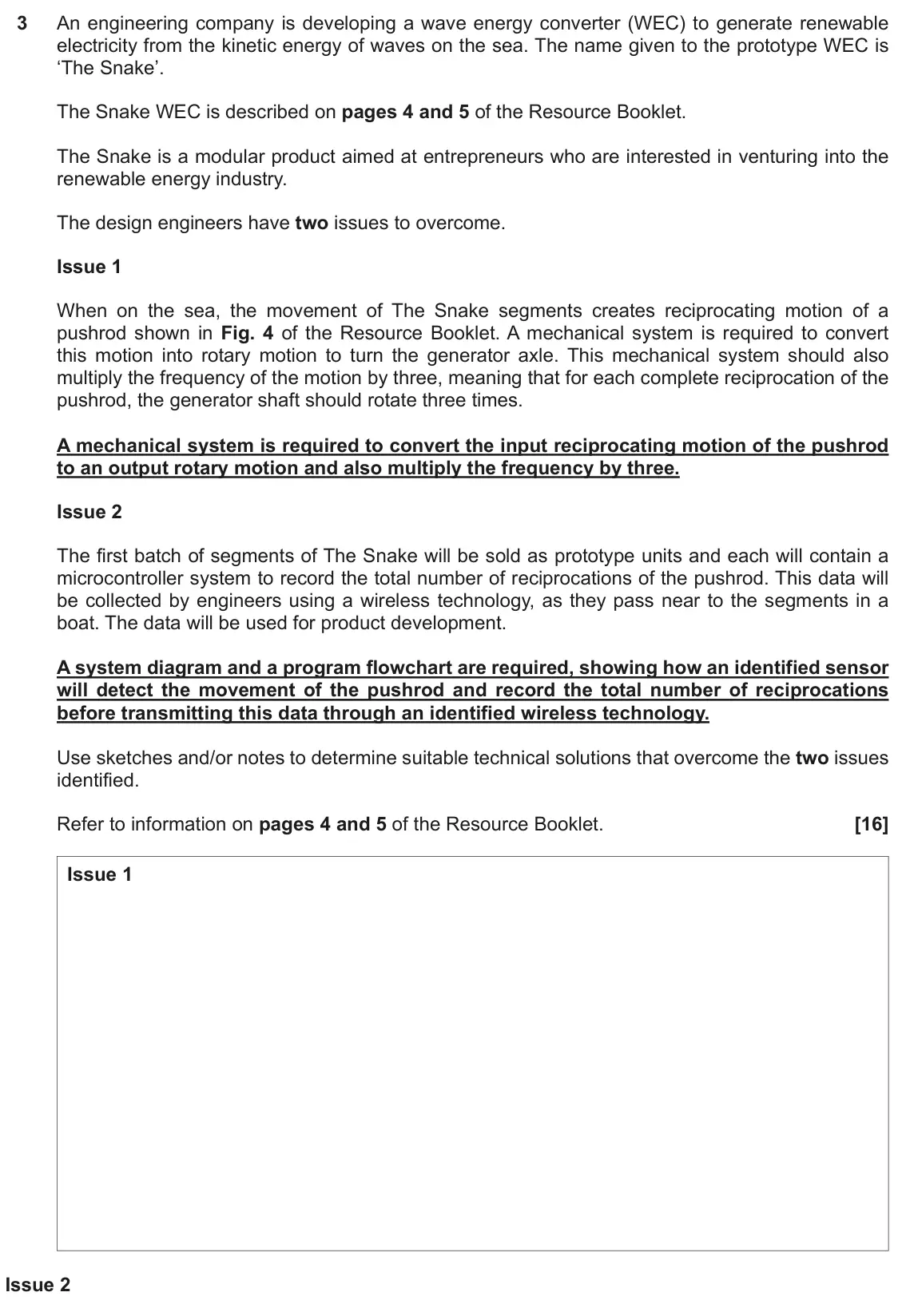
    Original question 3: An engineering company is developing a wave energy converter (WEC) to generate renewable electricity from the kinetic energy of waves on the sea. The name given

    Loading the question…

  16. Q1(e)

    Specimen · H404/01 · ★★★★

    The whole paper ↗
    16
    Setup for original question 1(e)

    Loading the question setup…

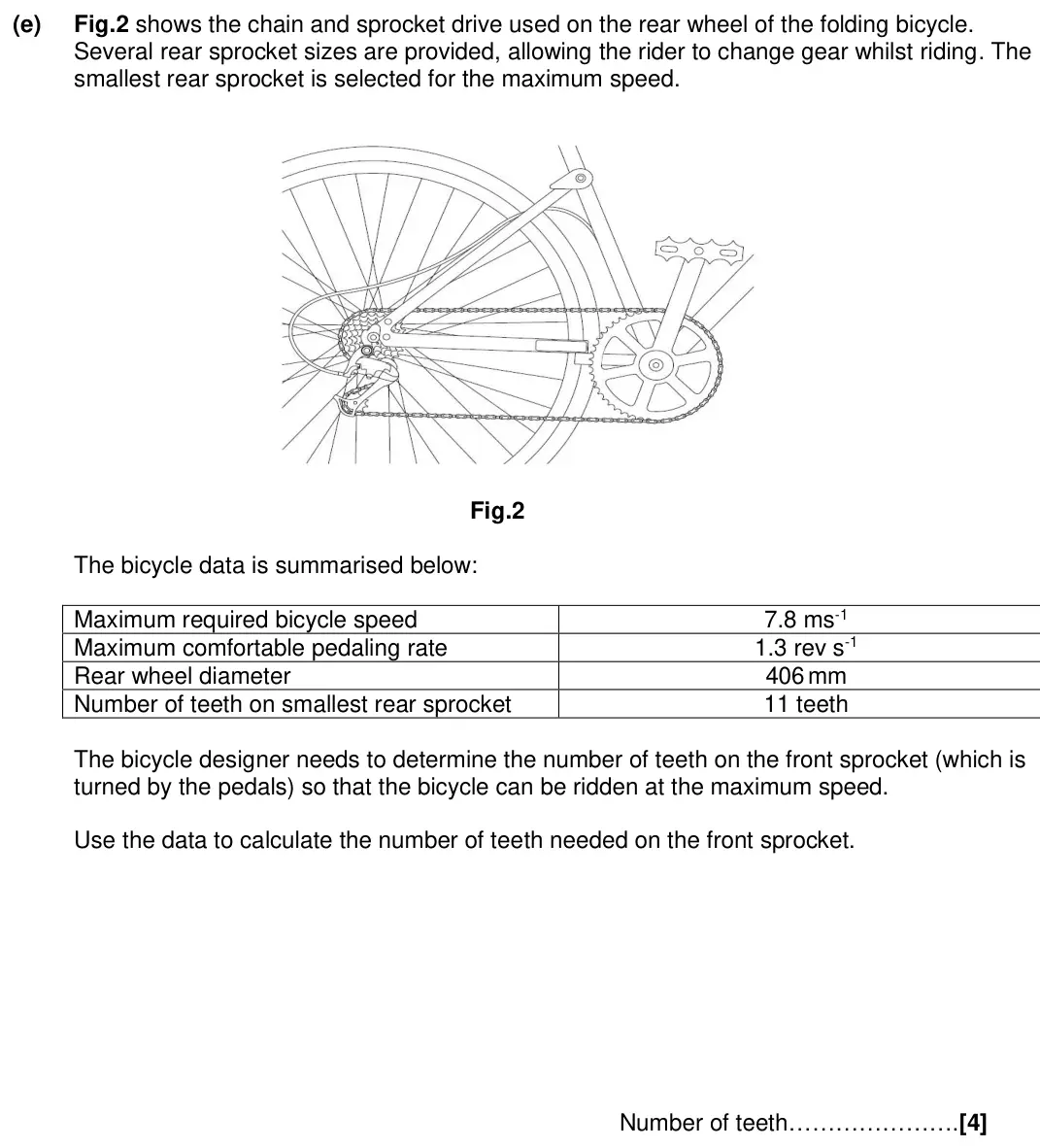
    Original question 1(e): Fig.2 shows the chain and sprocket drive used on the rear wheel of the folding bicycle. Several rear sprocket sizes are provided, allowing the rider to change g

    Loading the question…

  17. Q2(c)(i)

    Specimen · H404/01 · ★★★

    The whole paper ↗
    17
    Setup for original question 2(c)(i)

    Loading the question setup…

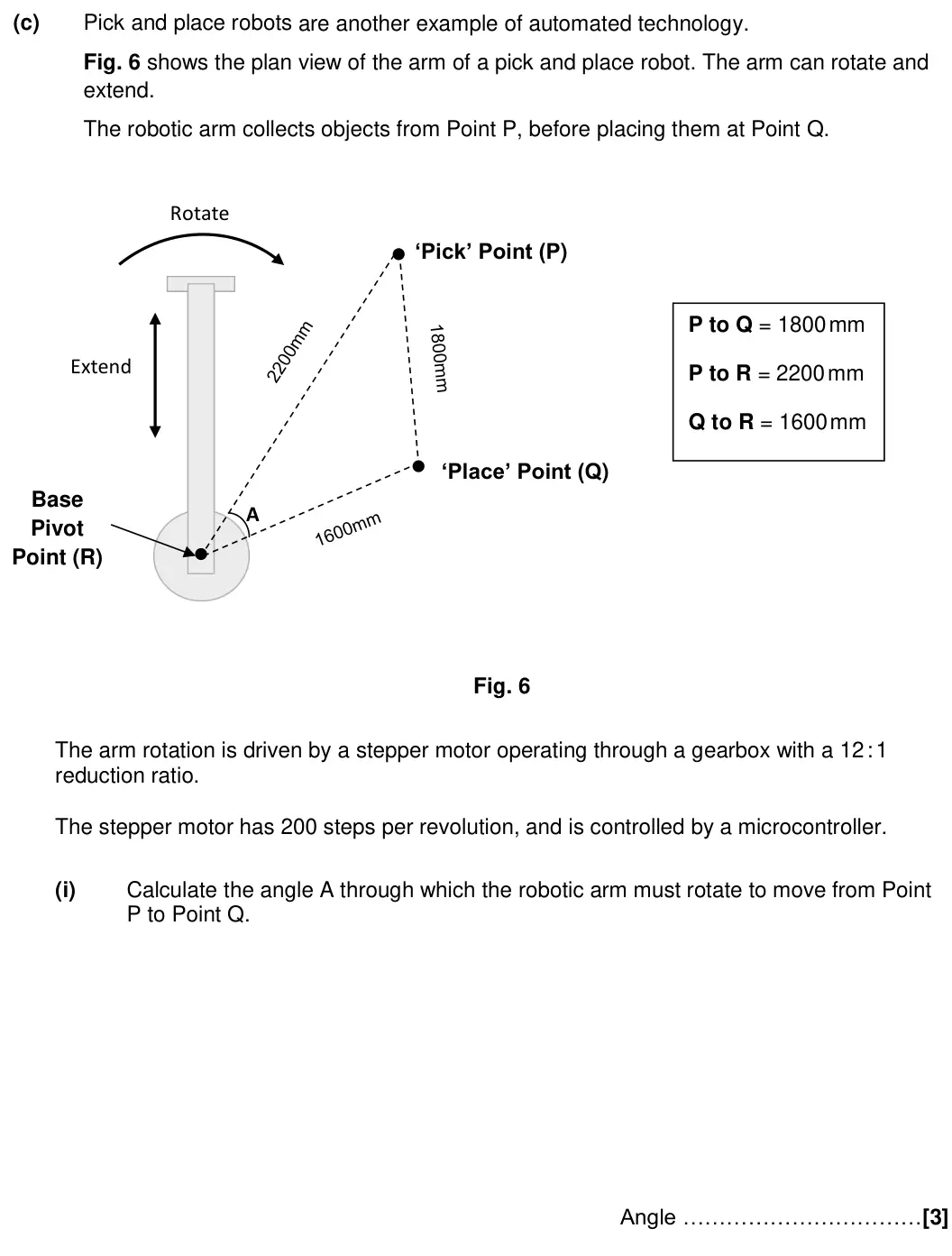
    Original question 2(c)(i): Calculate the angle A through which the robotic arm must rotate to move from Point P to Point Q. Angle [3]

    Loading the question…

  18. Q4(a)(ii)

    Specimen · H404/01 · ★★★★

    The whole paper ↗
    18
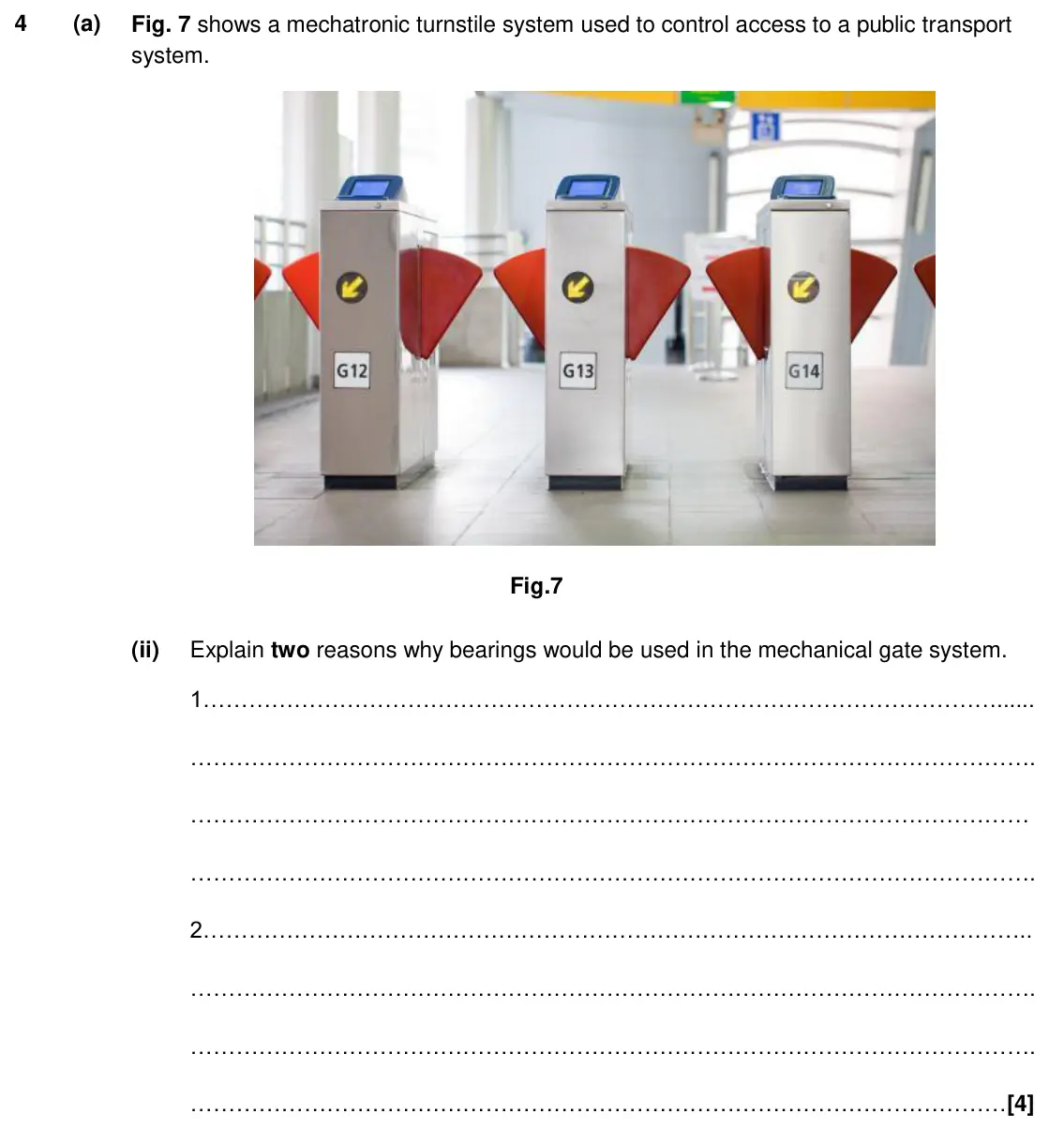
    Original question 4(a)(ii): Explain two reasons why bearings would be used in the mechanical gate system. 1 2 [4]

    Loading the question…

  19. Q4(a)(iii)

    Specimen · H404/01 · ★★

    The whole paper ↗
    19
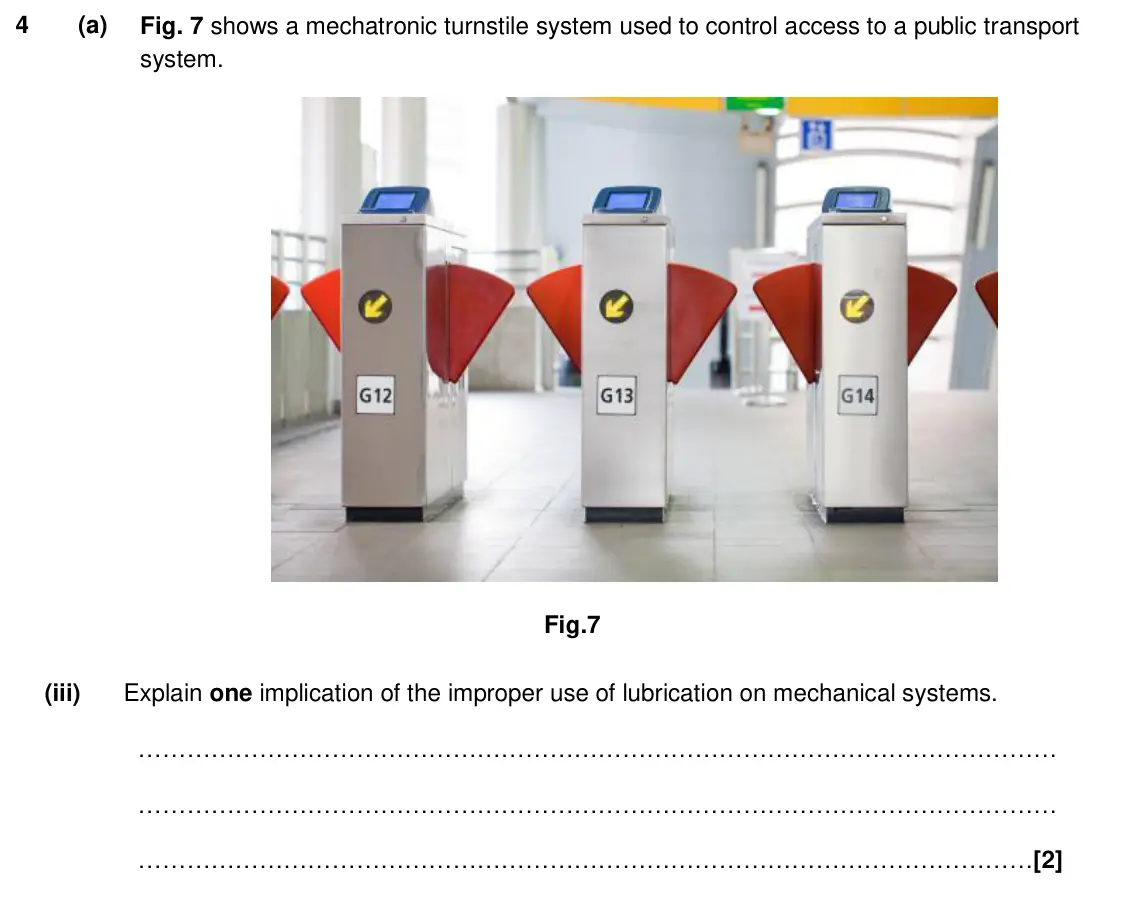
    Original question 4(a)(iii): Explain one implication of the improper use of lubrication on mechanical systems. [2]

    Loading the question…

  20. Q4(b)(i)

    Specimen · H404/01 · ★★★

    The whole paper ↗
    20
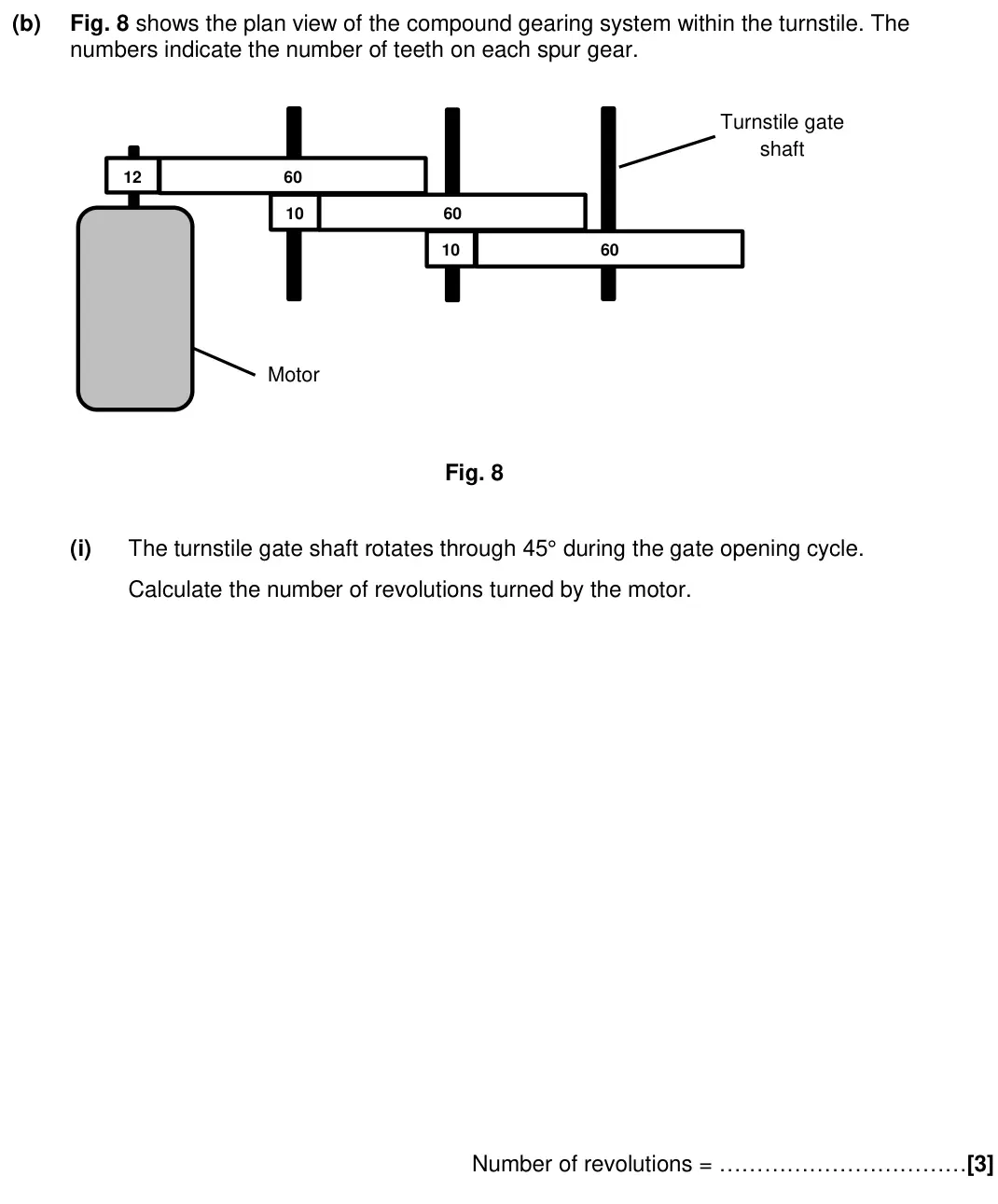
    Original question 4(b)(i): The turnstile gate shaft rotates through 45° during the gate opening cycle. Calculate the number of revolutions turned by the motor. Number of revolutions = [3]

    Loading the question…

All 22 questions on Mechanisms and motion, as a list
  1. June 2025, H404/01, Q1(c) (2 marks): An electric toothbrush head contains a mechanism that converts reciprocating motion of a shaft into oscillating motion of the bristles. Fig. 1.3 shows the input
  2. June 2025, H404/02, Q3(b)(i) (2 marks): Use Fig. 6 to calculate the velocity ratio of the ZS-50 gear box. Show your working. [2] Velocity ratio
  3. June 2025, H404/02, Q3(b)(ii) (4 marks): Determine by calculation that the proposed motor gear box combination will produce an output speed of 3.53 km/h for the Scout robot. Show your working and use t
  4. June 2025, H404/02, Q4 (16 marks): The Scout robot is equipped with a tilting fork mechanism which will help to clear small pieces of debris from its path. Details of the fork system are shown on
  5. June 2024, H404/01, Q1(b)(i) (3 marks): The electric motor runs at a speed of 3000 rpm. Use the information in Fig. 1.2 to calculate the rotational speed of the output gear. Give your answer in rpm to
  6. June 2024, H404/01, Q1(b)(ii) (2 marks): The gears in Fig. 1.2 have teeth of different sizes. Explain one reason why the designer chose to use a gear with larger teeth for the output gear. [2]
  7. June 2023, H404/01, Q1(b) (2 marks): Explain why bearings are needed in mechanical systems such as those used in the personal mini fan. [2]
  8. June 2023, H404/01, Q4(b)(i) (4 marks): Use the information on page 14 to calculate distance L. Give your answer to the nearest mm and show your working. [4] Distance L mm
  9. June 2023, H404/01, Q4(b)(ii) (3 marks): Use the information on page 14 to calculate the number of revolutions of the worm wheel that are required to rotate the output gear through an angle of 72°. Sho
  10. June 2022, H404/01, Q4(b)(i) (4 marks): To dispense gel, the pump on the bottle needs to move down 18 mm. Use Fig. 4.3 to calculate the number of revolutions of the pinion to move the rack down 18 mm.
  11. June 2022, H404/01, Q4(b)(ii) (5 marks): The DC motor output speed is 720 rpm. Experiments have determined that the pump must complete the 18 mm downward motion in a time of 0.5 seconds. A compound gea
  12. June 2022, H404/01, Q4(b)(iii) (2 marks): After being compressed and dispensing gel, the pump must return to its original start position to complete the pump action. Describe how this could be achieved
  13. November 2021, H404/01, Q1(b)(i) (4 marks): Explain two reasons why the designer chose to use an epicyclic gearbox in this product. 1 2 [4]
  14. November 2021, H404/01, Q1(b)(ii) (3 marks): The epicyclic gearbox in the electric screwdriver consists of two identical stages. Each stage has a gear ratio of 7:1. Use the information in Table 1.2 to calc
  15. November 2021, H404/02, Q3 (16 marks): An engineering company is developing a wave energy converter (WEC) to generate renewable electricity from the kinetic energy of waves on the sea. The name given
  16. Specimen, H404/01, Q1(e) (4 marks): Fig.2 shows the chain and sprocket drive used on the rear wheel of the folding bicycle. Several rear sprocket sizes are provided, allowing the rider to change g
  17. Specimen, H404/01, Q2(c)(i) (3 marks): Calculate the angle A through which the robotic arm must rotate to move from Point P to Point Q. Angle [3]
  18. Specimen, H404/01, Q4(a)(ii) (4 marks): Explain two reasons why bearings would be used in the mechanical gate system. 1 2 [4]
  19. Specimen, H404/01, Q4(a)(iii) (2 marks): Explain one implication of the improper use of lubrication on mechanical systems. [2]
  20. Specimen, H404/01, Q4(b)(i) (3 marks): The turnstile gate shaft rotates through 45° during the gate opening cycle. Calculate the number of revolutions turned by the motor. Number of revolutions = [3]
  21. Specimen, H404/01, Q4(b)(ii) (5 marks): During the turnstile gate opening cycle, the motor ramps-up (accelerates) at 230 revs-2 until it reaches a full speed of 50 revs-1 which it then maintains befor
  22. Specimen, H404/01, Q4(b)(iii) (2 marks): Explain one reason why the designer chose to ramp down the motor speed at the end of the opening cycle rather than maintaining full speed for as long as possibl

Questions, mark schemes and examiner’s reports are © OCR, from their published past papers. Plumi isn’t affiliated with any exam board. Want whole papers? OCR A-Level Design Engineering past papers.

The Plumi iPad app also offers exam-style questions with AI feedback on your handwritten working.