 plumi
Organic functional groups: OCR A‑Level Chemistry B questions
Every OCR A-Level Chemistry B exam question on PL Organic functional groups (specification points PL(k)–(l)), 2016–2025, with its mark scheme and examiner’s report.
Find questions2,049
Calculations
Q2(a)(i)
The whole paper ↗
Q3(a)(ii)
The whole paper ↗
Q2(b)(i)
The whole paper ↗
Q33(e)(i)
The whole paper ↗
Q34(a)(ii)
The whole paper ↗

Q1(a)
The whole paper ↗
Q4(b)(ii)
The whole paper ↗
Q1(a)
The whole paper ↗
Q2(a)
The whole paper ↗
Q1(b)(i)
The whole paper ↗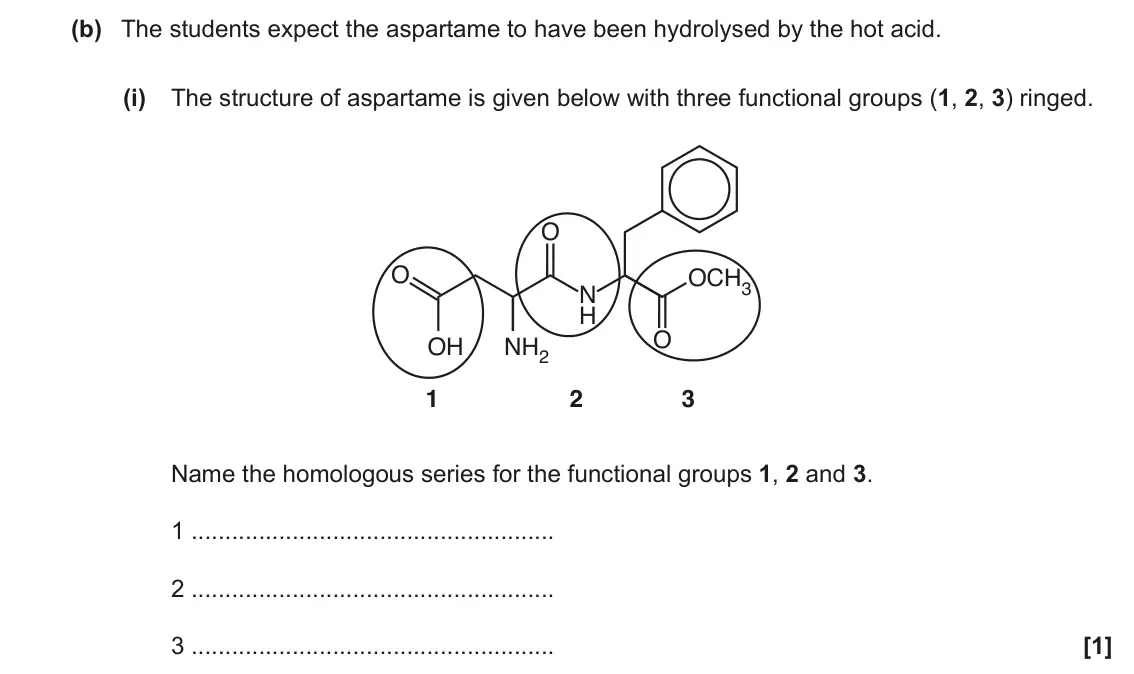
All 11 questions on Organic functional groups, as a list
- June 2025, Paper 3, Q2(a)(i) (1 mark): Name the nylon shown in this repeat unit. [1]
- June 2024, Paper 2, Q3(a)(ii) (1 mark): The link between the amino acids is often described as a peptide bond. Give another chemical name for the link. [1]
- June 2023, Paper 2, Q2(b)(i) (1 mark): Give the systematic name of compound B. [1]
- June 2022, Paper 1, Q33(e)(i) (1 mark): Give the name of the functional group COCl that is formed in this reaction. [1]
- November 2021, Paper 1, Q34(a)(ii) (1 mark): Name the functional group that is circled. [1]
- November 2020, Paper 1, Q23 (1 mark): Which formula has the correct systematic name? Formula Name A C2H5COCl propyl chloride B HOCH2CH2OH ethylene glycol C CH3CH2CHO propan-1-al D (CH3CH2CO)2O propa
- November 2020, Paper 2, Q1(a) (1 mark): Circle a secondary amide group on the structure of aspartame in Fig. 1.1. [1]
- November 2020, Paper 2, Q4(b)(ii) (2 marks): Give the systematic name for maleic acid. [2]
- June 2019, Paper 2, Q1(a) (2 marks): Name the functional groups in compounds A and B. A B [2]
- June 2017, Paper 2, Q2(a) (2 marks): Name two functional groups in paracetamol, apart from the benzene ring. [2]
- June 2017, Paper 3, Q1(b)(i) (1 mark): The structure of aspartame is given below with three functional groups (1, 2, 3) ringed. O O OCH3 N H O OH NH2 1 2 3 Name the homologous series for the function
Questions, mark schemes and examiner’s reports are © OCR, from their published past papers. Plumi isn’t affiliated with any exam board. Want whole papers? Every OCR A-Level Chemistry B paper.
Rather write your answers by hand on iPad? Plumi marks them against the same mark schemes.