 plumi
Kinetics: OCR A‑Level Chemistry B questions
Every OCR A-Level Chemistry B exam question on PL Kinetics (specification points PL(f)–(g)), 2016–2025, with its mark scheme and examiner’s report.
Find questions2,049
Calculations
Q4(d)
The whole paper ↗

Q3(e)(i)
The whole paper ↗
Q35(f)
The whole paper ↗
Q4(e)(i)
The whole paper ↗
Q4(e)(ii)
The whole paper ↗
Q4(e)(iii)
The whole paper ↗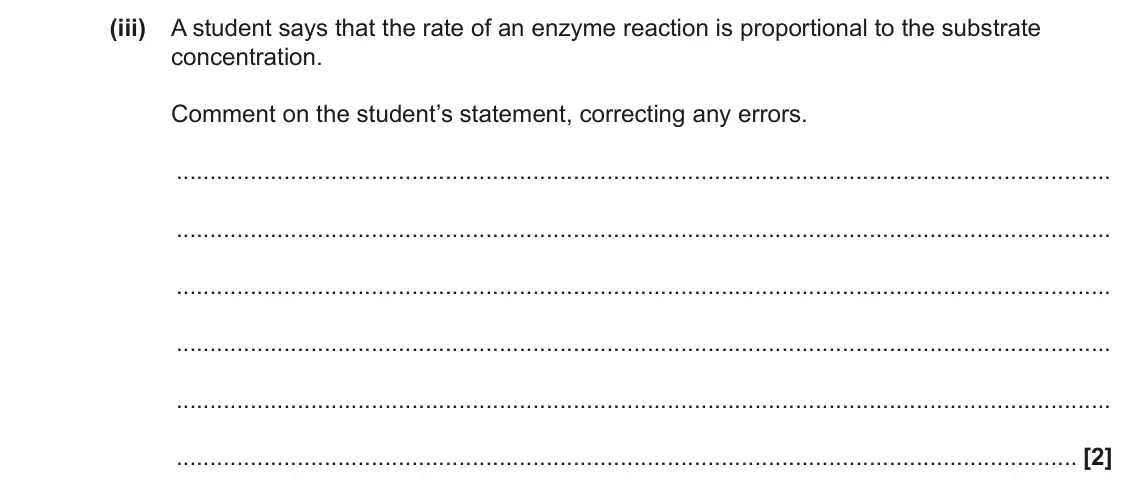
Q2(d)
The whole paper ↗

Q1(e)(ii)
The whole paper ↗
Q1(e)(iii)
The whole paper ↗

Q32(d)
The whole paper ↗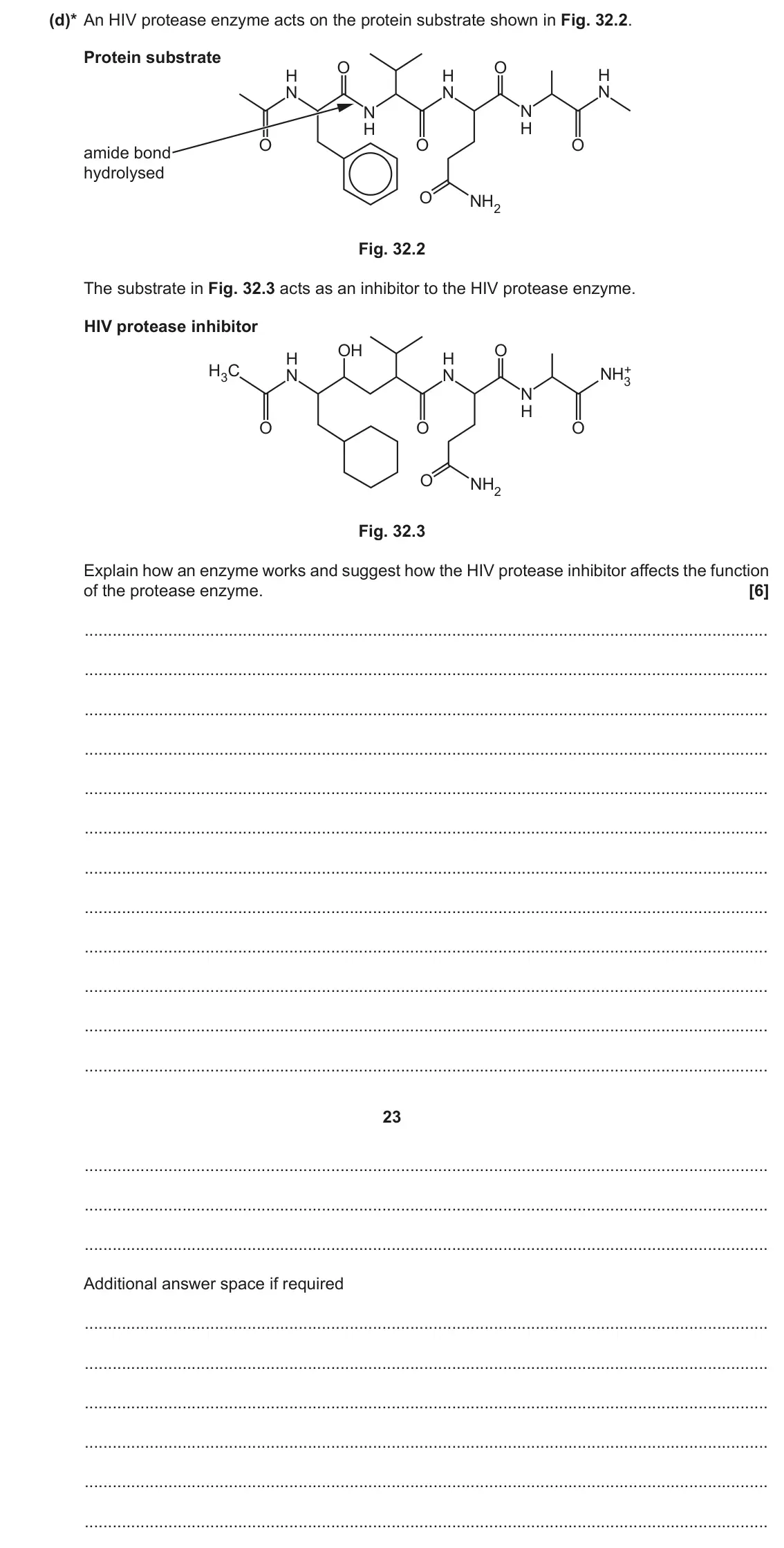
Q32(b)
The whole paper ↗
Q3(a)
The whole paper ↗
Q3(c)
The whole paper ↗
Q3(d)(i)
The whole paper ↗
Q3(d)(ii)
The whole paper ↗
Q3(e)(ii)
The whole paper ↗
All 22 questions on Kinetics, as a list
- June 2025, Paper 2, Q4(d) (1 mark): Enzymes have a three-dimensional region that bonds with the substrate. Name this region. [1]
- June 2024, Paper 1, Q29 (1 mark): The graph shows how the rate of an enzyme catalysed reaction varies with substrate concentration. reaction rate substrate concentration At low substrate concent
- June 2024, Paper 2, Q3(e)(i) (2 marks): Explain this specificity in terms of the enzyme active site. [2]
- June 2023, Paper 1, Q35(f) (6 marks): When developing vaccines against viruses, scientists need to understand the chemistry of the virus spike protein. One type of vaccine contains the messenger RNA
- June 2022, Paper 2, Q4(e)(i) (2 marks): Explain why warming a solution of chymotrypsin will destroy its activity as an enzyme. [2]
- June 2022, Paper 2, Q4(e)(ii) (3 marks): Chymotrypsin has an optimum pH = 8. Draw a sketch to suggest the shape of the graph of chymotrypsin activity against pH. Explain the shape of your graph. [3]
- June 2022, Paper 2, Q4(e)(iii) (2 marks): A student says that the rate of an enzyme reaction is proportional to the substrate concentration. Comment on the student’s statement, correcting any errors. [2
- November 2021, Paper 3, Q2(d) (3 marks): An investigation into the effect of changing substrate concentration on the rate of an enzyme catalysed reaction gave the following graphical results. rate of r
- November 2020, Paper 1, Q15 (1 mark): Which statement about an enzyme reaction is correct? A Enzymes only work over a narrow range of pH values. B Enzymes only work over a 10 °C range of temperature
- November 2020, Paper 2, Q1(e)(ii) (1 mark): Other students boil the mixture of aspartame and pepsin to attempt to speed up the hydrolysis reaction. State and explain whether or not this would work. [1]
- November 2020, Paper 2, Q1(e)(iii) (2 marks): Another student says that using a higher concentration of aspartame at room temperature will speed up the hydrolysis reaction. Comment on this statement. [2]
- June 2019, Paper 1, Q15 (1 mark): Which statement about enzyme catalysed reactions is correct? A The rate determining step is always the formation of an enzyme substrate complex. B They always s
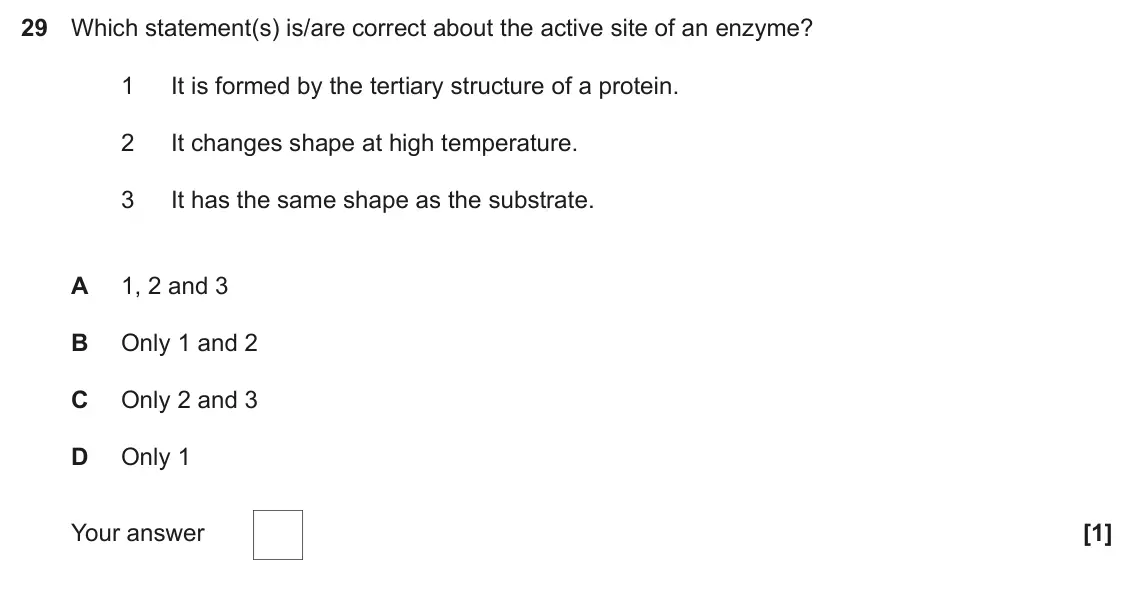
- June 2019, Paper 1, Q29 (1 mark): Which statement(s) is/are correct about the active site of an enzyme? 1 It is formed by the tertiary structure of a protein. 2 It changes shape at high temperat
- June 2019, Paper 1, Q32(d) (6 marks): DNA carries the instructions for synthesising the primary structures of protein molecules. Its backbone consists of alternating phosphate and deoxyribose sugar
- June 2018, Paper 1, Q32(b) (1 mark): Give two ways a substrate can bind to an enzyme. 1 2 [1]
- June 2018, Paper 2, Q3(a) (3 marks): Catalase has an active site. Explain how this results in faster decomposition of hydrogen peroxide. [3]
- June 2018, Paper 2, Q3(c) (6 marks): Why does human hair turn grey? Studies have shown that this is caused by lower levels of the enzyme catalase in hair follicles. Catalase catalyses the breakdown
- June 2018, Paper 2, Q3(d)(i) (2 marks): Arrange the results in a more appropriate format. [2]
- June 2018, Paper 2, Q3(d)(ii) (4 marks): Use the grid below to plot a graph of the results and draw a line of best fit. [4]
- June 2018, Paper 2, Q3(e)(ii) (3 marks): Explain why the student is incorrect and give the correct information. [3]
- June 2017, Paper 1, Q20 (1 mark): What is correct for reactions involving enzymes? A The enzyme works best at high temperature. B The rate is zero order with respect to substrate at low substrat
- June 2017, Paper 2, Q2(c)(i) (3 marks): Suggest how AM404 inhibits the breakdown of anandamide. [3]
Questions, mark schemes and examiner’s reports are © OCR, from their published past papers. Plumi isn’t affiliated with any exam board. Want whole papers? Every OCR A-Level Chemistry B paper.
Rather write your answers by hand on iPad? Plumi marks them against the same mark schemes.