 plumi
Oxidation of alcohols: OCR A‑Level Chemistry A questions
OCR A-Level Chemistry A past-paper questions on 4.2.1.2 Oxidation of alcohols, 2016–2025, with mark schemes and examiner’s reports where available.
Paper
All papers
Exam
All years
Calculations
- Your answer
Q25(a)
The whole paper ↗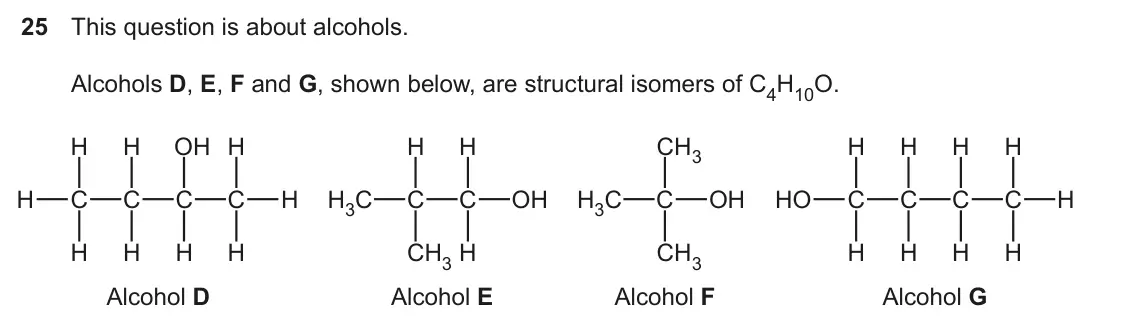
Q17(b)
The whole paper ↗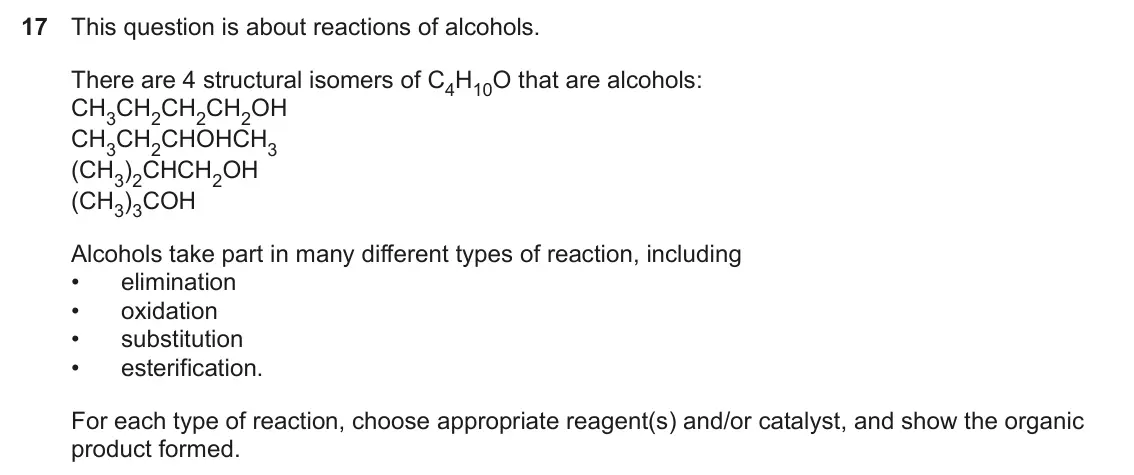
Q5(b)(i)
The whole paper ↗
Q25(b)
The whole paper ↗
Q17(b)
The whole paper ↗
Q20(c)
The whole paper ↗
Q1(d)
The whole paper ↗
Q7(c)(ii)
The whole paper ↗
- Your answer
Q18(a)(i)
The whole paper ↗
- Your answer
Q5(a)
The whole paper ↗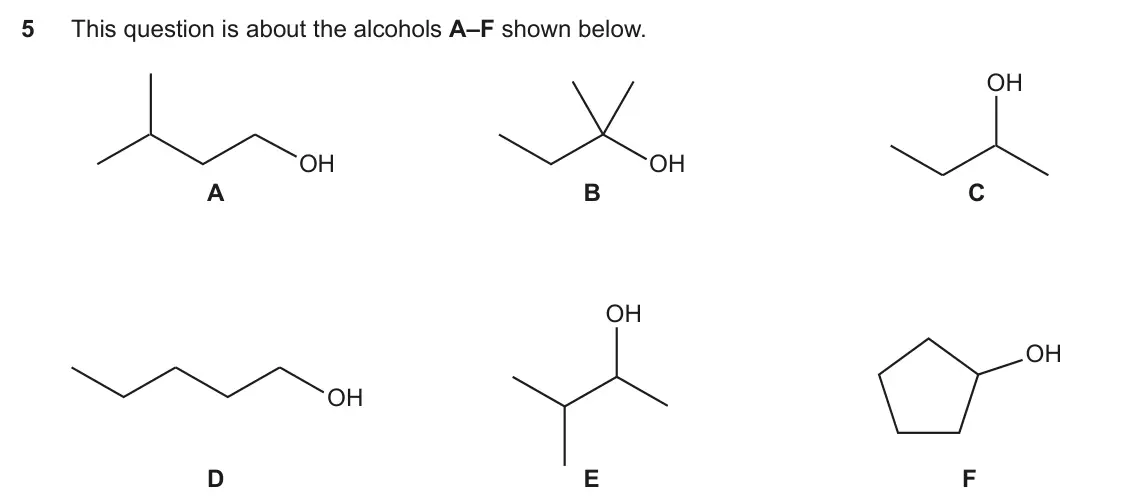
Q5(f)
The whole paper ↗Q2(c)
The whole paper ↗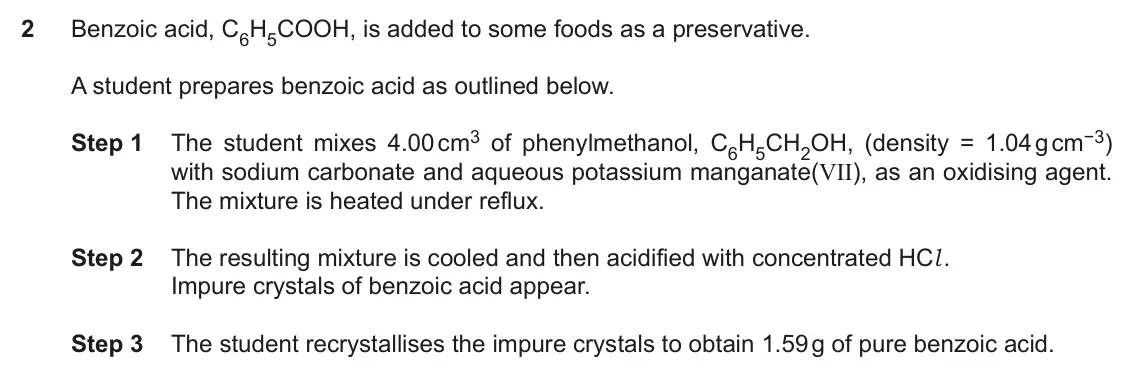
Q25(a)(i)
The whole paper ↗
Q16(b)
The whole paper ↗
- Your answer
Q25(a)(i)
The whole paper ↗
All 28 questions on Oxidation of alcohols, as a list
- June 2025, Paper 2, Q13 (1 mark): Which molecule(s) would form a ketone group when oxidised? OH 1 HO OH O 2 HO OH 3 OH A 1, 2 and 3 B Only 1 and 2 C Only 2 and 3 D Only 1 Your answer [1]
- June 2025, AS Paper 1, Q25(a) (3 marks): Alcohols D, E, F and G are each heated under reflux with H+ / Cr2O7 2–. Draw the structure of the organic product that is formed from each alcohol. If there is
- June 2024, Paper 2, Q17(b) (2 marks): Oxidation reaction of CH3CH2CHOHCH3 Reagent(s) and/or catalyst organic product [2]
- June 2024, Paper 3, Q5(b)(i) (2 marks): Write the formula of the species causing the colours after refluxing with acidified dichromate(VI). Green solution Orange solution [2]
- June 2024, AS Paper 1, Q25(b) (3 marks): Alcohols A, B and C are each refluxed with acidified dichromate(VI), H+/Cr2O7 2–. The organic products are shown in the table below. Complete the table to show
- June 2023, Paper 2, Q17(b) (3 marks): Compound C, shown below, is refluxed with excess acidified potassium dichromate(VI) to form a single organic product and one other product. Complete the equatio
- June 2023, AS Paper 1, Q26 (5 marks): This question is about the oxidation of two alcohols that are structural isomers of C3H8O. Compare the oxidation of these two structural isomers using different
- June 2022, Paper 2, Q20(c) (2 marks): Compound J, C6H5CH2CH2OH, is reacted with acidified potassium dichromate(VI) under reflux to form organic product M. Write an equation for this reaction. Use [O
- June 2022, AS Paper 2, Q1(d) (2 marks): Other fruits contain different organic acids. Apple juice contains malic acid which has the following structure. H OH HOOC C C COOH H H Malic acid can be oxidis
- November 2021, AS Paper 2, Q7(c)(ii) (3 marks): Compound B is a branched primary alcohol. Compound B is refluxed with acidified potassium dichromate(VI) as an oxidising agent. Write the equation for the react
- November 2020, Paper 2, Q4 (1 mark): Which compound can be refluxed with acidified potassium dichromate(VI) to form an organic product with molecular formula C5H8O2? A HO O B HO O O HO C O HO D You
- November 2020, Paper 2, Q18(a)(i) (3 marks): State the reagents and conditions and write an equation for this oxidation. In the equation, use [O] for the oxidising agent. Reagents and conditions: Equation:
- November 2020, AS Paper 1, Q17 (1 mark): Which compound could react with both • K2Cr2O7/H2SO4 in an oxidation reaction and • an acid catalyst (e.g. H2SO4) in an elimination reaction? A OH B OH C HO D H
- November 2020, AS Paper 2, Q5(a) (2 marks): Which of the alcohols A–F are secondary alcohols? [2]
- November 2020, AS Paper 2, Q5(f) (6 marks): This question is about the alcohols A–F shown below. OH OH OH A B C OH OH OH D E F (f)* The structures of A–F are repeated below. OH OH OH A B C OH OH OH D E F
- June 2019, Paper 3, Q2(c) (1 mark): Write the overall equation for the preparation of benzoic acid from phenylmethanol. Use [O] for the oxidising agent. [1]
- June 2019, AS Paper 1, Q25(a)(i) (3 marks): Draw the structures for the organic products. If there is no reaction, write ‘NONE’. OH A OH B OH C [3]
- June 2018, Paper 2, Q16(b) (2 marks): Compound B, shown below, is refluxed with excess acidified potassium dichromate(VI) to form a single organic product. Complete the equation for this reaction. C
- June 2018, AS Paper 1, Q16 (1 mark): How many structural isomers of C6H14O are tertiary alcohols? A 1 B 2 C 3 D 4 Your answer [1]
- June 2018, AS Paper 1, Q25(a)(i) (3 marks): Complete Fig. 25.1 to show the structures of the organic products formed in the reactions. F H2SO4 + heat CH3 H H3C C C OH H H E H2SO4 / K2Cr2O7 H2SO4 / K2Cr2O7
- June 2017, Paper 2, Q19(d) (5 marks): Butan-1-ol can be oxidised to form two different organic products, depending on the reaction conditions used. Describe both oxidation reactions of butan-1-ol. F
- June 2017, AS Paper 1, Q19 (1 mark): An alcohol A is heated under reflux with sulfuric acid and potassium dichromate(VI). The organic compound formed produces the infrared spectrum below. 100 trans
- June 2017, AS Paper 2, Q4(c) (6 marks): The hydroxyl group, –OH, is responsible for many properties of alcohols. (c)* Describe the oxidation reactions of butan-1-ol forming an aldehyde and a carboxyli
- June 2016, AS Paper 1, Q18 (1 mark): Which alcohol can be oxidised by K2Cr2O7 and H2SO4 to form a ketone? A OH B OH C OH OH D Your answer [1]
- June 2016, AS Paper 1, Q26(b) (2 marks): Some reactions involving compound B are shown in the flowchart below. Complete the flowchart, showing the structures of organic compounds C and D. H CH3 concent
- June 2016, AS Paper 2, Q6(a) (1 mark): Why is butan-2-ol classified as a secondary alcohol? [1]
- June 2016, AS Paper 2, Q6(c)(i) (2 marks): Write an equation for the reaction. Use [O] to represent the oxidising agent and show the structure of the organic product. [2]
- June 2016, AS Paper 2, Q6(c)(ii) (2 marks): A student plans to carry out this oxidation using the apparatus shown in the diagram. Give one reason why the apparatus is not suitable and describe a more suit
Questions, mark schemes and examiner’s reports are © OCR, from their published past papers. Plumi isn’t affiliated with any exam board. Want whole papers? OCR A-Level Chemistry A past papers, or our free OCR-style practice pack.
The Plumi iPad app also offers exam-style questions with AI feedback on your handwritten working.